10 Real Estate Software Development Companies in 2026
- February 03
- 9 min

Developing real estate software for a global market demands a deep understanding of regional regulations and the technical agility to adapt to them. From the strict data privacy laws of the European Union to the complex financial reporting standards in North America, developers must build compliance into the very DNA of their applications.
This guide explores how to engineer real estate software that meets the diverse regulatory needs of key global markets, highlighting the essential technologies and best practices for developers.
Compliance and regulatory reporting features are tools built into software to help real estate businesses follow the law. These features automate tasks that would otherwise be manual and prone to error. They can range from generating financial reports required by law to ensuring that tenant data is stored securely.
Key features often include:
Without these features, real estate firms risk fines, legal action, and damage to their reputation. The right software turns compliance from a liability into a streamlined process.
Compliance is not a one-size-fits-all concept. A property management company in Brussels faces different rules than a brokerage in California. Here is a look at the regulatory landscape in several key regions and how software can help you comply.
Europe has some of the world’s most comprehensive regulations, particularly concerning data privacy. Real estate software used in this region must be built with these strict rules in mind.
The regulatory environment in North America is fragmented, with laws varying at the federal, state or provincial, and local levels.
Key Regulations in the United States:
The APAC region is a diverse mix of developed and emerging economies, each with its own regulatory framework. Data protection is a growing focus across the area.
Key Regulations:
The MENA region is rapidly modernizing its regulatory frameworks, with a strong focus on data protection and large-scale property development oversight.
Key Regulations:
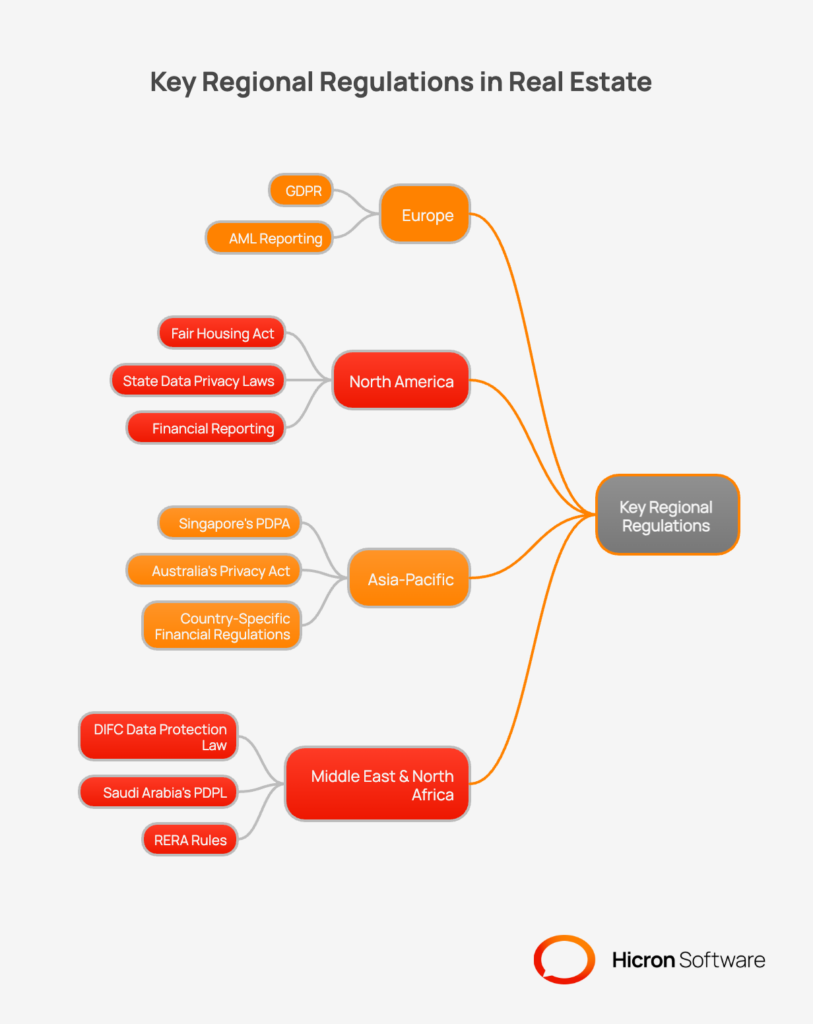
Before writing a single line of code, developers must understand the specific regulatory requirements of their target markets. Here is a breakdown of the key compliance needs by region and the features required to address them.
|
Region |
Focus Areas |
Key Regulations |
Requirements |
Developer Features |
|
Europe (EU & UK) |
Data Privacy and Anti-Money Laundering (AML) |
GDPR (General Data Protection Regulation) AML Directives |
Strict control over personal data collection, storage, and deletion (“Right to be Forgotten”). Verification of beneficial owners and reporting of suspicious transactions. |
• Implement granular consent management systems. • Integrate automated identity verification API calls. |
|
North America (USA & Canada) |
Fair Housing, Accessibility, and Financial Reporting |
Fair Housing Act (USA) ADA (Americans with Disabilities Act) IRS Tax Reporting |
Non-discriminatory practices in housing advertisements and tenant screening. Digital accessibility for users with disabilities. Generation of specific tax forms (e.g., 1099s). |
• Develop algorithmic bias audits and ensure screening algorithms use objective data points. • Adhere to WCAG 2.1 standards using semantic HTML and ARIA labels. • Build a reporting engine mapping database fields to government PDF templates or e-filing formats. |
|
Asia-Pacific (APAC) |
Diverse Data Sovereignty and Cross-Border Transactions |
Data Sovereignty Laws (e.g., China, Indonesia) Foreign Ownership Restrictions |
Data regarding citizens must be stored on servers physically located within the country. Limits on property types foreigners can purchase. |
• Utilize multi-region cloud architecture to route data storage based on user location. • Implement validation rules to automatically block non-eligible buyers from restricted property types. |
|
Middle East & North Africa (MENA) |
Escrow Management and Contract Standardization |
RERA (Dubai) Escrow Laws Standardized Contracts |
Developer funds must be held in regulated escrow accounts. Use of government-approved lease and sale contracts. |
• Integrate with banking APIs for real-time escrow visibility and milestone-based fund release logic. • Hard-code official contract templates, preventing users from editing mandatory clauses. |
Focus: Data Privacy and Anti-Money Laundering (AML).
Focus: Fair Housing, Accessibility, and Financial Reporting.
Focus: Diverse Data Sovereignty and Cross-Border Transactions.
Focus: Escrow Management and Contract Standardization.
Modern compliance requires modern tools. Developers should leverage these technologies to automate and secure their software.
Building compliant software is about architecture and process. Here are some of the best practices.
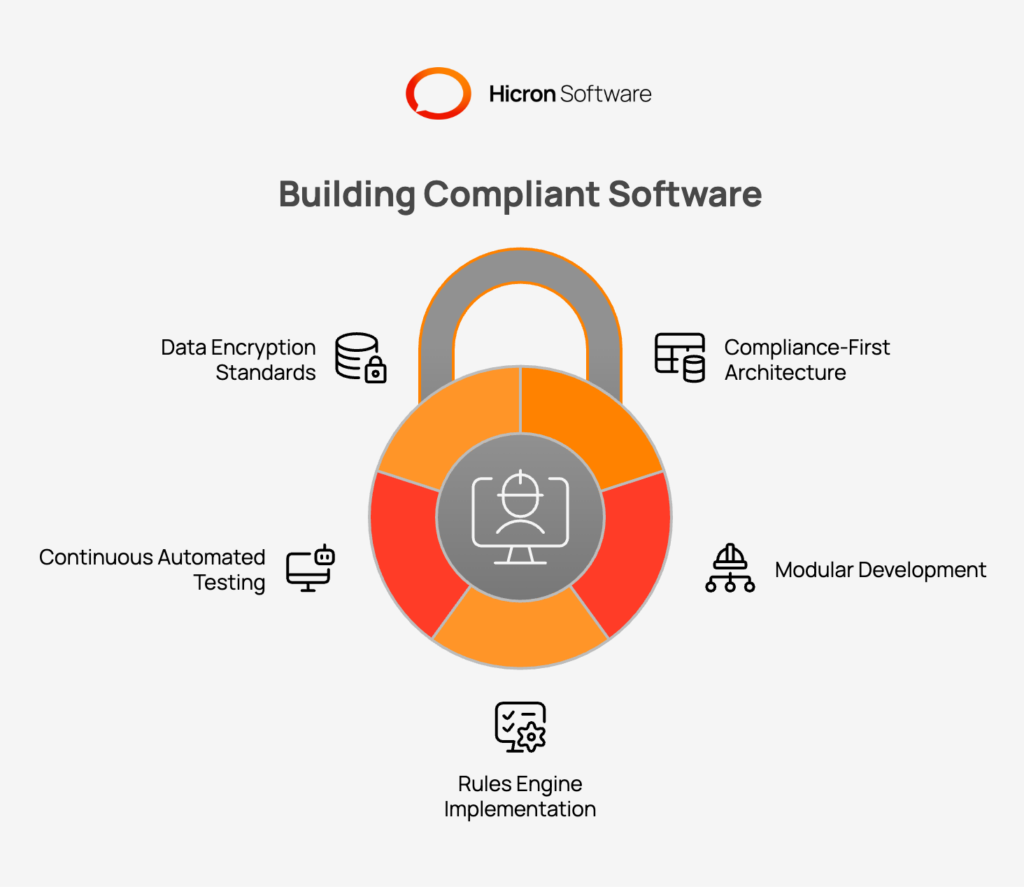
Don’t treat compliance as a plugin. Design your database schema to handle regulatory requirements from day one. For example, separate PII (Personally Identifiable Information) tables from general transaction data to simplify encryption and access control.
Regulations change frequently. If you hard-code rules into your core monolithic application, updates become risky and slow.
Instead of writing if/else statements for every regulation, implement a business rules engine.
Manual testing is insufficient for compliance.
Security is a core component of compliance.
Developing real estate software for the global stage is a complex balancing act between usability and strict adherence to the law. By understanding regional nuances, leveraging advanced technologies like AI and blockchain, and adopting a modular, compliance-first architecture, developers can build robust platforms. These systems protect users from legal risk and serve as scalable foundations for international growth. Check out our case studies and get in touch to build a compliant real estate software.

Hicron Software proved to be a trusted partner with unmatched technical expertise, delivering a scalable and user-friendly web application that was pivotal to our successful U.S. market expansion.

Hicron’s contributions have been vital in making our product ready for commercialization. Their commitment to excellence, innovative solutions, and flexible approach were key factors in our successful collaboration.
I wholeheartedly recommend Hicron to any organization seeking a strategic long-term partnership, reliable and skilled partner for their technological needs.

After carefully evaluating suppliers, we decided to try a new approach and start working with a near-shore software house. Cooperation with Hicron Software House was something different, and it turned out to be a great success that brought added value to our company.
With HICRON’s creative ideas and fresh perspective, we reached a new level of our core platform and achieved our business goals.
Many thanks for what you did so far; we are looking forward to more in future!

Hicron is a partner who has provided excellent software development services. Their talented software engineers have a strong focus on collaboration and quality. They have helped us in achieving our goals across our cloud platforms at a good pace, without compromising on the quality of our services. Our partnership is professional and solution-focused!

The IT system supporting the work of retail outlets is the foundation of our business. The ability to optimize and adapt it to the needs of all entities in the PSA Group is of strategic importance and we consider it a step into the future. This project is a huge challenge: not only for us in terms of organization, but also for our partners – including Hicron – in terms of adapting the system to the needs and business models of PSA. Cooperation with Hicron consultants, taking into account their competences in the field of programming and processes specific to the automotive sector, gave us many reasons to be satisfied.