Integrating Vendor Management Systems with SAP: Best Practices
- October 29
- 32 min


A vendor management system for a multi-division organization is a centralized platform designed to help large, complex companies manage their suppliers across various business units, regions, and departments. For these organizations, managing suppliers, data, and workflows can become an intricate puzzle of disconnected processes. A modern Vendor Management System (VMS) offers the tools to unify data, tailor workflows, and foster clear collaboration across complex corporate structures.
This article explains the unique issues multi-division companies face in vendor management and shows how a specialized multi-division VMS offers powerful solutions. By using the right technology, you can turn a fragmented supply chain into a coordinated, strategic advantage.
Key Takeaways:
Standard vendor management software often proves inadequate when dealing with the scale of a multi-division enterprise. These organizations function more like a group of interconnected businesses than one single entity. This structure introduces several distinct operational difficulties.
The necessity of a robust, multi-division VMS becomes apparent when examining the common pain points that emerge from a fragmented approach. These issues often create operational friction and strategic disadvantages.
One of the most frequent problems is fragmented supplier data and inconsistent processes. Different divisions may store supplier information in separate systems, leading to duplicate records, outdated contact details, and conflicting performance metrics. This inconsistency makes it difficult to get a 360-degree view of a supplier that may serve multiple business units, hindering effective relationship management.
This fragmentation leads directly to a lack of visibility into supplier performance across the enterprise. A supplier might be performing exceptionally for one division but failing to meet standards in another. Without a centralized system to track these metrics, corporate sourcing teams cannot identify systemic issues or reward top-performing global partners. This siloed knowledge prevents the organization from making informed, strategic decisions about its supplier base.
Another major challenge is the difficulty in enforcing global policies while allowing for local flexibility. A corporate mandate for ethical sourcing or cybersecurity compliance is hard to implement uniformly when each division operates independently. Conversely, a rigid, top-down system can stifle the agility of local teams who need to adapt to regional market conditions. The ideal solution must strike a balance, which is difficult to achieve without the right technology.
Inefficient communication and collaboration between divisions and suppliers are also common. When a supplier needs to interact with multiple business units, they are often forced to use different portals, communication channels, and administrative processes. This creates a frustrating and inefficient experience for the supplier and adds administrative overhead for every division involved.
|
Challenge |
Description & Impact |
|
Fragmented Supplier Data & Inconsistent Processes |
Divisions use separate systems to store supplier information, leading to duplicate records, outdated details, and conflicting metrics. This prevents a complete view of supplier relationships and hinders effective management. |
|
Lack of Visibility into Supplier Performance |
Without a centralized tracking system, it’s impossible to compare a supplier’s performance across different divisions. This prevents the identification of systemic issues or top-performing partners, limiting strategic sourcing decisions. |
|
Difficulty Enforcing Global Policies with Local Flexibility |
Enforcing company-wide standards (e.g., ethical sourcing) is difficult when divisions operate independently. A rigid top-down approach can also restrict a local team’s ability to adapt to regional market needs. |
|
Inefficient Communication & Collaboration |
Suppliers working with multiple divisions are forced to use different portals and processes. This creates a frustrating experience for the supplier and increases administrative work for all divisions involved. |
A modern VMS designed for multi-division organizations addresses these pain points by offering a unique combination of centralization and flexibility of vendor management. It provides a single platform that unifies core functions while allowing for customization at the divisional level.
The foundation of a multi-division VMS is a unified supplier database. This central repository acts as the single source of truth for all vendor information, from contact details and contracts to certifications and performance history. However, it is more than just a static database. The system allows for division-specific views and access controls, ensuring that users only see the information relevant to their business unit. This approach eliminates data duplication while providing a holistic view of each supplier’s relationship with the entire organization.
To manage a complex user base, sophisticated role-based access control (RBAC) is essential. A VMS for complex organizations allows administrators to create highly tailored access permissions. A buyer in one division might have the ability to create purchase orders but not approve new suppliers. A quality manager in another region might only have access to audit reports and corrective action plans. This granular control ensures data security and process integrity while empowering users to perform their jobs efficiently.
Rigid, hard-coded workflows are the enemy of agility. A multi-division VMS provides configurable workflows that can be tailored to the specific needs of each business unit. For example, the supplier onboarding process for a manufacturing division might include detailed facility audits and material certifications, while the process for a services division might focus on background checks and insurance verification. The system allows you to design and deploy these unique workflows without needing custom code, ensuring both consistency and adaptability.
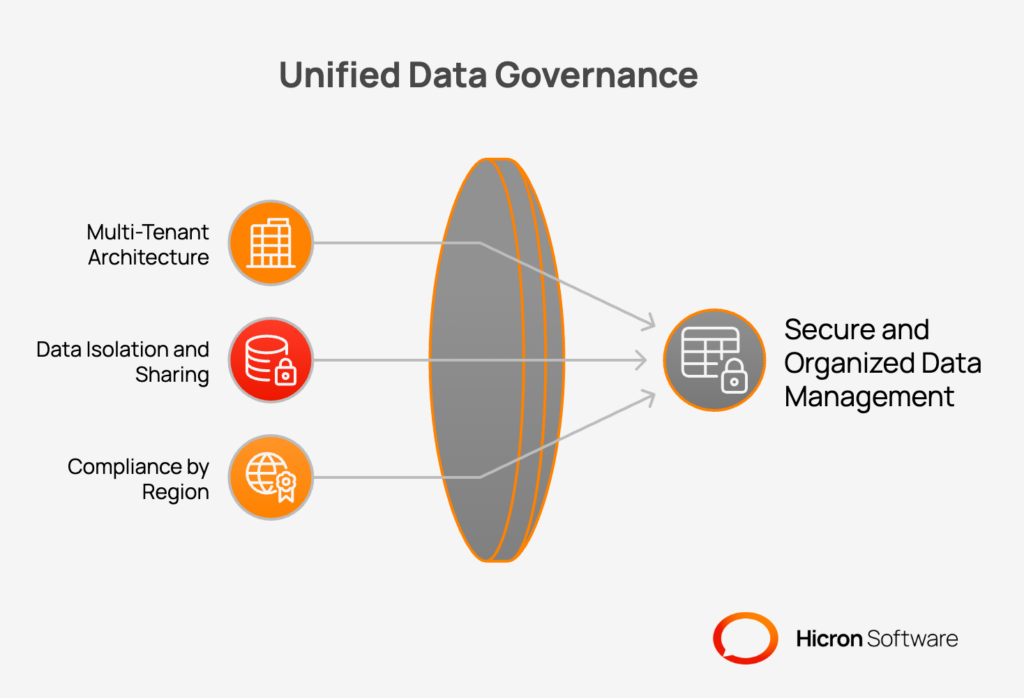
In a global organization, managing data securely and in compliance with various regulations is a top priority. A multi-division VMS is architected to handle these complexities, keeping data organized, secure, and compliant.
Many advanced VMS platforms use a multi-tenant architecture to logically separate data. This means each division or business unit can operate within its own secure “tenant,” with its data isolated from others. However, the system still allows for global oversight, where authorized corporate users can access consolidated data from across all tenants. This structure provides the best of both worlds: divisional autonomy and centralized visibility.
While data isolation is crucial for security, collaboration is equally important. A key feature of a multi-division VMS is the ability to control data sharing. Divisions can be configured to share relevant supplier data, such as performance ratings or risk assessments, while keeping sensitive information like contract pricing protected. This selective sharing promotes cross-divisional collaboration on strategic sourcing initiatives without compromising data security.
Operating globally means navigating a complex web of data regulations. A VMS built for these environments helps manage compliance by region. It can support localized data residency requirements, ensuring that certain data is stored in specific geographic locations. It can also enforce different data retention policies based on local laws, automating a critical aspect of regulatory compliance and reducing legal risk.
Effective supplier collaboration is a key driver of value. A VMS breaks down communication barriers between divisions and with suppliers, creating a more efficient and transparent ecosystem.
Instead of forcing suppliers to navigate multiple systems, a multi-division VMS provides a unified supplier portal. While the portal provides a single point of entry, the content can be customized for different divisions. A supplier can manage their global profile while also accessing division-specific documents, purchase orders, and communication channels. This streamlines the supplier experience and reduces administrative burdens for everyone.
Measuring supplier performance consistently across an enterprise is a major challenge. A VMS enables the setup of division-level Service Level Agreements (SLAs) and Key Performance Indicators (KPIs). These metrics can then be rolled up into global dashboards for leadership. This allows a division manager to track on-time delivery for their specific business unit, while a CPO can view overall supplier performance across the entire organization.
A VMS actively facilitates cross-division collaboration. Shared dashboards can highlight opportunities for joint sourcing initiatives, allowing divisions to consolidate their spend and negotiate better terms. The platform can also support workflows for shared projects, such as a joint quality improvement plan with a supplier that serves multiple business units. This fosters a culture of collaboration and unlocks strategic value.
Data is only valuable if it can be turned into actionable insights. A multi-division VMS provides customizable dashboards and reporting tools that deliver the right information to the right people, from divisional managers to the C-suite.
At the operational level, division managers need detailed insights into their specific activities. A VMS provides division-level dashboards that track real-time metrics like open purchase orders, pending quality issues, and supplier compliance status. These dashboards give managers the visibility they need to proactively manage their operations and address issues before they escalate.
For corporate leadership, the platform consolidates data from all divisions into global roll-up reports. These high-level summaries provide a strategic overview of supplier spend, risk exposure, and performance trends across the entire enterprise. This allows executives to identify systemic risks, spot opportunities for consolidation, and measure the effectiveness of global sourcing strategies.
Leading VMS platforms are now incorporating predictive analytics. By analyzing historical data from across all divisions, these tools can help identify potential supply chain disruptions, forecast supplier performance, and recommend opportunities for cost savings. This forward-looking capability transforms vendor management from a reactive function to a proactive, strategic advantage.
The ultimate goal of a multi-division vendor management system is to strike the perfect balance between global consistency and local customization. It enforces enterprise-wide standards while empowering divisions to adapt to their unique needs.
The VMS serves as the enforcement engine for global policies. You can configure standardized requirements for supplier qualification, code of conduct attestations, and periodic audits. These policies are applied universally, ensuring that a baseline level of compliance and quality is maintained across the entire organization.
While global policies provide a foundation, the system allows divisions to build upon them with local adaptations. A division in a high-risk region might add extra security screening steps to its supplier onboarding workflow. Another might include specific local certifications required for its industry. This flexibility ensures that processes are relevant and effective at the local level.
Complex purchasing decisions often require input from multiple stakeholders. The VMS supports multi-level approval hierarchies that can span across divisions. For example, a large capital expenditure might require approval from the divisional manager, the regional VP, and a corporate finance officer. The system automates this routing, ensuring that all necessary approvals are obtained in the correct sequence.
A VMS does not operate in a vacuum. To maximize its value, it must be tightly integrated with other critical enterprise systems like Enterprise Resource Planning (ERP), Product Lifecycle Management (PLM), and Manufacturing Execution Systems (MES).
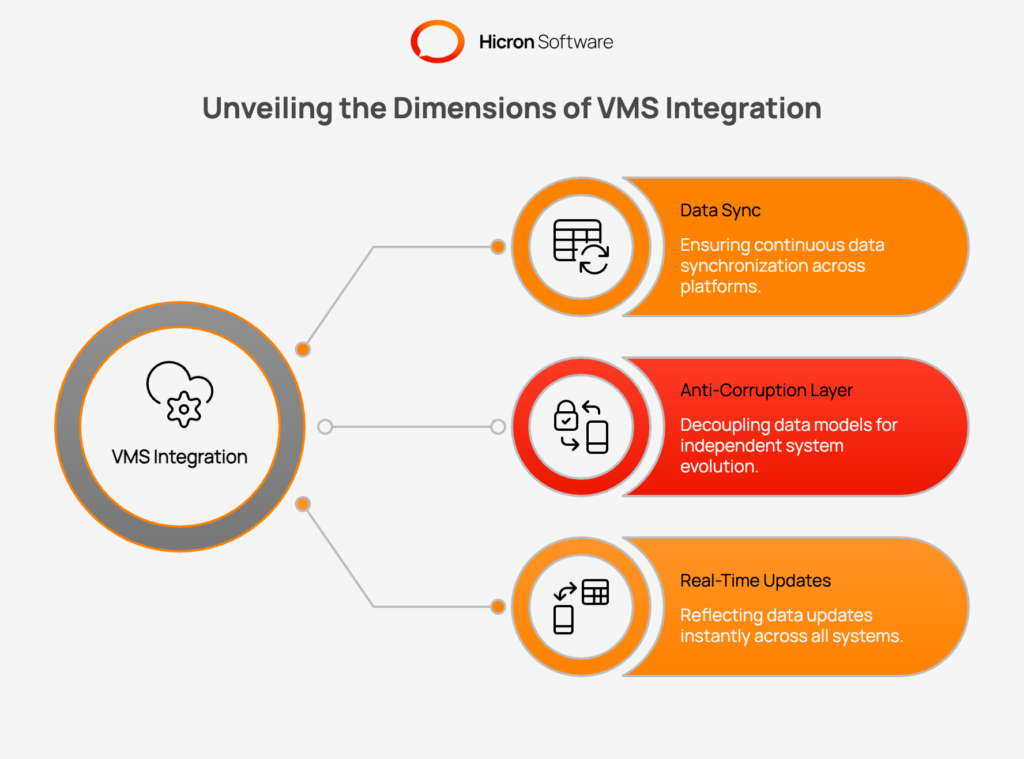
Integration ensures continuous data synchronization across platforms. Supplier master data created in the VMS can be automatically pushed to the ERP, while purchase orders created in the ERP can be sent to the VMS supplier portal. This bidirectional data flow eliminates manual entry, reduces errors, and ensures that all systems are working with the same information.
Modern integrations often use an “anti-corruption layer.” This is a middleware technology that decouples the VMS and ERP data models. It acts as a translator, allowing the two systems to evolve independently without breaking the integration. This architectural approach provides flexibility and resilience, making the entire enterprise technology stack more robust.
With real-time integration, data updates are reflected across all systems instantly. When a supplier updates their contact information in the VMS portal, it is immediately synced to the ERP. When a quality issue is logged on the factory floor in the MES, it appears on the supplier performance dashboard in the VMS. This real-time consistency is vital for making timely, data-driven decisions.
Implementing a VMS across a complex organization requires a thoughtful, phased approach. A “big bang” rollout is rarely successful.
Phase 1: The initial focus should be on centralizing supplier data. Migrate existing vendor information into the unified database and deploy division-specific supplier portals. This establishes the foundational single source of truth.
Phase 2: Next, configure the core processes. Work with each division to design and implement workflows for onboarding, performance management, and audits. Concurrently, build out the division-level dashboards and global roll-up reports.
Phase 3: Finally, tackle the advanced capabilities. Integrate the VMS with key enterprise systems like your ERP. Once a solid data foundation is in place, you can begin to leverage predictive analytics to drive strategic insights.
Throughout this process, change management is critical. Provide comprehensive training tailored to different user roles and divisions. Develop templates and best-practice guides to accelerate adoption and ensure users feel supported.
To justify the investment and demonstrate value, it is crucial to track key performance indicators (KPIs). Measure supplier metrics like on-time delivery (OTD), parts per million (PPM) defects, and audit closure rates, tracking them by division to identify high and low performers. Monitor cross-division collaboration metrics, such as the number of joint savings initiatives or the value of consolidated spend. Finally, track global compliance adherence and data consistency improvements to showcase the reduction in risk and operational overhead.
|
KPI |
Description & Purpose |
|
On-Time Delivery (OTD) |
Measures how often suppliers deliver goods or services by the agreed-upon date. Tracking this by division helps identify reliable partners and potential bottlenecks in the supply chain. |
|
Parts Per Million (PPM) Defects |
Tracks the number of defective parts per million units received from a supplier. This KPI is crucial for monitoring supplier quality and identifying performers that meet manufacturing standards. |
|
Audit Closure Rates |
Measures the speed and effectiveness with which suppliers address and resolve issues identified during audits. A high closure rate indicates responsive and compliant partners. |
|
Cross-Division Collaboration Metrics |
Monitors joint activities between divisions, such as the number of shared savings initiatives or the value of consolidated spend. This demonstrates the VMS’s effectiveness in fostering strategic collaboration. |
|
Global Compliance Adherence & Data Consistency |
Tracks adherence to company-wide policies and improvements in data accuracy across all divisions. This KPI showcases risk reduction and decreased operational overhead. |
While a multi-division VMS offers immense benefits, there are common pitfalls to avoid. One major mistake is over-customizing workflows for each division to the point where they become new silos. It is important to standardize processes where possible and only customize where necessary. Another error is ignoring cross-division collaboration opportunities; the implementation team should actively look for ways to bring divisions together. Finally, a lack of adequate training and ongoing support for division-specific users can doom an implementation. Adoption is key to realizing the full value of the system.
Managing vendors across a multi-division organization is inherently complex, but it does not have to be chaotic. A Vendor Management System built for this environment can tame the complexity. By centralizing data in a unified platform, providing tools for customized workflows and role-based access, and enabling clear collaboration, a VMS transforms your supply chain from a fragmented liability into a powerful strategic asset.
To begin your journey, start by auditing your current vendor management challenges. Identify the biggest pain points and prioritize the divisions where a VMS could have the highest impact. With a clear understanding of your needs, you can confidently pilot a VMS rollout and take the first step toward a more unified and efficient vendor management future.
Ready to build or improve your multi-division vendor management system? Get in touch with us today and take the first step toward streamlined operations and enhanced collaboration!
A multi-division VMS is a vendor management system specifically designed for large organizations with multiple business units or regional divisions. It provides centralized control over supplier data and global policies while allowing for localized workflows, access controls, and reporting for each division.
A VMS manages varying compliance requirements through configurable workflows and data segmentation. You can create unique onboarding and audit processes for divisions based on their industry or location. The system can also support regional data residency and retention rules to help ensure compliance with laws like GDPR.
Yes. A key feature of a multi-division VMS is a unified supplier portal. This allows a supplier to use a single login to interact with every division they serve within your organization, while the information and tasks they see can be tailored to each specific business unit.
A VMS integrates with an ERP system through APIs to enable real-time data synchronization. This ensures that supplier information, purchase orders, invoices, and performance data are consistent across both platforms, eliminating manual data entry and reducing errors.
A successful implementation typically follows a phased approach. Start by identifying your biggest vendor management pain points and centralizing your supplier data. Then, work with a few pilot divisions to configure their workflows and dashboards before rolling the system out to the entire organization. Strong change management and training are crucial for user adoption.
Hicron Software proved to be a trusted partner with unmatched technical expertise, delivering a scalable and user-friendly web application that was pivotal to our successful U.S. market expansion.
Hicron’s contributions have been vital in making our product ready for commercialization. Their commitment to excellence, innovative solutions, and flexible approach were key factors in our successful collaboration.
I wholeheartedly recommend Hicron to any organization seeking a strategic long-term partnership, reliable and skilled partner for their technological needs.

After carefully evaluating suppliers, we decided to try a new approach and start working with a near-shore software house. Cooperation with Hicron Software House was something different, and it turned out to be a great success that brought added value to our company.
With HICRON’s creative ideas and fresh perspective, we reached a new level of our core platform and achieved our business goals.
Many thanks for what you did so far; we are looking forward to more in future!

Hicron is a partner who has provided excellent software development services. Their talented software engineers have a strong focus on collaboration and quality. They have helped us in achieving our goals across our cloud platforms at a good pace, without compromising on the quality of our services. Our partnership is professional and solution-focused!

The IT system supporting the work of retail outlets is the foundation of our business. The ability to optimize and adapt it to the needs of all entities in the PSA Group is of strategic importance and we consider it a step into the future. This project is a huge challenge: not only for us in terms of organization, but also for our partners – including Hicron – in terms of adapting the system to the needs and business models of PSA. Cooperation with Hicron consultants, taking into account their competences in the field of programming and processes specific to the automotive sector, gave us many reasons to be satisfied.