Integrating Vendor Management Systems with SAP: Best Practices
- October 29
- 32 min


A vendor management system (VMS) ia digital platform that manages supplier relationships, contracts, compliance, and performance inside a manufacturing supply chain. Manufacturers use VMS solutions to coordinate materials and information across suppliers so production stays on schedule and quality stays controlled.
Manufacturing supply chains are known for their complexity. These supply networks typically involve multiple tiers of suppliers, stringent quality requirements, cost pressures, and just-in-time delivery expectations. Even a single delay or non-compliance incident can cause costly disruptions in production. Vendor Management Systems offer manufacturers a way to overcome these challenges, making supplier collaboration faster, compliance easier, and operations more reliable. In this article, you’ll learn how a VMS helps manufacturers gain control, maintain quality, and manage supplier risks.
Key Takeaways:
Manufacturers depend on many suppliers for critical materials, parts, and subassemblies. This high dependency creates risk if not managed proactively. Quality standards like ISO 9001, IATF 16949, or FDA regulations add layers of compliance that must be managed continuously. Supplier networks are frequently global and often multi-tiered, making communication and oversight challenging. Disruptions in delivery or quality can bring production to a halt and affect the entire business. Because of these challenges, manufacturing companies need specialized, purpose-built systems to keep everything running smoothly and reliably.
A VMS is designed to address these pressures by creating a single source of truth for all supplier-related activities. It moves teams away from fragmented, manual processes and into a more integrated and efficient environment. The core benefits for manufacturing are clear.
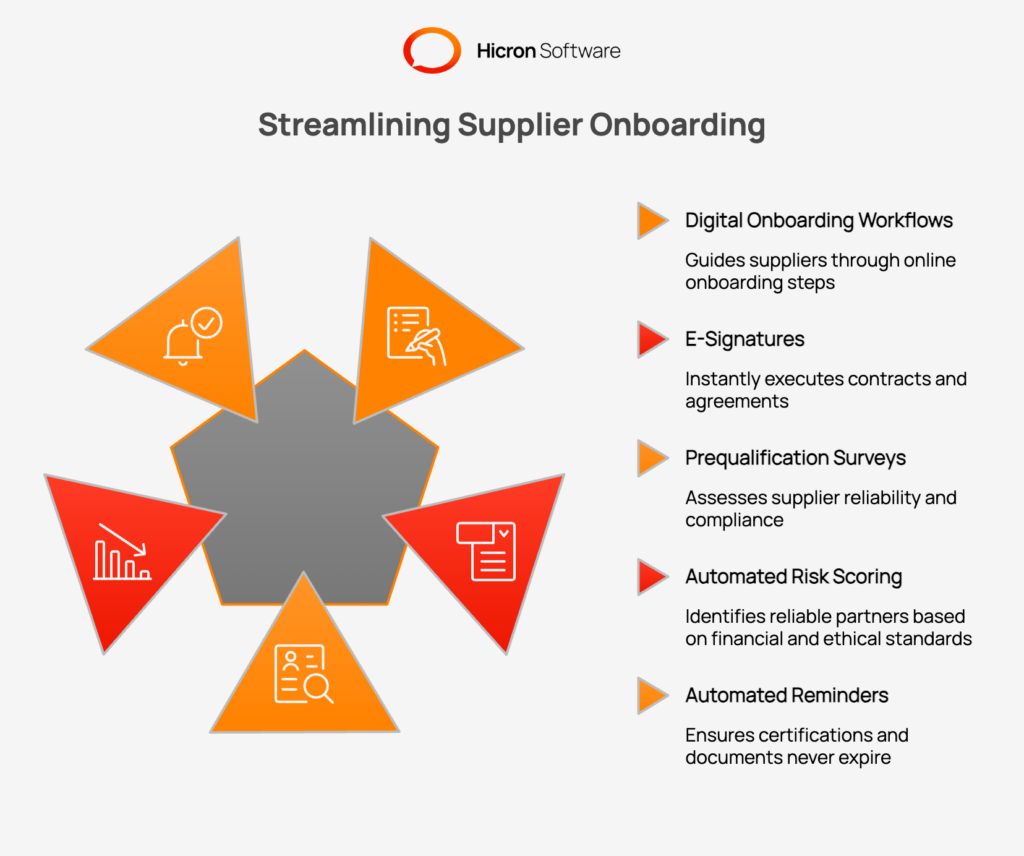
Onboarding new suppliers can be time-consuming without digital tools. A VMS automates the process, allowing suppliers to submit documents digitally and complete onboarding steps online. Digital onboarding workflows can guide new suppliers through the process, allowing them to upload necessary documents like insurance certificates, tax forms, and compliance certifications with ease. E-signatures can be used to execute contracts and agreements instantly.
Prequalification surveys and automated risk scoring help identify reliable partners from the beginning. You can assess their financial stability, operational capacity, and adherence to ethical standards from the outset.
For ongoing governance, the system can send automated reminders for requalification, ensuring that certifications and documents never expire and compliance is continuously maintained. Automation potential is especially high here: self-service registration, document AI for certificate extraction, tax/KYC/bank validation, duplicate-vendor checks, and approval routing reduce manual handoffs and keep supplier master data clean from day one.
This structured approach shortens the time from supplier selection to first delivery, supporting efficient production planning.
The highest automation potential lies in high-volume, rule-based, document-heavy, and exception-prone processes. Supplier onboarding, PO/ASN/invoice matching, compliance monitoring, and supplier risk scoring benefit most because they are repetitive, data-intensive, and still depend on manual handoffs between procurement, quality, finance, and suppliers.
|
Area |
What can be automated |
Automation pattern |
|
Supplier onboarding |
Registration, document collection, tax/KYC/bank validation, duplicate-vendor checks, approval routing |
Workflow + rules + document AI |
|
Compliance management |
Certificate expiry monitoring, audit scheduling, missing-document reminders, requalification workflows |
Event-driven workflows and alerts |
|
Purchase-order collaboration |
PO acknowledgements, promised-date updates, status chasing, ASN reminders |
Supplier portal + ERP integration + automated follow-ups |
|
Inbound logistics |
ASN matching to PO lines, delivery-date updates, receipt reconciliation, shortage/overage flags |
ERP/WMS event processing |
|
Invoice-to-pay |
OCR capture, GL coding, 2-way/3-way matching, duplicate detection, approval routing, payment scheduling |
OCR/IDP + matching rules + workflow |
|
Supplier performance |
OTIF, PPM/defect trends, lead-time variance, responsiveness, scorecards |
Scheduled analytics and KPI computation |
|
Risk management |
Risk scoring, anomaly detection, financial/compliance/geopolitical signals, early-warning alerts |
ML models + external data feeds |
|
Contract lifecycle |
Renewal reminders, obligation tracking, price-change detection, contract-to-PO linkage |
Contract metadata extraction + workflow |
|
Routine replenishment |
Reorder-point monitoring, draft PO creation for standard MRO or recurring components |
Demand/inventory rules + ERP integration |
For most manufacturers, prioritize these four use cases first:
Ensuring consistent, high-quality output is mandatory for manufacturers. A Vendor Management System provides a structured framework for managing quality control processes consistently across your entire supplier base.
A VMS standardizes the intake process for complaints and Non-Conformance Reports (NCRs). It facilitates root cause analysis using established methodologies like the 5 Whys or Fishbone diagrams. The system then tracks the resulting Corrective and Preventive Actions (CAPAs) from assignment to closure, ensuring that issues are fully resolved and documented for future reference.
Regular audits are vital for verifying compliance with standards like ISO 9001 or IATF 16949. A VMS allows you to build and deploy standardized audit checklists directly within the platform. Auditors can capture findings, attach evidence, and assign corrective actions in real time. The system then automatically schedules follow-up audits to verify that all non-conformities have been addressed, creating a closed-loop quality improvement process.
Manufacturing relies on precise documentation. From technical specifications and Standard Operating Procedures (SOPs) to material safety data sheets and quality certifications. A VMS provides robust document control features, including versioning to ensure everyone is working from the latest revision. It manages approval workflows and tracks expiry dates, sending alerts before a critical document becomes invalid. This prevents non-compliant parts from ever entering your production flow.
|
Aspect |
Description |
Key Features |
|
Complaint and NCR Handling |
Standardizes the intake and resolution process for quality issues to ensure thorough problem-solving and documentation. |
• Standardized intake for Non-Conformance Reports (NCRs) |
|
Supplier Audits and Assessments |
Facilitates regular verification of supplier compliance with industry standards like ISO 9001 and IATF 16949. |
• Customizable audit checklists |
|
Document Control |
Manages the lifecycle of critical manufacturing documentation to prevent the use of outdated or invalid specs. |
• Robust versioning control |
Effective order management and delivery coordination are the lifeblood of a manufacturing operation. A VMS creates transparency and control over the entire procure-to-pay lifecycle.
A VMS can integrate with your ERP to provide real-time updates on purchase order (PO) status. Suppliers can acknowledge POs, provide shipping estimates, and submit Advance Shipping Notices (ASNs) directly through the portal. This gives procurement and logistics teams a clear view of when materials are expected, reducing uncertainty and enabling better planning.
To prevent bottlenecks at the receiving dock, a VMS can include a dock scheduling module. Suppliers can book delivery time slots in advance, allowing you to manage inbound logistics efficiently. The system can generate standardized barcode labels for pallets and cartons, which speeds up the receiving process and reduces errors. A shared dock calendar gives everyone visibility into planned arrivals.
The reliable Vendor Management System should be designed to be managed by exception. It can automatically send alerts for critical events such as late shipments, quantity shortages, or materials placed on a quality hold. This allows your team to focus their attention where it’s needed most, proactively resolving issues before they disrupt the production schedule. PO/ASN exception management is one of the strongest automation starting points. Matching ASNs to PO lines, chasing missing acknowledgements, and escalating late or short shipments before the line is affected keeps teams focused on true exceptions rather than status chasing.
Inventory management is a delicate balancing act. Too much inventory ties up working capital, while too little risks a stockout and production shutdown. A VMS provides the visibility and tools needed for effective inventory optimization. By sharing demand forecasts and production schedules with suppliers, you enable them to plan their own operations more effectively.
This visibility supports advanced inventory strategies like Vendor-Managed Inventory (VMI) or consignment stock. In a VMI model, the supplier is responsible for maintaining inventory levels at your facility, shifting the carrying costs. A VMS provides the data-sharing infrastructure to make these models work. The platform’s analytics can also help you calculate optimal lead times, safety stock levels, and reorder points based on historical performance and demand variability.
A VMS transforms the supplier relationship from purely transactional to a strategic partnership focused on mutual improvement.
|
Aspect |
Description |
Key Features |
|
Supplier Scorecards |
Establishes an objective foundation for performance discussions by automating the collection and calculation of critical metrics. |
• Automated KPI collection |
|
Supplier Development Plans |
Facilitates collaborative improvement initiatives to address performance dips and drive mutual growth. |
• Formal development plan creation |
|
Risk Monitoring |
Proactively identifies potential disruptions by integrating with external data sources to assess supplier stability. |
• Financial health tracking |
Objective performance data is the foundation of a strong supplier development program. A VMS automates the collection and calculation of key performance indicators (KPIs) into supplier scorecards. Common metrics include On-Time Delivery (OTD), quality performance (Parts Per Million or PPM defects), cost variance, and responsiveness. These scorecards provide a factual basis for performance discussions.
When a supplier’s performance dips, a VMS helps you create and track targeted improvement initiatives. Based on scorecard trends, you can collaborate with the supplier on a formal development plan, assign action items, and monitor progress directly within the system. This collaborative approach fosters partnership and drives continuous improvement.
A VMS can integrate with third-party data providers to monitor various dimensions of supplier risk. This includes tracking financial health indicators, screening for compliance or legal issues, and assessing exposure to geopolitical or environmental risks. Proactive risk monitoring helps you anticipate and mitigate potential disruptions.
A VMS delivers maximum value when it is integrated into your existing technology landscape. It should not be another data silo. Modern VMS platforms are designed to connect with Enterprise Resource Planning (ERP), Manufacturing Execution Systems (MES), and Product Lifecycle Management (PLM) systems.
This integration allows for the synchronization of supplier master data, purchase orders, receiving information, and quality results across all platforms.
A critical integration point is pushing a supplier’s compliance status from the VMS to the ERP. This can automatically block the creation of purchase orders for non-compliant or unapproved vendors, acting as an enforcement mechanism. Using anti-corruption layers or middleware can help decouple the VMS and ERP data models, making the integration more resilient and easier to maintain.
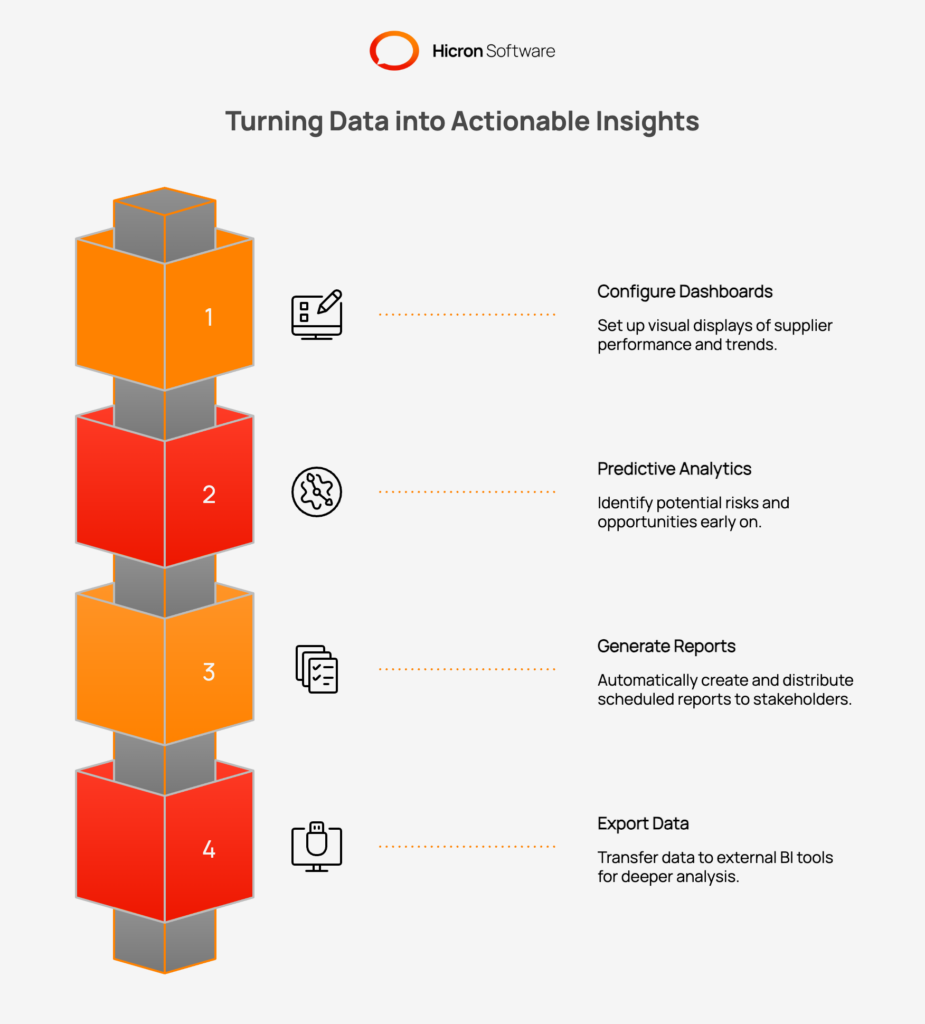
Data is only useful if it leads to better decisions. A VMS is a powerful analytics engine that turns raw supplier data into actionable business intelligence. Configurable dashboards provide at-a-glance views of overall supplier performance, quality trends, and cost-saving opportunities.
Predictive analytics can identify early warning signs of risk, such as declining on-time delivery rates or increased lead-time variability. This allows you to intervene before a problem becomes critical. Vendor Management System can also be configured to automatically generate and distribute scheduled reports to leadership, keeping all stakeholders informed and aligned. For deeper analysis, data can be exported to external Business Intelligence (BI) tools.
Implementing a Vendor Management System is a big project, and a phased approach is often the most successful. This allows you to achieve quick wins and build momentum.
Throughout the process, change management is critical. Develop supplier enablement kits and provide thorough training to ensure your partners can use the new system effectively. Similarly, invest in training your internal procurement, quality, and logistics teams.
|
Phase |
Focus Areas |
Key Actions |
|
Phase 1 |
Foundational Modules |
• Digitize supplier onboarding workflows |
|
Phase 2 |
Core Operational Workflows |
• Roll out quality management modules (NCRs, CAPAs, Audits) |
|
Phase 3 |
Advanced Capabilities |
• Deepen integrations with ERP and MES systems |
|
Ongoing |
Change Management |
• Develop supplier enablement kits |
To demonstrate the return on investment from a VMS, it’s important to track the KPIs that matter most in a manufacturing context. Key metrics include:
|
Category |
Description |
Key Metrics |
|
Quality & Compliance |
Measures the supplier’s adherence to quality standards and contractual obligations. |
• Supplier On-Time Delivery (OTD) |
|
Efficiency |
Tracks the speed and effectiveness of procurement and issue resolution processes. |
• Purchase Order (PO) cycle time |
|
Cost & Inventory |
Monitors the financial impact of inventory management and supply chain performance. |
• Reduction in inventory carrying costs |
While a Vendor Management System offers tremendous benefits, there are common pitfalls to avoid. One major mistake is over-customizing workflows for every single plant or division. Strive for standardization wherever possible to maintain efficiency and ease of maintenance. Another common oversight is ignoring multi-tier supplier visibility. Your risk exposure extends beyond your direct Tier 1 suppliers, so look for solutions that can provide insight deeper into the supply chain. Finally, do not underestimate the importance of supplier adoption. A lack of training and ongoing support for your partners will undermine the success of the entire project.
A Vendor Management System is no longer a luxury for manufacturers; it is a competitive necessity. By centralizing supplier data, automating key processes, and providing deep visibility into performance and risk, a VMS directly addresses the core challenges of the modern manufacturing supply chain. It strengthens collaboration, enforces quality and compliance, and optimizes inventory and logistics.
The path forward begins with a clear assessment of your current supply chain challenges. Identify the areas of highest impact, whether it’s streamlining supplier onboarding, tightening quality control, or improving delivery performance. With these priorities in mind, you can begin to explore VMS solutions and pilot a module that will deliver immediate value to your organization. Ready to optimize your supply chain? Contact us today to schedule a consultation or discuss building a custom VMS solution tailored to your manufacturing needs.
Compliance management is a core strength of a VMS. The system can automate the collection and tracking of certifications, insurance documents, and audit results. It ensures that no expired or non-compliant suppliers are used in production, providing a robust audit trail that simplifies regulatory inspections and ISO certification renewals.
ROI comes from several areas: reduced administrative costs through automation, lower inventory carrying costs via better visibility, and improved product quality which reduces scrap and rework. Additionally, by mitigating supply chain risks and preventing disruptions, a VMS protects revenue and preserves customer trust, which can be invaluable.
Implementation timelines vary based on the complexity of your supply chain and the scope of the rollout. A phased approach is recommended. Basic modules like supplier onboarding and document control can often be up and running in a few weeks. A full deployment involving deep ERP integration and advanced analytics may take several months to fully optimize.
Keep a human-in-the-loop model for material decisions: supplier qualification, contract awards, price negotiations, quality dispositions, and alternate sourcing. Automate capture, validation, matching, alerts, routing, and reporting so people spend time on judgment, strategy, and supplier relationships.
Prioritize automated invoice processing and 3-way matching, supplier onboarding and master-data hygiene, PO/ASN exception management, and continuous supplier risk and performance monitoring. These workflows are high-volume, rule-based, and document-heavy, so they return value before advanced predictive models.
Hicron Software proved to be a trusted partner with unmatched technical expertise, delivering a scalable and user-friendly web application that was pivotal to our successful U.S. market expansion.
Hicron’s contributions have been vital in making our product ready for commercialization. Their commitment to excellence, innovative solutions, and flexible approach were key factors in our successful collaboration.
I wholeheartedly recommend Hicron to any organization seeking a strategic long-term partnership, reliable and skilled partner for their technological needs.

After carefully evaluating suppliers, we decided to try a new approach and start working with a near-shore software house. Cooperation with Hicron Software House was something different, and it turned out to be a great success that brought added value to our company.
With HICRON’s creative ideas and fresh perspective, we reached a new level of our core platform and achieved our business goals.
Many thanks for what you did so far; we are looking forward to more in future!

Hicron is a partner who has provided excellent software development services. Their talented software engineers have a strong focus on collaboration and quality. They have helped us in achieving our goals across our cloud platforms at a good pace, without compromising on the quality of our services. Our partnership is professional and solution-focused!

The IT system supporting the work of retail outlets is the foundation of our business. The ability to optimize and adapt it to the needs of all entities in the PSA Group is of strategic importance and we consider it a step into the future. This project is a huge challenge: not only for us in terms of organization, but also for our partners – including Hicron – in terms of adapting the system to the needs and business models of PSA. Cooperation with Hicron consultants, taking into account their competences in the field of programming and processes specific to the automotive sector, gave us many reasons to be satisfied.