10 Real Estate Software Development Companies in 2026
- February 03
- 9 min



The real estate data layer is the accumulated lease, cost, tenant, and maintenance history that a property management system stores over years of daily operation, most of which never reaches a decision.
A mature property management system holds five to ten years of lease dates, tenant turnover, maintenance history, operating costs, and payment records. That history sits in the database long after anyone stops looking at it. Most organizations respond to a sense that the system delivers too little value by buying a new AI tool or running another pilot on external data. The real estate data layer already holds most of what a vacancy alert, a tenant risk score, or a cost anomaly flag needs. This article maps that inventory, three decisions it can already answer, and why the gap persists.
Key Takeaways
A property management system that has run for five years or more accumulates a specific kind of record: not just current leases, but the full history behind them. This holds whether the underlying platform is a large enterprise suite, a mid-market tool, or a system built for a single regional market.
Six categories account for most of what a mature system stores.
|
Data category |
What is typically stored |
Decision it can support |
|
Tenant turnover history |
Monthly or quarterly reported sales per unit, often across multiple years |
Vacancy risk detection through declining turnover trend |
|
Lease dates and terms |
Start date, expiry, break option windows, renewal notice periods, indexation schedule |
Renewal planning and proactive leasing action before expiry |
|
Maintenance and incident history |
Work orders, repair frequency, response times, recurring fault categories |
Preventive maintenance planning and cost anomaly detection |
|
Operating cost per unit |
Utilities, service charge allocation, common area costs, cleaning and security splits |
Cost anomaly detection across comparable units |
|
Payment history |
On-time versus late payments, partial payments, arrears duration and frequency |
Tenant financial health signal ahead of formal default |
|
Vacancy history |
Which units stood empty, for how long, and at what re-leasing rate |
Benchmark data for current vacancy risk scoring |
None of this data was collected as a deliberate analytics effort. Turnover history accumulates because percentage rent calculations require it every billing cycle. Maintenance history accumulates because a work order system logs a date, a category, and a resolution time for every reported fault. The record exists as a byproduct of running leases, billing tenants, and dispatching repairs.
That is also why the record goes unused. A system built to record transactions answers “what happened” by design. It was never asked to answer “what happens next.”
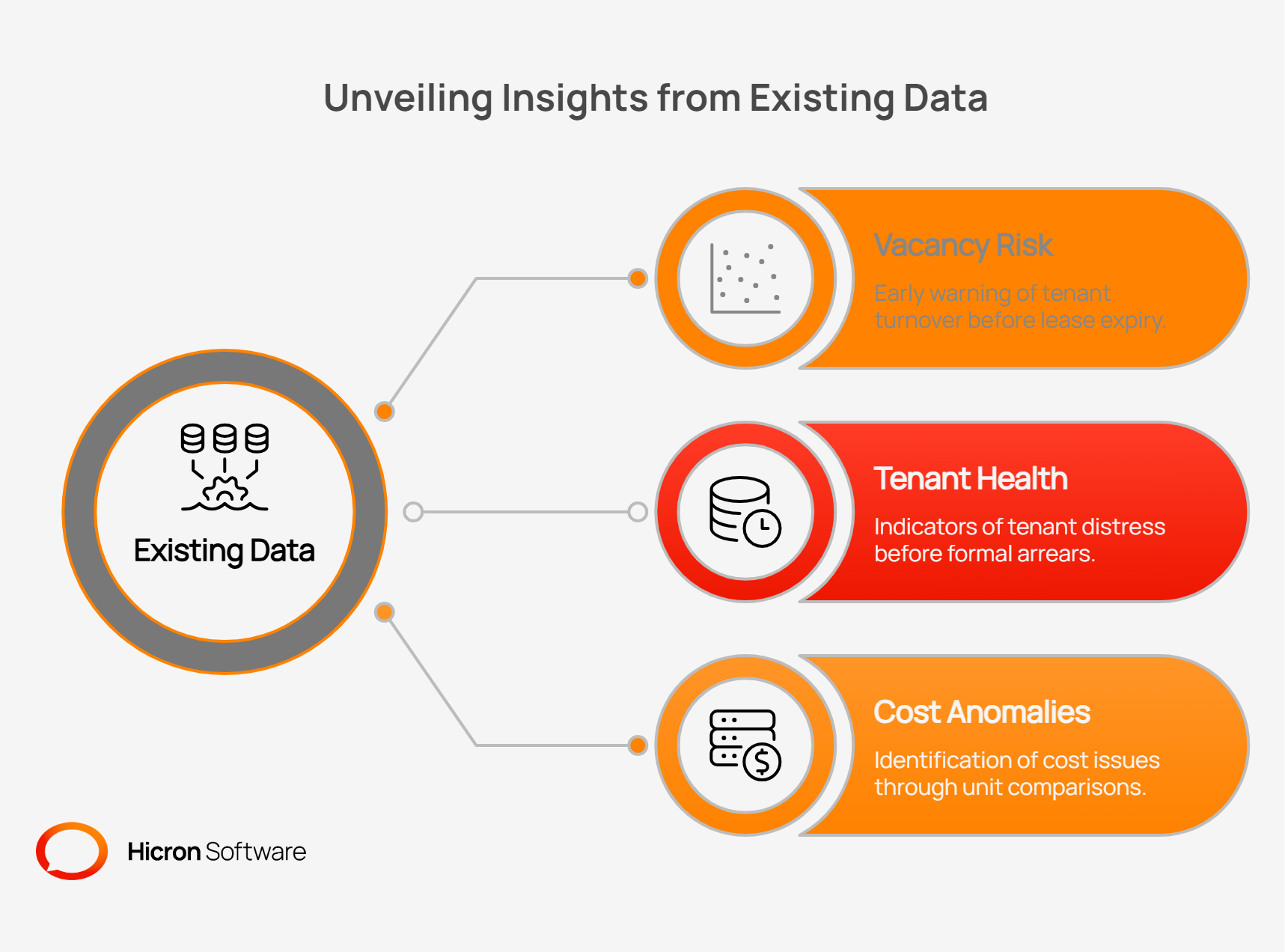
Three categories of decisions can be answered from the inventory above, without connecting a new data source or commissioning an additional tool.
A tenant’s monthly turnover typically declines for several reporting periods before a lease ends without renewal. Combined with an approaching expiry date and the absence of a renewal signal, that pattern produces an early warning. A lead time of six to twelve months gives a leasing team room to start a marketing campaign or reopen commercial terms before a unit sits empty.
Payment timeliness is the last signal of tenant distress, not the first. Turnover decline, a shift from full to partial payments, and a pattern of requests for short extensions typically appear earlier. Reading those signals together produces a risk indicator months before a tenant appears on a formal arrears report.
Operating cost per square meter, compared across comparable units in the same portfolio, surfaces problems that a single unit’s cost report hides. A unit running consistently above its peers points to a billing error, an outdated vendor contract, or a recurring maintenance pattern. Preventive action often resolves that pattern more cheaply than repeated reactive repair.
Each of these questions draws on figures that are already calculated, billed, and reconciled inside the system. None requires a sensor, a survey, or an external dataset to get started.
Call the distance between what a system records and what a team acts on the adoption gap. Three conditions keep that gap open in most organizations.
The gap is organizational before it is technical. Fixing it does not start with new software. It starts with someone deciding that connecting three existing reports is worth doing on a recurring basis.
A decision layer is a set of analytics and models that reads from the existing property management system. It turns stored history into a flag, a score, or an early alert, without replacing the system underneath it or duplicating its records.
A decision layer for vacancy risk might combine turnover trend, lease expiry proximity, and prior vacancy patterns into a single score. Refreshed monthly, that score ranks units by risk. A decision layer for tenant health might combine payment timeliness, turnover trend, and sector context into a similar score. A decision layer for cost anomalies might compare operating cost per unit against portfolio peers and flag outliers automatically, instead of waiting for a manual review.
None of these require the underlying system to change. Each one reads from tables that already exist and writes a result back to a dashboard a leasing, asset management, or operations team already checks.
A narrow starting point works better than a broad one. One model, tested against tenants who have already left, validates whether a vacancy score would have flagged them early enough to matter before that score drives any live decision.
The remaining articles in this series look at three of these decisions in more depth. Vacancy prediction from lease and turnover data, tenant financial health as an early signal, and contract intake for non-standard lease terms each get a dedicated article.
Four steps structure the work before any vendor conversation or platform evaluation begins.
The system already holds the record of what happened across leases, tenants, and costs. Turning that record into a decision layer does not require a new platform, a new vendor relationship, or another pilot. It requires an audit of what is already stored, one well-scoped question, and someone accountable for acting on the answer.
The real estate data layer is the accumulated lease, tenant, cost, and maintenance history that a property management system stores over years of operation. It builds up as a byproduct of billing tenants, tracking lease dates, and logging maintenance work, rather than through a dedicated analytics effort. Most of it is structured, searchable, and rarely queried for anything beyond the report it was built for.
A decision layer reads from the existing property management system rather than replacing it. It draws on tables and reports the system already produces, adds a scoring or flagging step on top, and writes the result back to a dashboard the team already uses. Replacing the underlying system is a separate decision from building a decision layer on the data it already holds.
The data layer is the historical record a property management system accumulates: lease terms, turnover, costs, payments, and maintenance events. The decision layer sits on top of that record. It turns the record into a flag, a score, or an early alert, such as a vacancy risk ranking or a tenant health score. The data layer records what happened. The decision layer supports what to do next.
Operational silos, systems built primarily as compliance and record-keeping tools, and the absence of a role responsible for turning stored records into decisions all keep existing data unused. A new tool or pilot feels like progress, while the harder and often cheaper step is connecting reports that already exist across leasing, finance, and maintenance teams.
A mature system typically holds tenant turnover history, lease dates and terms including expiry and break options, and maintenance and incident records. It also holds operating cost per unit, payment history, and vacancy history. Together these categories cover most of what vacancy prediction, tenant health scoring, and cost anomaly detection require as a starting point.
Hicron Software proved to be a trusted partner with unmatched technical expertise, delivering a scalable and user-friendly web application that was pivotal to our successful U.S. market expansion.

Hicron’s contributions have been vital in making our product ready for commercialization. Their commitment to excellence, innovative solutions, and flexible approach were key factors in our successful collaboration.
I wholeheartedly recommend Hicron to any organization seeking a strategic long-term partnership, reliable and skilled partner for their technological needs.

After carefully evaluating suppliers, we decided to try a new approach and start working with a near-shore software house. Cooperation with Hicron Software House was something different, and it turned out to be a great success that brought added value to our company.
With HICRON’s creative ideas and fresh perspective, we reached a new level of our core platform and achieved our business goals.
Many thanks for what you did so far; we are looking forward to more in future!

Hicron is a partner who has provided excellent software development services. Their talented software engineers have a strong focus on collaboration and quality. They have helped us in achieving our goals across our cloud platforms at a good pace, without compromising on the quality of our services. Our partnership is professional and solution-focused!

The IT system supporting the work of retail outlets is the foundation of our business. The ability to optimize and adapt it to the needs of all entities in the PSA Group is of strategic importance and we consider it a step into the future. This project is a huge challenge: not only for us in terms of organization, but also for our partners – including Hicron – in terms of adapting the system to the needs and business models of PSA. Cooperation with Hicron consultants, taking into account their competences in the field of programming and processes specific to the automotive sector, gave us many reasons to be satisfied.