Developing a Secure AI Solution for Enterprise Applications
- June 16
- 28 min


Custom enterprise software development is the process of designing, building, and maintaining software tailored to a specific organization or user base. It requires precise planning and execution. Large organizations often struggle with software project failure causes that derail their progress. Developing bespoke enterprise applications involves overcoming challenges related to underlying technical complexity and coordinating the team’s work. Choosing the right custom software development company helps you avoid massive budget overruns. Enterprise business owners – CIOs, IT directors, and delivery leaders – need clear strategies to manage development costs and ensure long-term success.
Many enterprise companies approach software development projects not just as a task. It’s a strategic solution to address specific industry challenges. However, launching such projects without a clearly defined scope often leads to wasted resources, misunderstandings, or even project failure. While each industry faces unique challenges, there are common risks that span across sectors.
Hidden technical complexity obscures the actual difficulty of a custom software project. Leaders often underestimate how new tools interact with legacy platforms and real-world operations. Failure to plan for these dependencies causes budget overruns and missing features. By identifying and addressing these potential risks early, you strengthen your custom software investment and steer it away from costly setbacks. Proactive risk management streamlines project delivery and positions your organization to capture the full value of its technology initiatives. We can therefore list some of the most common risks associated with enterprise software development that require attention:
Except for coding itself, custom software development in large enterprises often fails due to deeper alignment and execution issues. Even when experienced development companies or a reliable custom software development company are involved, projects can derail if business goals, governance, and the software development cycles are not aligned from the start.
Enterprise software development requires more than selecting the right technology stack or deciding between custom solutions and off-the-shelf solutions. It demands strong enterprise software project management, clear communication, and continuous risk assessment across the entire lifecycle. Without that, even well-funded initiatives face budget overstepping, delayed deployment, and limited scalability.
One of the biggest risk factors in custom software development is misalignment between stakeholders, developers, and business units. Many failures in software projects stem from a poor understanding of user needs and a lack of clearly defined business objectives right from the start. This is a serious mistake because these elements are essential for effectively delivering enterprise software development services. Without them, a gap exists between app creation and delivering actual value.
Teams working in isolation make the software development process even more complex. Without clear communication, individual departments end up duplicating work, causing interface and compatibility issues, and producing poorly documented integration requirements. These flaws often lead to rework, performance bottlenecks, and increased development costs.
Effective project management and software oversight for businesses are equally important for mitigating risk. Establishing a centralized decision-making structure, supported by agile practices and clear allocation of responsibilities, unifies teams and reduces misinterpretation in custom software development services. This is especially critical when outsourcing or coordinating multiple specialists across complex, customized software development initiatives.
Uncontrolled scope creep remains one of the most common risks in enterprise custom software development. As priorities shift, organizations expand the project scope without adjusting development lines, budget, line expectations, or resource allocation. This creates instability throughout the software development cycle, leading to budget overruns and missed delivery targets in application development.
The biggest risk here is the lack of structured change management. Without proper change control, teams lose focus, and even the right custom software development strategy becomes ineffective. Developers are forced into constant rework, which increases custom software development costs and delays deployment.
To choose the right custom software approach, organizations should define clear boundaries upfront. A strong risk governance framework ensures that every change aligns with business needs, maintains workflow consistency, and protects long-term scalability. This is especially important in app development, including mobile app development, where rapid iterations can quickly spiral out of control.
When project timelines get tight and the scope of work expands, testing is often the first thing to be sacrificed. Inadequate quality checks lead to buggy systems, security issues, and failure to adhere to regulatory requirements. The problem intensifies in advanced environments involving AI or computer vision, where complexity increases the likelihood of hidden weaknesses and performance issues. Skipping proper validation results in unstable deployment, poor usability, and weak UX, especially in high-demand systems like e-commerce or CRM systems.
Prioritizing quality assurance is a core part of risk control in software development. Your teams should allocate for bug fixes, security measures, and regular updates throughout the lifecycle and post-launch phases. Strong support and maintenance, including ongoing technical support and a dedicated support team, ensure long-term success, future updates, and post-deployment maintenance.
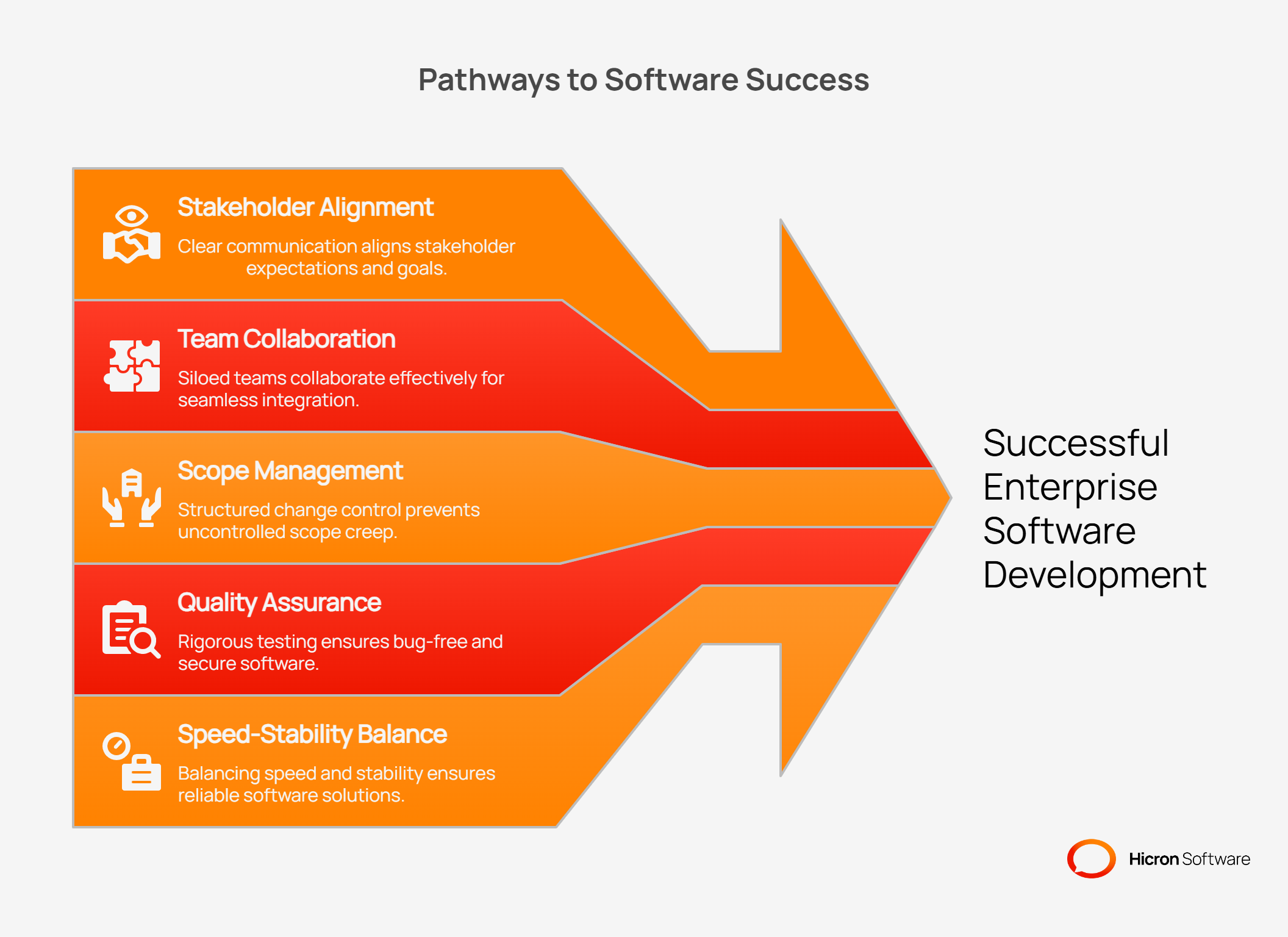
It is important to remember that successful custom software development depends on balancing speed with stability. Organizations that build custom systems with a strong focus on reliability, ongoing maintenance, and best practices reduce failure risks, avoid costly disruptions, and ensure their solutions remain stable and aligned with evolving custom software needs.
To achieve this, organizations can implement several strategies:
By adopting these best practices, organizations can reduce the risk of failure and ensure their software remains stable and effective as it evolves.
Agile practices help bring structure and adaptability into complex enterprise environments, where changing requirements are the norm. By embedding feedback loops and iterative delivery into the lifecycle, teams can improve stability while maintaining steady progress.
|
Agile Process |
Scope |
Outcome |
|
Iterative Development (Sprints) |
Work is divided into short, manageable cycles with defined goals. |
|
|
Early Testing & Continuous Feedback |
Features are tested during each iteration with stakeholder input. |
|
|
Sprint Reviews |
Teams present completed work to stakeholders at the end of each sprint. |
|
|
Retrospectives |
Teams regularly evaluate what worked and what didn’t. |
|
|
Daily Stand-ups |
Short daily meetings to track progress and blockers. |
|
|
Adaptive Roadmapping |
Plans are continuously updated based on feedback and changing conditions. |
|
|
Incremental Delivery |
Features are released in smaller, usable increments. |
|
|
Agile Risk Mitigation |
Risks are identified and addressed continuously throughout development. |
|
Leaders often misjudge the difficulty of connecting new platforms with rigid legacy systems. This miscalculation triggers compatibility issues and traps data in isolated silos. Post-launch integration costs skyrocket when you ignore these technical realities. Mapping out integration strategies from day one prevents these issues. Allocating resources for extensive API testing is an absolute necessity to mitigate potential risks.
Ineffective change management can completely undermine the expected benefits of your new software. Pushing new tools onto users without training results in very low adoption rates. You need a comprehensive change management strategy that includes continuous training programs. Phased rollouts help employees adjust to the new user interface. Prioritizing UX and usability ensures higher adoption and better overall efficiency.
Assuming a new application will automatically fix broken operational processes is a massive mistake. Technology often merely digitizes bad processes without delivering real productivity improvements. You should combine a custom software implementation with a thorough process-optimization audit. Fixing underlying organizational issues ensures your investment yields actual results.
Implementing new technology without addressing underlying operational flaws is a common pitfall. A new application might digitize existing inefficiencies rather than resolve them, leading to disappointing ROI and marginal productivity gains. To make the most of your investment, a custom software rollout should be preceded by a comprehensive Business Process Reengineering audit. This ensures that the technology is built upon an optimized operational framework, enabling it to deliver the intended strategic value and tangible results.
To maximize the benefits of artificial intelligence, organizations should pair its capabilities with thorough human oversight. All developed elements require detailed code reviews, comprehensive testing, and compliance checks.
The most strategic approach is to position AI as a support tool that augments developer expertise, rather than attempting to replace it. When implemented responsibly under this model, AI enhances risk control frameworks, drives operational efficiency, and ultimately contributes to the creation of more stable, secure, and scalable custom software solutions.
Overly optimistic timelines that disregard the true complexity of enterprise-grade development are a primary cause of enterprise software project failure. Aggressive deadlines compel development teams to cut corners, resulting in subpar code quality and elevated technical risk. Project schedules must be grounded in historical data and expert technical assessments, incorporating mandatory contingency buffers to mitigate unforeseen delays and protect project integrity, especially regarding budget and timeline.
Ignoring strict security protocols exposes your organization to devastating data breaches. Overlooking regulatory compliance leads to heavy legal penalties and lost stakeholder trust. You should integrate security measures into every stage of the software development lifecycle. Regular vulnerability scans and compliance checks ensure your data remains completely safe.
Designing custom and/or enterprise software projects for immediate needs without forecasting future growth and long-term maintenance is a huge business risk. Systems built with a short-term focus can rapidly become obsolete, fail under increased load, or succumb to new security vulnerabilities. This lack of foresight often leads to expensive, large-scale overhauls to support business expansion, integrate mobile applications, or patch critical weaknesses. By contrast, adopting a scalable architecture and embedding rigorous security protocols from project inception ensures your software can manage future demands while protecting sensitive data. Proactive planning for scalability and security is a strategic investment that safeguards your capital and prevents operational disruptions.
Designing projects for immediate needs without anticipating future vulnerabilities presents significant risks. Custom software requires continuous updates to maintain optimal performance and security over its lifecycle. Allocating budget and resources for ongoing maintenance and proactive upgrades is crucial for ensuring long-term operational stability and resilience against emerging cyber threats. Post-deployment maintenance prevents system degradation, minimizes risks, and avoids expensive downtime. It’s good practice to have well-defined service-level agreements that prioritize technical support and fast bug resolution to keep your data secure.
Ignoring future growth can leave systems outdated and unable to handle increasing user demands. This can lead to expensive upgrades to support business expansions or mobile app development, making long-term maintenance essential. Using scalable architectures and planning for future capacity ensures your application can grow with your user base. A solid foundation is necessary for adding advanced features like computer vision or complex CRM systems. Consulting with experts to choose reliable, high-performing technologies can help avoid issues. Planning for scalability early saves money and reduces future operational problems.
Choosing the right strategy for custom software development is a pivotal decision that can determine whether your initiative succeeds or becomes another example of the common causes of software project failure. Enterprise business leaders should focus on aligning delivery with long-term business value while proactively managing risks in custom enterprise software development. Strategic alignment is the foundation of success, ensuring every initiative is tied to measurable business outcomes, such as improving operational efficiency, reducing costs, or enabling new revenue streams. Strong enterprise software project management plays a crucial role in continuously validating these goals throughout the lifecycle, rather than merely defining them at the outset.
Governance is equally critical in large organization software delivery, where complexity escalates due to multiple stakeholders, integrations, and compliance requirements. Establishing clear ownership, decision-making frameworks, and cross-functional communication prevents misalignment and costly delays, issues that often stem from coordination gaps rather than technological shortcomings. When evaluating your approach, it’s essential to weigh the trade-offs between off-the-shelf and custom solutions. While packaged software may offer faster initial deployment, it often imposes long-term limitations, forcing organizations to adapt their processes to the tool. In contrast, custom development allows businesses to create systems specifically tailored to their needs, offering control over integrations, scalability, and user experience. These factors are crucial in reducing hidden risks associated with custom enterprise software development.
A robust strategy also integrates risk management into the software development process from the outset. This involves auditing existing systems, identifying integration dependencies, addressing security and compliance early, and validating assumptions before full-scale implementation. Without this discipline, even well-funded projects can falter due to overlooked risks or late-stage changes. Iterative delivery, continuous feedback, and post-launch optimization reduce the likelihood of failure. For instance, a company implementing a new internal operations platform might start with a focused proof of concept, validate critical integrations, and then scale functionality in phases, minimizing risk while maintaining momentum.
By combining strategic alignment, strong governance, and proactive risk management, organizations can overcome custom software implementation challenges and build solutions that deliver lasting value in complex enterprise environments.
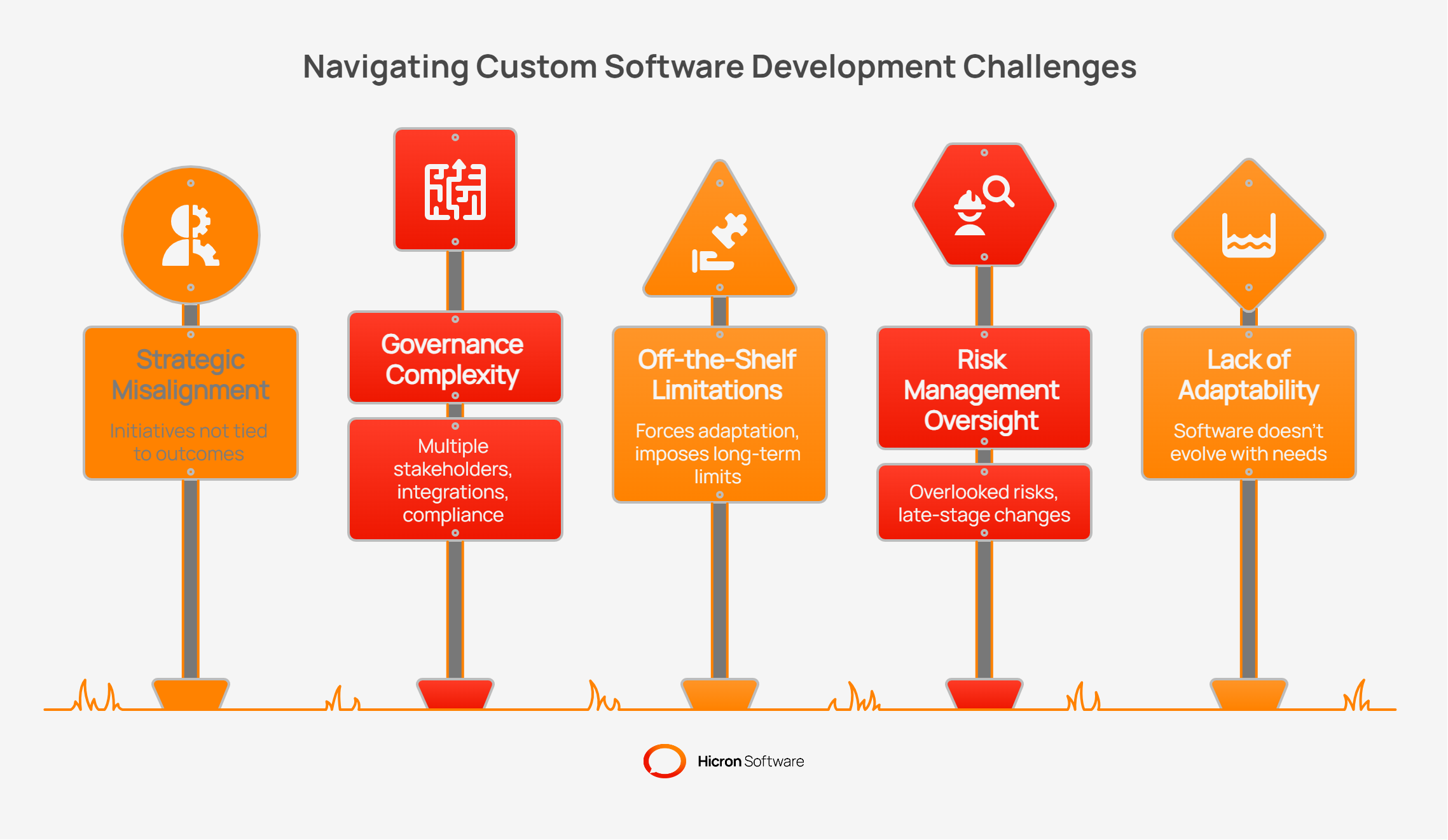
Enterprise software initiatives rarely fail due to a single issue. More often, they collapse under a combination of unclear requirements, weak governance, and overlooked custom enterprise software development risks. For CIOs and IT leaders, understanding the causes of software project failures and applying structured execution are essential to delivering scalable, high-performing solutions in large organizations.
Effective enterprise software project management goes beyond timelines and budgets. It requires aligning business goals with technical execution, embedding risk management in enterprise software development, and proactively addressing custom software implementation challenges that can derail delivery.
A clear, repeatable process is the foundation of successful large organization software delivery:
However, enterprise environments introduce added complexity, requiring stronger governance and planning:
Try defining ownership across product, architecture, QA, and operations to avoid accountability gaps. A proven sequence for reducing custom enterprise software development risks is:
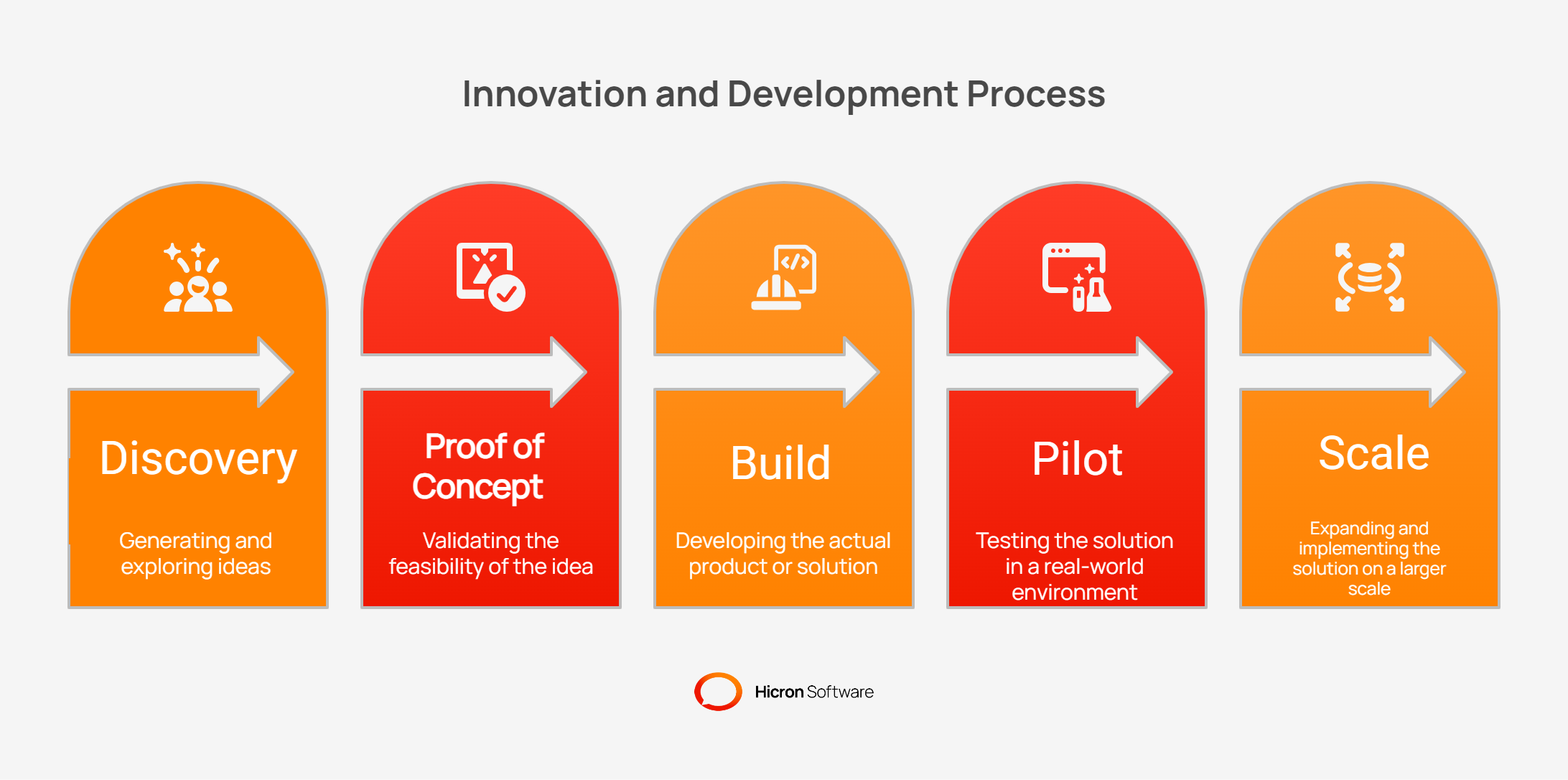
This model ensures that high-risk assumptions are validated early. For example, when developing an internal claims platform, teams should first map workflows and integrations, then prototype the most complex integration point, and only then scale feature delivery across claims intake, approvals, and reporting.
By combining structured execution with strong enterprise software project management and proactive risk management in software development, organizations can significantly reduce software project failure causes and deliver solutions that are scalable, secure, and aligned with long-term business goals.
Protect your investment and line by following this straightforward checklist:
Before you sign any agreements, force potential development partners to prove their competence by asking these direct questions:
Ask for specific case studies where they solved problems matching your current challenges.
Make sure they have a proven method for connecting modern software to older, vital infrastructure without causing costly downtime.
Require them to explain their quality assurance process and how they identify potential bottlenecks early.
Proactive risk management serves as the ultimate safeguard for your custom enterprise software development projects. When you anticipate challenges like scope creep, poor alignment, and technical debt, you protect your budget and your line.
Reach out to Hicron Software to customize the software development process to your needs and ensure sustained benefits!
Hicron Software proved to be a trusted partner with unmatched technical expertise, delivering a scalable and user-friendly web application that was pivotal to our successful U.S. market expansion.

Hicron’s contributions have been vital in making our product ready for commercialization. Their commitment to excellence, innovative solutions, and flexible approach were key factors in our successful collaboration.
I wholeheartedly recommend Hicron to any organization seeking a strategic long-term partnership, reliable and skilled partner for their technological needs.
After carefully evaluating suppliers, we decided to try a new approach and start working with a near-shore software house. Cooperation with Hicron Software House was something different, and it turned out to be a great success that brought added value to our company.
With HICRON’s creative ideas and fresh perspective, we reached a new level of our core platform and achieved our business goals.
Many thanks for what you did so far; we are looking forward to more in future!

Hicron is a partner who has provided excellent software development services. Their talented software engineers have a strong focus on collaboration and quality. They have helped us in achieving our goals across our cloud platforms at a good pace, without compromising on the quality of our services. Our partnership is professional and solution-focused!

The IT system supporting the work of retail outlets is the foundation of our business. The ability to optimize and adapt it to the needs of all entities in the PSA Group is of strategic importance and we consider it a step into the future. This project is a huge challenge: not only for us in terms of organization, but also for our partners – including Hicron – in terms of adapting the system to the needs and business models of PSA. Cooperation with Hicron consultants, taking into account their competences in the field of programming and processes specific to the automotive sector, gave us many reasons to be satisfied.