10 Real Estate Software Development Companies in 2026
- February 03
- 9 min



Commercial vacancy management is the process of monitoring, forecasting, and reducing unoccupied space in a commercial property portfolio. Most organizations track vacancy after it happens.
This article explains what CRE vacancy actually costs, which data signals predict it early, and what purpose-built software should do to shift that process from reactive to planned. It is a practical reference for asset managers, leasing teams, and operations leaders working across office, retail, and mixed-use portfolios. The goal is to cover the full scope: costs, system gaps, early warning signals, commercial real estate software design, and implementation approach.
Key Takeaways
Vacancy management in CRE is the process of monitoring, forecasting, and reducing unoccupied space within a commercial property portfolio. It covers processes from tracking current lease status to anticipating future gaps in occupancy. It also coordinates the actions needed to fill those gaps before they affect financial performance.
In practice, this process spans multiple teams. Asset managers track portfolio-level performance. Leasing teams engage new and existing tenants. Operations staff manage the physical condition of spaces during and between tenancies.
The challenge is that these teams often work from different systems, different reports, and different timelines.
What most organizations call vacancy management is closer to vacancy monitoring. It is a periodic review of what is already empty, rather than a forward-looking process designed to prevent it. True vacancy management begins before a space becomes vacant. It relies on data analysis, early warning signals, and coordinated action across teams.
The financial impact of CRE vacancy extends well beyond lost rent. Understanding the full cost picture is the first step toward treating vacancy as a dedicated risk category.
An empty unit generates no income. For a large shopping center, even a modest increase in vacancy rate translates into notable monthly revenue loss.
Operating costs are distributed across tenants based on occupied floor area. These costs include cleaning, security, utilities, and building maintenance. When a unit sits empty, those costs fall to the property owner. The larger the vacancy, the greater the share of unrecoverable operating expenses.
A known vacancy problem shifts the negotiating position. Prospective tenants understand this. Landlords with high vacancy rates often offer:
These concessions directly reduce the effective yield of a new lease.
In certain lease structures, prolonged vacancy in key locations can trigger compensation clauses. If a high-profile tenant departs and foot traffic declines, nearby tenants may have contractual grounds to seek rent relief.
One departure, particularly from an anchor tenant, can accelerate the performance decline of surrounding tenants. This cascade dynamic produces several outcomes:
Despite the financial stakes, most commercial real estate organizations remain in a reactive position when it comes to vacancy. The reasons are structural.
Standard property management and ERP systems are well-designed for recording and processing lease contracts. They handle complex rent calculation methodologies, including turnover-based rents, rent indexation tied to inflation benchmarks, and operating cost recoveries. They maintain master data on buildings, floors, and individual units. They generate billing and financial reporting with a high degree of accuracy.
Managing hundreds of tenants across a portfolio of shopping centers, office buildings, and mixed-use properties requires a solid contract management backbone. Established systems provide exactly that.
The gap lies in prediction. Current systems record past events and active contracts. Current systems do not:
The result is that leasing teams typically learn about upcoming vacancies when a non-renewal notice arrives. At that point, the options for responding are already narrowed.
A lease expiry date tells when a contract ends. It does not tell whether the tenant is likely to renew. That probability depends on factors outside the contract: how the tenant is performing financially, whether foot traffic in their zone is declining, and whether any payment concerns have been raised recently. Lease data is a necessary input, but it is insufficient on its own.
A reactive process begins when a vacancy is confirmed or imminent. A predictive process begins months earlier, when data suggests that a vacancy is probable. A team with six to twelve months of lead time can run a proactive leasing campaign, offer targeted retention incentives, and plan any necessary refurbishment. A team with four weeks of lead time is managing a crisis.
The information needed to predict vacancy is often already present within or adjacent to existing systems. The challenge is that it sits in different places and is rarely analyzed together.
|
Signal |
Source |
Predictive Value |
|
Lease expiry and renewal windows |
Contract management system |
Identifies units at risk by quarter |
|
Declining tenant turnover |
Tenant sales reports |
Flags financial stress before lease events |
|
Payment irregularities |
Financial systems |
Early indicator of non-renewal or departure |
|
Foot traffic and sensor data |
Building sensors |
Reveals structurally underperforming zones |
|
Maintenance patterns |
Operations systems |
Correlates disruption with renewal risk |
The most direct signal is also the most frequently underused. Every lease has an expiry date, and most leases include option windows during which tenants elect to renew or provide notice of departure. When those windows are tracked across a portfolio, they create a forward-looking picture of which units are at risk each quarter.
The gap in most organizations is that this data exists in the contract management system but is not translated into a dynamic, prioritized risk view. A lease expiring in nine months may appear in a standard report, but it does not automatically trigger a workflow without active monitoring.
In retail environments, many leases require tenants to report monthly sales figures. This data has historically been used for turnover-based rent calculations. Its predictive value is often overlooked.
A tenant whose reported turnover is declining quarter over quarter is showing early signs of financial stress. That stress increases the probability of non-renewal or early departure. Analyzed across a portfolio, turnover data provides a tenant-level risk signal well before any formal lease event occurs.
Tenants who begin missing payments, requesting deferrals, or negotiating informally about rent levels are providing another early signal. This data exists within financial systems but is rarely integrated with lease management or leasing pipeline views. When payment behavior is connected to lease status, it adds a meaningful dimension to the risk picture.
Modern commercial properties, particularly shopping centers, generate large volumes of occupancy and movement data from sensors installed throughout the building. Entrance counts, elevator usage, escalator activity, and zone-level traffic patterns all reflect how different parts of a property are performing.
A retail unit in a low-traffic zone is structurally disadvantaged. A tenant in that zone with declining sales and an upcoming lease expiry represents a concentrated vacancy risk. Connecting these data points creates a richer picture of where the portfolio is exposed.
A pattern of maintenance requests from a specific tenant or unit can also indicate underlying issues. Frequent disruptions affect tenant satisfaction and may correlate with an intention not to renew. Operations data is rarely connected to leasing decision systems, but it carries relevant signal when viewed alongside other risk factors.
A purpose-built vacancy management solution addresses the gaps described above. It does not replace the contract management or financial processing capabilities of existing systems. It adds a layer of intelligence on top of them.
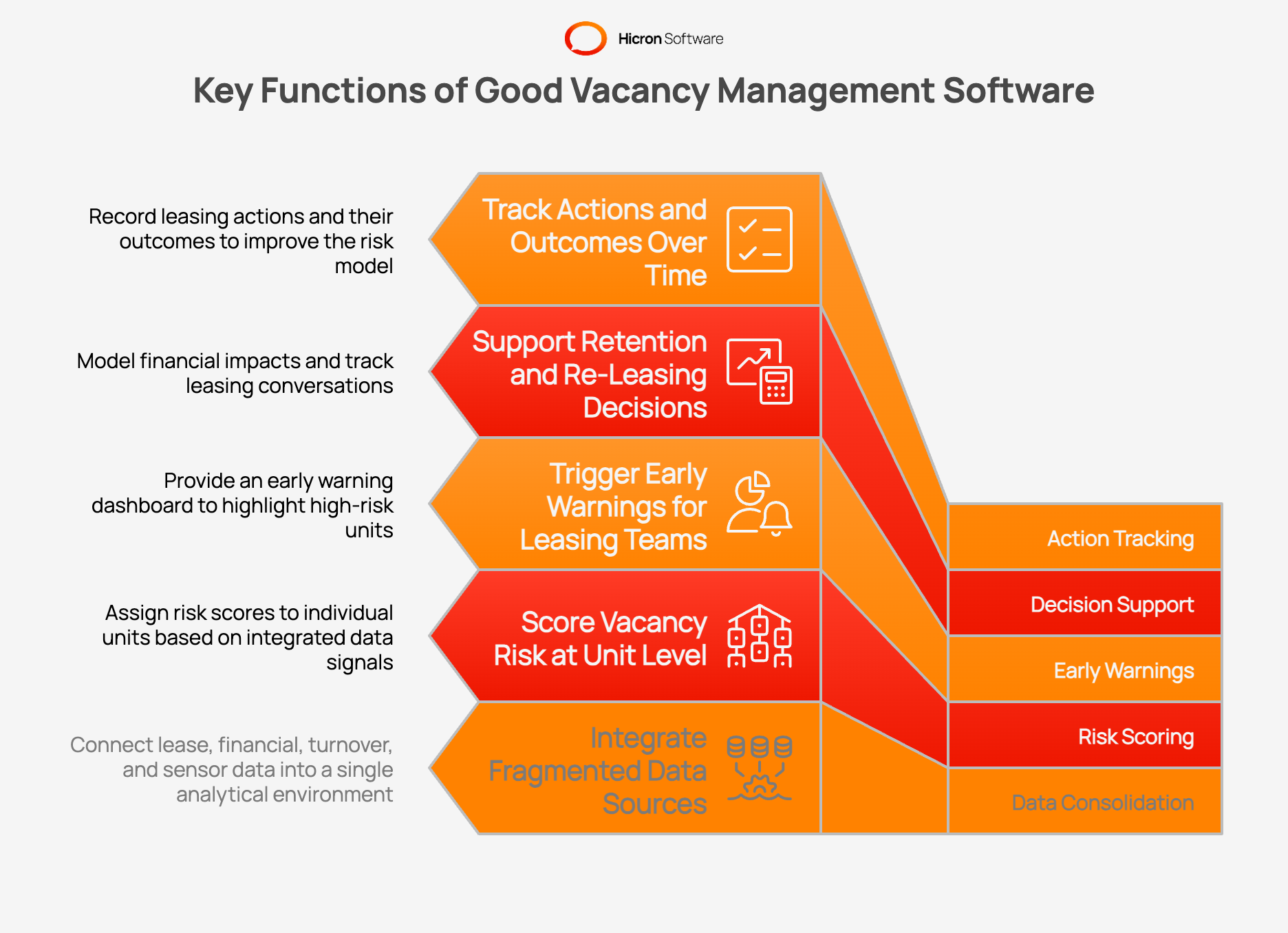
The first function is connectivity. Lease data from the contract management system, financial data from accounts receivable, turnover reports from tenant submissions, and sensor data from building management infrastructure all need to flow into a single analytical environment. This requires well-defined data pipelines that keep the vacancy management layer current.
With integrated data in place, a risk model assigns scores to individual units based on the combination of signals available. The model weights different factors according to their predictive relevance. A lease expiring in 90 days with declining turnover and a recent missed payment scores very differently from a lease expiring in 90 days with stable sales and a consistent payment history.
Risk scores are only useful when surfaced to the right people at the right time. A well-designed vacancy management tool provides an early warning dashboard that presents high-risk units clearly. It allows managers to drill into the underlying signals and tracks changes in risk status over time. This dashboard serves both operational and strategic functions.
Vacancy management software supports the decisions that follow. This includes modeling the financial impact of different scenarios, such as offering a rent-free period to retain an at-risk tenant versus allowing the lease to expire and re-letting at market rates. It also includes tracking the status of active leasing conversations and connecting outreach activity to the underlying risk view.
Closing the loop is essential for improving the model over time. When a leasing action is taken, the system tracks the outcome: whether the lease was renewed, at what terms, and how long the re-letting process took. This data feeds back into the risk model, improving its accuracy with each cycle.
Translating the components described above into an operational process requires deliberate design. The following stages reflect how a mature vacancy management workflow functions in practice.
Step 1: Data Integration
Connect lease data, financial data, tenant turnover reports, and sensor data into a unified analytical environment. Define clear data pipelines to keep information current across sources.
Step 2: Risk Scoring at Unit Level
Apply a risk model that scores individual units based on the combination of available signals. Configure weighting based on asset type and portfolio characteristics.
Step 3: Alerts and Escalation
Route high-risk unit alerts to the appropriate team members based on property, geography, or role. Configure alert thresholds to match the needs of different stakeholder groups.
Step 4: Action Recommendations
Surface recommended responses alongside risk alerts. These may include initiating a retention conversation, launching a proactive marketing campaign, commissioning a condition assessment, or flagging the unit for financial forecasting.
Step 5: Outcome Monitoring and Model Improvement
Track the results of leasing actions and feed that data back into the risk model. Each completed cycle improves the accuracy of future predictions.
One practical barrier to adopting dedicated vacancy management software in commercial real estate is the assumption that it requires a large-scale system replacement. In most cases, that assumption is incorrect.
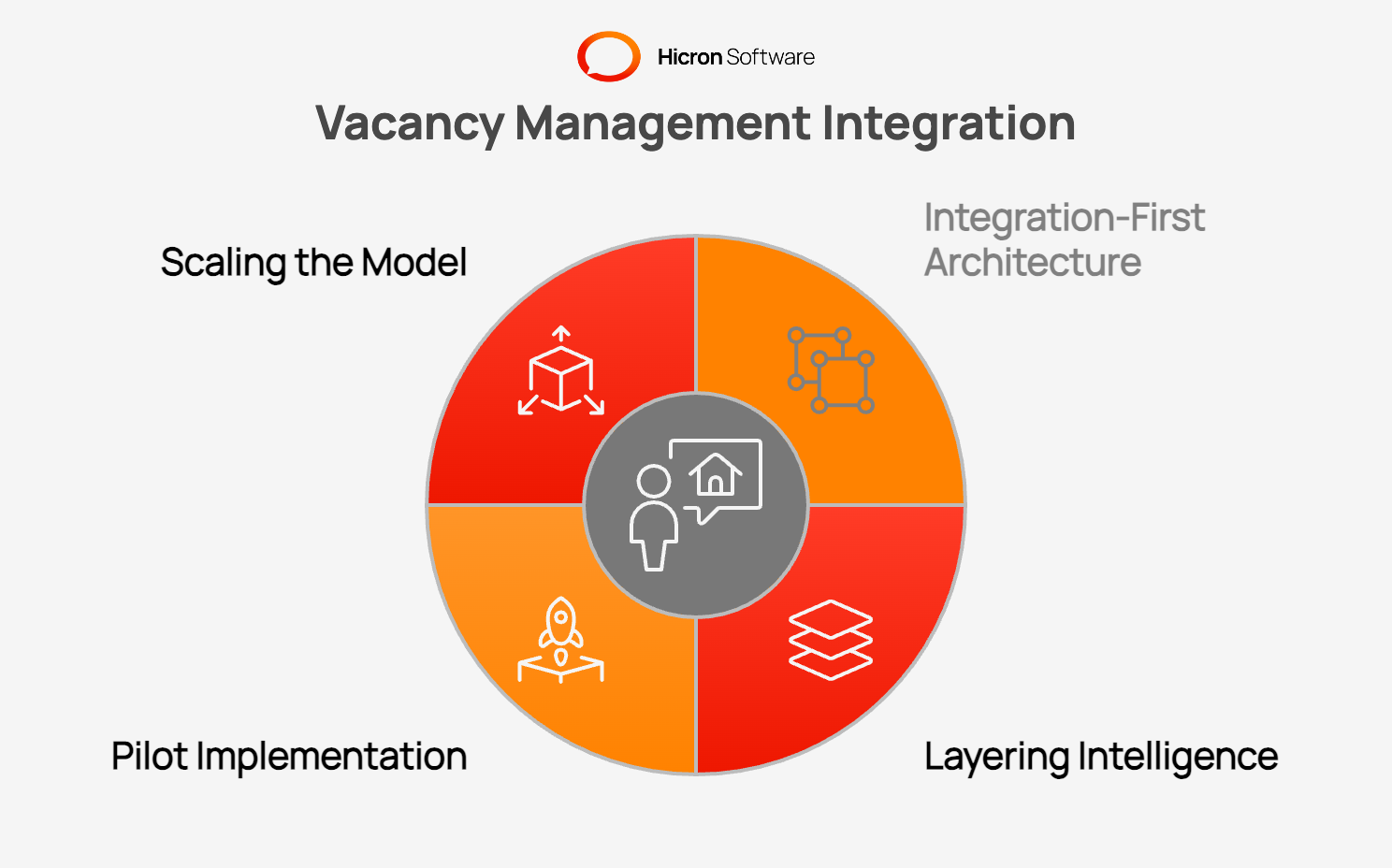
A well-designed vacancy management solution connects to existing infrastructure through APIs and data feeds. The contract management system continues to be the record of truth for lease data. Financial systems continue to handle billing and payment processing. The vacancy management layer reads from these systems, applies analytics, and surfaces insights through its own interface.
The goal is not to rebuild what already works. It is to add the predictive capability that contract management systems were never designed to provide. The new layer is additive, not disruptive. Existing workflows and system investments are preserved.
Implementation does not need to be portfolio-wide from day one. A phased approach, starting with the properties where vacancy risk is highest or where data availability is strongest, allows teams to validate the system and build confidence before broader rollout. This also creates internal case studies that support adoption across the organization.
A vacancy management solution designed for scale accommodates portfolio growth without requiring re-implementation. Data models that support multiple property types, flexible risk scoring configurations, and modular dashboards are the markers of a scalable architecture. New data sources can be added as they become available.
Not every organization needs a dedicated vacancy management layer. The decision depends on portfolio scale, data maturity, and the complexity of the problem being solved.
Vacancy management sits at the intersection of asset management, leasing, and finance. Effective implementation requires coordination between these functions.
Asset managers need portfolio-level visibility into vacancy risk and its financial implications. Leasing teams need unit-level alerts and decision support to prioritize outreach. Finance teams need accurate forecasting inputs that reflect the probability of future vacancies. Operations teams contribute data about maintenance patterns and physical condition.
No single function owns the full picture. Ownership of the vacancy management process works best when treated as a cross-functional responsibility. The tools in a dedicated system are most useful when they surface information to all relevant groups in a format suited to their respective roles.
Vacancy will always be a feature of commercial real estate. The question is whether organizations respond to it or anticipate it. The data needed to act early is already being generated in most portfolios. What has been missing is the layer that connects it, analyzes it, and surfaces it as actionable insight.
A practical starting point is a structured assessment of current data availability. This means understanding
That assessment determines what is achievable in a first phase and what integration work is needed to get there.
For organizations evaluating options for building a dedicated vacancy management solution that fits existing infrastructure and operational models, our team is open to that conversation.
Commercial vacancy management is the process of monitoring, forecasting, and reducing unoccupied space within a commercial property portfolio. It covers current occupancy tracking, forward-looking risk assessment, and coordinated leasing and retention activity.
No. A well-designed vacancy management solution integrates with existing property management and financial systems through APIs and data feeds. It reads from those systems and adds an analytical layer on top, without disrupting current workflows.
Lease tracking records what is contractually in place. Vacancy management analyzes patterns across lease data, tenant performance indicators, and operational signals to estimate the probability of future vacancies before they are confirmed. The two processes use different data and serve different purposes.
Cascade risk refers to the dynamic in which one significant vacancy triggers declining performance among neighboring tenants. This is particularly relevant in retail environments, where anchor tenant departures reduce foot traffic and can lead to further non-renewals or rent relief claims from surrounding tenants.
The most commonly used sources are lease expiry timelines and option windows from contract management systems, tenant turnover and sales reports, payment history from accounts receivable, and foot traffic data from building sensors. The predictive value increases when these sources are analyzed together rather than in isolation.
Hicron Software proved to be a trusted partner with unmatched technical expertise, delivering a scalable and user-friendly web application that was pivotal to our successful U.S. market expansion.

Hicron’s contributions have been vital in making our product ready for commercialization. Their commitment to excellence, innovative solutions, and flexible approach were key factors in our successful collaboration.
I wholeheartedly recommend Hicron to any organization seeking a strategic long-term partnership, reliable and skilled partner for their technological needs.

After carefully evaluating suppliers, we decided to try a new approach and start working with a near-shore software house. Cooperation with Hicron Software House was something different, and it turned out to be a great success that brought added value to our company.
With HICRON’s creative ideas and fresh perspective, we reached a new level of our core platform and achieved our business goals.
Many thanks for what you did so far; we are looking forward to more in future!

Hicron is a partner who has provided excellent software development services. Their talented software engineers have a strong focus on collaboration and quality. They have helped us in achieving our goals across our cloud platforms at a good pace, without compromising on the quality of our services. Our partnership is professional and solution-focused!

The IT system supporting the work of retail outlets is the foundation of our business. The ability to optimize and adapt it to the needs of all entities in the PSA Group is of strategic importance and we consider it a step into the future. This project is a huge challenge: not only for us in terms of organization, but also for our partners – including Hicron – in terms of adapting the system to the needs and business models of PSA. Cooperation with Hicron consultants, taking into account their competences in the field of programming and processes specific to the automotive sector, gave us many reasons to be satisfied.