10 Real Estate Software Development Companies in 2026
- February 03
- 9 min



Property management and facility management integration is the practice of connecting the system that manages leases and billing to the system that manages maintenance and technical cost, so an event on one side updates the other automatically.
A commercial portfolio runs two systems that never exchange data automatically. One holds leases, tenants, and billing. The other holds work orders, repair costs, and maintenance schedules. Property management and facility management integration connects those two records, so a repair or a fault report updates both sides without anyone re-typing it. Most portfolios never build that connection. The gap then shows up as three costs: repairs billed to the wrong party, maintenance scheduled on a calendar instead of actual usage, and capital decisions made without repair history. This article maps that gap, its cost, and when closing it pays off.
Key Takeaways
A property management system holds the commercial side of a building: lease terms, tenant contracts, cost allocation rules, service charge schedules, and rent rolls. A facility management system holds the technical side: work orders, fault history, contractor visits, preventive maintenance schedules, and utility or energy readings. Each system answers a different question about the same asset, and each does it well on its own.
The problem sits in the handoff between them. Two events illustrate what should cross from one system to the other, and typically does not.
|
Event |
What the FM system records |
What the PM system needs |
Whether it usually flows automatically |
|
Equipment fault or repair |
Fault type, response time, parts and labor cost, technician notes |
Which lease or cost center the repair cost belongs to, so it can be billed or allocated correctly |
No, usually a manual export or a spreadsheet |
|
Planned maintenance or inspection |
Scheduled date, area affected, expected access restriction |
Which tenants are affected, so notices go out ahead of the work |
No, usually a separate email or notice process |
|
Recurring fault pattern |
Frequency and cost of repairs on a specific asset, such as a lift or a chiller |
Repair history to support a capital replacement decision |
Rarely, usually reconstructed manually before a budget cycle |
|
Utility and energy consumption |
Metered usage by building, floor, or unit |
Data for tenant recharge and for ESG or sustainability reporting |
Rarely, usually collected on request rather than fed continuously |
Every row in that table describes a piece of information that already exists in one system and would change a decision in the other. The connection between the two rarely gets built as part of implementing either system. Each one gets specified, procured, and rolled out to solve its own problem, and nobody in that process owns the handoff between them.
Running property management and facility management as two unconnected systems is common, and it is rarely a deliberate decision. It produces three recurring costs once a portfolio operates at any meaningful scale.
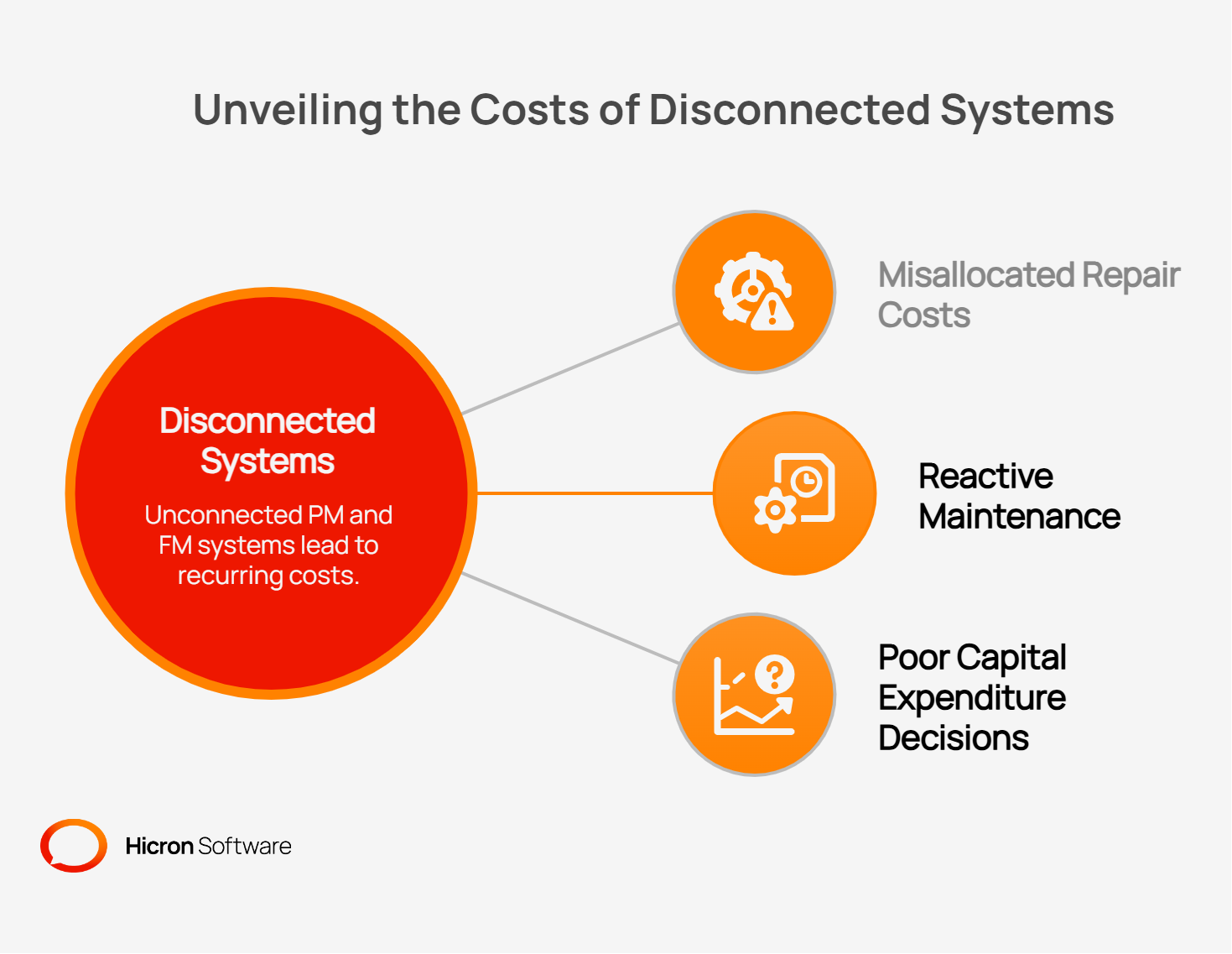
None of these three costs requires a large portfolio to become visible. A single lift with an unflagged fault history, or a single tenant billed months late for a repair, produces a dispute. That dispute erodes trust well before the underlying pattern gets noticed and fixed.
The clearest way to see what integration changes is to follow a single event through both a disconnected setup and a connected one. Start with a tenant reporting a faulty lift.
In a disconnected setup, steps four and five depend on someone remembering to check the lease terms. That means matching the work order to the right cost center by hand, then re-entering the amount into the billing system before the cycle closes. Every one of those manual handoffs is a place where a repair cost gets delayed, misallocated, or dropped.
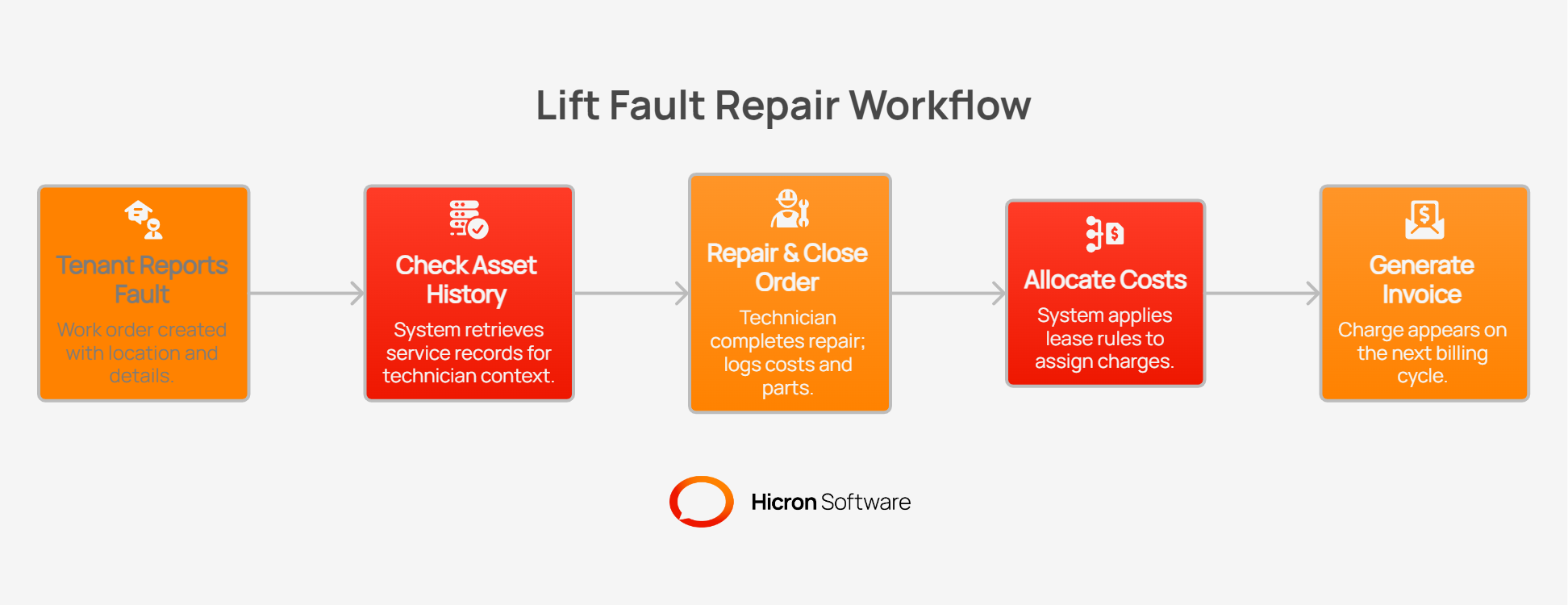
A technician still shows up and fixes the lift either way, connected system or not. What changes is the record. How much of that repair’s history survives the trip from one system to the other decides whether the next work order starts with context, or without it.
Facility management systems already generate part of the data that ESG reporting asks for. That includes energy consumption by building or unit, utility usage, and, in some systems, an emissions estimate calculated from that consumption. Property management systems generate the other portion: which tenants occupy which space, at what square footage, and under what terms.
An ESG report that covers energy intensity per square meter, or emissions attributed to a specific tenant’s footprint, needs both halves at once. Where the two systems are not connected, someone assembles that report by hand. Figures get exported from each system separately and joined together, usually once a year, ahead of a reporting deadline. Where the systems are connected, the same figures flow continuously. A portfolio can then report at the frequency its ESG commitments require, not the frequency its manual process can sustain.
For a portfolio with active ESG commitments, this connection turns facility management data from an operational record into a compliance input. That reframing tends to make the case for integration to stakeholders who were not persuaded by repair cost allocation or maintenance scheduling on their own.
Not every portfolio needs a full integration between the two systems. A single office building with a handful of leases and a small maintenance workload can run on a loose connection: a monthly export, a shared spreadsheet, a person who checks both systems as part of a routine. The manual step never grows into a bottleneck at that scale.
A fifteen-property portfolio looks different. Hundreds of monthly service requests, dozens of lease-specific cost allocation rules, and a capital planning cycle that depends on repair history push manual reconciliation into a full-time job, or a source of errors large enough to matter. Three factors tend to signal that the threshold has been crossed.
Below that threshold, the cost of building and maintaining an integration can exceed what the silo actually costs in misallocated charges and manual hours. Above it, the reverse holds, and the gap between the two systems becomes the more expensive option to leave in place. The portfolios that benefit most are not necessarily the largest ones by square footage. They are the ones where maintenance activity, lease complexity, and capital planning already depend on data. That data currently lives in two places that do not talk to each other.
Property management and facility management integration connects the system that manages leases, tenants, and billing to the system that manages maintenance, work orders, and technical cost, for the same building or portfolio. It lets an event recorded in one system, such as a repair, update the other automatically, without someone re-entering the same information twice.
Not every portfolio does. A small building with a light maintenance workload can manage a loose, manual connection without it becoming a bottleneck. Larger portfolios differ. High service request volume, many non-standard cost allocation rules, or capital planning that depends on repair history push the cost of the manual gap past the cost of building the integration.
Facility management systems generate energy, utility, and emissions data, while property management systems hold tenant and space information. ESG reporting that covers energy intensity or emissions by tenant needs both. Without integration, that report gets assembled manually from two exports. With integration, the same figures flow continuously and support reporting at a higher frequency and a finer level of detail.
A disconnected setup produces three recurring costs. Repair costs get misallocated or billed late because someone has to match a work order to a lease manually. Maintenance gets scheduled reactively, on a fixed calendar, instead of around actual building usage. Capital expenditure decisions get made without the repair history that would show how often, and how expensively, an asset has already failed.
Repair and fault costs should reach the property management system so they can be allocated to the correct lease or cost center. Planned maintenance schedules should reach tenants who will be affected by access restrictions. Recurring fault history should reach whoever approves capital expenditure. Utility and energy data should reach both tenant recharge processes and ESG reporting.
Hicron Software proved to be a trusted partner with unmatched technical expertise, delivering a scalable and user-friendly web application that was pivotal to our successful U.S. market expansion.

Hicron’s contributions have been vital in making our product ready for commercialization. Their commitment to excellence, innovative solutions, and flexible approach were key factors in our successful collaboration.
I wholeheartedly recommend Hicron to any organization seeking a strategic long-term partnership, reliable and skilled partner for their technological needs.

After carefully evaluating suppliers, we decided to try a new approach and start working with a near-shore software house. Cooperation with Hicron Software House was something different, and it turned out to be a great success that brought added value to our company.
With HICRON’s creative ideas and fresh perspective, we reached a new level of our core platform and achieved our business goals.
Many thanks for what you did so far; we are looking forward to more in future!

Hicron is a partner who has provided excellent software development services. Their talented software engineers have a strong focus on collaboration and quality. They have helped us in achieving our goals across our cloud platforms at a good pace, without compromising on the quality of our services. Our partnership is professional and solution-focused!

The IT system supporting the work of retail outlets is the foundation of our business. The ability to optimize and adapt it to the needs of all entities in the PSA Group is of strategic importance and we consider it a step into the future. This project is a huge challenge: not only for us in terms of organization, but also for our partners – including Hicron – in terms of adapting the system to the needs and business models of PSA. Cooperation with Hicron consultants, taking into account their competences in the field of programming and processes specific to the automotive sector, gave us many reasons to be satisfied.