10 Real Estate Software Development Companies in 2026
- February 03
- 9 min



Tenant financial health monitoring is the practice of combining payment, turnover, and lease renewal data a property management system already stores into an early signal of a commercial tenant’s financial distress, months before a missed rent payment.
An asset manager usually learns a tenant is in financial trouble when the rent payment does not arrive. At that point, a decision has to be made under pressure, pursue collections or negotiate relief, with little time to weigh the tenant’s real situation. Turnover reports, payment patterns, and renewal behavior typically signal distress months earlier, recorded inside the property management and finance systems a portfolio already runs. External signals, from utility usage to public workforce announcements, add confirmation. This article maps those signals, the cost of waiting for a missed payment, and what tenant health adds to an NOI forecast.
Key Takeaways
Two paths open once a rent payment fails to arrive. An asset manager can pursue collections, or negotiate a form of relief. Both carry a real price, and neither price is fixed. It moves depending on how much time exists to choose.
Collections brings legal fees, the time cost of a recovery process that often runs months, and the risk that the process ends in a vacant unit rather than a paying tenant. It also carries a relationship cost inside a network of tenants who watch how a landlord handles distress. Negotiated relief avoids that immediate confrontation. A rent reduction, a deferral, or a restructured payment schedule keeps the tenant in place and preserves occupancy. The cost shows up as reduced revenue over the relief period, and as the risk of granting terms the tenant still cannot sustain.
Neither option is inherently cheaper. The variable that moves the price is timing.
|
Decision path |
Cost when decided with lead time |
Cost when decided at the point of default |
|
Collections or enforcement |
Planned legal process, marketing for the unit starts before filing |
Rushed filing, unplanned vacancy, legal fees paid to accelerate the process |
|
Negotiated relief |
Terms sized against a verified ability to pay, phased over several quarters |
Concessions granted under pressure, often insufficient, raising the odds of a second default |
|
Portfolio reporting |
NOI impact modeled and flagged to the investment committee in advance |
NOI impact discovered in the same reporting cycle as the default itself |
A negotiated deal signed with four months of runway looks at the tenant’s turnover trend, prior payment behavior, and stated recovery plan. The same deal signed the week rent goes unpaid runs on incomplete information and a shorter fuse, which is exactly why it fails more often.
A commercial tenant rarely moves from healthy to delinquent in a single reporting period. Several signals typically build first, and they differ in how easy they are to reach inside the systems a portfolio already runs.
No single signal on that list settles the question by itself. A quiet quarter can reflect a seasonal dip rather than distress, and a late payment can reflect an administrative delay rather than a cash problem. The pattern becomes trustworthy once two or three of these signals move in the same direction for the same tenant over a sustained period.
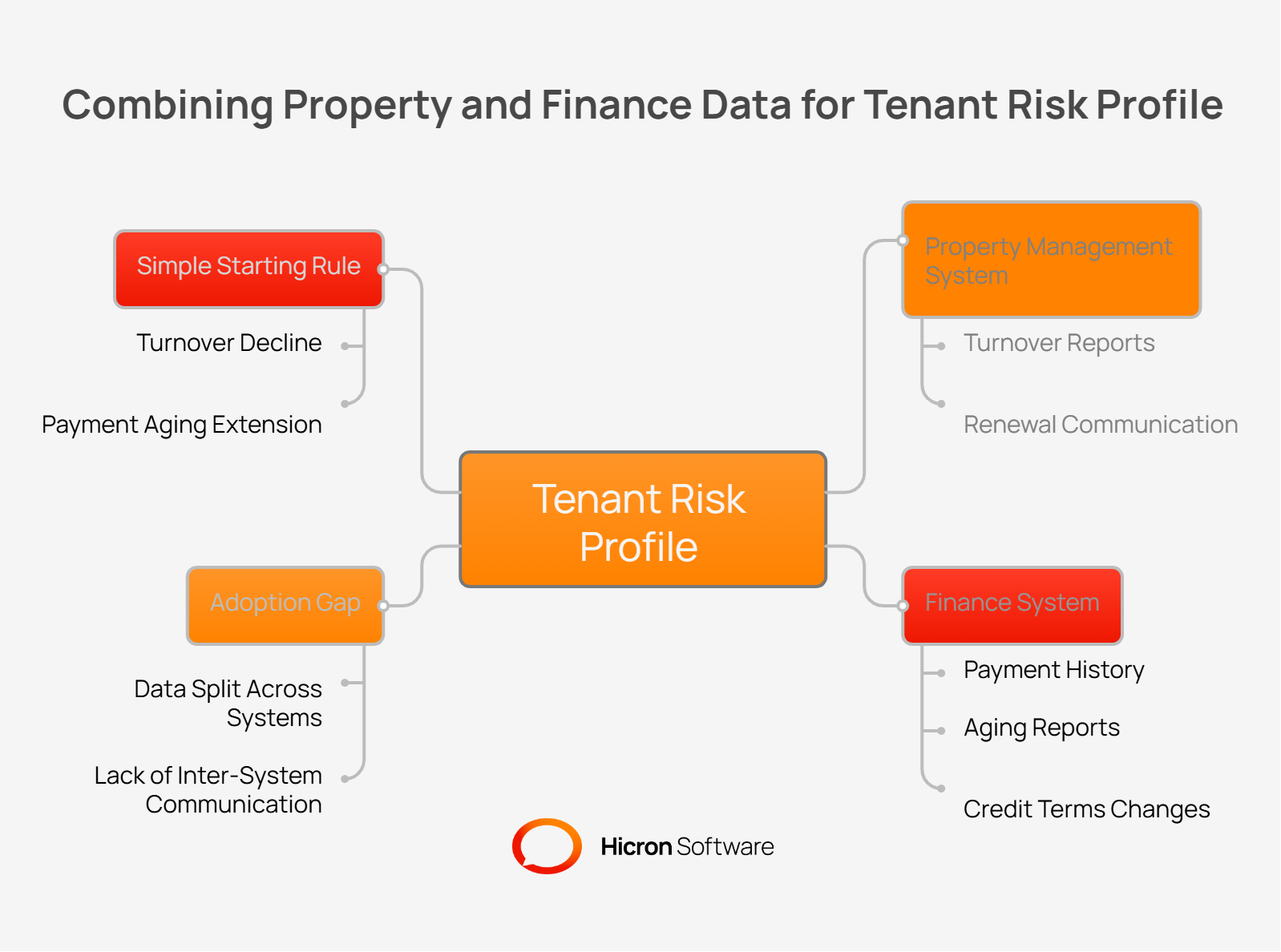
The signals above rarely sit in one place. Turnover reports and renewal communication usually live in the property management system, owned by a leasing team. Payment history, aging reports, and any credit terms changes usually live in a finance or ERP system, owned by an accounts receivable team. Each side sees half of the picture and rarely compares notes on the same tenant at the same time.
A tenant risk profile joins both halves for the same lease over the same timeline. Turnover trend, payment aging, and renewal status combine into a single view that neither the leasing team nor the finance team produces alone.
This gap is a version of the adoption gap that runs through every mature property management system: the data needed for a decision already exists, split across systems that were never asked to talk to each other. Closing it means pulling turnover, payment, and renewal records for the same tenant identifier into one profile, refreshed on a schedule finance and leasing both trust, rather than commissioning a new data source.
A simple starting rule works before any statistical model does. Flag a tenant when turnover declines for two consecutive periods and payment aging extends past its usual pattern for the same tenant. That combination alone surfaces tenants heading toward distress, long before a missed payment forces a decision.
A single tenant’s risk score matters for one lease. Rolled up across a portfolio, the same scores become an input to a twelve-month NOI forecast rather than a tool for managing one relationship at a time.
Four steps connect a tenant-level score to a portfolio-level number.
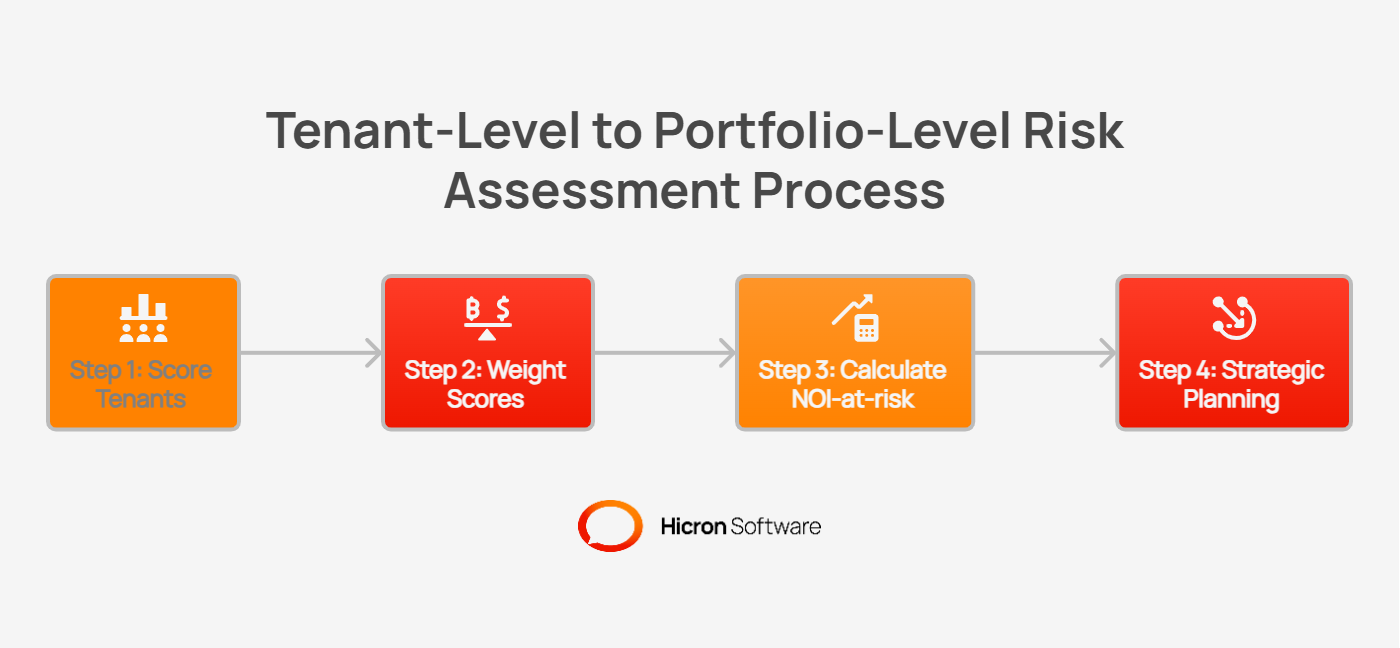
A portfolio running this way reports a NOI forecast with a stated risk band attached, rather than a single number that gets revised downward the same month a tenant defaults.
An asset manager who waits for a missed payment functions as a contract enforcer. The system tells them a default occurred, and the response, collections or a hurried negotiation, follows the same reactive pattern every time.
Reading turnover, payment, and renewal signals together shifts that role toward portfolio risk management. The asset manager decides which lever to pull, and when, while a tenant still has options and the portfolio still has choices about timing.
That shift changes the conversation with a struggling tenant as much as it changes the internal process. A manager who raises a renewal or restructuring conversation four months ahead of trouble arrives as a partner assessing a shared problem. A manager who calls the day after a missed payment arrives as a collector. The data available to build that lead time already sits inside the systems a portfolio runs. The remaining work is deciding to read it before the payment date forces the question.
Turnover decline and payment pattern shifts typically appear several months before a missed rent payment, though the exact window varies by lease terms, sector, and how closely a portfolio tracks its own reports. Renewal silence tends to appear closer to the tenant’s lease expiry date.
The most accessible signals are a decline in reported turnover where the lease includes a turnover clause, a shift toward smaller or later rent payments, and silence from the tenant as a lease renewal window opens. Footfall decline and external signals such as corporate registry filings add further confirmation where available.
Tenant risk scores, weighted by each lease’s share of portfolio rent, roll up into a single NOI-at-risk figure that can be tracked alongside occupancy and collections metrics. That figure lets a forecast carry a stated risk band instead of a number that gets revised only after a tenant defaults.
No. Credit scoring typically draws on external financial statements and credit bureau data that a landlord rarely has direct access to for a private tenant. Tenant health monitoring works from operational and payment data a property management and finance system already hold, without requiring the tenant’s own financial disclosures.
The core inputs are turnover reports, payment and aging history, and lease renewal status, all of which most property management and finance systems already store. Footfall sensor data and external sources, such as corporate registry filings or utility usage, add further signal where a portfolio has access to them.
Hicron Software proved to be a trusted partner with unmatched technical expertise, delivering a scalable and user-friendly web application that was pivotal to our successful U.S. market expansion.

Hicron’s contributions have been vital in making our product ready for commercialization. Their commitment to excellence, innovative solutions, and flexible approach were key factors in our successful collaboration.
I wholeheartedly recommend Hicron to any organization seeking a strategic long-term partnership, reliable and skilled partner for their technological needs.

After carefully evaluating suppliers, we decided to try a new approach and start working with a near-shore software house. Cooperation with Hicron Software House was something different, and it turned out to be a great success that brought added value to our company.
With HICRON’s creative ideas and fresh perspective, we reached a new level of our core platform and achieved our business goals.
Many thanks for what you did so far; we are looking forward to more in future!

Hicron is a partner who has provided excellent software development services. Their talented software engineers have a strong focus on collaboration and quality. They have helped us in achieving our goals across our cloud platforms at a good pace, without compromising on the quality of our services. Our partnership is professional and solution-focused!

The IT system supporting the work of retail outlets is the foundation of our business. The ability to optimize and adapt it to the needs of all entities in the PSA Group is of strategic importance and we consider it a step into the future. This project is a huge challenge: not only for us in terms of organization, but also for our partners – including Hicron – in terms of adapting the system to the needs and business models of PSA. Cooperation with Hicron consultants, taking into account their competences in the field of programming and processes specific to the automotive sector, gave us many reasons to be satisfied.