10 Real Estate Software Development Companies in 2026
- February 03
- 9 min



Non-standard lease clauses are negotiated terms, such as indexation exclusions or custom cost allocation keys, that deviate from a portfolio’s standard lease template. They typically exist only as text in a signed contract, not as a rule inside the property management system.
A shopping center running two hundred leases treats its standard contract as a starting point, not a rule. Strong tenants, anchor stores and national chains, negotiate indexation exclusions, custom cost allocation keys, and altered notice periods. Each exception gets signed, filed, and remembered only by whoever negotiated it. The gap surfaces during a mass rent indexation across every lease. A meaningful share of tenants turn out to carry terms the system never recorded. This article maps why exceptions multiply, which cause the most damage, and how AI-assisted contract intake catches them before an invoice goes out wrong.
Key Takeaways
A standard lease template exists for a reason. It sets a baseline for indexation, cost allocation, notice periods, and renewal terms that a leasing team can offer without renegotiating from scratch. In practice, two forces push individual leases away from that baseline almost every time a deal gets signed.
Neither force is a sign of weak CRE lease management. A portfolio manager reading pushback from a strong tenant as a failure to enforce the standard template misreads the negotiation entirely. The realistic goal is tracking which exceptions exist, and where, not preventing them from happening. That second requirement is where most portfolios fall short. A ten-year-old shopping center with two hundred leases has typically accumulated exceptions across years of separate negotiations. Each one was handled by a different leasing manager, some of whom no longer work for the company. The number of exceptions tracks portfolio age and tenant mix, and it rarely moves in the other direction.
Not every deviation from the standard template carries the same weight. Four types account for most of the financial and legal exposure that shows up once a portfolio operates at scale.
|
Exception type |
What it changes |
Where it typically fails |
|
Indexation exclusion |
Tenant is exempt from annual rent indexation for a fixed period, often the first two or three years of the lease |
Missed during a mass indexation run across hundreds of leases, tenant is billed the standard increase |
|
Custom cost allocation key |
Tenant pays operating costs on a different formula than floor area or standard percentage, negotiated for a large or anchor unit |
Invoicing runs on the default formula, producing a bill the tenant is contractually entitled to dispute |
|
Altered notice period or renewal option |
Tenant has a longer or shorter termination notice window, or an option to extend on pre-agreed terms |
Deadline passes unflagged, triggering an automatic renewal or a termination window the landlord did not intend to open |
|
Rent increase cap |
Annual increase is capped below the standard indexation formula, regardless of the index’s actual movement |
System calculates the standard increase and invoices above the contractual cap |
Each row in that table describes a clause that reads clearly on the page it was signed on. The risk appears once the lease stops being read individually. It gets processed instead as part of a batch, alongside hundreds of others that follow the standard formula.
An indexation exclusion is the clearest example. A tenant negotiates three years free of indexation as part of a difficult lease-up, the clause gets signed, and the file gets archived. Three years later, a portfolio-wide indexation run touches every active lease at once. Unless someone remembers, or a system flags, that specific tenant’s exclusion window, the increase goes out anyway.
A clause that exists only in a signed PDF creates risk in three distinct ways, each tied to a different kind of event.
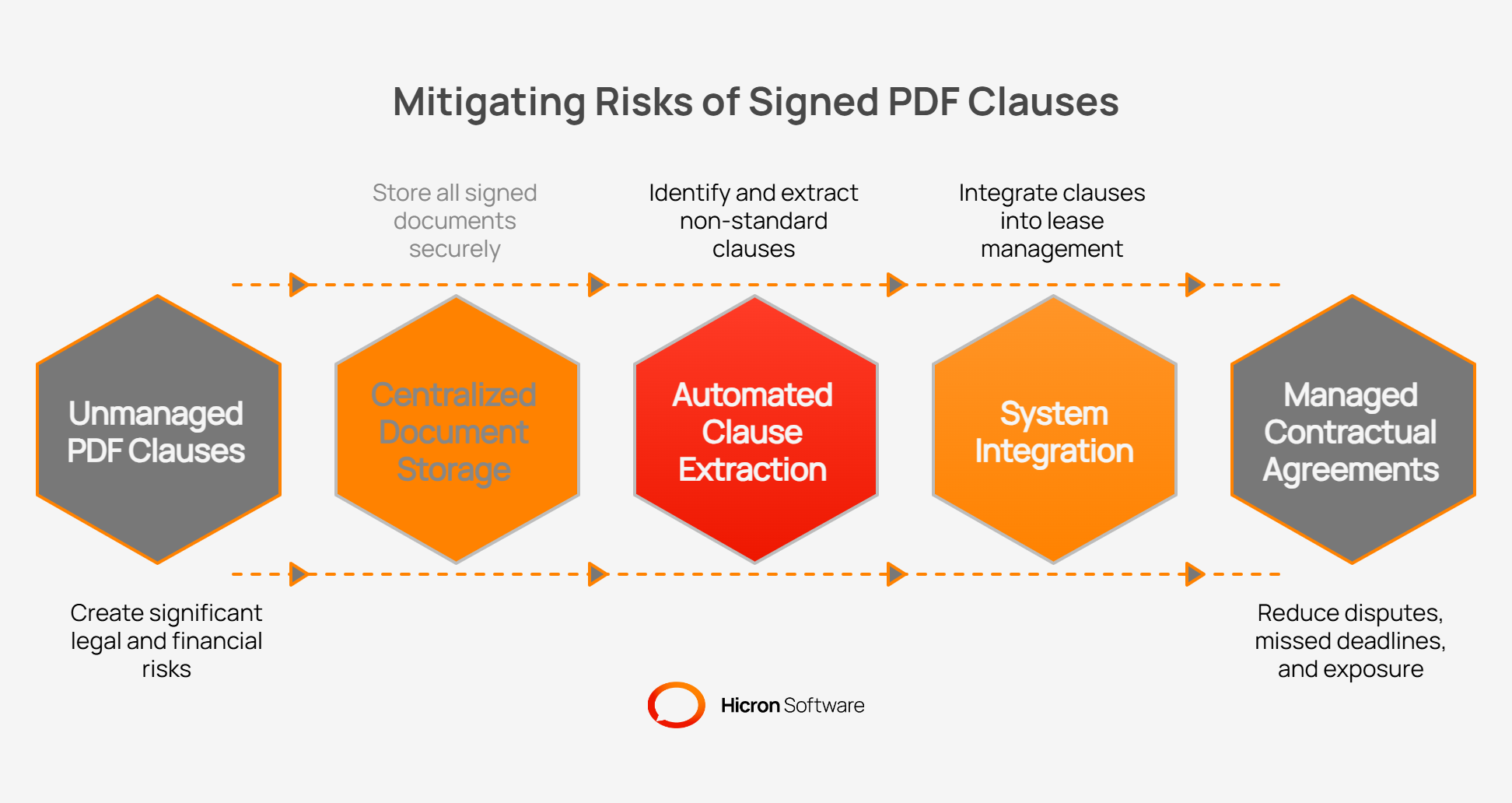
None of these three outcomes requires a large number of unregistered exceptions to become expensive. A single missed indexation exclusion on an anchor tenant can outweigh the combined cost of dozens of smaller invoicing errors.
This is a version of the same adoption gap that runs through every mature property management system. The record exists, but nothing in the system’s structure asks anyone to read it before a mass event runs. A signed lease sits in a document repository as a scanned file. The clause inside it never becomes a rule the billing or renewal engine checks against.
Contract intake built on optical character recognition and a large language model reads a signed lease the way a paralegal would. It runs at a pace no legal team can match manually across a full portfolio.
The process runs in a fixed sequence, and the order matters because each step depends on the one before it.
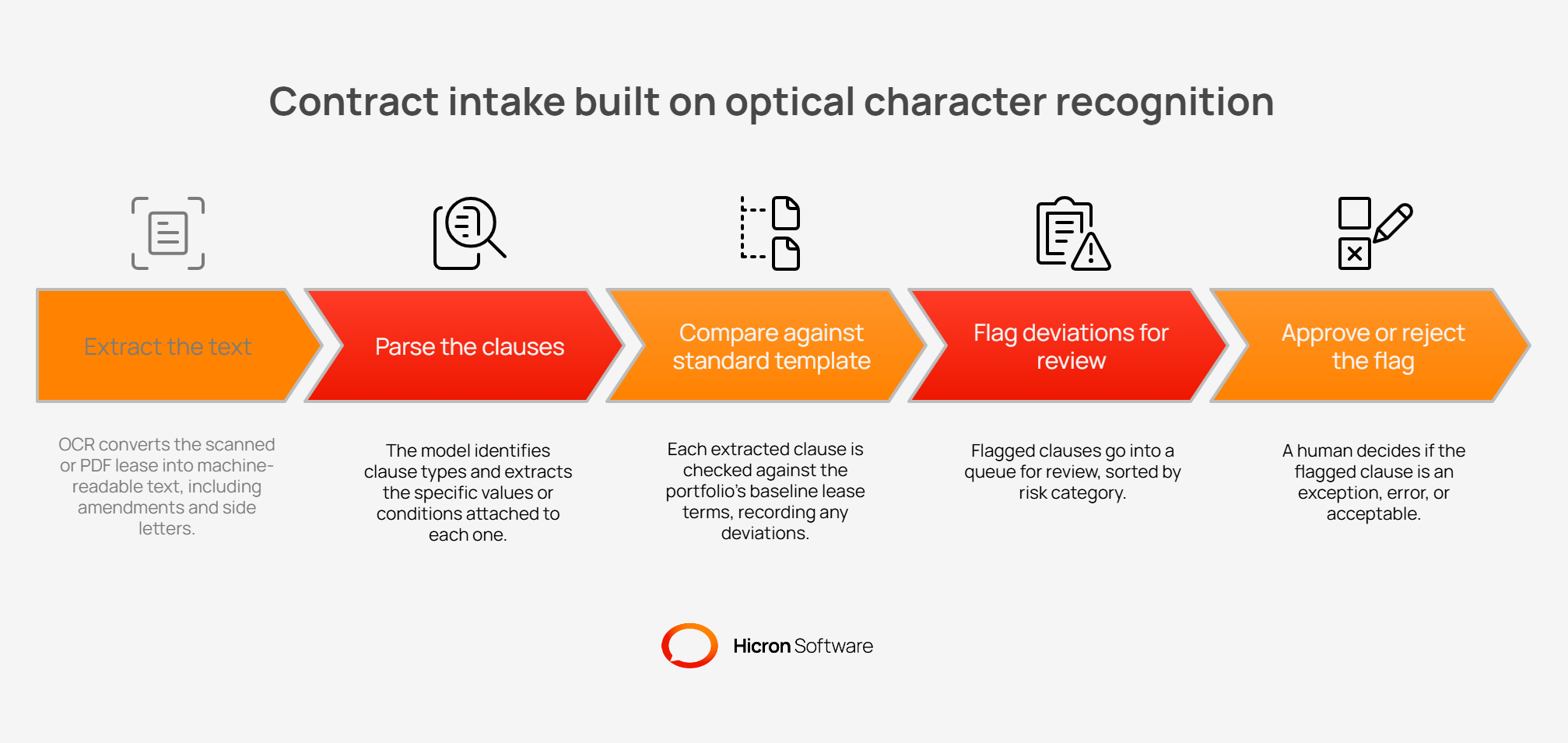
That fifth step is where the model’s role ends, and judgment starts. AI contract intake flags and suggests. It does not decide that a clause is binding, and it does not resolve ambiguity in contract language on its own. A lawyer or operator reviews every flag before it becomes a rule that changes how a lease bills or renews. The system does not replace legal review. It replaces the version of legal review that means reading two hundred contracts front to back, looking for the handful that differ.
The clearest way to see the value of this approach is to compare the two ways a portfolio finds its own exceptions. Reviewing two hundred leases manually, page by page, for indexation terms, cost allocation formulas, notice periods, and rent caps is a task measured in weeks of a lawyer’s or lease administrator’s time. It usually happens once, and rarely again until the next crisis forces it. Running the same two hundred leases through an AI intake pipeline compresses the extraction and comparison step to a matter of hours, leaving the review queue as the only remaining manual work.
The time saved is only half the value. The other half is what a manual review tends to miss. A person working through two hundred contracts under deadline pressure, especially contracts negotiated by former colleagues years earlier, skips clauses that look routine on a quick read but hide a deviation in a subordinate paragraph. A parsing and comparison step checks every lease against the same baseline with the same attention, no matter how many contracts came before it in the queue.
A portfolio that runs this kind of review ahead of its next mass indexation, rather than during it, converts a likely scramble of billing corrections and tenant disputes into a short list of flagged clauses a lawyer clears in a single sitting. The exceptions were always going to surface eventually. The only variable a portfolio controls is the schedule: one it picks, or one a tenant’s legal team picks for it.
Non-standard lease clauses are negotiated terms that deviate from a portfolio’s standard lease template. Common examples include an indexation exclusion, a custom operating cost allocation key, an altered notice period, or a cap on annual rent increases. They typically result from vacancy pressure or negotiations with a strong tenant, such as an anchor store or national chain.
An unrecorded exception typically surfaces in one of three ways. It shows up as a billing dispute when an invoice runs on the standard formula against a signed amendment, as a missed deadline that triggers an unwanted automatic renewal, or as legal exposure from enforcing terms that contradict the actual signed contract. These outcomes tend to appear during mass events, such as portfolio-wide indexation, rather than during routine operations.
No. AI contract intake flags and suggests which clauses deviate from the standard template. A lawyer or lease operator still decides whether each flagged clause represents a genuine exception, a parsing error, or a term close enough to standard to ignore. The system removes the need to read every contract line by line, not the need for legal judgment.
AI contract intake uses optical character recognition to convert a signed lease into machine-readable text. A language model then identifies clause types and extracts their specific terms. Each extracted clause is compared against the portfolio’s standard lease template, and any deviation is flagged for a lawyer or lease operator to review and approve.
Two forces push leases away from the standard template. A vacant unit shifts negotiating power to the prospective tenant, who can request concessions the landlord would not otherwise offer. A strong tenant, such as an anchor store or national retail chain, often negotiates from its own legal paper or a fixed list of required clauses.
Hicron Software proved to be a trusted partner with unmatched technical expertise, delivering a scalable and user-friendly web application that was pivotal to our successful U.S. market expansion.

Hicron’s contributions have been vital in making our product ready for commercialization. Their commitment to excellence, innovative solutions, and flexible approach were key factors in our successful collaboration.
I wholeheartedly recommend Hicron to any organization seeking a strategic long-term partnership, reliable and skilled partner for their technological needs.

After carefully evaluating suppliers, we decided to try a new approach and start working with a near-shore software house. Cooperation with Hicron Software House was something different, and it turned out to be a great success that brought added value to our company.
With HICRON’s creative ideas and fresh perspective, we reached a new level of our core platform and achieved our business goals.
Many thanks for what you did so far; we are looking forward to more in future!

Hicron is a partner who has provided excellent software development services. Their talented software engineers have a strong focus on collaboration and quality. They have helped us in achieving our goals across our cloud platforms at a good pace, without compromising on the quality of our services. Our partnership is professional and solution-focused!

The IT system supporting the work of retail outlets is the foundation of our business. The ability to optimize and adapt it to the needs of all entities in the PSA Group is of strategic importance and we consider it a step into the future. This project is a huge challenge: not only for us in terms of organization, but also for our partners – including Hicron – in terms of adapting the system to the needs and business models of PSA. Cooperation with Hicron consultants, taking into account their competences in the field of programming and processes specific to the automotive sector, gave us many reasons to be satisfied.