10 Real Estate Software Development Companies in 2026
- February 03
- 9 min



Commercial vacancy management software covers the systems that track leased space, calculate complex rent structures, allocate shared costs, monitor vacancy across a portfolio, and enforce timely action on critical lease dates and contractual obligations. The term spans dedicated platforms and enterprise suites where this capability sits as one module among many.
Most commercial portfolios already store the contract data required for vacancy decisions. A decision layer that turns lease history, tenant performance, and clause exceptions into early action remains the open requirement. Off-the-shelf vacancy modules handle the contract layer well. The build-vs-buy question opens where vacancy prediction and contract intelligence sit on data the portfolio already holds. This article maps what major platforms deliver at the contract layer, where that layer stops, and how to fit a decision layer to the commercial portfolio.
Key Takeaways
Commercial vacancy management software covers the full lifecycle of a commercial lease. That lifecycle is the contract layer: structured records, calculations, events, and compliance. Vacancy prediction and contract intelligence sit above it as the decision layer.
Property and contract data layer. Every system in this category starts with a structured record of the physical asset: buildings, floors, units, and common areas. On top of that structure sit the lease contracts, recorded in both directions. The same organization may own some assets while leasing others from third parties.
Complex rent calculation. Commercial rent structures carry a degree of complexity that standard ERP modules and residential property software do not handle well. A retail tenant in a shopping center typically pays:
A shopping center with two hundred major tenants and several hundred kiosk operators runs those calculations simultaneously for every billing cycle. The software engine needs to handle this at scale without manual intervention per lease.
Lease lifecycle management. Commercial leases contain dates that, if missed, cost money. Rent review dates, break option windows, indexation trigger points, and expiry notices all require action within defined periods. Missing a rent review date means the landlord absorbs a full year of inflation without the contractually permitted adjustment.
CAM reconciliation. Common area maintenance costs, including cleaning, security, landscaping, and structural maintenance, are allocated across tenants based on their lease terms. Where a unit sits vacant, that share of the cost transfers to the owner. Tracking which spaces are vacant, calculating their proportional burden, and reconciling estimates against actual expenditure at year-end is one of the more technically demanding functions these systems provide.
Compliance and reporting. Larger portfolios operate under accounting standards (IFRS 16 governs how leases appear on corporate balance sheets) and local regulatory requirements that vary by country. Tax declarations, utility permits, government reporting integrations, and compliance documentation fall within the system’s scope.
Organizations that approach commercial property management software assuming it resembles a more complex residential system tend to underestimate implementation complexity.
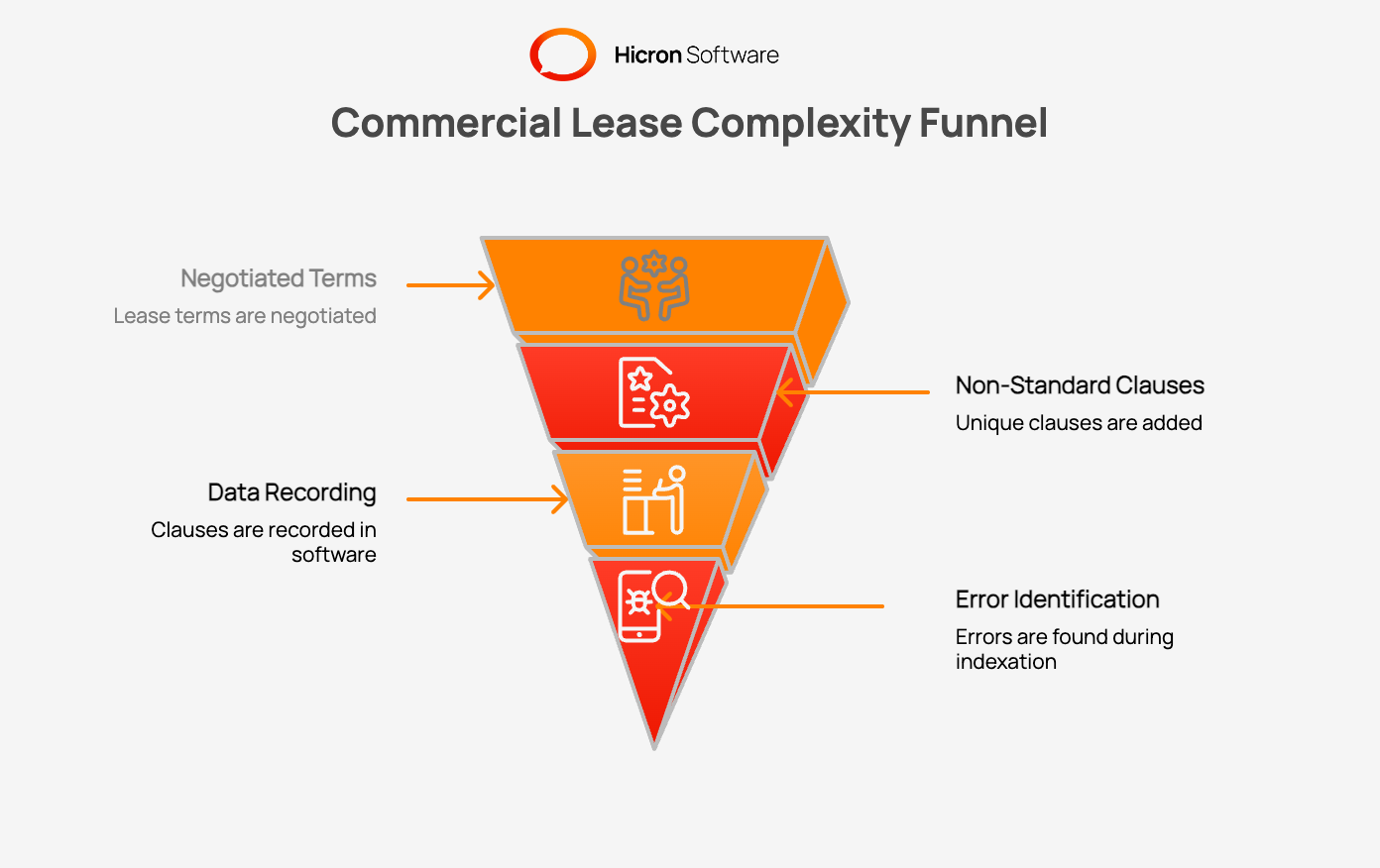
The distinction starts with the lease contract itself. A residential lease runs on standard terms, often governed by tenant protection law, with limited variation between tenants. A commercial lease is a negotiated instrument. A strong anchor tenant, whether a major retailer, a bank, or a logistics operator, brings its own contract template and the leverage to insist on it.
The resulting agreement may differ from the landlord’s standard in material ways: a carve-out from the indexation clause, an exclusion from specific CAM cost categories, a different revenue share formula. At a portfolio of fifteen shopping centers with several thousand tenants, these exceptions accumulate into a complex data problem.
Each non-standard clause needs to be recorded accurately at lease signing. The error surfaces two or three years later at the first indexation run, when the system applies a clause that should have been excluded.
Scale amplifies every data quality problem. A single missed exception in a small portfolio is a billing dispute. The same error rate across two thousand leases is a systematic financial exposure that takes quarters to identify and resolve.
The off-the-shelf market for commercial vacancy management software covers a range from enterprise suites to focused point solutions. Many large European and corporate portfolios already run SAP RE-FX as the contract layer and evaluate decision tools against that foundation.
SAP RE-FX is the Real Estate Flexible module for commercial and corporate lease administration inside SAP. It covers list-in and list-out contracts, complex rent calculation, CAM allocation, indexation with exceptions, vacancy monitoring, object and space registry, local tax handling, and IFRS 16. It suits organizations that already run SAP finance and need lease data tied to the general ledger. Vacancy prediction and deep clause-risk review sit outside the module.
Re-Leased builds its data model around the commercial lease as the primary object rather than the property. That design choice shows up in how the system handles lease events: rent reviews, break options, and expiry dates are tracked proactively with automated reminders, which reduces revenue leakage from missed contractual windows. The platform suits mid-market commercial property managers who need fast implementation without heavy IT involvement.
MRI Software operates at the enterprise end of the market, with particular strength in retail portfolios and corporate real estate. Its AI-assisted lease abstraction accelerates the data entry problem: the system reads a contract, extracts key terms, and populates lease records without full manual input. MRI handles percentage rent and tenant sales reporting at the scale that large retail portfolios require.
Yardi Voyager serves real estate investment trusts and large fund managers with complex ownership structures. Every lease event generates a corresponding entry in the general ledger automatically. The Yardi ecosystem extends into marketing: CommercialCafe and CommercialSearch syndicate vacancy listings to commercial property portals, which shortens the marketing workflow when a unit becomes available.
VTS positions itself for institutional investors who prioritize lease analytics and tenant relationship management over day-to-day lease administration. It complements a core property management system rather than replacing it.
Facilio focuses on the operational and technical maintenance side of commercial property, integrating IoT sensors to monitor energy usage in vacant units and optimize preventive maintenance scheduling. For large campuses and complex retail environments, it addresses the facility management layer that most lease-focused systems leave to a separate tool.
|
Platform |
Best fit |
CAM handling |
Notable strength |
|
SAP RE-FX |
SAP-centric enterprise, corporate RE |
Strong |
Contract layer tied to SAP finance, IFRS 16 |
|
Re-Leased |
Mid-market commercial |
Native |
Fast deployment, proactive lease event tracking |
|
MRI Software |
Enterprise retail, corporate RE |
Very strong |
AI lease abstraction, retail scale |
|
Yardi Voyager |
REITs, large fund managers |
Advanced |
Accounting automation, full ecosystem |
|
VTS |
Institutional investors |
Financial analysis |
Lease analytics, tenant CRM |
|
Facilio |
Large campuses, complex retail |
Operational layer |
IoT integration, preventive maintenance |
Mature portfolios usually already run a contract layer. The gap between what that layer stores and what vacancy decisions require shows up in four consistent areas. Two of them define the decision layer: contract intelligence and vacancy prediction.
|
Gap |
Layer |
What the platform holds |
What remains unaddressed |
|
Contract intelligence for non-standard leases |
Decision |
Lease record and stored deviations |
Comparison to landlord standard, downstream risk flags, future-event impact |
|
Vacancy prediction from adjacent signals |
Decision |
Expiry dates, notice events, often turnover history |
Early departure signal from turnover + footfall + seasonality before formal notice |
|
Country-specific regulatory compliance |
Contract / integration |
Core lease and financial records |
Local tax declarations, municipal permits, government registry integrations |
|
Mass rent indexation with exceptions |
Contract / operations |
Standard indexation formulas at scale |
Pre-run exception identification, validation, and post-run correction of deviations |
Contract intelligence for non-standard lease agreements. Every major platform handles a well-structured lease entered according to a template. The problem appears when a strong tenant has negotiated a deviation: an exclusion from a CAM cost category, an indexation formula that differs from the standard, a specific carve-out for a particular type of expenditure. Most systems will store the deviation if a user knows to record it. They do not compare the clause set against the landlord’s standard, assess its downstream significance, or flag which future events it affects.
That is the contract intelligence gap. The lease record already holds the clause. What portfolios still need is support that compares it to the landlord’s standard, scores downstream risk, and flags which future events it affects before those events fire. Intake stays manual, and the error surfaces two or three years later at the first indexation or CAM reconciliation run.
Vacancy prediction using signals already adjacent to the contract. A system knows when a lease expires. It knows when a tenant has filed notice. It also often holds the tenant’s monthly turnover history. What it rarely does is combine that history with foot traffic in the tenant’s zone, seasonal patterns, and lease proximity to produce an early departure signal before formal notice arrives.
Vacancy prediction before the contract event requires connecting lease data with tenant performance data, people-counting sensors, and seasonal patterns. That connection does not exist as a native decision capability in off-the-shelf vacancy modules today. With six to twelve months of lead time, teams can start a leasing campaign or reopen commercial terms before the unit goes dark.
Shopping centers deploy substantial sensor infrastructure:
That data sits entirely outside the lease management system. Property managers who use it for vacancy risk assessment do so through manual analysis or separately commissioned tools. The contract data and the behavioral signals already exist in parallel. The decision layer that joins them is what portfolios still build or buy separately.
Country-specific regulatory compliance. Commercial property portfolios operating in multiple countries face a fragmented compliance environment. Polish requirements include property tax declarations with monthly installment payments, fees related to agricultural land conversion, and various municipal permits tied to construction activity. In the Gulf region, operators face integration requirements with government property registration platforms. A global platform builds compliance modules for markets where it has sufficient license volume to justify the investment. Operators in smaller markets find themselves managing compliance outside the system.
Mass rent indexation with exceptions. Running an indexation cycle across several thousand leases is mechanically straightforward when every lease uses the same formula. In practice, a shopping center portfolio at scale will contain leases where the indexation is delayed for the first two years, excluded entirely, capped at a different percentage, or tied to an unusual index. The system applies the standard formula correctly. Identifying which leases deviate before the run, validating the exceptions, and correcting any errors after the run is substantial manual work. Contract intelligence that flags those deviations at intake reduces the volume of exceptions that still require manual handling at each indexation cycle.
Custom development produces better outcomes than purchasing when the gap sits in the decision layer: real, identifiable, and connected to a material vacancy or contract process. The contract layer is usually already in place.
The conditions that justify a custom decision layer:
The conditions where custom development introduces more risk than it resolves:
Most mature commercial property portfolios already run the contract layer and add a decision layer where vacancy prediction or contract intelligence requires it.
A large shopping center operator might run SAP RE-FX or Yardi Voyager for lease administration, CAM reconciliation, and financial reporting, while building a separate vacancy prediction tool that connects lease data with sensor streams and tenant performance reports, and a contract intelligence layer that flags non-standard clauses at intake. A facility management system like Facilio or the SAP Field Service Management module sits alongside the lease platform and handles maintenance workflows independently.
This architecture fits how the work actually splits. Platforms that administer leases well rarely also deliver predictive vacancy alerts or deep clause-risk review. The integration between the contract layer and the decision layer is a real engineering investment. It is usually smaller than the cost of forcing one platform to cover a function it was not designed for.
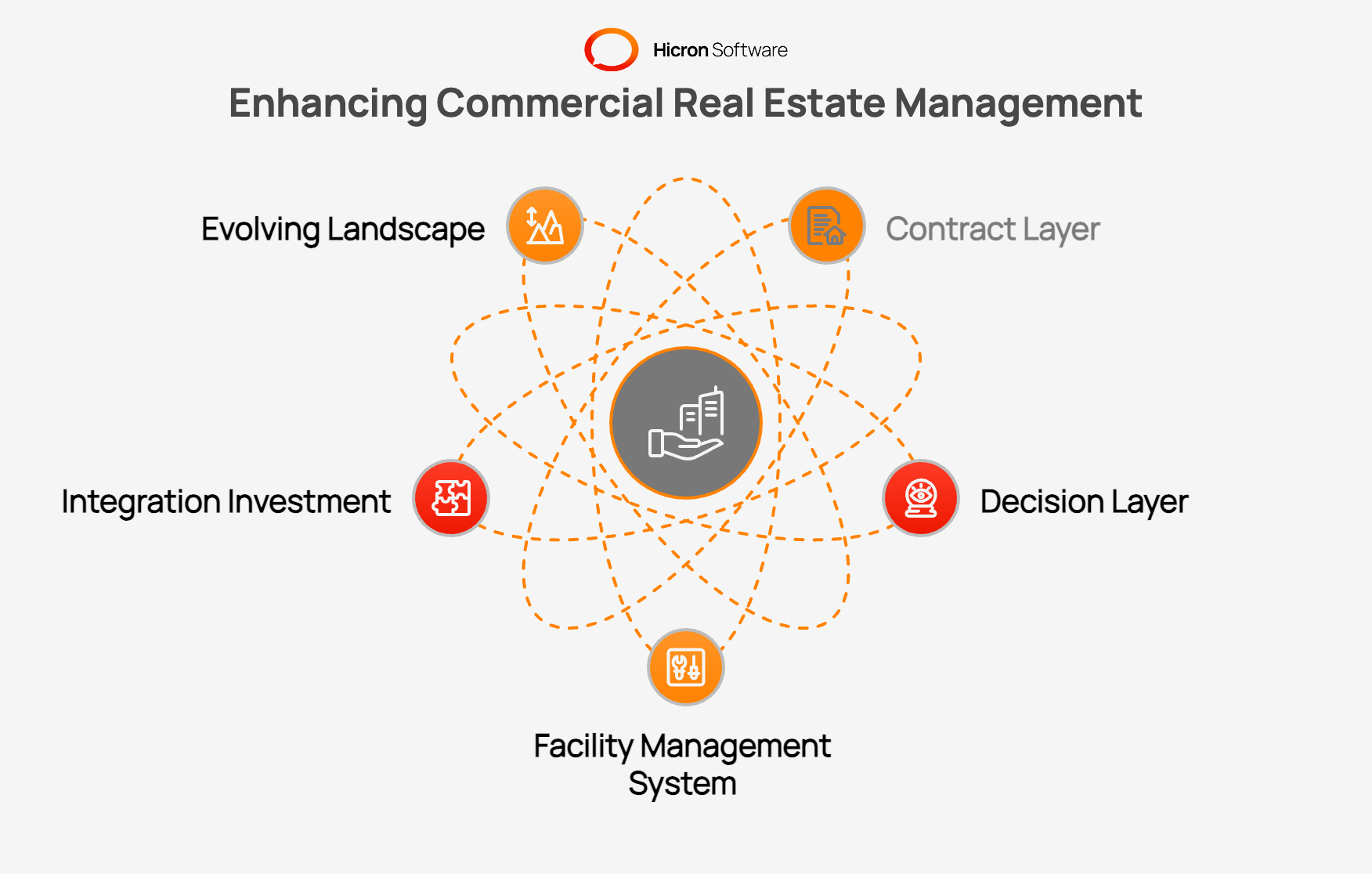
The boundary between off-the-shelf and custom is also moving. AI-assisted lease abstraction, which required a custom NLP pipeline three years ago, now ships as a native feature in MRI Software. Parts of contract intelligence are migrating into the platform. Vacancy prediction that joins lease history with sensor and performance signals still typically sits outside the core module. Capabilities that require a custom build today may be standard platform features within two or three product cycles.
Three questions structure the evaluation before any vendor conversation begins.
First: do you already hold the contract data for vacancy decisions, and where does the decision layer break? For most commercial portfolios, lease event management, CAM reconciliation, and vacancy duration after notice are covered in major platforms. The decision gaps that still justify a custom layer are vacancy prediction before notice and contract intelligence for non-standard agreements. If those gaps are material, the evaluation starts from architecture: keep the contract layer, define the decision layer. If they are not, the starting point is a platform evaluation.
Second: what is the five-year total cost of ownership, including configuration, integration, and maintenance? Enterprise platforms like Yardi Voyager carry license and configuration costs that are front-loaded in vendor proposals. A mid-market platform like Re-Leased may have a lower five-year cost for a portfolio that does not need the full enterprise feature set. A purpose-built decision layer has a different cost structure: high upfront, then maintenance cost that scales with team capacity, usually against an existing contract system rather than a greenfield rebuild.
Third: does the gap that appears to require custom development persist across the portfolio over time, or does it reflect a current process that may change? Custom systems built for current workflows become legacy constraints when those workflows evolve. A platform with an active product roadmap absorbs change more efficiently than a custom codebase maintained by a small internal team. Vacancy prediction methods and clause-review rules that are core to how the portfolio protects NOI are the gaps most likely to persist.
For portfolios at specific stages and sizes, the option set narrows:
The software selection follows the portfolio analysis. Start with a process audit:
That analysis produces specific criteria for the contract layer and for the decision layer. Those criteria determine whether a standard platform closes both, or whether vacancy prediction and contract intelligence need a purpose-built layer on data the portfolio already holds.
Off-the-shelf platforms are the right starting point for the contract layer, financial reporting, and compliance at scale. The underlying platform, whether a current cloud system or a legacy RE-FX installation holding years of lease and vacancy history, provides that foundation. On top of it, purpose-built tools for vacancy prediction and contract intelligence turn existing lease data into earlier leasing action and fewer exception failures at billing and renewal.
The organizations that get this right choose the architecture before choosing the vendor: keep the contract system that already holds the data, then decide where the decision layer belongs.
A property management system (PMS) covers the full operational scope of a real estate portfolio: leases, maintenance, financials, and tenant communications. Commercial vacancy management software is either a full PMS with commercial-specific features such as percentage rent, CAM reconciliation, and break option tracking, or a component of a larger system focused specifically on tracking and reducing vacant space. In practice, the terms are often used interchangeably for commercial platforms, since vacancy management is one of their central functions.
Portfolio size alone does not determine the answer. A portfolio of one hundred properties under straightforward lease structures rarely justifies a custom build over a standard platform. A portfolio of fifty properties with country-specific regulatory integrations, complex percentage rent structures, and an existing SAP environment may justify custom extensions to that environment rather than a new standalone system. The trigger for a custom build is a decision-layer gap: vacancy prediction or contract intelligence that the available market does not provide on top of contract data the portfolio already holds.
A decision layer sits on top of the contract system the portfolio already runs. It turns existing lease data, tenant performance signals, and clause exceptions into earlier action: vacancy prediction before formal notice, and contract intelligence that flags non-standard terms before they hit billing or renewal. The contract layer still owns records, calculations, and compliance. The decision layer owns the alerts and reviews that those records do not produce on their own.
CAM reconciliation requires allocating actual expenditure across tenants at year-end based on their lease terms. The complexity accumulates from three sources: tenants with different allocation methods (by floor area, by revenue share, or by negotiated fixed amounts), tenants with specific CAM exclusions, and the allocation of costs for vacant units. At a portfolio of fifteen properties with several thousand tenants, the reconciliation requires a system that can store and apply a different rule set for each tenant. Manual reconciliation at this scale is both slow and error-prone.
For simple commercial portfolios with small office buildings and straightforward gross leases, residential platforms extended with basic commercial features may suffice. For portfolios with percentage rent, complex CAM reconciliation, or large numbers of tenants with non-standard clauses, residential platforms consistently fall short. The data model in residential software treats the unit and the tenancy as the primary objects. Commercial software needs to treat the lease contract itself as the primary object, with its full term structure, indexation logic, and event calendar.
Hicron Software proved to be a trusted partner with unmatched technical expertise, delivering a scalable and user-friendly web application that was pivotal to our successful U.S. market expansion.

Hicron’s contributions have been vital in making our product ready for commercialization. Their commitment to excellence, innovative solutions, and flexible approach were key factors in our successful collaboration.
I wholeheartedly recommend Hicron to any organization seeking a strategic long-term partnership, reliable and skilled partner for their technological needs.

After carefully evaluating suppliers, we decided to try a new approach and start working with a near-shore software house. Cooperation with Hicron Software House was something different, and it turned out to be a great success that brought added value to our company.
With HICRON’s creative ideas and fresh perspective, we reached a new level of our core platform and achieved our business goals.
Many thanks for what you did so far; we are looking forward to more in future!

Hicron is a partner who has provided excellent software development services. Their talented software engineers have a strong focus on collaboration and quality. They have helped us in achieving our goals across our cloud platforms at a good pace, without compromising on the quality of our services. Our partnership is professional and solution-focused!

The IT system supporting the work of retail outlets is the foundation of our business. The ability to optimize and adapt it to the needs of all entities in the PSA Group is of strategic importance and we consider it a step into the future. This project is a huge challenge: not only for us in terms of organization, but also for our partners – including Hicron – in terms of adapting the system to the needs and business models of PSA. Cooperation with Hicron consultants, taking into account their competences in the field of programming and processes specific to the automotive sector, gave us many reasons to be satisfied.