10 Real Estate Software Development Companies in 2026
- February 03
- 9 min



Custom commercial vacancy management software is a purpose-built decision layer that sits on an existing lease and property system. It turns contract history, tenant performance signals, and non-standard clause data into vacancy prediction and contract intelligence, while the core platform continues to own billing, CAM, indexation, and compliance records.
Custom commercial vacancy management software succeeds as a dedicated decision layer on lease data the portfolio already holds. The build covers vacancy prediction before formal notice and contract intelligence for non-standard leases. Lease administration, CAM, and indexation stay in the existing platform. This article covers scope, architecture, frontend, backend, database, APIs, prediction and intake design, and integration with the current lease system. It also covers the development process and post-deployment support needed to keep alerts trustworthy after go-live. Readers who finished a buy versus build review can use this guide as the full decision layer path ahead.
Key Takeaways
The useful build target is a decision layer on the lease and property system already in place. The portfolio already stores leases, rent formulas, vacancy status after notice, and often tenant turnover history. Custom software adds the joins and rules those records leave open.
Two capabilities carry most of the value:
Everything else in commercial vacancy operations (event calendars, CAM runs, indexation engines, IFRS reporting) belongs in the existing contract platform unless a genuine market gap forces a local build. Once the portfolio has confirmed a decision layer gap, the question shifts from vendor comparison to build design.
Scope fails when the brief says “build vacancy management” without naming decisions, signals, and system boundaries.
Name the decisions the software should support. Typical decisions include: which tenants enter a retention conversation this quarter, which units need an early leasing campaign, which clause exceptions block a clean indexation run, and which spaces are candidates for repositioning before they empty.
Name the signals already available. Lease end dates and break options sit in the contract system. Monthly turnover reports often sit in the same system or in a retail sales feed. Footfall counters, escalator sensors, and zone traffic usually sit outside, in building or mall operations tools. Payment timing may sit in finance. The build plan lists each source, owner, refresh rate, and quality risk.
Name the contract system of record. SAP RE-FX, Yardi Voyager, MRI, or another platform remains authoritative for lease master data. The custom layer reads from it and writes alerts, scores, and review tasks back in a controlled way. Duplicate lease masters create immediate drift.
Name success in operational terms. Useful measures include months of average lead time before notice, share of high risk tenants contacted before expiry, reduction in surprise vacancies, and reduction in indexation or CAM exceptions found only after a billing run. Feature count is a weak success measure.
|
Definition item |
Example output |
|
Decision |
Start retention talk 9 months before expiry for high risk retail tenants |
|
Signal set |
Turnover trend, zone footfall, lease proximity, break option window |
|
System of record |
Lease and condition records in the current contract platform |
|
Success measure |
Median lead time from first alert to notice or renewal outcome |
A short process audit produces this table. The audit also shows which work should stay manual in the first release.
A durable architecture has four parts: ingestion, a vacancy risk model, a contract intelligence path, and an action surface for property and leasing teams.
|
Layer |
Responsibility |
Typical build choice |
|
Contract platform |
Lease master, billing, CAM, indexation |
Keep the current lease system |
|
Decision data store |
Cleaned signals, scores, clause flags |
Dedicated store beside the ERP |
|
Prediction/scoring |
Risk model and alert thresholds |
Custom service |
|
Contract intelligence |
Extract, compare, review queue |
Custom GenAI + rules |
|
Action surface |
Tasks, owners, campaign triggers |
Light app or existing workflow tools |
Facility management stays adjacent. Sensors that support vacancy prediction may also feed preventive maintenance. The vacancy decision layer keeps work order management outside its product scope. That boundary keeps releases stable.
A vacancy decision layer stays thin when each tier has a clear job. Frontend shows alerts and review queues. Backend runs scoring and intake workflows. Database holds cleaned signals beside the lease system of record. APIs connect the contract platform, sensors, and workflow tools without a second lease master.
The frontend serves property managers, leasing teams, and lease administrators. The first release usually ships a portfolio cockpit with risk queues, alert detail, and a contract review screen. Teams act on owned alerts with due dates, lead time remaining, and plain language reasons for the score.
Heavy custom UI often waits until the alert workflow proves value. Many pilots start inside existing task or CRM tools, then add a thin web app for portfolio views. Mobile access matters for on site property staff who triage alerts between tenant meetings.
Key frontend jobs:
The backend owns scoring, clause comparison, orchestration, and write-back rules. A service layer reads lease extracts, joins performance and sensor signals, and produces risk scores on a schedule. A separate path handles document intake for contract intelligence: OCR, extraction, comparison to the landlord clause catalog, and a human confirmation step.
Keep prediction and contract intelligence as separate services or bounded modules. They share identity and lease context. Their release cycles and failure modes differ. Rule-based scoring can ship before any machine learning service. Machine learning joins later once labeled outcomes exist.
The decision data store sits beside the contract system of record. It holds cleaned unit and lease identity maps, time series for turnover and footfall, risk scores and alert history, clause flags, and outcome labels. The lease platform remains authoritative for contracts, conditions, and vacancy status after notice.
A relational store fits identity, alerts, ownership, and clause flags. Time series storage fits sensor and turnover streams at retail scale. Document blobs and extraction payloads need object storage with links back to lease identifiers. Cache what scoring needs and refresh on a known schedule. Keep lease master edits out of this store.
APIs define how the decision layer talks to the lease platform, sensor systems, finance feeds, and task tools. That lease platform may be RE-FX, Yardi, MRI, or another suite. The pattern stays the same: read authoritative lease data, join adjacent signals, return scores and approved flags.
Typical API surface:
Prefer documented batch or event interfaces over screen scraping. Version the contracts. Log every write back with who confirmed it.
ESB and iPaaS. Many portfolios already run an enterprise service bus (ESB) or an integration platform as a service (iPaaS) for ERP and property systems. Route lease extracts, sensor feeds, and write-backs through that bus when it exists. Point-to-point APIs can prove a pilot. An ESB or iPaaS scales better when the same lease and sensor streams also feed finance, facility management, and reporting. Shared sensor feeds can serve vacancy prediction and facility management while product scopes stay separate.
|
Tier |
Primary job |
First release focus |
|
Frontend |
Queues, explanations, review, outcomes |
Thin cockpit or existing workflow UI |
|
Backend |
Scoring, intake orchestration, write back rules |
Rule based services before ML |
|
Database |
Identity map, signals, scores, flags |
Store beside ERP, no second lease master |
|
APIs |
Lease, sensor, finance, and workflow links |
Versioned extract, ESB or iPaaS where available |
Vacancy prediction comes from joined signals and an operating rhythm.
Assemble the minimum signal set. Lease proximity and break windows from the contract system. Turnover history for percentage rent tenants. Zone or unit footfall where sensors exist. Optional: payment delays from finance. Each signal needs a definition of “normal” for that asset type and season.
Define alert logic teams can explain. Property managers act on alerts they can defend in a leasing meeting. A first release that states “turnover down for four periods, footfall down fifteen percent year over year, expiry inside nine months” beats an opaque score. Add model sophistication after the workflow proves useful.
Set lead time targets by portfolio type. Enclosed retail often needs six to twelve months for campaigning, fit out planning, and tenant mix decisions. Simpler office stock may operate on a shorter cycle. The software should expose lead time as a first class field, so teams see whether an alert still leaves room to act.
Close the loop with outcomes. When a tenant renews, leaves, or renegotiates, feed that result back into the model store. Without outcomes, the custom layer cannot improve thresholds or prove value to finance.
Build order that usually works:
Non-standard commercial leases create vacancy and billing risk years after signing. Custom contract intelligence reduces that lag.
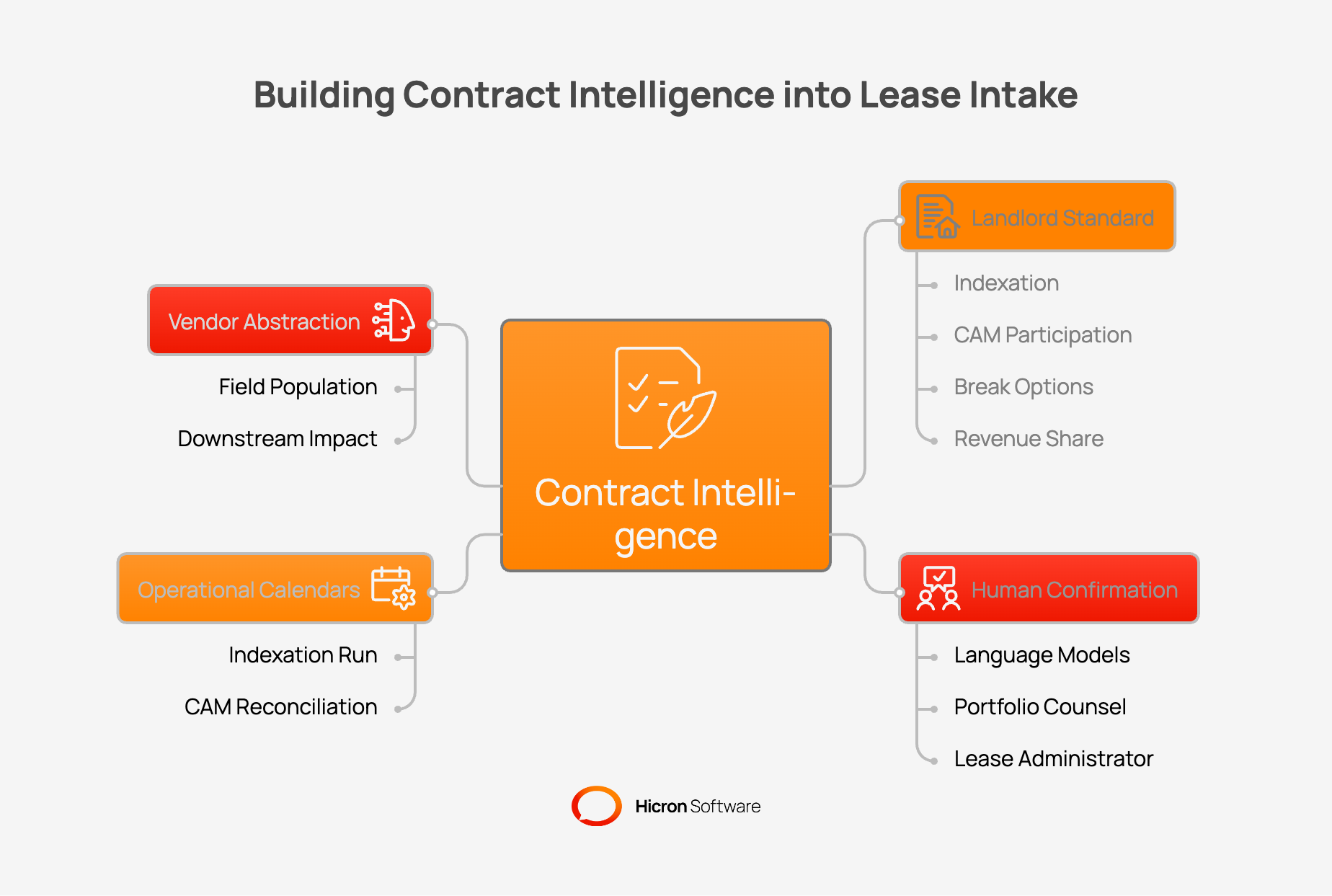
Anchor on the landlord standard. Maintain a clause catalog for indexation, CAM participation, break options, and revenue share. Every new lease is compared to that catalog. Deviations become review items with a plain language impact note: delayed indexation for two years, exclusion from a CAM category, special break window.
Keep a human in the confirmation step. Language models extract and propose. Portfolio counsel or a senior lease administrator confirms what enters the system of record. That design matches how strong tenants impose their own templates: speed for the routine, judgment for the exception.
Write flags forward into operational calendars. A carve out that matters only at the next indexation run should appear as a task before that run. A PDF annotation at signing alone leaves the exception invisible when billing starts. Contract intelligence earns its keep when it shrinks surprise exceptions during mass indexation and CAM reconciliation.
Reuse vendor abstraction where it already exists. Some platforms ship AI lease abstraction for field population. Custom work then focuses on comparison to the landlord standard and downstream event impact, which those modules rarely cover in full.
Integration design decides whether the custom layer stays a decision product or becomes a shadow lease database. The pattern applies to every lease system that already holds the portfolio data.
The build brief stays the same across platforms: keep the contract system that already holds the data, then build a dedicated decision layer for vacancy prediction and contract intelligence on top of those records.
The development process stays controlled when discovery, build, and validation follow the decision layer, with CAM and billing left in the contract platform.
Suggested release ladder:
If the backlog fills with requests to recreate indexation engines or full financial reporting, return those items to the contract platform roadmap. The custom layer improves vacancy decisions and clause foresight.
Go live starts the operating phase. Post-deployment support keeps scores trustworthy as leases, sensors, and templates change.
Ownership model. Custom software needs a product owner on the property side and an engineering owner for model and integration health. Property ownership sets alert thresholds, review SLAs, and campaign response. Engineering ownership covers pipeline health, API versioning, and data quality checks.
Model and threshold care. Turnover definitions, footfall zone maps, and seasonal baselines drift. Support includes periodic threshold reviews, false positive analysis, and outcome feedback into the model store. Without that loop, lead time gains fade within a few indexation or expiry cycles.
Integration and platform change. Contract platform upgrades, new sensor vendors, and finance feed changes all touch the API surface, including any ESB or iPaaS routes. Post-deployment support budgets regression tests on extracts, write-backs, and identity mapping whenever those upstream systems move.
Operational monitoring. Track extract freshness, scoring job success, alert acknowledgement rates, and median lead time from first alert to notice or renewal outcome. Those measures show whether the decision layer still earns its keep.
|
Support area |
What runs after go-live |
|
Product ownership |
Thresholds, review SLAs, campaign response rules |
|
Engineering ownership |
Pipelines, APIs, identity map, release hygiene |
|
Model care |
Threshold tuning, outcome labels, false positive review |
|
Integration care |
Extract and write back tests on upstream change |
|
Monitoring |
Freshness, job health, acknowledgement, lead time |
Portfolios that already run a mature contract system gain speed by building only what that system leaves open. Vacancy prediction and contract intelligence sit in that opening. A greenfield suite that also rebuilds rent engines and CAM reconciliation absorbs budget that should fund better signals, clearer alerts, and tighter leasing workflows.
The organizations that finish this build well treat architecture as the first product decision: keep the contract system that already holds the data, then deliver frontend, backend, database, and APIs as a thin decision layer with a clear development process and funded post-deployment support.
It is purpose-built software that adds vacancy prediction and contract intelligence on top of an existing commercial lease platform. The custom layer joins contract data with tenant performance and sensor signals, and supports earlier leasing and retention decisions. Billing, CAM, and indexation usually remain in the core platform.
Frontend shows risk queues, alert explanations, and contract review. Backend runs scoring, intake orchestration, and write-back rules. Database holds identity maps, signals, scores, and clause flags beside the lease system of record. APIs connect lease extracts, turnover, sensors, workflow tools, and controlled write-backs, often through an existing ESB or iPaaS.
A focused pilot on one asset class, with lease extracts, turnover joins, and rule-based alerts, often lands in a few months when the contract system and data owners are ready. Full portfolio coverage, sensor joins, GenAI intake, and write-backs take longer. Those steps follow a proven pilot in a staged release plan.
Post-deployment support covers product and engineering ownership, threshold and model care, integration regression when upstream systems change, and monitoring of extract freshness, alert acknowledgment, and lead time. Without that support, alert quality drifts as lease templates and sensor layouts change.
Language models help extract clauses from non-standard templates at speed. The first release still needs a landlord clause catalog, a human confirmation step, and flags that feed future indexation and CAM events. GenAI accelerates intake. Rules and ownership make the output operational.
Hicron Software proved to be a trusted partner with unmatched technical expertise, delivering a scalable and user-friendly web application that was pivotal to our successful U.S. market expansion.

Hicron’s contributions have been vital in making our product ready for commercialization. Their commitment to excellence, innovative solutions, and flexible approach were key factors in our successful collaboration.
I wholeheartedly recommend Hicron to any organization seeking a strategic long-term partnership, reliable and skilled partner for their technological needs.

After carefully evaluating suppliers, we decided to try a new approach and start working with a near-shore software house. Cooperation with Hicron Software House was something different, and it turned out to be a great success that brought added value to our company.
With HICRON’s creative ideas and fresh perspective, we reached a new level of our core platform and achieved our business goals.
Many thanks for what you did so far; we are looking forward to more in future!

Hicron is a partner who has provided excellent software development services. Their talented software engineers have a strong focus on collaboration and quality. They have helped us in achieving our goals across our cloud platforms at a good pace, without compromising on the quality of our services. Our partnership is professional and solution-focused!

The IT system supporting the work of retail outlets is the foundation of our business. The ability to optimize and adapt it to the needs of all entities in the PSA Group is of strategic importance and we consider it a step into the future. This project is a huge challenge: not only for us in terms of organization, but also for our partners – including Hicron – in terms of adapting the system to the needs and business models of PSA. Cooperation with Hicron consultants, taking into account their competences in the field of programming and processes specific to the automotive sector, gave us many reasons to be satisfied.