10 Real Estate Software Development Companies in 2026
- February 03
- 9 min


PropTech software compliance features are specialized functionalities embedded within real estate technology platforms designed to ensure adherence to legal, financial, and operational regulations. These features automate the complex process of monitoring transactions, verifying user identities, and securing sensitive data to meet industry standards.
This article explores the critical role of compliance in Property Technology (PropTech). It details what these features are, why they are essential for modern real estate software, and how developers can build and implement them effectively. You will learn about the specific tools needed to navigate the regulatory landscape and how to integrate them into SaaS platforms.
Key Takeaways:
Compliance features in PropTech software are specific tools designed to help real estate professionals follow the law. Real estate is a highly regulated industry. Agents, brokers, and property managers must follow strict rules regarding fair housing, financial reporting, and data privacy. Compliance features act as digital safeguards. They ensure that every action taken within the software aligns with these rules.
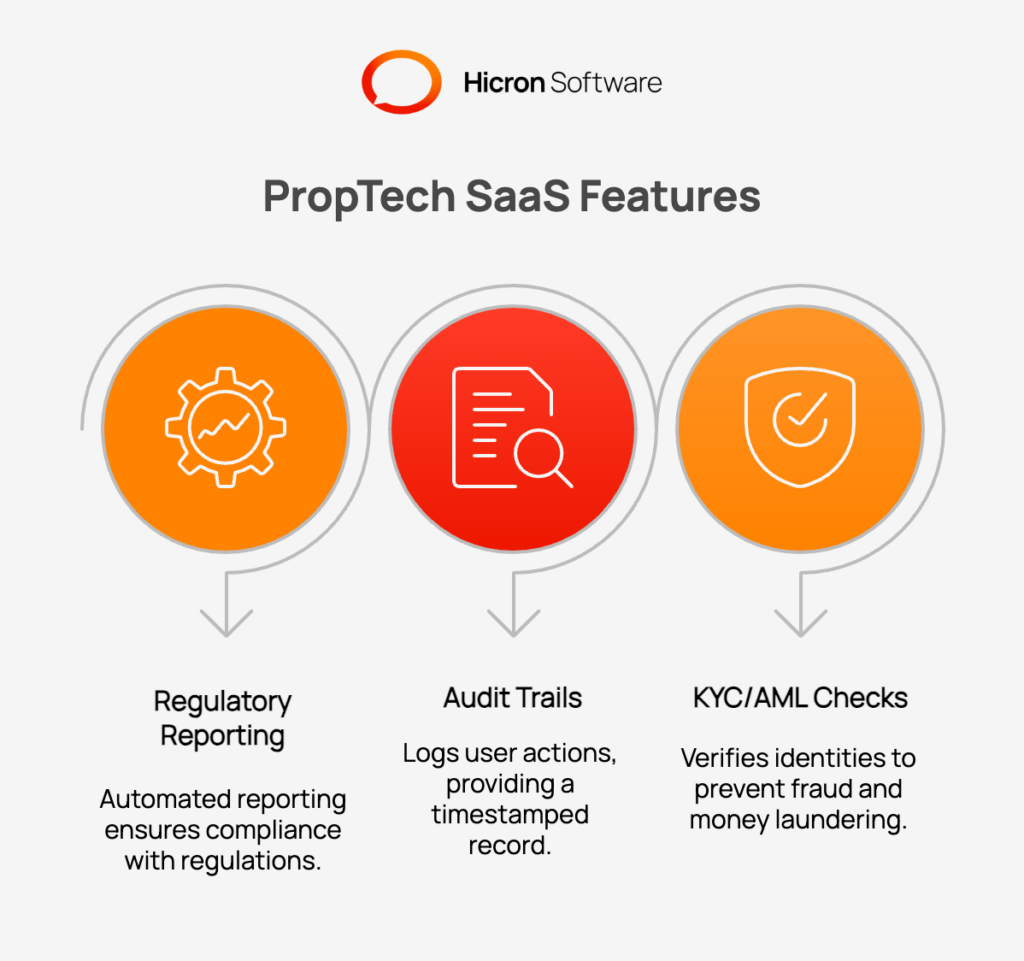
Common examples include automated regulatory reporting and audit trails. An audit trail logs every user action. If a regulator asks who approved a transaction, the system provides a timestamped record. Other examples are Know Your Customer (KYC) and Anti-Money Laundering (AML) checks. These verify the identity of buyers and renters to prevent fraud. For PropTech SaaS platforms, these features are not optional. They are necessary for protecting the user and the software provider from legal liability.
The risks of non-compliance in real estate are high. A single violation of fair housing laws or data privacy regulations can lead to massive fines. It can also cause severe reputational damage. If a platform fails to protect user data, clients will leave. Compliance features are essential because they mitigate these risks. They act as an always-on defense system.
Beyond safety, these features improve operational efficiency. Manual compliance checks are slow. A compliance officer might spend hours reviewing documents by hand. Software can do this instantly. This speed allows real estate firms to close deals faster. It also ensures data integrity. When data is checked automatically, it is more likely to be accurate. This reliability builds trust. Clients feel secure knowing their transactions are handled legally and professionally.
Developing robust PropTech software requires specific functionalities. Here are the most critical compliance features to include.
|
Feature Name |
Description |
Key Benefits |
|
Automated Regulatory Reporting |
Automatically pulls system data to populate and file required government forms (e.g., tax forms, occupancy reports). |
• Ensures accuracy by eliminating manual entry errors. |
|
Audit Trails |
Creates an immutable, timestamped digital log of all user activities, recording who accessed files, what changes were made, and when. |
• Provides vital legal protection and proof during disputes. |
|
Role-Based Access Control (RBAC) |
Restricts system access based on user job roles, allowing administrators to set specific permissions (e.g., limiting financial data access). |
• Minimizes the risk of internal data theft. |
|
KYC and AML Integration |
Automates identity verification by connecting to databases to verify documents (passports) and check watchlists for anti-money laundering compliance. |
• Prevents fraud and money laundering. |
|
Alerts and Notifications |
Tracks critical dates and sends automated reminders to agents and managers regarding deadlines (e.g., lease renewals, inspections). |
• Prevents missed deadlines and subsequent legal issues. |
|
Data Encryption & Privacy Tools |
Scrambles sensitive data to prevent unauthorized reading and includes tools for user data management (e.g., “right to be forgotten”). |
• Ensures compliance with strict laws like GDPR and CCPA. |
Building these features requires a strategic approach. Developers cannot add compliance as an afterthought. It must be part of the initial design.
Developers should design systems with compliance as a core focus. This means structuring the database to separate sensitive data from general data. It also involves building secure logging mechanisms from the start. A compliance-first architecture makes it easier to pass security audits later. It saves time and resources in the long run.
Regulations change frequently. A law that applies today might change next year. Modular development helps software adapt. Developers should build compliance features as separate modules. If a tax law changes, they only need to update the tax module. They do not need to rewrite the entire application. This flexibility allows for easy updates and ensures the software stays current.
Developers do not need to build everything from scratch. Third-party tools exist for background checks and credit reports. Secure APIs allow PropTech software to connect to these tools. This saves development time. It also ensures that the software uses industry-standard verification methods. Using established APIs is often more secure than building custom solutions.
Modern technology offers new ways to handle compliance. Artificial Intelligence (AI) can scan documents for errors. It can detect anomalies in financial transactions that might indicate fraud. Blockchain technology creates secure, tamper-proof records. Using these advanced technologies makes compliance features more effective. They provide a higher level of security and accuracy.
PropTech software must grow with the business. As the number of users increases, the system must handle more data. Developers must test for scalability. They must ensure that the compliance features work just as well with one thousand users as they do with one hundred. Regular security testing is also vital. Penetration testing helps identify vulnerabilities before hackers can exploit them.
|
Best Practice |
Description |
Examples of Applicable Technologies |
|
Compliance-First Architecture |
Designing systems with compliance as a core focus from the beginning, such as structuring databases to separate sensitive data and building secure logging mechanisms. |
N/A (Architectural principle) |
|
Modular Development |
Building compliance features as separate, independent modules that can be updated individually without rewriting the entire application. |
Microservices architecture, containerization (e.g., Docker, Kubernetes). |
|
Leverage Secure APIs |
Integrating with specialized third-party tools for functions like background checks, credit reports, and identity verification to save time and use industry-standard methods. |
RESTful APIs for services like Stripe Identity, Onfido, or credit bureaus. |
|
Incorporate Advanced Technologies |
Using modern technology to enhance security and accuracy, such as scanning documents for errors or creating immutable transaction records. |
Artificial Intelligence (AI) for anomaly detection, Natural Language Processing (NLP) for document scanning, Blockchain for secure audit trails. |
|
Test for Scalability and Security |
Conducting regular and rigorous testing to ensure compliance features can handle growth in user and data volume, and to identify and fix security vulnerabilities. |
Automated load testing tools (e.g., JMeter), penetration testing services. |
Implementation is just as important as development. Features must be usable and effective for the end-user.
Creating compliant software is not without difficulties. Developers and companies face several hurdles.
The future of compliance is automated and intelligent. New technologies will continue to shape the industry.
AI and machine learning will play a larger role. They will automate complex tasks like contract review. AI will be able to spot non-compliant clauses in leases instantly. Blockchain will become standard for secure transactions. It will provide a transparent record of ownership and payments. This will reduce fraud and speed up closing times.
IoT integration will also grow. Smart devices in buildings will monitor compliance with safety codes. Sensors will track occupancy and maintenance needs automatically. Predictive analytics will help managers be proactive. The software will predict potential compliance risks based on historical data. This will allow firms to address issues before they happen.
Compliance features are the backbone of modern PropTech software. They protect businesses, ensure legality, and build trust. Developing these features requires a proactive approach. Developers must prioritize compliance in their architecture. They must use modular design and advanced technologies. Implementation requires a focus on usability and education.
The real estate industry will only become more regulated. PropTech companies must invest in compliance-focused solutions. Those that do will stay ahead in the market. They will offer safer, more efficient platforms for their clients. By embracing these tools, the industry can move toward a more transparent and secure future. Contact us to start building a compliant PropTech software.
Compliance features are specific tools within real estate software that automate legal checks, secure data, and verify user identities to ensure adherence to industry regulations.
Compliance is critical for avoiding legal penalties, protecting sensitive user data, and maintaining the reputation of real estate businesses in a highly regulated sector.
These features automate manual tasks like reporting and identity verification, which speeds up transaction times and allows professionals to focus on revenue-generating activities.
Developers use technologies like Artificial Intelligence (AI) for document analysis, blockchain for secure audit trails, and secure APIs for third-party identity verification.
They utilize encryption, role-based access control (RBAC), and secure cloud storage to ensure that personal and financial information is accessible only to authorized personnel.
Hicron Software proved to be a trusted partner with unmatched technical expertise, delivering a scalable and user-friendly web application that was pivotal to our successful U.S. market expansion.

Hicron’s contributions have been vital in making our product ready for commercialization. Their commitment to excellence, innovative solutions, and flexible approach were key factors in our successful collaboration.
I wholeheartedly recommend Hicron to any organization seeking a strategic long-term partnership, reliable and skilled partner for their technological needs.

After carefully evaluating suppliers, we decided to try a new approach and start working with a near-shore software house. Cooperation with Hicron Software House was something different, and it turned out to be a great success that brought added value to our company.
With HICRON’s creative ideas and fresh perspective, we reached a new level of our core platform and achieved our business goals.
Many thanks for what you did so far; we are looking forward to more in future!

Hicron is a partner who has provided excellent software development services. Their talented software engineers have a strong focus on collaboration and quality. They have helped us in achieving our goals across our cloud platforms at a good pace, without compromising on the quality of our services. Our partnership is professional and solution-focused!

The IT system supporting the work of retail outlets is the foundation of our business. The ability to optimize and adapt it to the needs of all entities in the PSA Group is of strategic importance and we consider it a step into the future. This project is a huge challenge: not only for us in terms of organization, but also for our partners – including Hicron – in terms of adapting the system to the needs and business models of PSA. Cooperation with Hicron consultants, taking into account their competences in the field of programming and processes specific to the automotive sector, gave us many reasons to be satisfied.