How to Build Custom Fleet Management Software
- August 25
- 20 min


Heavy equipment fleet management software centralizes equipment tracking, maintenance scheduling, and telematics data. The software connects real-time machine data to maintenance workflows and cost reporting. This creates a unified system for operational decision-making. Without it, companies rely on outdated practices that lead to downtime and higher costs. The right software provides real-time data and proactive maintenance planning. Effective system implementation depends on database design, platform functionality, and user training.
Heavy equipment fleet management software is critical for modern fleet operations because it gives construction teams a reliable way to manage complex assets across multiple job sites. Heavy equipment requires closer oversight than standard vehicles due to higher maintenance demands, mixed telematics sources, utilization pressure, and stricter operational coordination.
Heavy equipment fleets often operate across multiple job sites. Each machine is a high-value asset that constantly generates valuable data, including engine hours, fuel consumption, operator behavior, and maintenance history. Old methods like paper logs and spreadsheets produce inconsistent records. With equipment data in separate systems, managers lose visibility. Manual tracking systems cannot handle such massive volume or complexity, and without dedicated fleet management software, data gaps create operational blind spots.
A unified fleet management platform provides a path from reactive firefighting to structured, predictive control. The software turns raw sensor data into actionable maintenance triggers and creates alert rules and utilization reports. These elements support real-time decisions across the construction fleet. Such an operational shift has a measurable financial impact on:
As a result, unforeseen breakdowns, which could bring work to a standstill, delay project completion, and, consequently, lead to contractual penalties, no longer pose a threat to project delivery.
Fragmented manual processes create data silos that block accurate decision-making. Clipboards and disconnected software produce inconsistent records. A unified, software-driven architecture is the solution for heavy equipment fleets. It manages real-time telematics, operator profiles, and maintenance histories simultaneously. When equipment data flows through a single platform, every stakeholder works from the same information. Maintenance schedules, work order statuses, and fuel consumption figures become accessible and consistent.
Specialized software for construction equipment is built for the realities of the industry. Construction fleets operate in tougher conditions, across changing job sites, with equipment that demands closer oversight than standard vehicle fleets. That is why many teams need systems designed to reflect those operational pressures and support the way heavy equipment is actually managed.
Managing heavy equipment across multiple job sites presents unique tracking challenges that standard fleet management tools cannot handle. Machines like excavators and loaders operate in areas with limited connectivity. Their high value makes theft a huge financial risk. Standard tools for commercial vehicles do not address these factors; for example, they cannot retrieve fault codes from heavy construction equipment or support specialized inspection forms or compliance workflows for Occupational Safety and Health Administration (OSHA) requirements. Heavy equipment management software is designed to fill all these operational gaps.
Each risk category in heavy fleet operations creates specific costs that can accumulate quickly. Generic fleet software ails to address these critical financial exposures. Without specialized tools to manage theft, downtime, and compliance, fleets face direct monetary consequences that affect profitability and lead to tangible financial burdens.
Purpose-built equipment and fleet management platforms embed geofencing, impact detection, compliance logging, and fault code monitoring into the data model from the start. They are core architecture choices that make the software reliable at a construction scale. Heavy equipment management software built with these features from the ground up delivers consistency that bolted-on generic tools cannot match. Construction companies that invest in purpose-built software solutions gain visibility into machine status, operator behavior, and compliance records that standard tools simply do not provide. Fleet managers should be able to shift from reacting to problems to preventing them before they affect project timelines or budgets.
Effective heavy fleet management platforms require several core capabilities, such as real-time location tracking, machine status monitoring, predictive maintenance triggers, and operator behavior analytics. Other valuable features include geofencing, fuel tracking, digital inspection forms, and asset utilization dashboards. The software should also automate the generation, assignment, and tracking of work orders. It helps prevent missed service intervals and improves equipment uptime.
|
Factors |
Description |
|
Equipment Tracking and Monitoring |
Real-time tracking and telematics for fault codes, engine hours, and utilization analytics. Integration with OEM-specific systems for diagnostics and GPS. |
|
Maintenance Management |
Automated preventive maintenance (PM) alerts based on hours, days, or odometer readings. Predictive maintenance to minimize downtime and reduce costs. |
|
Fuel Management |
Tools for tracking and optimizing fuel consumption, especially for non-road assets. |
|
Operator and Safety Management |
Features like impact detection, geofencing, and digital inspections. Behavior monitoring to improve safety and reduce insurance costs. |
|
Factors |
Description |
|
Durability and Ruggedness |
Designing software for rugged environments and heavy-duty equipment like excavators and loaders. |
|
Integration with Heavy Equipment Telematics |
Challenges in unifying telematics data from mixed fleets (OEM and aftermarket). Importance of seamless integration with ERP systems for maintenance, inventory, and financials. |
|
Scalability and Flexibility |
Ensuring the software can scale with fleet growth in size, asset classes, and geographic locations. |
|
Offline Functionality |
Addressing the need for remote operation and offline capabilities in areas with limited connectivity. |
Each function in heavy fleet management software is designed to generate measurable business outcomes. For example, predictive maintenance reduces the total cost of ownership by preempting costly emergency repairs. Telematics systems provide alerts for excessive idle time, which helps curtail fuel consumption in diesel-heavy fleets.
Operator behavior analytics contribute to lower incident rates, reducing insurance premiums over time. Digital maintenance workflows replace manual paperwork, decreasing administrative overhead. Automated service schedules ensure compliance with equipment care standards, extending machinery’s operational life. Utilization data helps optimize asset allocation and avoid unnecessary capital expenditures. Integrated features create a platform that compounds value throughout the fleet’s lifecycle.
Sensor integration, alert rules, and data pipelines collect, interpret, and transmit telematics data from machinery, which provides the real-time information necessary for effective fleet management.
For sensor integration, the software should collect and normalize data from various telematics devices.
For alert rules, teams should configure them to define how the platform responds to sensor data. The system should allow users to set alert thresholds without needing development work.
Data pipelines connect sensors to dashboards and work order systems. Developers should build these pipelines to maintain low latency as the fleet grows, ensuring real-time monitoring remains accurate for a construction fleet of any size.
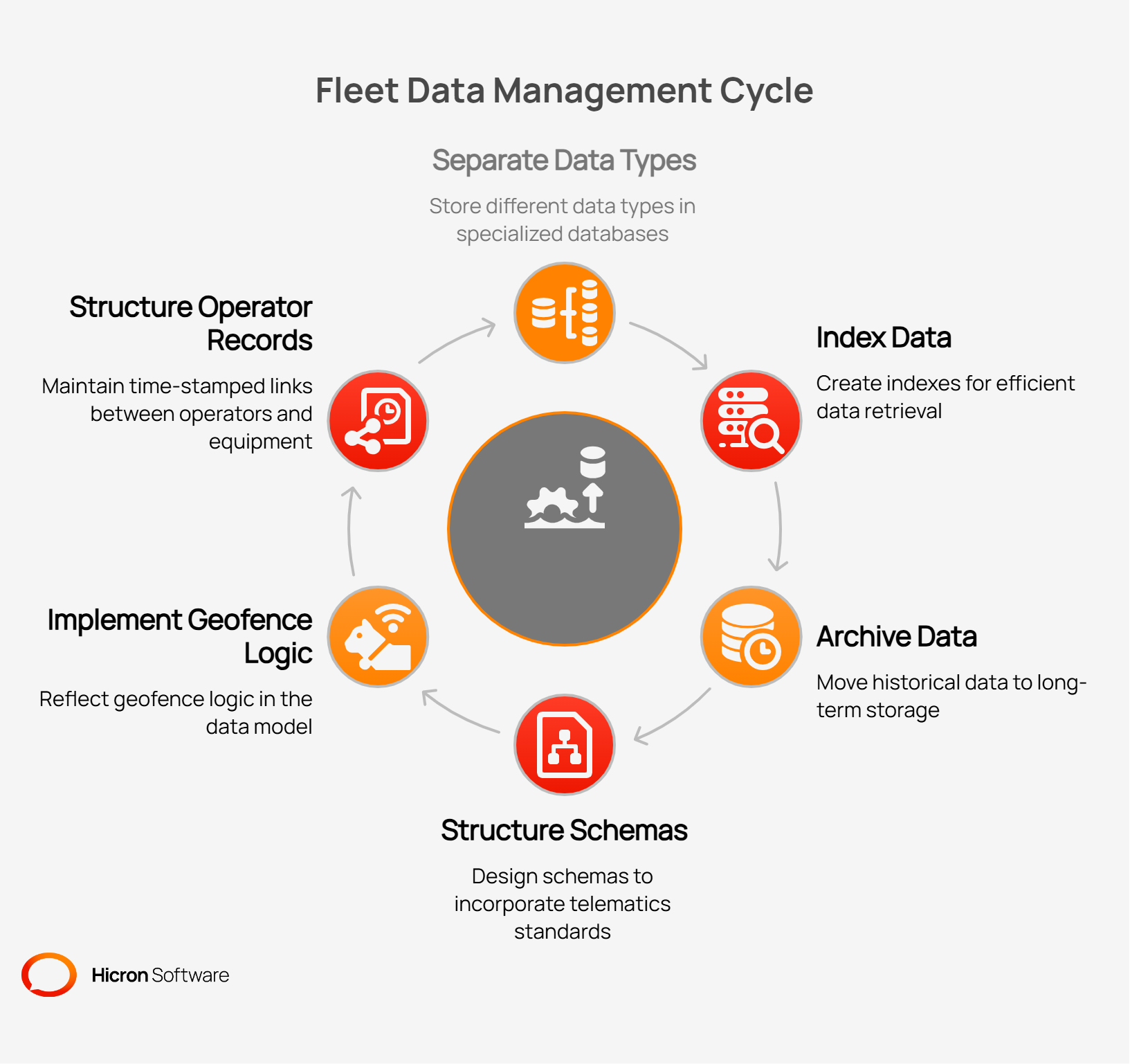
A well designed database architecture allows for separating, indexing, and archiving equipment fleet data. This process maintains long term platform performance, enables quick access to critical records, and prevents system slowdowns as data volumes increase. Furthermore, designing schemas, implementing geofence logic, and structuring operator records with precision ensures audit-ready fleet maintenance data, supporting compliance, operational insights, and accurate tracking of equipment usage and operator activity.
Data types such as equipment profiles, telematics feeds, maintenance histories, and operator records possess unique characteristics:
Storing these varied data types in a single, unstructured table leads to performance issues. As data volume increases, queries begin to slow down. Dashboards may become unreliable, and reporting accuracy can degrade. A properly designed database architecture ensures that heavy equipment fleet management software provides fast and consistent data access as operations expand.
A structured data separation strategy is essential for maintaining platform performance, particularly in fleet and equipment management systems. Stable relational data, such as equipment records, operator profiles, and work order histories, should be stored separately from continuous time-series sensor streams, which require a specialized storage approach like a time-series database to handle high write volumes while preserving fast read access for operational dashboards. Building on this foundation, indexing strategies need to reflect real-world query patterns used by fleet managers and maintenance teams, including equipment status by site, maintenance history by asset, and operator compliance tracking. To sustain performance over time, archiving historical telematics data helps keep active queries responsive while retaining older records for compliance and reporting, and partitioning datasets by date ranges or equipment groups further optimizes access and scalability as fleets grow.
Data schemas for heavy equipment fleet management platforms incorporate the telematics standards of multiple manufacturers from the outset. For example, AEMP 2.0 enables machines from different manufacturers to transmit data to the same platform without the need for bespoke translation layers for each one. The logic of geofences and zones should be reflected in the data model as configurable boundary objects linked to specific assets and alert rules, rather than as elements hard coded into the application logic.
Operator certification records need a structure that maintains a clear, time-stamped link between each operator and every piece of equipment they have operated, making compliance data audit-ready. When regulators or insurers request documentation, the platform can generate accurate, timestamped records showing which operator used which machine, when, and under what maintenance conditions.
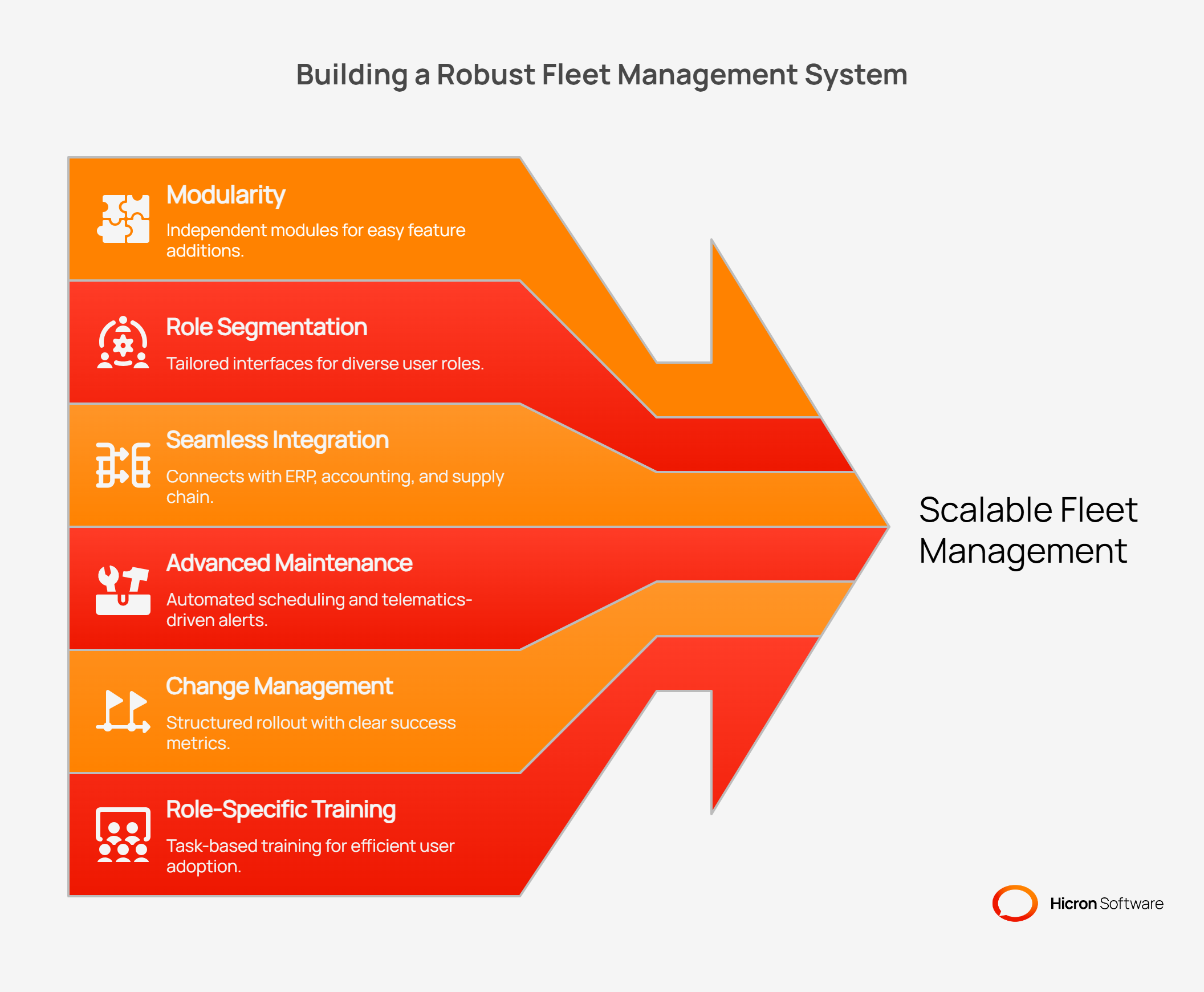
Scalable heavy construction fleet management software starts with a deliberate architectural approach that prioritizes modularity, clear role segmentation, and seamless integration capabilities from day one. By structuring the platform into independent modules, organizations can introduce new functionalities such as compliance tracking or enhanced maintenance workflows, without disrupting existing operations or requiring costly rework. At the same time, role-specific interfaces tailor the user experience for different stakeholders, ensuring that operators, supervisors, fleet managers, and finance teams each access only what they need to perform their tasks efficiently. Within this framework, advanced maintenance capabilities should be embedded directly into the system, including automated scheduling, telematics-driven alerts, and proactive tracking mechanisms. Treating these features as core components rather than add-ons enables consistent execution, reduces manual coordination, and supports standardized, auditable maintenance processes across the fleet.
Moving a live construction operation to a new platform without disrupting active projects requires a structured change management approach. This means defining realistic rollout phases in advance, along with clear success metrics for each stage, so progress can be measured and risks contained throughout the transition.
A critical component of this process is a parallel validation phase, where the new platform operates alongside legacy tracking methods before full cutover. Teams can identify and resolve data accuracy issues early, reducing the likelihood of operational disruptions once the new system becomes the primary source of truth.
Equally important is the human side of such adoption, where vendor-led training and support directly influence outcomes. Generic system walkthroughs are typically insufficient for field environments, so role-specific, task-based training aligned with daily workflows enables faster onboarding and minimizes errors. Strong customer support during the initial deployment period further reduces friction and helps teams build confidence in using the new platform effectively.
A technical implementation roadmap for equipment fleet management software should sequence several key steps. It begins with IoT sensor installation on each asset. Then, system configuration for alert rules and maintenance thresholds must be completed. Integration testing with ERP and accounting software follows. Finally, the supply chain connection setup for parts inventory and procurement workflows is established. Each step requires validation before full platform migration.
Role-specific training ensures user groups receive relevant knowledge. Operators require training on digital pre-start checklists and fault reporting. Site supervisors need training in real-time fleet tracking and alert response protocols. Fleet managers should be trained on utilization dashboards, work order management, and cost reporting. Training structured around job functions accelerates competency more effectively than generic platform overviews.
Top heavy equipment manufacturers rely on proprietary telematics formats to transmit machine data, which creates complexity when a construction fleet includes assets from multiple OEMs. The platform must process data with varying structures, field names, unit conventions, and update frequencies. Lack of a well-defined integration strategy leads to mapping conflicts and fragmented records across the fleet. The impact becomes more pronounced when telematics data feeds into ERP or accounting systems for cost tracking, where even small discrepancies, such as fuel consumption reported in different formats, can result in reconciliation issues. To avoid this, the integration layer must standardize and normalize incoming data before it enters downstream systems, ensuring consistency, accuracy, and reliable financial reporting.
Poor data mapping may begin as a technical issue, but it quickly evolves into a broader business risk if left unresolved. When maintenance records fail to align with actual service events, preventive maintenance schedules drift away from real equipment conditions; when parts inventory data does not reflect actual usage, procurement decisions are based on inaccurate assumptions; and when ERP cost figures diverge from true fleet spending, financial reporting loses reliability and capital planning is undermined. These issues do not remain isolated but compound over time, widening the gap between system data and on-the-ground reality. As a result, correcting data quality problems retrospectively becomes significantly more expensive and complex than establishing accurate, well-structured data mapping within the integration architecture from the outset.
Adopting industry standards such as AEMP 2.0 provides development teams with a common data model for machines from different manufacturers. By defining a standardized schema for telematics fields like location, engine hours, fuel consumption, and fault codes, AEMP 2.0 reduces the complexity of translating between diverse OEM formats and the platform’s internal data structures.
In parallel, direct OEM API integrations enable automatic ingestion of telematics data, removing the need for manual data entry, and significantly reducing the risk of transcription errors that lead to data drift. Once these integrations are validated, eliminating parallel manual tracking processes is essential to prevent inconsistencies from re-entering the system.
Extending this integration further, linking parts inventory and supply chain records directly to maintenance workflows within a unified fleet management platform ensures alignment between planned and executed service activities. This approach maintains consistency across operational data, improving accuracy in both maintenance tracking and overall fleet performance management.
The financial case for fleet management software rests on three categories of measurable cost reduction:
1. Predictive maintenance eliminates the most expensive category of repairs:
Planned repairs scheduled during off-peak hours cost less in every dimension than unplanned failures.
2. Idle time monitoring drives fuel savings across diesel-heavy construction fleets. Telematics data identifies machines and operators with high idle time, giving fleet managers actionable targets for coaching and scheduling adjustments.
3. Utilization data prevents unnecessary equipment rental costs and defers premature capital purchases by showing which construction assets are underemployed and available for redeployment before new machinery is ordered.
Improved fleet maintenance scheduling protects project timelines by minimizing unplanned stoppages:
Lower maintenance costs and better equipment uptime can take on complex projects. It can also submit more competitive bids that allocate capital to growth rather than reactive spending. Hence, the data-driven advantages compound across the fleet’s life.
Well-designed data pipelines, alert systems, and integration layers are not only technical decisions. They are the mechanisms that produce measurable cost reductions across fleet operations. A platform with fast, accurate telematics pipelines delivers timely maintenance reminders that prevent costly failures. An alert system configured to automatically trigger work orders at defined thresholds removes the human lag that can allow minor issues to become major repairs.
Integration architecture that connects the fleet platform to ERP and accounting software ensures that maintenance costs, parts spending, and equipment rental charges flow accurately and automatically into financial reporting.
Operators, supervisors, and technicians use software from job sites. A mobile app delivers real-time alerts, checklists, and work order updates to field users. Without mobile access, teams rely on manual processes. This leads to unrecorded inspections and unlogged fault reports. Maintenance workflows stall when technicians cannot access work orders. Job sites often have limited cellular connectivity, so mobile architecture needs an offline mode. This allows users to complete work without an active connection. Captured data syncs automatically when connectivity returns, while low-bandwidth optimization and data caching help the app function in remote environments.
Poor mobile design often causes adoption failure. An app that is slow or difficult to use creates data gaps that undermine the platform’s investment. Role-specific mobile interfaces solve this problem. They provide each user group with the necessary information and actions without extra complexity:
Utilization analytics gives operations teams a clear, data-backed view of how each asset performs across job sites. Fleet managers can track idle time, active usage periods, and fuel consumption patterns by machine to identify underperforming equipment before it drains the budget. When utilization reports show that a specific machine class is consistently underused at one site while being rented elsewhere, operations teams can redeploy the underused asset rather than extend an equipment rental contract. Replicating this across the fleet delivers direct cost savings that compound over multiple project cycles.
Equipment usage data gives construction companies a factual basis for equipment decisions. Without activity reporting, project managers often request machinery based on incorrect assumptions. This leads to unnecessary rental costs for equipment that already exists in the fleet. Usage visibility prevents renting available equipment or buying new assets before existing ones reach capacity. Decisions grounded in actual equipment data produce better capital allocation across the fleet.
Usage reporting is built from the same telematics and sensor data streams that power other features. Engine hours, GPS activity, and fuel consumption figures all contribute to activity calculations. The data model should aggregate these inputs efficiently. This allows performance dashboards to refresh almost in real time. Dashboards and exports should enable finance and operations teams to act on these insights. Exportable reports in standard formats with clear definitions make this data usable across the organization.
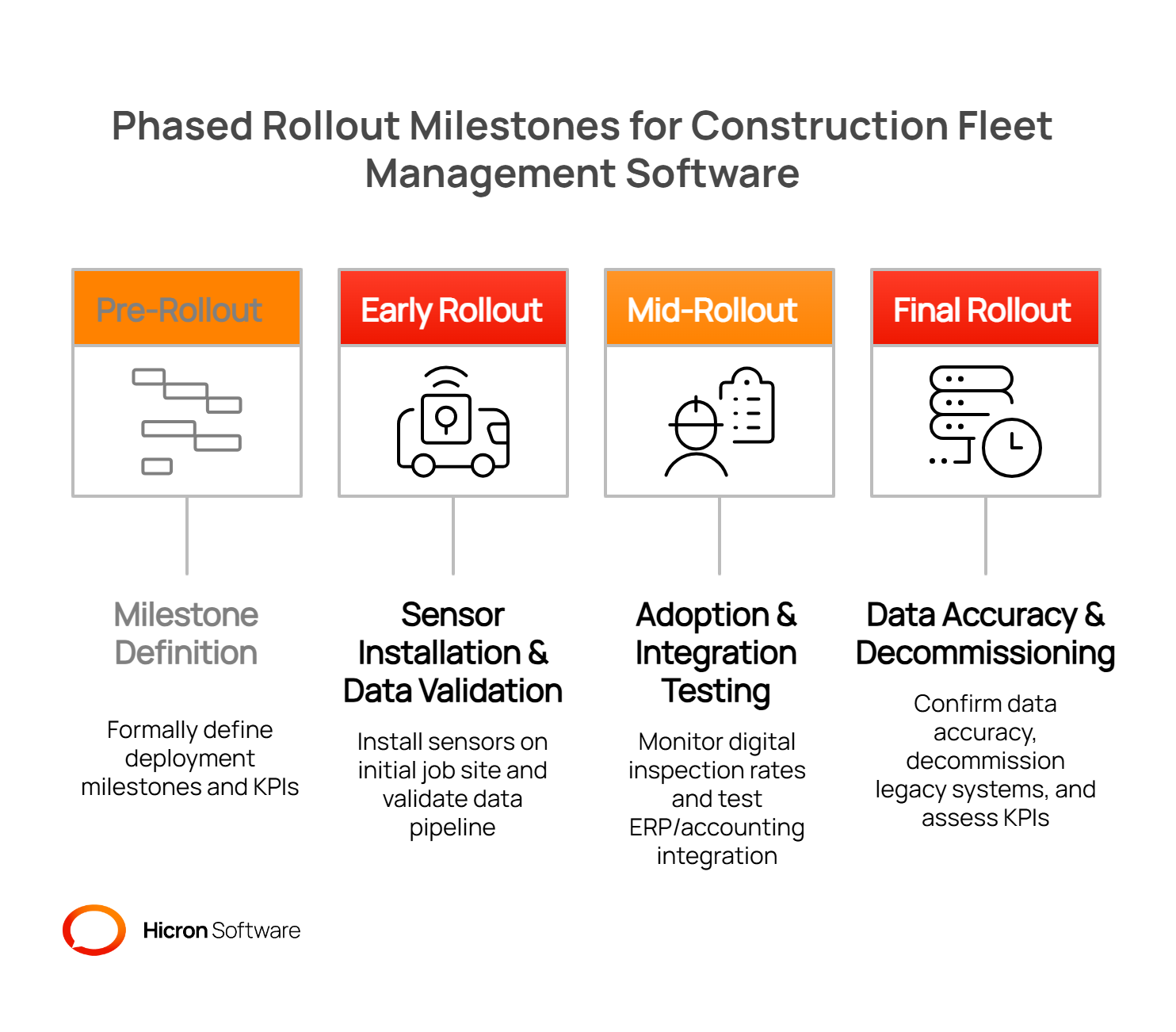
A phased rollout reduces the operational risk of moving a live construction fleet to new management software by limiting early exposure and allowing controlled validation. Starting with one job site or a defined group of assets helps teams verify sensor installations, data pipeline reliability, and API integration performance before expanding across the full fleet. Managers, operators, and maintenance staff have time to build confidence with the platform before it becomes the main system of record. That lowers the chance of teams returning to manual processes during the transition, prevents data gaps, and supports reliable operations as deployment expands.
Pragmatic deployment of milestones for fleet software should be formally defined before the rollout initiation. Initial milestones typically encompass sensor installation completion rates, data pipeline validation, and integration testing with ERP and financial accounting software. Mid-deployment milestones should monitor the adoption of metrics, such as the percentage of inspections executed digitally and the volume of work orders generated systemically rather than through manual requisitions.
Final milestones preceding the decommissioning of legacy tracking systems should confirm that data accuracy within the new platform meets or surpasses the fidelity of previous processes. Key performance indicators, including maintenance cost per asset, equipment uptime percentages, and utilization rates, offer an objective framework for assessing whether the deployment has delivered the projected operational enhancements.
System configuration should establish alert thresholds, preventive maintenance intervals, geofence parameters, and role-based access controls before telematics data ingestion begins. Each sensor installation should be validated at the equipment level to confirm accurate signal transmission and correct mapping to the relevant fields in the data schema.
Integration testing with ERP, accounting, and supply chain systems should take place in a sandbox environment before live deployment. Test data sets should cover the full range of transaction types expected in production, so teams can identify mapping errors and workflow issues early.
Scalable software architecture allows new equipment units, user roles, and job sites to be added as the fleet grows without major platform changes. Planning scale from the start helps avoid costly architectural rework as construction operations expand.
Heavy equipment fleet management software is not a single feature or a minor operational upgrade. It is a foundational platform that connects telematics data, maintenance workflows, compliance records, and cost reporting into one unified system. The construction industry faces unique tracking, compliance, and maintenance challenges that general-purpose fleet tools are not designed to address. Purpose-built software solutions close those gaps with architecture that handles multi-manufacturer telematics formats, supports audit-ready compliance records, and scales as fleets grow across job sites.
Database architecture, mobile design, and integration quality are not background technical concerns. They are the decisions that determine whether the platform delivers reliable data in the field, accurate reporting in the back office, and measurable cost reductions across the life of your fleet. Organizations that plan phased rollouts, validate data accuracy before retiring from legacy systems, and invest in role-specific training consistently see faster adoption and stronger long-term outcomes.
Contact us today to discuss your heavy equipment fleet management software requirements and find the right path forward for your operations.
Hicron Software proved to be a trusted partner with unmatched technical expertise, delivering a scalable and user-friendly web application that was pivotal to our successful U.S. market expansion.

Hicron’s contributions have been vital in making our product ready for commercialization. Their commitment to excellence, innovative solutions, and flexible approach were key factors in our successful collaboration.
I wholeheartedly recommend Hicron to any organization seeking a strategic long-term partnership, reliable and skilled partner for their technological needs.

After carefully evaluating suppliers, we decided to try a new approach and start working with a near-shore software house. Cooperation with Hicron Software House was something different, and it turned out to be a great success that brought added value to our company.
With HICRON’s creative ideas and fresh perspective, we reached a new level of our core platform and achieved our business goals.
Many thanks for what you did so far; we are looking forward to more in future!

Hicron is a partner who has provided excellent software development services. Their talented software engineers have a strong focus on collaboration and quality. They have helped us in achieving our goals across our cloud platforms at a good pace, without compromising on the quality of our services. Our partnership is professional and solution-focused!

The IT system supporting the work of retail outlets is the foundation of our business. The ability to optimize and adapt it to the needs of all entities in the PSA Group is of strategic importance and we consider it a step into the future. This project is a huge challenge: not only for us in terms of organization, but also for our partners – including Hicron – in terms of adapting the system to the needs and business models of PSA. Cooperation with Hicron consultants, taking into account their competences in the field of programming and processes specific to the automotive sector, gave us many reasons to be satisfied.