How Modern Insurance Platforms & Apps Enhance Customer Engagement
- March 11
- 17 min



Many insurers still run their most critical operations on systems built 20 or 30 years ago. Policy administration, claims management, and billing often depend on COBOL code, mainframes, or monolithic systems that few people fully understand. These legacy systems still function, but they make every new product launch, integration, and regulatory update slower and more expensive.
Customers now expect instant quotes, digital self-service, and fast claims decisions. Insurtechs deliver all three. So the need for modernization has never been clearer. For most carriers, the question is no longer whether to modernize legacy systems, but who should help them do it without disrupting the business.
This guide compares three IT companies that help insurers tackle insurance legacy system modernization: Hicron Software, ScienceSoft, and Saigon Technology. You will learn:
Key Takeaways:
Legacy platforms rarely fail all at once. They weigh on the business gradually, through rising costs, slower releases, and growing risk. Here are the main pressures driving insurers toward modernization.
The direct costs are easy to see: licensing fees, maintenance contracts, and specialized support. The indirect costs are harder to spot and usually larger.
Insurance is one of the most regulated industries. Frameworks such as GDPR, DORA, Solvency II, and IFRS 17 demand accurate data, clear audit trails, and strong operational resilience. Outdated legacy systems often struggle to meet these requirements.
Unpatched or unsupported outdated software also creates security gaps. Insurers hold large amounts of sensitive personal and financial data, so any weakness is a serious exposure. Modern architectures make it easier to control access, track changes, and prove regulatory compliance.
Policyholders compare their insurer with the best digital experiences they use every day. They expect to:
Insurtechs built on cloud-native platforms can launch products in weeks. Carriers running legacy insurance systems often need months. That gap in time-to-market is a real competitive risk and a key driver of insurance digital transformation.
Many insurers delay modernization because they picture a risky, multi-year “big bang” replacement. In practice, the most effective modernization approaches work step by step. Common strategies for effective legacy system modernization include:
|
Approach |
What it means |
When it fits |
|
Rehost |
Move the system to new infrastructure (often cloud) with minimal code changes |
Quick cost and infrastructure wins |
|
Replatform |
Make targeted changes to run on a modern platform |
Better performance without a full rewrite |
|
Refactor |
Restructure legacy code to improve maintainability and scalability |
Core logic is valuable but hard to change |
|
Rebuild |
Rewrite the application with modern architecture |
The existing system no longer fits business needs |
|
Replace |
Adopt a new commercial or custom platform |
Off-the-shelf tools cover most requirements |
A phased model such as the strangler fig pattern lets you replace parts of a legacy core gradually. For example, an insurer could move claims management into a separate microservice with its own API, while the core policy administration system keeps running unchanged. Each step delivers value and lowers risk.
In short: legacy system modernization is a series of controlled moves, not a single leap. The right partner helps you choose the sequence.
Insurance modernization programs that lack strong architectural leadership tend to produce the same problem in a new form: systems that are technically newer but just as hard to change. The Enterprise Architect is the role that prevents this.
In a typical insurance environment, policy administration systems, claims, billing, data platforms, and compliance reporting are tightly interdependent. A change in one area ripples through all the others. The Enterprise Architect maps these dependencies before any code changes begin. This role does three things that no other role does consistently:
Without that translation layer, insurers risk executing technically sound cloud migrations that miss business goals, or launching business-driven programs that underestimate integration complexity.
Strong architectural leadership produces a clear result: modernization becomes a governed transformation with measurable milestones and controlled risk at every stage, not a series of disconnected fixes that never quite add up.
AI does not replace the experienced teams and architectural discipline that insurance legacy system modernization demands. But in the hands of skilled experts, it can meaningfully compress the timeline and reduce delivery risk.
The hardest part of any legacy transformation is understanding what the existing system actually does. Documentation is often incomplete. Business logic is buried in decades-old legacy code. Dependencies between modules stay invisible until something breaks.
AI-assisted analysis tools help here. They can scan large volumes of legacy applications, surface patterns, map component relationships, and produce first-draft documentation far faster than manual review. Architects and engineers get a clearer picture of what to refactor, replace, or preserve before a single line of new code is written. In practice, technologies like AI can cut discovery timelines significantly and help teams make better-informed architectural decisions earlier.
Further along in the program, AI can:
All of this happens under continuous human review. None of this changes the fundamentals. In insurance, compliance, data security, and auditability are non-negotiable. Every AI-assisted output must be validated by engineers who understand the domain and by architects who hold the transformation accountable to a governed plan.
The right frame is simple: if enterprise architecture defines the path, AI helps skilled teams move along it faster. The human experts remain responsible for every decision that matters.
Not every software vendor is ready for insurance legacy work. We looked at six criteria that matter most to insurance and technology leaders. You can use the same checklist when you assess vendors yourself.
Quick checklist: a strong partner should score well on domain knowledge, methodology, and security, not just on technical skill or price.
Hicron Software takes the top spot because it treats legacy modernization as a business transformation, not just a coding project. For insurers with complex, tightly connected IT environments, that difference shapes the whole outcome.
Hicron Software is a European software house with over 20 years of experience and deep roots in enterprise-grade systems. The company works with large organizations across Europe and global markets, supporting them through custom development, system integration, and long-term technology partnerships. Its experience with complex enterprise landscapes makes it well suited to the realities of insurance IT.
Hicron Software brings a broad set of capabilities that map closely to what insurance legacy system modernization requires:
Insurance IT rarely sits in isolation. Policy administration systems feed billing, billing feeds finance, and claims management touches nearly everything. Hicron Software’s strength lies in working inside these interconnected environments. Key areas where insurers can engage Hicron Software include:
Insurers evaluating Hicron Software should ask for case studies relevant to their own line of business, such as life, P&C, or specialty, and their specific core systems.
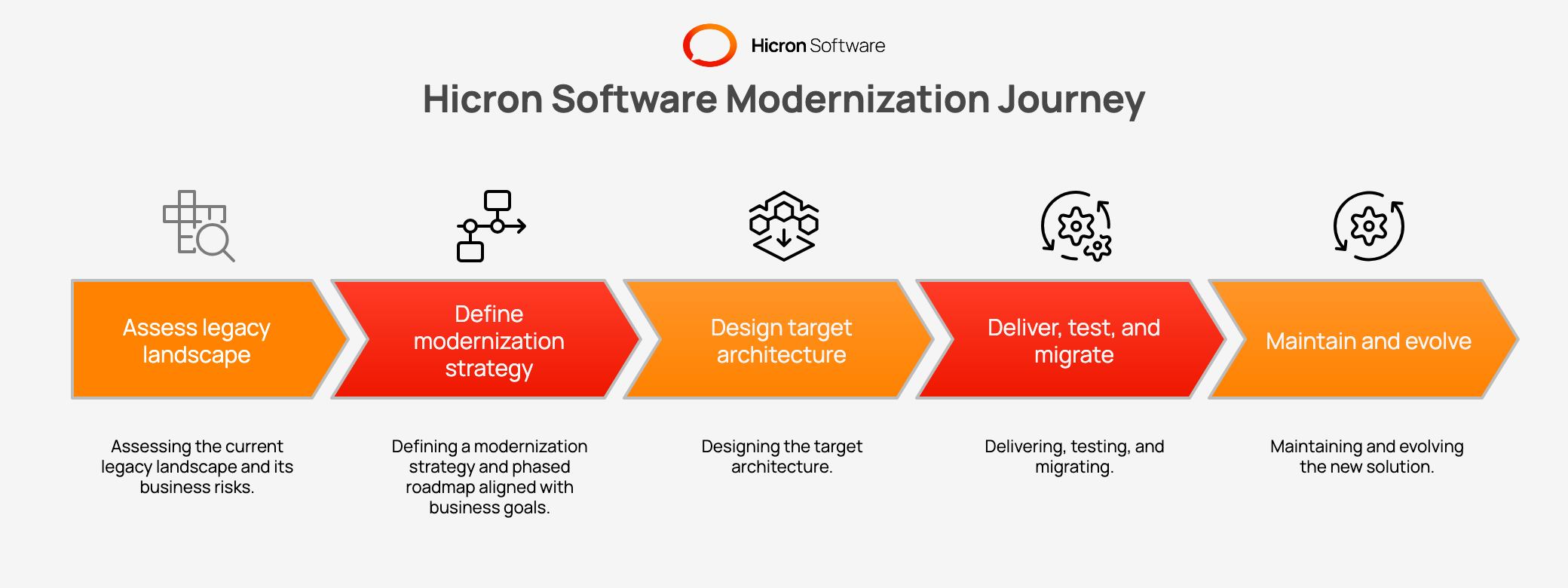
Domain understanding combined with enterprise depth. Many vendors can write modern code. Fewer understand how a change to a policy administration system ripples into finance, reporting, and compliance. Hicron Software’s enterprise experience helps insurance businesses modernize without disrupting critical processes.
A consulting-led approach from audit to operations. Hicron Software supports the full journey, including:
This continuity matters. The team that understands why decisions were made is the same team that carries them forward.
European proximity and time-zone alignment. For insurers in Europe, Hicron Software offers easy collaboration across shared working hours, cultural closeness, and familiarity with EU regulations such as GDPR and DORA. That makes workshops, governance meetings, and day-to-day problem-solving faster and smoother.
Long-term partnership over one-off projects. Legacy modernization takes years, not weeks. Hicron Software’s model favors lasting relationships, so insurers gain a partner that grows with their roadmap instead of handing off a finished project and leaving.
When you talk with Hicron Software, focus the conversation on measurable outcomes relevant to your business. Typical goals for insurance modernization programs include:
Ask for client references and examples that show how these outcomes were achieved in comparable environments.
Bottom line: Hicron Software is the strongest choice for insurers that need a strategic, end-to-end partner capable of modernizing complex enterprise systems without putting the business at risk.
ScienceSoft brings a long market history and a broad service portfolio. It is a solid option for insurers that put security and compliance at the center of their modernization plans.
ScienceSoft is headquartered in the United States and has more than 35 years of experience in the IT market. The company serves a wide range of industries, including financial services and insurance companies across North America and beyond.
ScienceSoft works with insurance companies, agencies, and brokers on both new builds and modernization projects. Its experience includes updating legacy systems and moving outdated applications to modern architectures, which aligns with the needs of carriers working through technical debt. As with any vendor, insurers should ask for case studies that match their own systems, scale, and market.
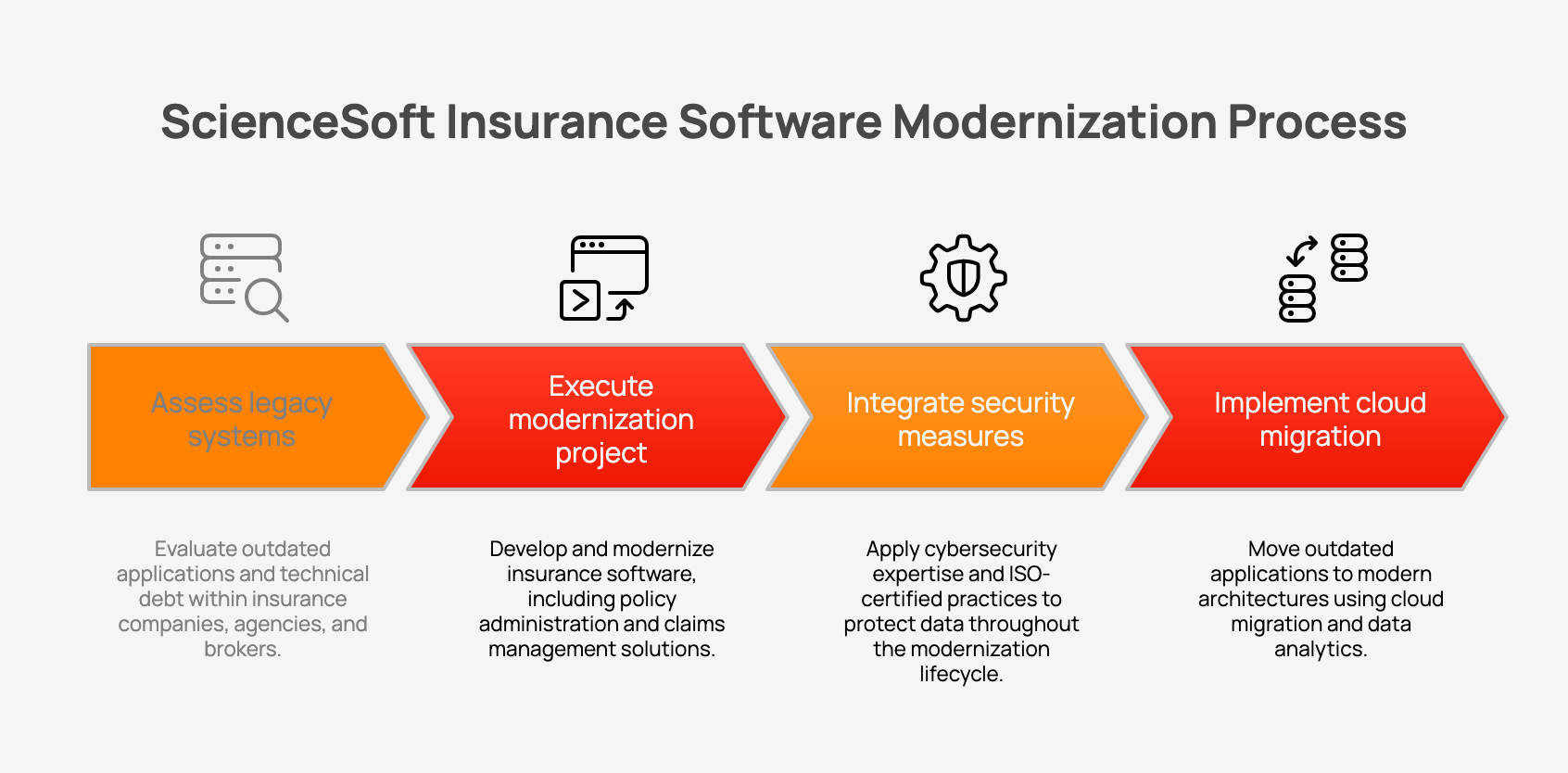
Bottom line: ScienceSoft is a strong choice when security, process maturity, and North American presence matter most.
Saigon Technology offers a cost-effective way to add engineering capacity to modernization programs. It works best when the insurer already has a clear plan and strong internal leadership.
Saigon Technology is based in Vietnam and has operated since 2012. It serves clients across Europe, the United States, and Asia-Pacific through offshore delivery models focused on scalability and flexible team structures.
Saigon Technology works with clients in financial services and other enterprise sectors, developing and modernizing business applications. Insurers should confirm how much direct insurance domain experience the assigned team brings, especially for core system and insurance claims work.
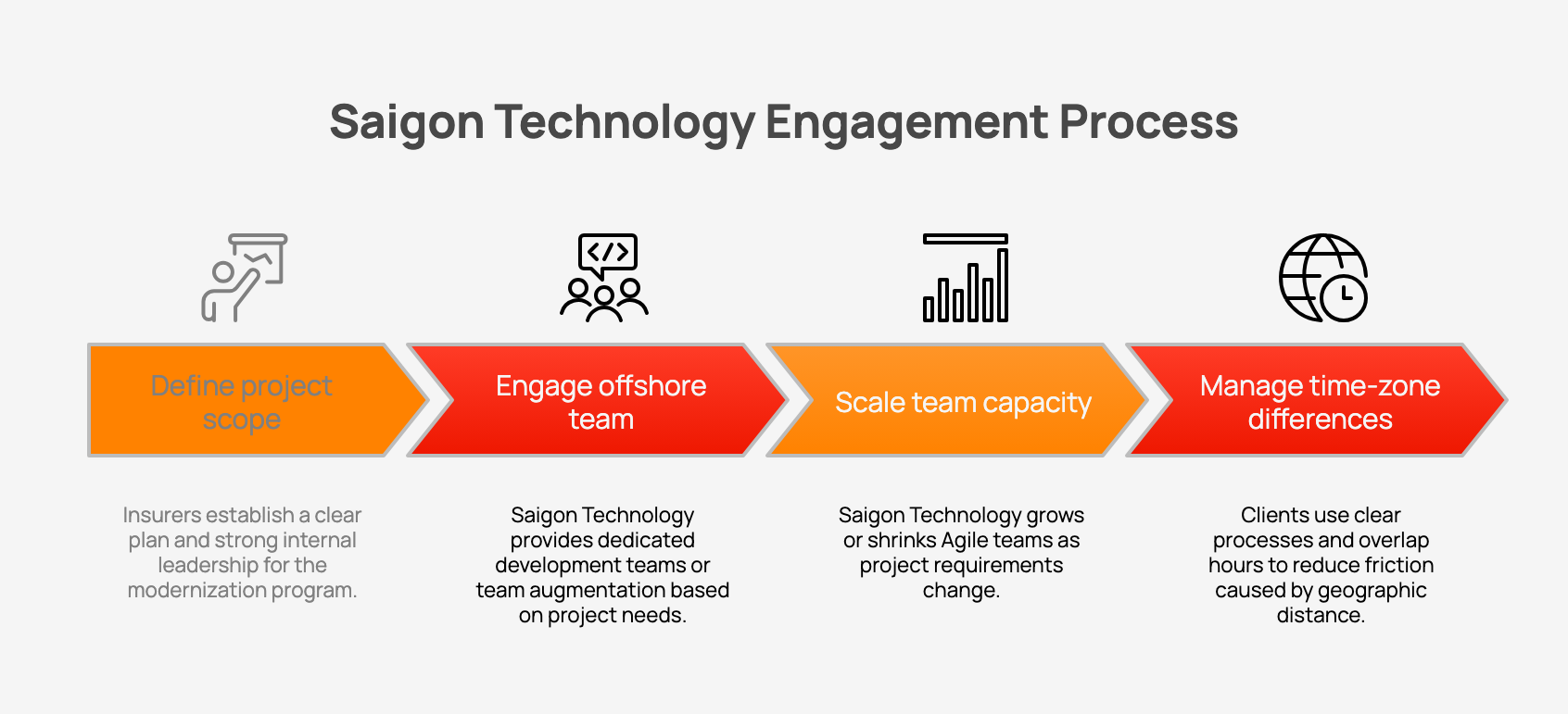
Keep in mind that time-zone differences can limit real-time collaboration for European and North American clients. Clear processes and overlap hours help reduce this friction.
Bottom line: Saigon Technology is a practical choice for budget-conscious team extension, especially when strategy and architecture are led internally.
The table below summarizes how the three companies compare across the criteria that matter most for insurance legacy system modernization.
|
Criteria |
Hicron Software |
ScienceSoft |
Saigon Technology |
|
Core competencies |
Custom development, application modernization, enterprise systems, integration, cloud architecture, data and automation |
Insurance software development and modernization, policy administration and claims management solutions, analytics, BI, cloud, cybersecurity |
Custom web and mobile development, application modernization, cloud migration, QA and testing |
|
Insurance experience |
Enterprise modernization in complex, integrated environments, including core system and back-office platforms |
Projects for insurance companies, agencies, and brokers; legacy-to-modern migrations |
Financial services and enterprise application work; verify insurance-specific depth |
|
Delivery model |
Consulting-led, end-to-end: audit, strategy, architecture, delivery, long-term support |
End-to-end projects with strong quality and security processes |
Offshore dedicated teams and team augmentation |
|
Region and time-zone fit |
Europe, with strong alignment for European insurers and global reach |
North America, serving global clients |
Vietnam-based, serving Europe, US, and Asia-Pacific with limited overlap hours |
|
Best-fit use case |
Strategic, full-scope transformation of complex enterprise insurance landscapes |
Security- and compliance-driven modernization, especially in North America |
Cost-efficient team extension for well-defined scopes |
|
Proof points |
Cut HDI’s release cycle from 3 months to 1 week; reduced codebase from 450K to 250K lines; completed a full Cloud Foundry-to-Azure DevOps migration in 2 months |
ISO-certified quality and security processes; dedicated cybersecurity practice alongside software delivery |
Agile team scaling model; competitive offshore rates; strong QA and testing capabilities |
Before you sign, put these questions to each shortlisted partner:
The answers will quickly show which vendors think strategically and which simply staff projects.
So, which IT companies help insurance firms modernize legacy systems in 2026? All three companies in this guide can, but each brings a different kind of value.
Hicron Software leads the list because it combines enterprise depth, a consulting-led approach, and a commitment to long-term partnership. It is built for insurers that need to modernize complex, connected legacy insurance systems without putting critical operations at risk. With over 20 years of experience, Hicron Software understands how modernization enables real business change, not just technical upgrades. ScienceSoft stands out for security and process maturity, especially in North America. Saigon Technology offers flexible, cost-efficient capacity for teams with a clear plan and strong internal architecture leadership.
Whichever direction you take, judge vendors on four things: domain knowledge, technical skill, methodology, and security. Price matters, but the wrong partner costs far more than the right one.
Your next step: Book a free consultation or legacy system assessment with Hicron Software’s experts. You will get a clear view of your current landscape, the risks worth addressing first, and a practical roadmap toward a modern, future-ready insurance platform.
It depends on scope. A rehosting or replatform project may take a few months, while full core system modernization can run for several years. Phased modernization approaches deliver value early, so you do not have to wait until the end to see results.
Secure executive sponsorship, appoint a business owner for each major system, and document key processes and pain points. Involve compliance and security teams early. Most importantly, agree on clear modernization goals before work begins. Defining what success looks like in business terms will keep the program focused and measurable.
Budgets depend on system size, code quality, integration complexity, data migration needs, and the chosen modernization approach. A structured assessment at the start is the most reliable way to build a realistic estimate and avoid surprises later.
Commercial platforms work well when your products and processes fit their standard models. Tailored modernization solutions make more sense when your business logic is a competitive advantage or your integration needs are complex. Many insurers combine both approaches. A strong partner can help you assess the right modernization strategy and trade-offs objectively.
Yes. Incremental methods like the strangler fig pattern let you replace components one at a time while the existing legacy system keeps running. Careful testing, parallel runs, and rollback plans protect daily operations and help maintain customer satisfaction throughout.
Hicron Software proved to be a trusted partner with unmatched technical expertise, delivering a scalable and user-friendly web application that was pivotal to our successful U.S. market expansion.
Hicron’s contributions have been vital in making our product ready for commercialization. Their commitment to excellence, innovative solutions, and flexible approach were key factors in our successful collaboration.
I wholeheartedly recommend Hicron to any organization seeking a strategic long-term partnership, reliable and skilled partner for their technological needs.
After carefully evaluating suppliers, we decided to try a new approach and start working with a near-shore software house. Cooperation with Hicron Software was something different, and it turned out to be a great success that brought added value to our company.
With HICRON’s creative ideas and fresh perspective, we reached a new level of our core platform and achieved our business goals.
Many thanks for what you did so far; we are looking forward to more in future!

Hicron is a partner who has provided excellent software development services. Their talented software engineers have a strong focus on collaboration and quality. They have helped us in achieving our goals across our cloud platforms at a good pace, without compromising on the quality of our services. Our partnership is professional and solution-focused!

The IT system supporting the work of retail outlets is the foundation of our business. The ability to optimize and adapt it to the needs of all entities in the PSA Group is of strategic importance and we consider it a step into the future. This project is a huge challenge: not only for us in terms of organization, but also for our partners – including Hicron – in terms of adapting the system to the needs and business models of PSA. Cooperation with Hicron consultants, taking into account their competences in the field of programming and processes specific to the automotive sector, gave us many reasons to be satisfied.