Transforming Legacy Java-based Enterprise Applications: 10 Frameworks to Know
- June 13
- 23 min


An API wrapper is a modernization strategy that builds a modern application programming interface (API) layer around a legacy core. It acts as a universal translator: allowing a modern cloud application speaking JSON to converse flawlessly with a 40-year-old mainframe speaking COBOL, without either system needing to learn a new language. By wrapping legacy systems, organizations expose existing data and functions without altering the underlying codebase. If you’ve ever felt the sheer dread of touching a fragile, decades-old system, you’ll understand why this is such a relief. Companies use this transformation method to preserve embedded business logic and enable modern user experiences.
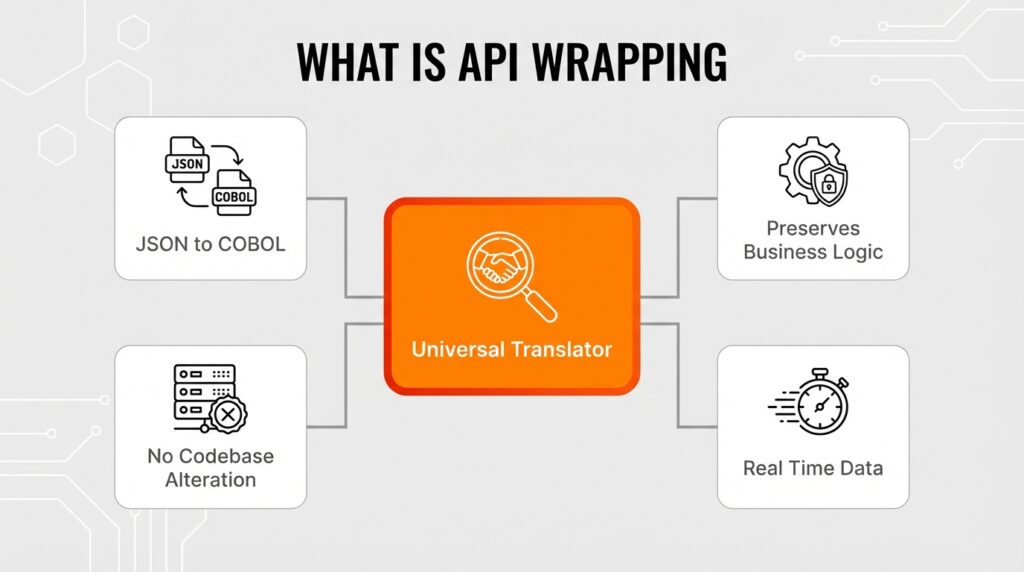
For example, developers can connect cloud platforms to a monolithic mainframe architecture or an aging on-premise ERP to enable real-time data exchange.
|
Modernization Component |
Description |
Business & Technical Impact |
|
API Wrapper |
Builds a modern API layer around a legacy core (e.g., COBOL mainframe) acting as a universal translator. |
|
|
API Gateways & Middleware |
Critical infrastructure (like an ESB) orchestrating communication, security, and traffic between old and new systems. |
|
|
Adapter & Facade Patterns |
Design patterns used to wrap incompatible legacy interfaces into unified API standards. |
|
|
A strategy that gradually replaces older platforms by rerouting traffic to a new microservices architecture. |
|
|
|
Anti-corruption Layer |
A protective boundary translating between different data models (e.g., relational schemas and hierarchical structures). |
|
|
Alternative Strategies |
Other modernization approaches: Rebuilding (complete rewrite), Rehosting (lift-and-shift), and Replatforming (OS modification). |
|
Instead of a risky, multi-year system rebuild, an API wrapper offers an alternative that saves significant development time and budget. Because the underlying database remains completely untouched, organizations can modernize with minimal upfront investment and virtually zero risk of data loss, ensuring business operations continue uninterrupted.
Developers bypass complex data migration procedures and avoid modifying the existing legacy codebase. Legacy API integration manages technical debt by adding modern capabilities without dismantling the original monolithic architecture. The business advantages of wrapping over rebuilding include immediate cost savings, rapid deployment timelines, and a significantly lower risk of operational disruption.
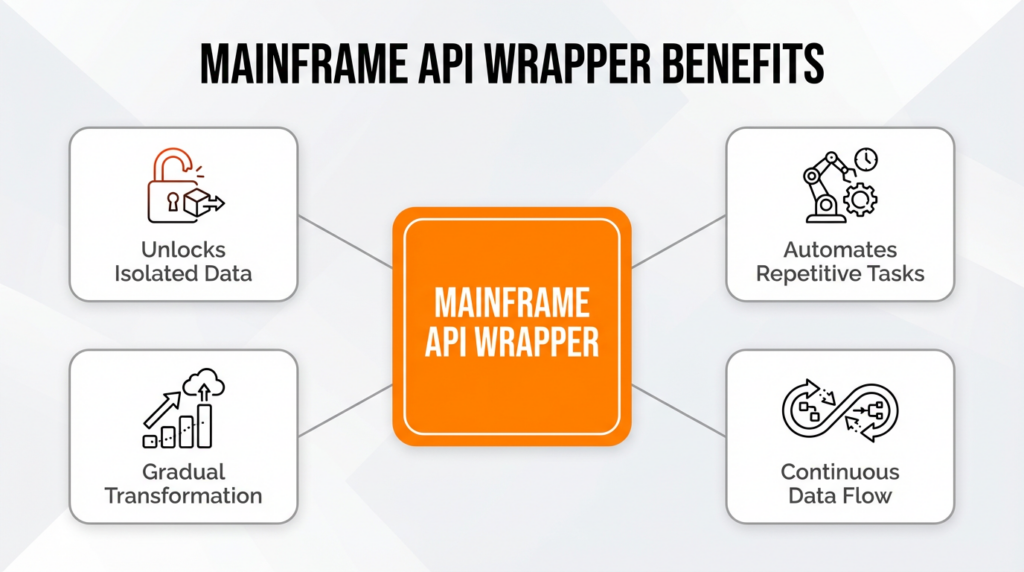
Implementing a mainframe API wrapper provides several clear benefits for legacy environments:
API wrapping bridges new protocols and older architectures by translating modern requests into formats a COBOL mainframe can process. The technical process begins with static code analysis to identify integration touchpoints and data dependencies within the existing COBOL code.
Developers then expose specific COBOL functions as modern endpoints without modifying the core mainframe architecture or the underlying legacy codebase. To integrate these systems, organizations rely on middleware, design patterns, and protocol translation. These tools process modern digital inputs while preserving the original business logic.
Middleware and API gateways act as the critical infrastructure orchestrating communication, security, and traffic between older architectures and modern applications, such as cloud platforms and mobile apps. An enterprise service bus (ESB) and middleware bridge disparate legacy formats, allowing modern REST APIs to easily interact with older legacy systems.
API gateways handle several core functions during legacy API integration, including:
A strong API strategy places an API gateway directly in front of the legacy system to perform traffic throttling. In my experience, skipping this protective step is the absolute fastest way to accidentally crash an aging mainframe. This configuration prevents sudden request spikes from overwhelming older systems with modern cloud demands.
Developers use the adapter and facade patterns as essential techniques to wrap incompatible legacy interfaces into unified application programming interface standards. To solve technical incompatibility, these design patterns translate outdated protocols into standardized outputs. The adapter pattern wraps the existing legacy codebase in a modern format. For example, it can expose a complex mainframe function as a simple REST endpoint. An adapter is like a travel plug converter—it changes the shape of the connection (e.g., SOAP to REST) for a single function.
Meanwhile, the facade pattern simplifies a monolithic architecture by providing a single, unified interface for external requests. A facade, however, is like a hotel concierge—it hides the complex, messy coordination of multiple backend systems (kitchen, housekeeping, billing) behind one simple, unified desk. This specific API wrapper approach streamlines complex backend operations and makes the system easier to manage and secure.
Protocol translation converts outdated legacy communication formats into modern standards like REST and GraphQL. The API layer functions as a middleman, converting calls between disparate systems. Examples of these legacy formats include EBCDIC data representations, XML structures, and VSAM file configurations.
This mechanism converts rigid legacy data structures into flexible JSON or XML formats. For instance, middleware can take a mainframe’s EBCDIC data or SOAP requests and instantly return a JSON response, allowing modern web apps to seamlessly read and process older VSAM files during a migration.
A successful mainframe modernization strategy uses API wrappers as a foundational step to unlock data while planning for long-term, incremental upgrades. Consider these strategic steps to modernize a mainframe using APIs:
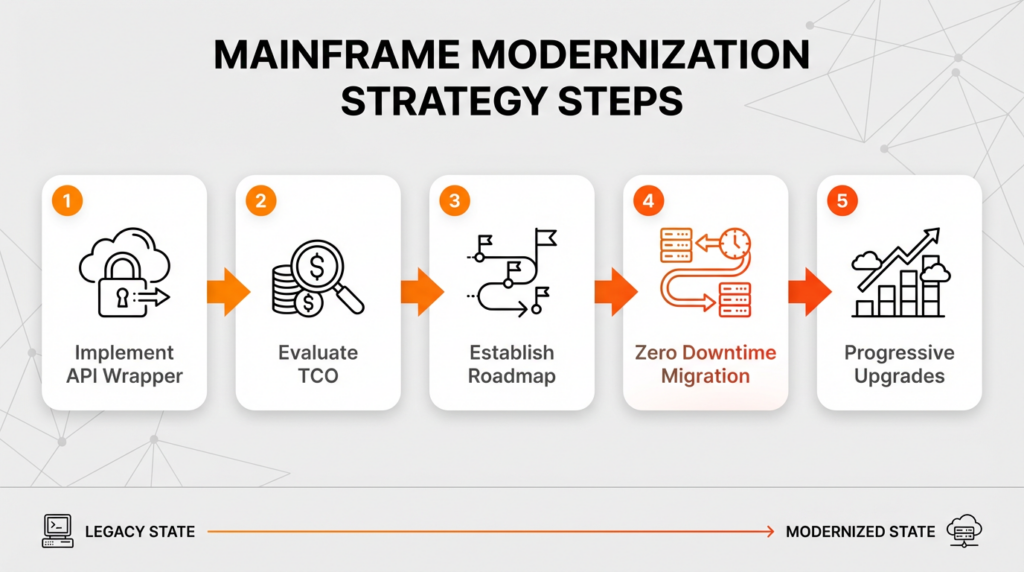
The Strangler Fig Pattern reduces the risk of legacy modernization by allowing organizations to gradually replace older platforms. I almost always recommend this specific pattern to teams who are understandably nervous about making a massive transition all at once. Developers build an API wrapper first to establish reliable communication between the existing legacy codebase and a new microservices architecture. This mainframe modernization strategy minimizes operational disruption as teams incrementally rewrite specific functions.
Teams use API wrappers to reroute traffic to modern services. For example, an updated billing module can operate independently while the rest of the monolithic architecture runs normally. This legacy transformation ensures continuous availability for REST API legacy systems until the original system retires safely.
API wrapping acts as the critical bridge allowing a monolithic architecture to communicate with a modern microservices architecture. Organizations split their hybrid environment into two distinct areas. Here, teams deploy new features as independent microservices while core business functions remain safely inside the API wrapper.
By using a well-configured API gateway, developers can connect legacy systems to modern REST APIs without touching the underlying COBOL. This allows a Java-based microservice to query customer data directly from the mainframe, bridging the gap between the old core and new distributed environments.
An anti-corruption layer prevents modern systems from inheriting the flawed logic and technical debt of a legacy codebase. I cannot stress enough how crucial this particular boundary is for your long-term sanity. This barrier translates between different data models—such as relational schemas and hierarchical structures—to maintain data integrity during legacy API integration, while also preventing outdated design flaws from dictating the structure of a new microservices architecture.
When pulling information from legacy silos like mainframe databases or isolated enterprise modules, the anti-corruption layer reformats outdated inputs to fit the clean schemas of new applications. Companies establish stable integration without compromising new software designs by combining an API wrapper with this protective boundary during data migration.
Legacy API integration faces significant hurdles, including inherited security vulnerabilities, performance bottlenecks, and the persistence of underlying technical debt. Despite the addition of new external interfaces, a monolithic architecture retains its original structural limitations.
Securing legacy APIs requires enforcing modern authentication protocols at the API gateway layer. API gateways provide security hardening by requiring OAuth tokens and enforcing TLS data encryption before processing mainframe requests.
Implementing a zero-trust architecture mitigates inherited legacy risks, such as SQL injection and malware attacks. Proper API governance protects outdated legacy systems from modern cyber threats.
API wrapping adds a modern scalability layer, but the underlying legacy database capacity ultimately dictates maximum processing speeds. Transitioning a monolithic architecture to real-time data exchange exposes these internal limitations directly to external networks. API gateways, such as cloud routers and edge servers, mitigate this hardware limitation by managing incoming traffic.
Smart API management relies on strict rate-limiting and throttling to preserve system stability without overwhelming the legacy codebase. For example, if a web application sends 5,000 concurrent requests to a mainframe capable only of executing batch processing, the gateway throttles those modern cloud workloads, such as mobile apps and customer portals.
API wrapping doesn’t eliminate technical debt. It merely hides underlying code issues behind a modern interface. I’ve seen far too many organizations fall into the trap of treating a wrapper like a permanent cure-all. Several structural flaws remain completely untouched beneath an API wrapper, including internal errors (such as undocumented logic loops and obsolete data handling routines), an outdated legacy codebase, and a rigid monolithic architecture. A wrapped system still requires specialized developers to maintain the aging core behind the new APIs.
Organizations use API wrapping as a strategic stopgap to provide immediate business agility. To address the underlying technical debt permanently, companies must execute a full mainframe modernization strategy. While COBOL modernization through API wrapping preserves existing logic, it doesn’t fix the root causes of system degradation.
API wrapping is a less invasive modernization approach compared to the high costs of Rebuilding or the infrastructure shifts of Rehosting and Replatforming. Rebuilding involves a complete rewrite of a monolithic architecture. This method is costly and highly risky, whereas wrapping is fast and preserves existing business logic.
Instead of spending years Rebuilding an on-premise ERP, a company can use an API wrapper to expose its data to modern cloud workloads in months. Rehosting is a lift-and-shift strategy that moves the underlying system to the cloud without changing the existing legacy codebase. Unlike Rehosting, API wrapping actively modernizes how external applications access the system rather than merely relocating the hardware environment. Replatforming modifies the underlying operating environment to achieve cloud compatibility.
This approach demands significant infrastructure shifts, whereas wrapping focuses strictly on establishing new communication layers around the untouched core. API wrapping stacks up against these other strategies by offering the lowest entry barrier for managing technical debt. Organizations can connect their systems immediately without the extended timelines of a Rebuild or the complex migrations required by a Rehost or Replatform.
Hicron Software proved to be a trusted partner with unmatched technical expertise, delivering a scalable and user-friendly web application that was pivotal to our successful U.S. market expansion.

Hicron’s contributions have been vital in making our product ready for commercialization. Their commitment to excellence, innovative solutions, and flexible approach were key factors in our successful collaboration.
I wholeheartedly recommend Hicron to any organization seeking a strategic long-term partnership, reliable and skilled partner for their technological needs.

After carefully evaluating suppliers, we decided to try a new approach and start working with a near-shore software house. Cooperation with Hicron Software House was something different, and it turned out to be a great success that brought added value to our company.
With HICRON’s creative ideas and fresh perspective, we reached a new level of our core platform and achieved our business goals.
Many thanks for what you did so far; we are looking forward to more in future!

Hicron is a partner who has provided excellent software development services. Their talented software engineers have a strong focus on collaboration and quality. They have helped us in achieving our goals across our cloud platforms at a good pace, without compromising on the quality of our services. Our partnership is professional and solution-focused!

The IT system supporting the work of retail outlets is the foundation of our business. The ability to optimize and adapt it to the needs of all entities in the PSA Group is of strategic importance and we consider it a step into the future. This project is a huge challenge: not only for us in terms of organization, but also for our partners – including Hicron – in terms of adapting the system to the needs and business models of PSA. Cooperation with Hicron consultants, taking into account their competences in the field of programming and processes specific to the automotive sector, gave us many reasons to be satisfied.