Modernizing Insurance Frontends with Java-Based Frameworks like Vaadin
- June 07
- 13 min


Domain expertise refers to a software development team’s deep, practical knowledge of the insurance industry. It involves a clear understanding of core insurance operations, including policy lifecycle management, claims processing, underwriting rules, and strict regulatory compliance. Unlike generic software, custom insurance software reflects the actual workflows, data standards, and compliance requirements that insurance businesses operate within.
This article explains why domain expertise is central to insurance software development. The insurance industry operates under strict regulations, specialized data standards, and complex operational workflows. Software built without deep insurance knowledge often produces compliance gaps and inaccurate outputs. This article covers the main challenges insurance companies face today. It also explains how custom software addresses those challenges, from automating claims to detecting fraud. Best practices for development, testing, and long term support are covered throughout. Whether you are planning a new insurance application or updating an existing platform, this article offers practical guidance.
Key Takeaways
Domain expertise means having deep knowledge of an industry’s processes, rules, and data models. In insurance software development, this knowledge covers how insurers calculate premiums, manage claims, and meet regulatory obligations. Developers without this background often build systems that are technically sound but operationally flawed.
The insurance sector covers many product lines. Life insurance, property insurance, health insurance, and crop insurance each follow different rules and workflows. A development team that does not understand these differences will produce software that fails to serve the business correctly.
Insurance software design requires alignment with industry terminology, data standards, and end to end workflows. When developers have genuine insurance domain knowledge, they reduce error rates and cut the time staff spend correcting system mistakes.
Underwriting and claims are two of the most demanding areas in any insurance business. Underwriting involves risk assessment through actuarial data, credit scoring, and behavioral information. Claims management covers the full path from the initial submission through adjudication and settlement.
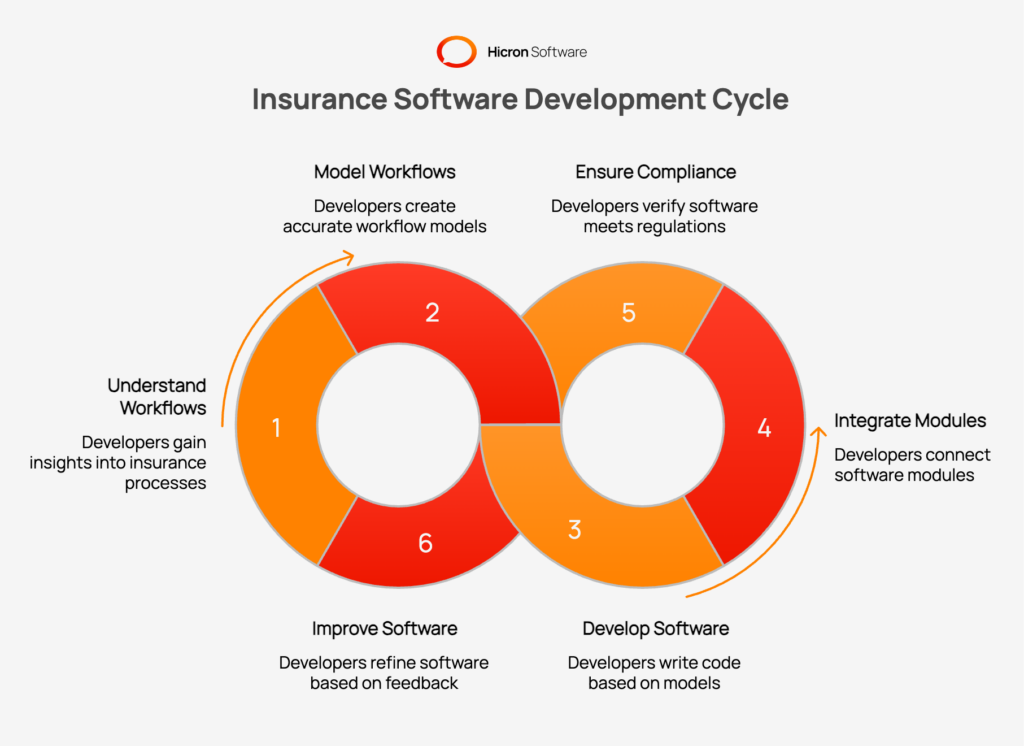
Software that does not reflect these processes creates downstream errors. Incorrect premium calculations, rejected claims, and compliance failures all trace back to poor process modeling. A development team with genuine insurance knowledge maps workflows before writing code. This ensures the software architecture reflects actual insurance operations from the beginning.
Policy management systems also need to communicate with billing, regulatory reporting, and other connected modules. Any gap in this communication creates data inconsistencies and manual workarounds. Domain expertise enables developers to anticipate these integration points and build them correctly from the start.
ACORD is the primary data exchange standard in the insurance industry. Insurance platforms need to communicate with reinsurers, brokers, payment processors, and other third party systems. Without a working understanding of these standards, software development for insurance businesses produces systems that cannot share data reliably.
Integration is a core business requirement. Insurance companies often operate across multiple product lines, each with its own reporting obligations. Integration testing confirms that data flows correctly between the core insurance system and all connected platforms. Development teams with insurance domain knowledge design integration architectures that account for these requirements in advance.
Poor integration carries real consequences. Incorrect data in a policy administration system can result in miscalculated premiums or rejected claims. Domain experts validate data accuracy at every connection point, ensuring insurance software solutions remain dependable as the surrounding technology environment changes.
Insurers’ biggest challenge is maintaining consistent workflows when working with multiple external systems, such as third-party administrators, healthcare provider databases, or regulatory agencies. Seamless integration with these systems is essential for insurers to operate efficiently and deliver competitive customer experiences.
Insurance ecosystems are increasingly interconnected, with third-party systems playing critical roles in claims verification, policy management updates, and underwriting processes.
For example, connecting an insurer’s policy database to a healthcare provider’s system ensures that claims information flows seamlessly. Whether it’s real-time updates on medical procedures for a policyholder or automated approval of routine claims, integration reduces redundancies and avoids delays.
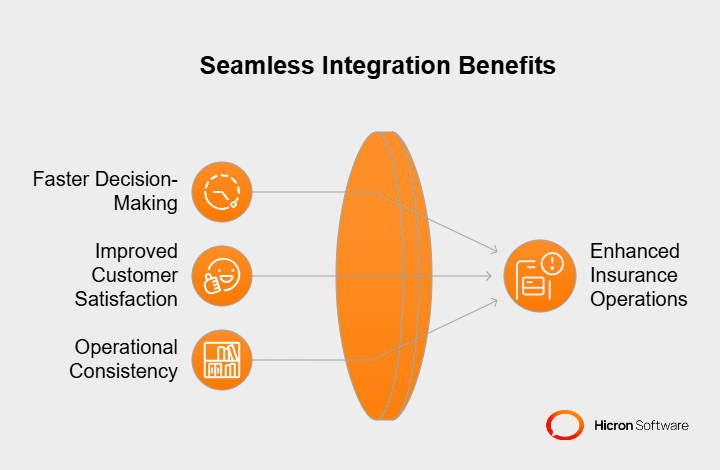
The advantages of integration extend across insurers’ operations:
Custom insurance software development focuses on creating systems that work effortlessly with third-party platforms to achieve seamless connectivity. Developers ensure that APIs, EDI protocols, and various software architectures are compatible with the workflows of external partners. For example, integration with a regulatory body’s reporting system can simplify compliance audits by automatically generating and submitting the necessary documentation.
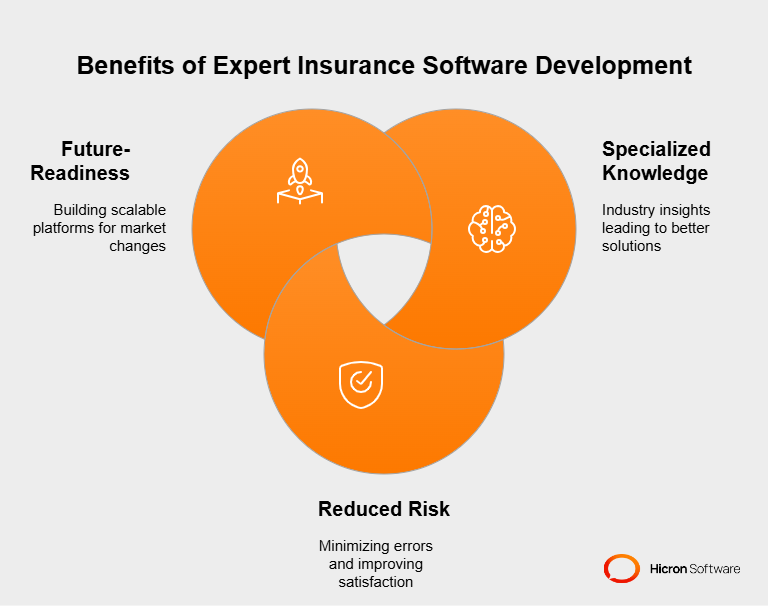
Software designed for interoperability future-proofs an insurer’s operations, enabling them to adopt new technologies or partner with new vendors without major disruptions. By building systems with third-party integration in mind, insurers can stay agile, competitive, and customer-focused in a rapidly evolving market.
Development teams with insurance expertise start productive work faster. They already understand the vocabulary, data models, and regulatory context of the insurance sector. This reduces the time spent translating business requirements into technical specifications and lowers the risk of misaligned features requiring expensive rework.
Insurance software testing also improves with domain knowledge. Specialists design testing strategy and test cases that reflect real insurance scenarios, not just technical checks. Software testing services validate premium calculations, confirm claims workflows meet regulatory requirements, and catch errors before they reach production. This approach combines manual testing with automated test suites to reduce post-deployment defects.
Specialist teams improve digital transformation for insurance. The collaboration between technical and business stakeholders. They apply domain-driven design to build modular insurance platforms that can be extended as the business grows. The result is software that is easier to maintain, adapt, and scale over time.
Policyholders today expect digital experiences that are fast and easy to use. Many insurance companies struggle to provide this because their systems were not designed with the customer in mind. Custom insurance software development allows teams to place the customer journey at the center of the design process, from onboarding through claims resolution.
Self-service portals and mobile applications give policyholders direct access to their coverage information. They can submit claims, track claim processing status, and receive policy updates without contacting an agent. This improves customer experience and reduces the volume of inbound service requests handled by staff.
Custom software can also use customer data to support more relevant interactions. Predictive analytics can flag renewal risks or identify patterns in policyholder behavior. Domain expertise ensures these tools are built on accurate insurance data models, so the outputs are useful and trustworthy.
Many insurance companies still run on policy administration and claims management systems built decades ago. These systems are often incompatible with modern APIs, cloud environments, and real-time data tools. Replacing them all at once carries high risk. A phased approach, building new insurance software alongside existing systems while gradually transferring functionality, tends to produce better outcomes.
Legacy systems often contain business logic accumulated over many years without proper documentation. Domain experts can identify this logic, verify it against current insurance regulations, and rebuild it within a modern platform. This process requires both technical depth and genuine insurance knowledge to complete accurately.
Scalable architecture is the goal of any modernization effort. Insurance businesses grow, add product lines, and face updated regulatory demands over time. Domain-driven design of insurance technology produces modular systems that can incorporate new insurance workflows and data sources without requiring a full rebuild.
Developing software for the insurance industry requires a deep understanding of its unique challenges and standards. To create functional and future-ready solutions, insurers and developers must adopt best practices emphasizing collaboration, flexibility, scalability, and ongoing innovation. Below, we outline key strategies for building successful insurance software.
|
Best Practice |
Key Strategy |
Real-World Example |
Primary Benefits |
|
Collaborating with Insurance Experts |
Engage industry professionals like underwriters and compliance officers early to understand complex regulations and workflows. |
Identifying data entry delays in claims processing or integrating fraud detection protocols flagged by specialists. |
Delivers tailored solutions that address real-world challenges, improves overall functionality, and boosts market credibility. |
|
Adopting Agile Development |
Use iterative progress, continuous feedback loops, and modular designs to easily adapt to shifting market demands. |
Adjusting an underwriting tool mid-project to include new database integrations or adapting instantly to new compliance rules. |
Ensures quick market response, supports rapid scalability during peak claim periods, and maintains a competitive advantage. |
|
Focusing on Long-Term Support |
Maintain a robust upgrade framework to keep systems functional, compliant, and ready for emerging technologies. |
Proactively updating software for data protection laws (GDPR) or adding IoT integrations to monitor driver behavior. |
Keeps software relevant and compliant, optimizes long-term performance, and builds deep client trust through reliable maintenance. |
Table: Key Strategies, Examples, and Benefits for Developing Custom Insurance Software
Compliance is one of the most demanding aspects of insurance software development. Software needs to meet standards such as GDPR, Solvency II, and IFRS 17. These requirements vary by region and change over time. Without domain expertise, software teams often miss these variations until they have already caused problems.
Compliance-driven software design means building regulatory logic into the core of the insurance application from the start. This includes compliance testing, regression testing after regulatory updates, and penetration testing to protect customer data. Teams with insurance knowledge anticipate regional differences and build them into the architecture from the beginning.
Standards such as IFRS 17 and Solvency II have different requirements for contract valuation and capital reporting. Software that cannot maintain accurate audit trails for long term policies exposes businesses to regulatory liability. Domain experts in insurance software development services build governance and documentation requirements directly into the software, making compliance an ongoing process rather than a periodic correction.
Automation is one of the core advantages of modern insurance software. Policy issuance, claim processing, premium calculation, and renewal notifications can all be automated within a well-designed system. This reduces turnaround times and allows underwriters and adjusters to focus on cases that require closer attention.
Machine learning tools can score risk in real time by processing large volumes of data from various sources. Custom insurance software development integrates these tools directly into the underwriting workflow. Underwriters receive real time information and can identify cases that need manual review, while routine decisions are handled by the system.
For custom claims management, automation addresses the most common source of customer dissatisfaction: waiting time. Software can move claims through submission, review, and approval with minimal manual input. Human involvement is reserved for complex or disputed cases. This allows insurance businesses to handle higher claim volumes without proportionally increasing headcount.
Real time data gives insurance companies better information for pricing, risk assessment, and claims decisions. Custom insurance software can pull data from policy management systems, third party providers, and connected devices, then surface relevant information quickly. This supports faster and more informed decisions at every level of the business.
Fraud detection is one of the most valuable uses of analytics in insurance. Insurance fraud increases costs across the market and affects all policyholders. Custom development can deploy machine learning tools that analyze claim patterns and score fraud probability in real time. This allows teams to investigate suspicious claims before payment is made. Fraud patterns differ across insurance product lines, so detection tools need to be built on domain specific data to produce accurate results.
Predictive analytics supports longer term risk management. Insurers can develop custom software to forecast claims frequency, monitor portfolio risk, and identify emerging loss patterns before they affect financial results. The quality of these outputs depends on the data architecture. Domain experts ensure that data is captured and structured in ways that align with insurance industry standards.
Collaboration with insurance professionals throughout the development process improves outcomes. Domain knowledge should inform not just the initial requirements but also ongoing testing and quality assurance. Insurance software testing should include scenarios based on real insurance workflows, not just generic technical criteria.
Agile development methods work well for insurance software projects. Short development cycles allow insurance companies to validate features against real business requirements before they are finalized. Insurance testing is integrated into each cycle, covering automated test suites, integration checks between connected systems, and compliance verification against current standards.
Long term support is important in a regulatory environment that changes regularly. Insurance software solutions need to evolve with the market, adding new product types, adapting to updated regulations, and incorporating new technologies. A development partner that stays engaged over time carries forward the domain knowledge that makes updates both reliable and cost effective.
Custom insurance software is a game-changing force for organizations seeking efficiency and innovation in a competitive market. This case study explores the accomplishments of two companies. Highlighting their challenges, strategy-driven improvements, and measurable results. Both success stories showcase how insurance technology solutions and software modernization can revolutionize business operations.
About HDI: It is a global insurance provider headquartered in Germany, specializing in helping businesses manage risks. HDI’s internal application, Policy, was built in 2009 and is a business-critical tool used to manage contracts, create invoices, and streamline corporate client workflows.
The challenges
HDI faced several pressing issues with its aging software infrastructure:
The solution: HDI partnered with Hicron Software to modernize the Policy application by transitioning its client-side architecture to Vaadin Flow V14, paired with a Spring Boot backend. The modernization process involved:
The modernization approach allowed HDI to run its older system alongside the evolving Vaadin-based system until stability was achieved. Over 350 application views and 250+ dialogs were refactored for usability enhancements.
Results achieved:
Artificial intelligence, machine learning, and predictive analytics are becoming standard embedded insurance components in software. AI powered underwriting tools can score risks in real time using data sources that were not previously accessible. Automated processing of unstructured claims data is also becoming more common across insurance firms.
Demand for personalized insurance software is growing. Global insurance companies offer products that are increasingly usage-based and behavior-linked. These products require software that can handle dynamic pricing, real time data input, and continuous policy updates. Meeting these needs requires development services grounded in deep insurance knowledge.
Insurance companies that build custom insurance software with genuine domain expertise at the core will be better prepared for the changes ahead. Regulatory demands will increase. Customer expectations will rise. The data environment will grow more complex. Domain knowledge is what allows software to adapt to these pressures reliably over time.
If your insurance business is ready to move beyond generic tools and build software that truly reflects how you work, our team is ready to help. With deep expertise in insurance software development and a track record of delivering tailored solutions that automate operations, meet compliance requirements, and improve customer experience, we are the development partner your project deserves. Reach out today to discuss how we can build something that works for your business, your policyholders, and your long term goals.
Domain expertise in this context means detailed knowledge of insurance processes, regulations, and data standards. This includes understanding how insurance products are structured, how claims are processed, and how software is expected to meet regulatory requirements across different markets and product lines.
Insurance application testing covers more than technical checks. It includes validation of insurance workflows such as claims submission and premium calculation, compliance testing against applicable regulations, and verification of fraud detection logic. Domain experts design these test scenarios based on real insurance operations, which standard testing approaches do not cover.
Compliance requires ongoing software updates as regulations change. This includes regression testing after each regulatory change, compliance reviews built into the development cycle, and a development partner with current knowledge of insurance regulations in relevant markets. Software that is not actively maintained against regulatory changes becomes a liability over time.
Automation allows insurers to handle policy issuance, claim processing, fraud detection screening, and regulatory reporting with less manual input. This reduces processing times and allows staff to focus on complex cases that benefit from human judgment. Accurate automation depends on business logic that reflects real insurance rules, which is where domain expertise matters most.
Generic software does not accommodate the specific workflows, compliance requirements, and data standards of the insurance sector. Custom insurance software is designed around the way insurance businesses actually operate, which makes it more accurate, more compliant, and better suited to the needs of both staff and policyholders.
Hicron Software proved to be a trusted partner with unmatched technical expertise, delivering a scalable and user-friendly web application that was pivotal to our successful U.S. market expansion.

Hicron’s contributions have been vital in making our product ready for commercialization. Their commitment to excellence, innovative solutions, and flexible approach were key factors in our successful collaboration.
I wholeheartedly recommend Hicron to any organization seeking a strategic long-term partnership, reliable and skilled partner for their technological needs.
After carefully evaluating suppliers, we decided to try a new approach and start working with a near-shore software house. Cooperation with Hicron Software House was something different, and it turned out to be a great success that brought added value to our company.
With HICRON’s creative ideas and fresh perspective, we reached a new level of our core platform and achieved our business goals.
Many thanks for what you did so far; we are looking forward to more in future!

Hicron is a partner who has provided excellent software development services. Their talented software engineers have a strong focus on collaboration and quality. They have helped us in achieving our goals across our cloud platforms at a good pace, without compromising on the quality of our services. Our partnership is professional and solution-focused!

The IT system supporting the work of retail outlets is the foundation of our business. The ability to optimize and adapt it to the needs of all entities in the PSA Group is of strategic importance and we consider it a step into the future. This project is a huge challenge: not only for us in terms of organization, but also for our partners – including Hicron – in terms of adapting the system to the needs and business models of PSA. Cooperation with Hicron consultants, taking into account their competences in the field of programming and processes specific to the automotive sector, gave us many reasons to be satisfied.