Your AI Chatbot is Lying to You: The Quick Guide to Getting Smarter Answers from AI
- October 24
- 8 min



Developer judgment in the AI era is the ability to understand a business problem deeply enough to choose the right model, apply the right pattern at the right time, and accept explicit trade-offs, while using AI to execute faster without outsourcing accountability.
AI-assisted development is now routine on production teams. Boilerplate arrives in minutes. Prototypes ship in days. The business often reads that as proof that engineering was the bottleneck.
It rarely was. More often, the bottleneck was unclear requirements, a model that did not match the domain, or an architecture that worked for the first release and failed under the next contract. AI did not create those problems. It made them arrive faster.
When implementation gets cheaper, the expensive work moves upstream: understanding what the business actually needs, choosing a representation that can survive the roadmap, and knowing which pattern fits this case, and which one only looks correct on a diagram.
Key Takeaways
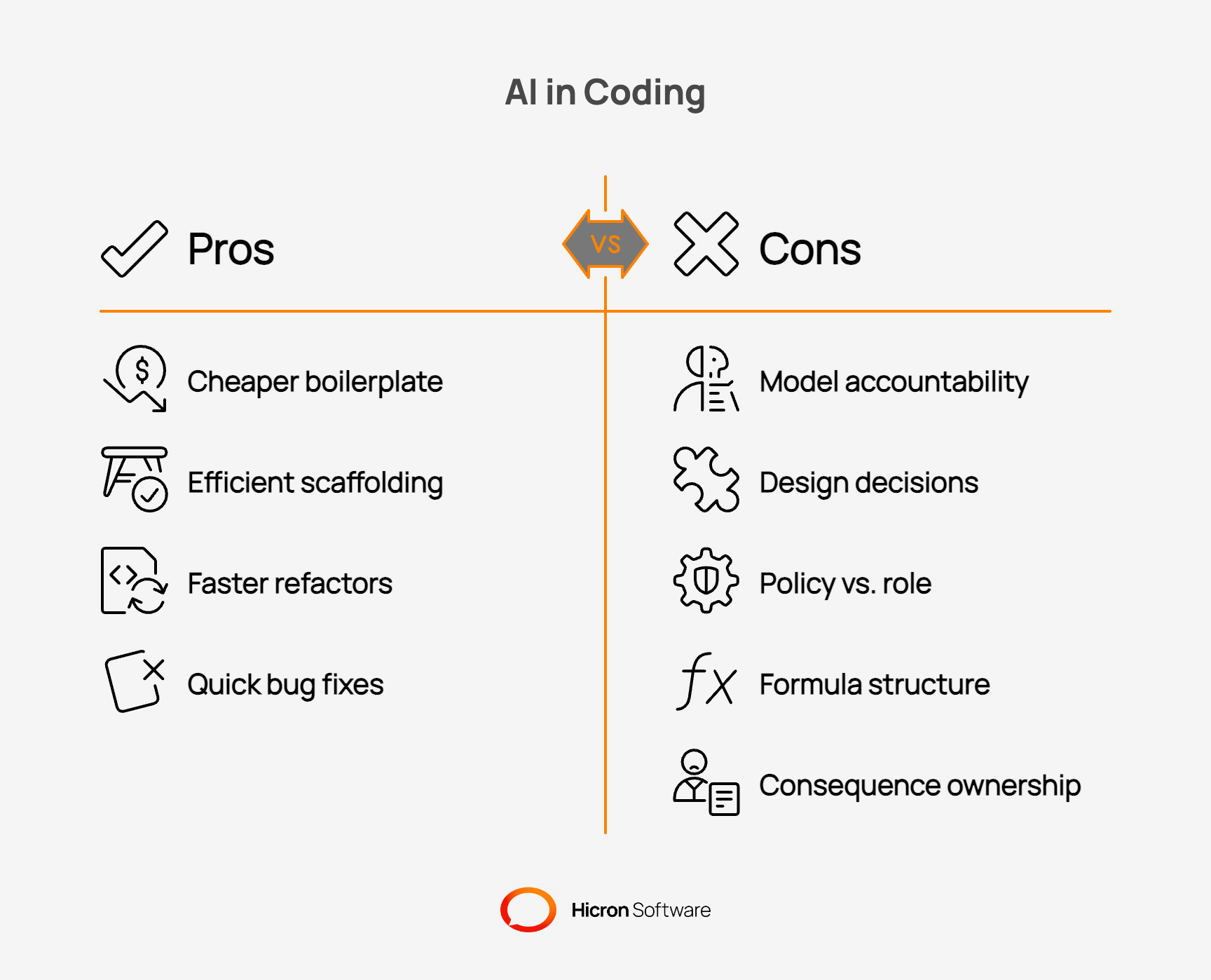
Boilerplate, scaffolding, mechanical refactors, and narrow bug fixes get cheaper. That is real leverage.
What does not get cheaper: deciding what the system should represent, where one bounded context ends and another begins, which cross-cutting rule belongs in policy rather than in a role, or whether formulas should stay strings or become a parse tree before the roadmap demands editing, preview, and workbook scan.
AI can draft all of those implementations. It cannot own the consequence when two vendors on the same floor see each other’s workers because scope and organization were modeled as one dimension, or when every formula feature re-parses raw text because the product never committed to a structured internal model.
Execution can be assisted. Accountability for the model cannot.
The answer is not “every new framework before it peaks on Hacker News.” Most stacks reuse a small set of ideas: layering, inversion of control, event-driven flow, caching, idempotency, eventual consistency, bounded contexts, strategy objects for varying rules. Reactivity, CQRS, hexagonal architecture, and the Party Pattern are not resume keywords. They are answers to specific shapes of problem, each with costs attached.
SOLID, DRY, and KISS are useful when they inform a decision. They are harmful when they become performance art.
Design patterns work the same way. Strategy fits when business rules vary by context, such as cross-vendor visibility policies that cannot live inside a role definition. A parse tree fits when the product edits structure, not only evaluates it. Factory or builder patterns fit when object construction encodes domain variation. None of them are virtues on their own. Each is a trade.
The skill is not drawing the diagram. It is looking at a requirement and noticing: this will vary independently, this boundary will move, this rule will need audit, this representation will not survive the next feature. Patterns are vocabulary for those observations.
Every architectural choice is a trade-off. Reactive streams simplify async composition and make backpressure explicit. They also raise the cost of debugging and onboarding. A monolith ships faster early and concentrates risk later. Microservices scale teams and multiply operational surface. Strings carry an MVP; an AST carries a formula editor.
Mature engineering sounds less like “X is best practice” and more like “X buys us this, costs us that, and we accept that because of how the business is likely to evolve.”
That framing is what business stakeholders need. They do not need another framework name. They need to know why one path is faster now, which path is cheaper to change in twelve months, and what breaks if the next vendor contract assumes a rule the current model cannot express.
A large share of production bugs are not typos. They are mismatches between how the business works and how the system models it.
Each vendor sees only their own people is not a missing if statement. It is an authorization design question. Replace one formula argument without corrupting the rest is not a regex problem. It is a representation problem. Fixing those in code without fixing the model produces more code and the same class of incident.
Developers create business value when they slow the conversation down at the right moment, when a requirement sounds simple but the domain is not, and name the concept the system is missing. That is not meetings for their own sake. It is cheaper than shipping the wrong structure quickly.
Knowing five ORMs does not make someone five times more valuable. Knowing when persistence should leak across aggregates, when a read model is justified, and when a transaction boundary follows a business operation that transfers across stacks.
AI lowers the penalty for not memorizing framework syntax. It raises the penalty for not recognizing which problem shape you are looking at. A developer who understands event-driven boundaries and idempotent handlers can be productive in a new message bus in weeks. A developer who only knew the old bus’s API starts from zero every time the stack changes.
The honest version of career advice in 2026: learn concepts deeply, stay fluent in one or two ecosystems, and treat new frameworks as dialects of ideas you already understand, not as identity.
Three rules are enough:
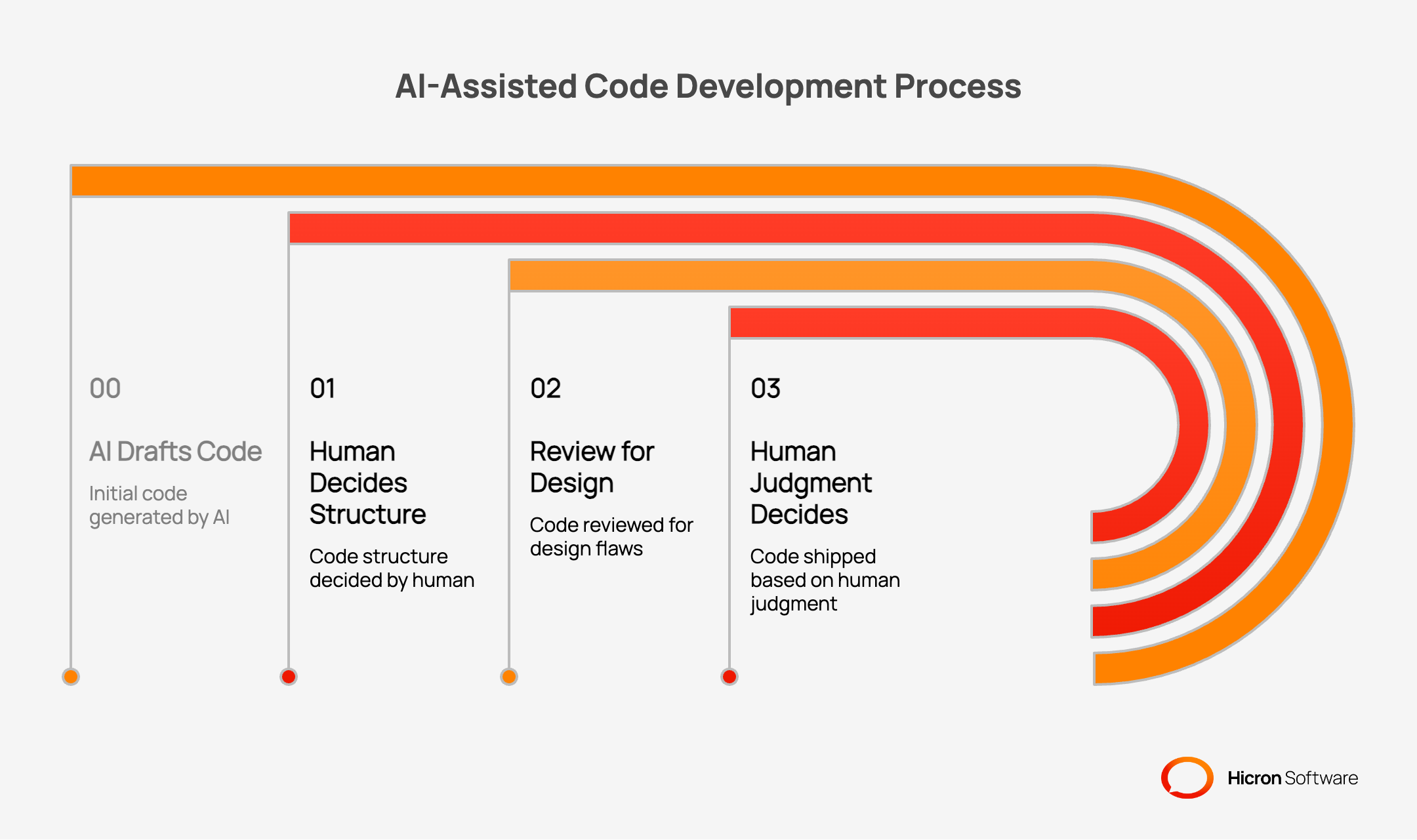
In practice, the useful pattern is a focused session: one engineer with system and business context, AI extending scenario coverage, human judgment deciding what ships.
AI makes it easier to build the wrong thing correctly. That is the shift.
The developer is not obsolete. The job is more visible than before. Less typing. More reading the business, choosing representations, applying patterns when they fit, refusing them when they do not, and stating trade-offs plainly.
Frameworks will keep appearing. Syntax will keep changing. The durable skill is recognizing the shape of the problem and matching it to a structure the business can live with, then letting AI help with the code that follows.
Building a product where delivery is accelerating but the domain model is not keeping up? Contact us to discuss how we approach business-aligned architecture and design decisions that survive the roadmap.
It replaces large amounts of routine implementation. It does not replace accountability for domain modeling, architectural trade-offs, or production outcomes. Teams gain leverage when AI handles drafts and humans own decisions.
Yes, as decision tools, not interview trivia. Their value is knowing when a responsibility is splitting, when duplication is safer than the wrong abstraction, and which pattern matches the variation in the business rule. Reciting definitions without context adds little.
Transferable concepts: domain modeling, boundaries, async and reactive trade-offs, consistency models, authorization dimensions, representation choices, and how to explain costs and benefits to non-engineers. Depth in one ecosystem plus strong conceptual grounding outlasts framework collecting.
Because code expresses a model. When the model misreads the business, conflating scope with organization, treating editable formulas as plain strings, encoding relationship rules inside roles, the implementation can be clean and still fail in production. Fixing symptoms in code without fixing the structure repeats the failure at the next requirement.
Hicron Software proved to be a trusted partner with unmatched technical expertise, delivering a scalable and user-friendly web application that was pivotal to our successful U.S. market expansion.

Hicron’s contributions have been vital in making our product ready for commercialization. Their commitment to excellence, innovative solutions, and flexible approach were key factors in our successful collaboration.
I wholeheartedly recommend Hicron to any organization seeking a strategic long-term partnership, reliable and skilled partner for their technological needs.

After carefully evaluating suppliers, we decided to try a new approach and start working with a near-shore software house. Cooperation with Hicron Software House was something different, and it turned out to be a great success that brought added value to our company.
With HICRON’s creative ideas and fresh perspective, we reached a new level of our core platform and achieved our business goals.
Many thanks for what you did so far; we are looking forward to more in future!

Hicron is a partner who has provided excellent software development services. Their talented software engineers have a strong focus on collaboration and quality. They have helped us in achieving our goals across our cloud platforms at a good pace, without compromising on the quality of our services. Our partnership is professional and solution-focused!

The IT system supporting the work of retail outlets is the foundation of our business. The ability to optimize and adapt it to the needs of all entities in the PSA Group is of strategic importance and we consider it a step into the future. This project is a huge challenge: not only for us in terms of organization, but also for our partners – including Hicron – in terms of adapting the system to the needs and business models of PSA. Cooperation with Hicron consultants, taking into account their competences in the field of programming and processes specific to the automotive sector, gave us many reasons to be satisfied.