Microservices Architecture Style: Pros & Cons
- June 25
- 28 min


Modernizing a monolithic application often addresses core issues more cost-effectively than transitioning to microservices. Most delivery pain comes from unclear boundaries, tangled business logic, an aging technology stack, or slow development and deployment. Microservices pay off only when specific pressures justify their operational cost.
Engineering leaders facing a slow, hard-to-change monolith often reach for the same answer: split it into services. Independent deployment, targeted scaling, and team autonomy are genuinely valuable, and microservices have delivered strong results for organizations with the right conditions and operational maturity. But these benefits don’t automatically fix problems in the codebase or deployment process. In some cases, moving to a distributed architecture adds complexity on top of problems that were never architectural to begin with.
Martin Fowler’s MonolithFirst essay notes that many successful microservice systems started as monoliths that grew too large, while systems designed as microservices from the start often ran into trouble. Committing to service boundaries before the business logic and usage patterns are well understood can make migration more expensive than the problem it was intended to solve.
This article distinguishes between a monolith, a modular monolith, microservices architecture, and a big ball of mud. It explains when modernizing a monolithic application is the better first move, what that modernization involves, and when microservices make sense.
When a monolithic application begins to cause issues, teams frequently regard migration as the apparent solution. The benefits are real in principle: independent deployment, targeted scaling, fault isolation, and more autonomy for individual teams. However, it is prudent to examine the pattern of adopting a microservices architecture as an initial response to delivery challenges before committing.
As Fowler and Lewis define it, microservices architecture organizes a system into independently deployable services built around business capabilities that communicate over a network. Each new service can use a different programming language or technology stack, giving teams more flexibility to choose tools that fit the problem they are solving. Each team can deploy on its own schedule, without waiting on the rest of the codebase, which removes a common coordination bottleneck in larger engineering organizations. These advantages make microservices genuinely attractive when the organizational and technical conditions are right.
Such independence comes with a cost. Fowler describes this as a premium: working with microservices and managing many services slows a team down, and the premium pays off only in sufficiently complex systems. Practitioner research on teams that migrated from monolithic applications to microservices points to a consistent pattern: organizations migrate to improve maintainability, enable more independent development and deployment, and support scaling needs, but they also face recurring challenges during the transition. Those challenges are specific to migration contexts, not evidence of a general failure rate for microservices architecture. Establishing appropriate service boundaries early is difficult because real usage patterns often become clear only after deployment. When teams draw boundaries too early or in the wrong place, they create ongoing maintenance costs instead of a one-time architectural fix.
The most commonly reported motivations and challenges from that survey include:
Understanding the terms clearly before deciding is crucial. Mixing them can lead to assumptions driving choices instead of focusing on the system’s real state. The table below highlights the main differences between monolithic and microservices architectures:
|
Architecture Type |
Deployment |
Internal Structure |
Distributed Concerns |
|
Monolith |
Single unit |
Variable, no enforced boundaries |
None |
|
Big Ball of Mud |
Single unit |
No meaningful boundaries |
None |
|
Modular Monolith |
Single unit |
Enforced module boundaries |
None |
|
Microservices |
Multiple independent services |
Defined per service |
Network latency, partial failures, data consistency |
A monolith is a single deployable unit. This term describes how software is packaged and released, not how the code inside is structured. A big ball of mud, on the other hand, describes a codebase with no meaningful internal boundaries. It grows through unregulated changes and repeated quick fixes.
These two terms are often confused. When a monolithic application becomes difficult to change, teams frequently blame the deployment model. In many cases, the real issue is the codebase’s internal structure.
A monolithic application can be well organized or poorly structured. That difference determines what kind of modernization work the system actually requires. Treating both terms as interchangeable leads to overengineered solutions for problems that a focused refactoring effort could resolve more directly.
A modular monolith is a single deployable unit with enforced internal boundaries between modules. That means the application remains one deployment artifact, but its business logic is divided into clearly owned parts that communicate through defined interfaces. The term matters here because teams often assume that achieving clearer boundaries, team autonomy, or better scalability requires moving straight to separately deployed services. A modular monolith shows that you can pursue many of those benefits within a single codebase first. As Kamil Grzybek noted in an InfoQ interview, the main differences between a modular monolith and microservices come down to deployment and how modules communicate. By keeping communication in-process rather than over the network, a modular monolith avoids many distributed-system concerns, such as network latency, partial-failure handling, distributed transactions, and cross-service data consistency, while still maintaining a well-organized structure that developers can reason about clearly.
Microservices architecture splits a software application into independently deployable services, each owning its own data and communicating through APIs. Unlike a modular monolith, it treats boundaries not just as internal structure but also as deployment boundaries. That distinction matters because it changes both what the architecture enables and what it costs to operate. Communication between microservices happens over a network, allowing teams to deploy services independently, scale specific parts of the system, and use different technologies where needed. At the same time, it introduces concerns that don’t exist within a single deployable unit: tracing requests across multiple microservices, handling partial failures gracefully, coordinating communication between microservices, and keeping data consistent without a single shared database. These are real engineering costs, and they grow with the number of services in the system.
For software development teams, the microservice premium shows up as slower delivery, heavier coordination, and costlier mistakes when boundaries are drawn too early or in the wrong place. The main costs tend to surface in deployment and coordination overhead. The decision table below helps distinguish cases where those tradeoffs are justified from cases where a monolith still fits the problem better.
Each new service adds a deployment pipeline, a set of APIs to maintain, and a dependency other services may rely on. Over time, changes to one service can ripple across several others, requiring coordination that a modular monolith handles through in-process calls instead. Taibi, Lenarduzzi, and Pahl built a taxonomy of recurring anti-patterns from a survey of experienced practitioners working with microservices architecture in a microservices environment. The taxonomy documents common mistakes, not evidence that microservices fail more often than monolithic systems, but it shows the premium is a known and recurring cost that teams should account for when making architectural decisions.
A wrong boundary within the monolith is a refactoring job that a team can address in a single codebase, often without changing any external interfaces. A wrong boundary between two deployed services is a long-running cost, since every service on either side needs to change to fix it, and any consumer of those services may also be affected. A distributed monolith, where services are tightly coupled despite being deployed separately, is one of the most common failure modes when teams split a large monolithic application before those boundaries are clear. Monolith decoupling and splitting a single database are among the most commonly reported issues in teams that have migrated from monoliths to microservices. These are findings from migration contexts, not a general prediction of how microservices architecture performs once it is stable. This cost grows larger the earlier a team commits to service boundaries, before the business logic is fully understood and the real usage patterns of the system have had time to emerge.
Microservices architecture pays off when three specific conditions are present:
Outside of those conditions, the operational premium rarely justifies the cost.
Where those pressures are absent or unclear, the coordination overhead, deployment complexity, and operational cost of running many independently deployed services tend to outweigh the benefits.

Teams that need to release different parts of a system on different schedules, without blocking each other, benefit from separate deployable services. This matters most when team size and release frequency make a shared deployment pipeline a real bottleneck, and a single slow or broken change can delay unrelated work across the organization. When that bottleneck is real and recurring, the operational cost of microservices architecture is more likely to pay for itself.
When one part of a system faces far more load than the rest, extracting that part into its own service lets it scale independently, without over-provisioning the entire system. This is one of the clearest cases where the cost of extraction is justified by a measurable, specific problem, rather than a general preference for distributed architecture. If the scaling pressure is uniform across the system, a well-tuned monolithic application with appropriate infrastructure choices can often handle the load without splitting.
Services divide cleanly only when the business capabilities behind them are already clear and stable. Fowler notes that good boundaries are hard to find early, and that systems built as microservices from day one often struggle because those boundaries shift as the product evolves. Systems that have matured enough to reveal stable usage patterns and clear ownership are better candidates for splitting than new, fast-changing systems where the domain model is still being discovered. Adding new features to a loosely coupled architecture is easier once those boundaries are established and tested in production.
|
Technical signal |
Architectural implication |
Monolith limitation |
|
Multiple teams need to deploy different parts of the system independently and frequently |
Deployment boundaries need to align with team ownership and release cadence |
A single deployment unit turns unrelated changes into coordination overhead and release contention |
|
A small number of components have materially different resource or throughput profiles |
Scaling boundaries need to align with workload asymmetry |
The whole application must be scaled for the highest-demand path, increasing infrastructure cost and operational waste |
|
Business capabilities are separated by stable interfaces, clear ownership, and distinct data boundaries |
Service boundaries are mature enough to extract safely |
Extraction risk stays high when boundaries are still shifting inside the codebase |
|
Parts of the system require different runtime, persistence, or infrastructure characteristics |
Technical constraints differ enough that a uniform platform becomes limiting |
A single stack and deployment model forces compromises across components with genuinely different operational needs |
|
Failure isolation is a recurring operational requirement for specific critical flows |
Some components need stronger fault containment and independent recovery behavior |
In-process coupling makes localized faults harder to isolate without structural separation |
A monolithic application can scale without migrating, provided that the architecture is well-structured and the infrastructure is sized to match real load. Teams that have run large, high-traffic systems without decomposing them show that splitting into services is not a prerequisite for handling substantial demand. Where scaling pressure does exist, it typically concentrates in one or two components, which points toward targeted extraction rather than a full migration.
Nick Craver documented Stack Overflow’s infrastructure in a series of blog posts and infrastructure write-ups published around 2013. At that time, the entire Stack Exchange network ran on four SQL servers, eleven IIS web servers, two Redis servers, three tag engine servers, and three Elasticsearch servers, all of which were operating at low load. The team maintained this architecture without splitting the application into separate services, and Craver’s descriptions clearly indicate that doing so was unnecessary. This reflects Stack Overflow’s scale and the engineering choices made at that time, rather than serving as a universal benchmark. It demonstrates that well-considered infrastructure decisions can ensure that a high-traffic monolithic application remains operational for longer than teams often expect.
Most systems do not need every part to scale the same way. When only one component faces different scaling pressure than the rest of the system, extracting that single component and leaving the rest of the existing monolithic application in place often solves the problem directly, without the overhead of a full migration to microservices. This targeted approach preserves the simplicity of the existing architecture where it is working well, and applies additional complexity only where it is actually needed.
A modular monolith addresses the core tension in the article’s central question: when a growing web application starts to hurt, the problem is rarely the monolithic structure itself. It is almost always the absence of clear internal structure within the monolith. Enforcing module boundaries solves that problem at the source. Each module takes ownership of a distinct slice of business logic, exposes defined interfaces to the rest of the system, and can be developed and tested without touching unrelated parts of the monolithic codebase. That structure reduces delivery friction, clarifies responsibility, and makes the system easier to reason about. It does so without introducing the network boundaries, partial-failure handling, distributed transactions, and data-consistency challenges that come with microservices.
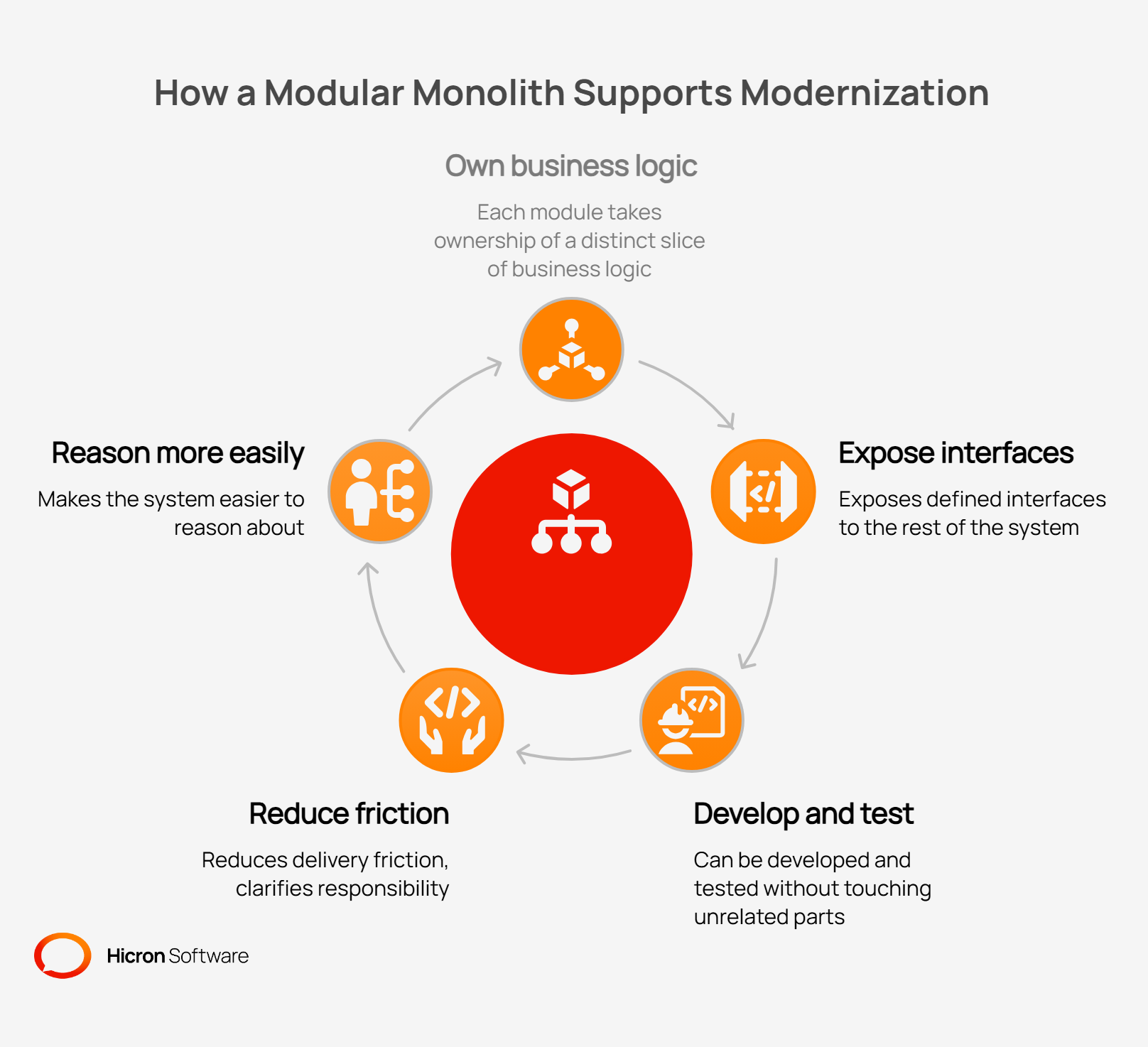
To see what this looks like in practice, let’s turn to real cases: what enforcing boundaries looks like inside an actual codebase, which engineering practices support it, and how this approach can create a foundation for later extraction if the evidence eventually points in that direction.
Shopify chose to enforce boundaries between components inside a single deployable unit rather than split into separate services. Where different technologies were needed, the team adopted them without fragmenting the deployment model. The result was a codebase where developers could work within a single relevant module and run tests only against the components that changed: shortening feedback cycles and reducing the cognitive load of each contribution. Shopify’s engineering team later published Under Deconstruction, a follow-up engineering account that is equally instructive. It documents how the architectural plan shifted considerably once it met production conditions. That is not a failure of the approach. It is evidence that enforcing internal boundaries is an ongoing practice, not a one-time structural decision, and that a modular foundation gives teams room to adapt without rewriting the entire system.
The evidence for this comes from diverse contexts. Kamil Grzybek’s open-source project, Modular Monolith with DDD, demonstrates that module boundaries and data ownership can be clearly represented in code, providing teams with a practical, framework-independent starting point that can be used with any technology stack. These structural principles have proven effective over two decades in mission-critical environments, including systems managing multimillion-euro semiconductor manufacturing hardware. These are not modern web stacks or greenfield projects but complex systems where structural mistakes lead to tangible costs. Alongside Shopify’s experience, they show that enforcing internal boundaries is a sustainable engineering practice that scales across technical and organizational settings.
These best practices address the underlying causes of delivery pain in a growing web application. They work whether a team is building toward a modular monolith or evaluating whether a migration to microservices is warranted. Each one targets a specific condition that makes a monolithic codebase harder to change, rather than adding network boundaries around problems that the existing monolithic structure can solve:
Taken together, these practices build a foundation that supports growth in either direction. A team that enforces boundaries, clarifies ownership, and reduces deployment friction creates a monolithic codebase that is easier to extend as a modular monolith and easier to split when extraction becomes the right call.
When research into staged migration paths evaluates the monolith to modular monolith to microservices sequence, a consistent finding emerges: the modular step does not just reduce immediate delivery pain. It builds internal boundaries that translate more directly into service boundaries when extraction becomes the right call. Teams transitioning from a monolithic architecture to microservices that enforce module ownership and clear interfaces before splitting tend to draw better boundaries, because the structure of the system has already revealed where the real seams are. This is the core logic behind treating modularization as a prerequisite rather than an optional intermediate step when pursuing a migration to microservices. For teams that do reach the point where service extraction is warranted, established decomposition patterns exist to guide the work. Those resources assume microservices as the eventual destination, so they are most useful once the evidence for extraction is already clear, not as a reason to begin the migration earlier than the system’s conditions justify.
A short set of questions, built around the actual problem, works better than following current trends in system architecture. The goal is to identify whether the system’s real constraints call for microservices or whether a targeted modernization effort would address them more directly.
If most answers point toward unclear boundaries and tangled code, modernizing the monolithic application is likely the stronger first move. If boundaries are stable and separate teams are already blocking each other’s releases, the conditions described above for microservices architecture are worth examining directly.
Modernizing a monolithic application is often the stronger first move. A migration to microservices architecture should follow clear evidence of specific pressures, not habit or industry trend. Teams that get the most value from microservices architecture typically already understand their system well enough to draw stable service boundaries, and that understanding usually comes from running the system in production as a well-structured monolith first.
The practical path starts by making the existing monolithic application modular:
From there, extract a new service only where you can measure the payoff, such as a single component with scaling needs that genuinely differ from the rest of the system. This way you avoid the cost of premature distribution while keeping the door open to further extraction as the system and the organization mature.
Hicron Software works with engineering teams on this kind of modernization, helping organizations restructure existing applications before deciding whether migrating to a microservices architecture is worth the cost.
A monolith is a single deployable unit. A modular monolith is also a single deployable unit, but with enforced boundaries between internal modules. The modular version keeps a structured monolithic codebase while avoiding the added complexity of a distributed system.
Migration makes more sense when independent teams are blocked by shared release cycles, when parts of the system need very different scaling, and when module boundaries are already stable and well understood through real usage.
Not inherently. Stack Overflow ran its platform as a monolithic application on a small number of servers at low utilization for years. Scalability and flexibility issues usually trace back to specific components, which you can often address without a full migration to microservices.
The microservice premium is the added coordination and operational cost of running many independently deployed services, as Martin Fowler describes. It includes deployment overhead, communication between microservices, cross-service tracing, and maintaining data consistency across multiple microservices, and it pays off mainly in sufficiently complex systems.
Common best practices include enforcing module boundaries, refactoring tangled business logic within the monolith, adding automated tests, upgrading the technology stack, and improving the development and deployment pipeline. Several teams, including Shopify, have applied these practices to build a modular monolith instead of transitioning from the monolithic application to separate services.
Hicron Software proved to be a trusted partner with unmatched technical expertise, delivering a scalable and user-friendly web application that was pivotal to our successful U.S. market expansion.

Hicron’s contributions have been vital in making our product ready for commercialization. Their commitment to excellence, innovative solutions, and flexible approach were key factors in our successful collaboration.
I wholeheartedly recommend Hicron to any organization seeking a strategic long-term partnership, reliable and skilled partner for their technological needs.

After carefully evaluating suppliers, we decided to try a new approach and start working with a near-shore software house. Cooperation with Hicron Software House was something different, and it turned out to be a great success that brought added value to our company.
With HICRON’s creative ideas and fresh perspective, we reached a new level of our core platform and achieved our business goals.
Many thanks for what you did so far; we are looking forward to more in future!

Hicron is a partner who has provided excellent software development services. Their talented software engineers have a strong focus on collaboration and quality. They have helped us in achieving our goals across our cloud platforms at a good pace, without compromising on the quality of our services. Our partnership is professional and solution-focused!

The IT system supporting the work of retail outlets is the foundation of our business. The ability to optimize and adapt it to the needs of all entities in the PSA Group is of strategic importance and we consider it a step into the future. This project is a huge challenge: not only for us in terms of organization, but also for our partners – including Hicron – in terms of adapting the system to the needs and business models of PSA. Cooperation with Hicron consultants, taking into account their competences in the field of programming and processes specific to the automotive sector, gave us many reasons to be satisfied.