How Software Team Extension Services Can Accelerate Your Project
- November 04
- 7 min


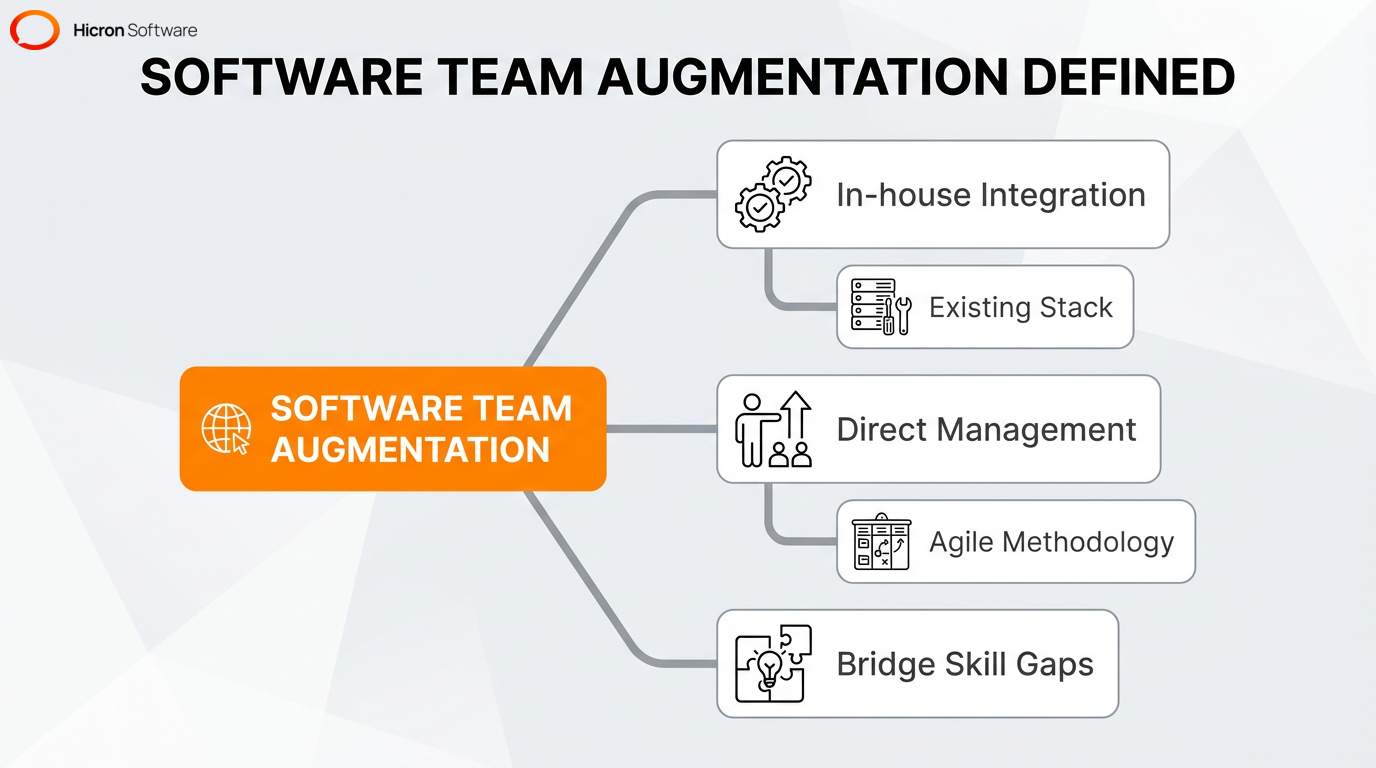
Software team augmentation is an outsourcing strategy that integrates external specialists into an in-house team under the client’s direct management. People also call this team extension or IT staff augmentation, and this model provides access to developers from around the world. It bridges skill gaps and increases project capacity without requiring long-term hiring commitments. Because the client retains full control over the engineering process, product quality, and remote team management, it feels much closer to home. Unlike traditional outsourcing, software development staff augmentation embeds professionals directly into daily operations. If you’ve ever felt the sting of a delayed product launch due to a sudden hiring freeze, you’ll immediately see the appeal here.
Because they act as your own employees, these developers plug right into your existing stack, including:
The augmented staff follows your agile methodology and reports directly to internal managers. Standardized onboarding ensures scalability for ongoing projects. Companies choose this route when they want to keep a close eye on the work of external contributors, particularly when they need specialized technical expertise quickly.
|
Category |
Key Elements |
Description & Impact |
|
Core Concept |
Direct Management & Integration |
|
|
Business Benefits |
Cost Efficiency & Scalability |
|
|
AI-Native Augmentation |
Generative-Driven Development |
|
|
Risks & Mitigation |
IP Security & Compliance |
|
|
Outsourcing Comparisons |
Control vs. Delegation |
|
Software team augmentation works by integrating skilled remote developers into an existing technical team and company culture. The process begins by identifying a specific skill gap within the internal department and selecting specialized talent to match precise project roles. Once selected, the organization integrates the talent to ensure alignment with existing workflows.
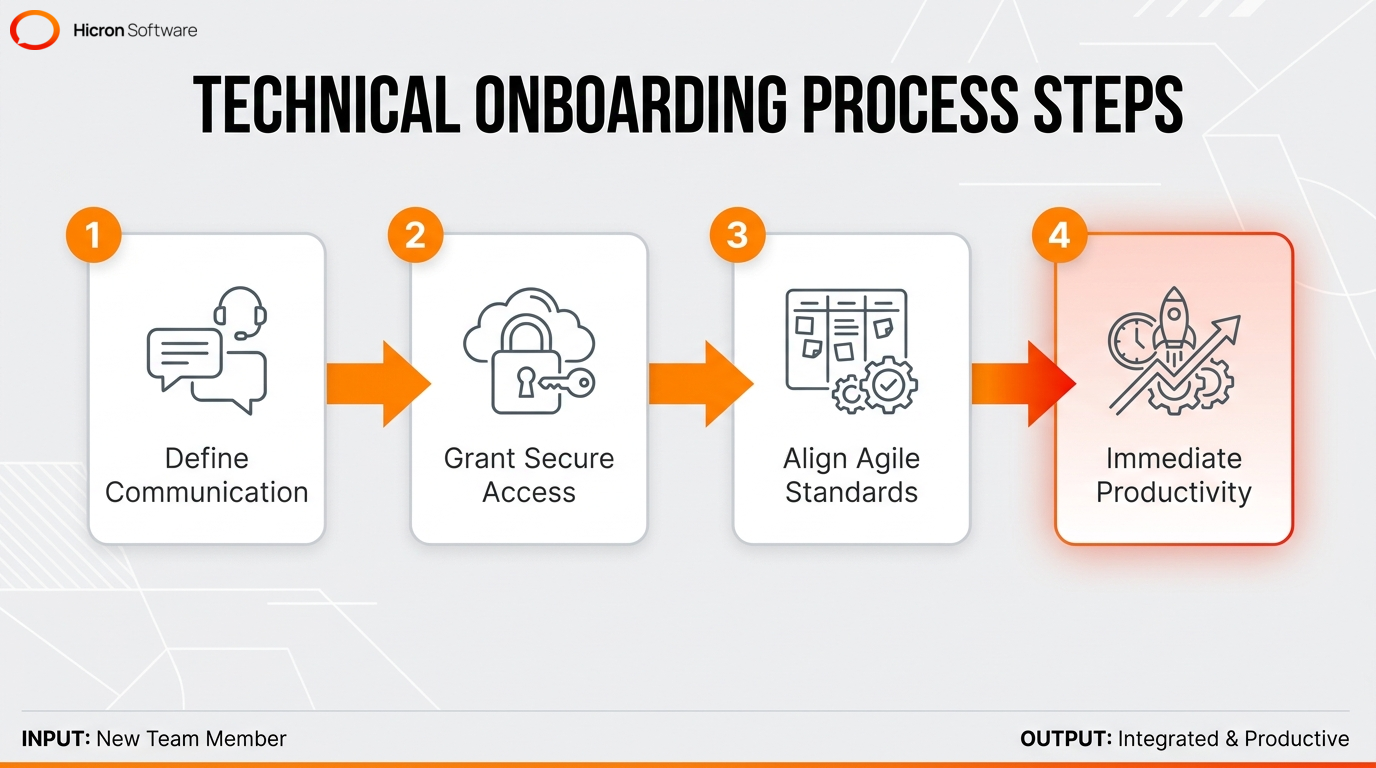
Technical onboarding embeds augmented staff into company workflows, tools, and codebases to ensure immediate productivity. A structured onboarding process helps remote developers get up to speed quickly. I always tell my clients that the first 48 hours dictate the success of the entire contract.
A successful integration hinges on three practical steps:
To ensure expertise remains in-house after a contract ends, organizations rely on a mix of systematic sharing and documentation. When augmented staff share their insights regularly, you prevent critical information from walking out the door. Mentorship programs and detailed documentation retain technical context.
Agile methodologies naturally encourage teams to share knowledge through standard ceremonies like:
By baking these habits into your daily routine, you minimize technical debt and enhance remote team management during a team extension. If you keep these practices going after onboarding, you’ll ensure your product remains stable long after the contract ends.
Software development staff augmentation offers clear business advantages over traditional hiring. This strategy allows an organization to adapt to sudden market changes and reduces development risks by providing immediate access to international developers.
Team extension resolves technical skill gaps by providing immediate access to a wider network of specialists. In-house teams often don’t have the niche expertise required for complex areas like cloud development, data engineering, and cybersecurity. IT staff augmentation bypasses local talent shortages by integrating niche software developers directly into an active project.
By tapping into this model, organizations can secure highly specialized professionals for advanced fields like machine learning, blockchain, and IoT, bypassing regional hiring limitations.
Software development staff augmentation provides the scalability needed to address sudden market shifts. Organizations can adjust their engineering capacity for changing project demands, such as core feature releases and intensive testing phases.
Project-based outsourcing aligns software developers with specific business cycles through sprint-based augmentation within the agile methodology. Rapid team extension provides a critical advantage in fast-moving industries by accelerating MVP development. Companies launch products faster when they use IT staff augmentation to access remote experts.
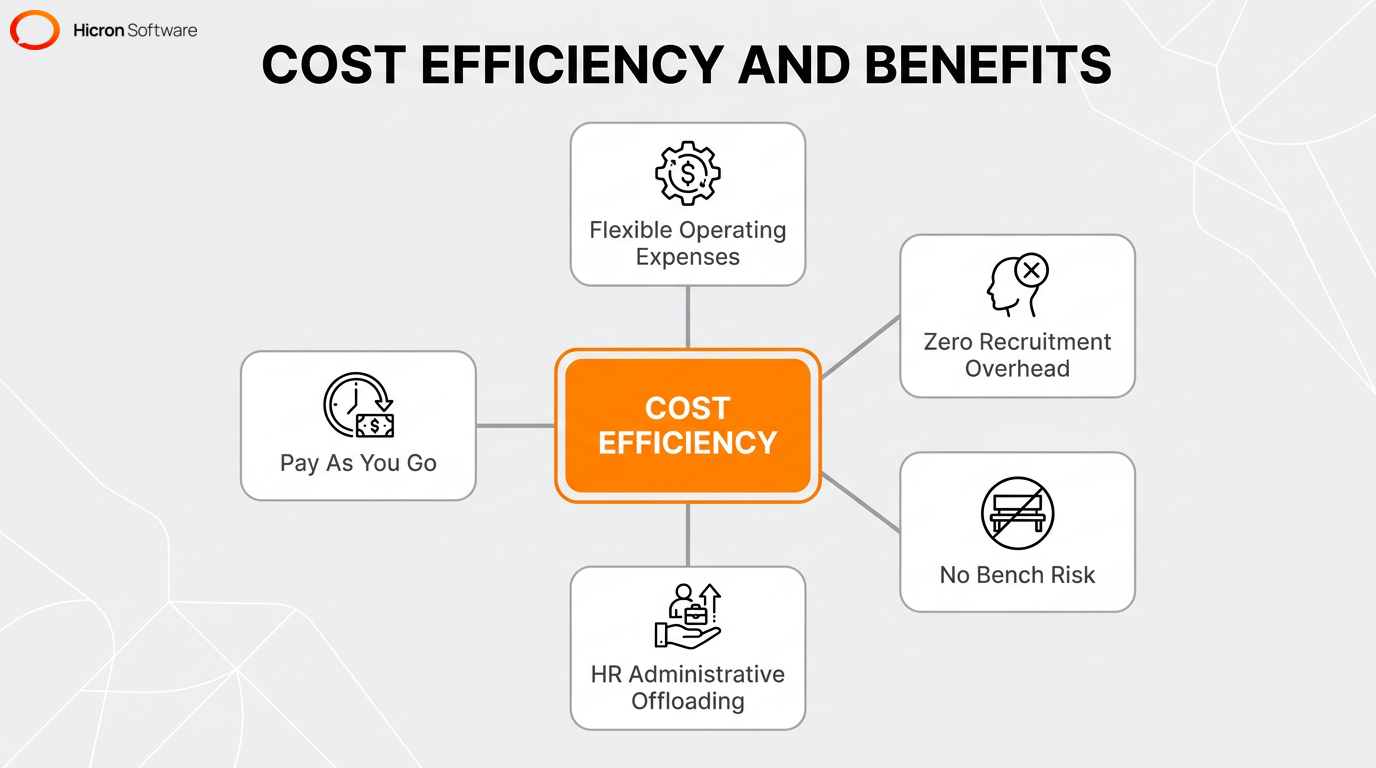
Software development staff augmentation improves cost efficiency by converting fixed payroll expenses into flexible monthly operating expenses. This financial model saves capital compared to traditional full-time hires by eliminating key financial burdens like recruitment overhead, training expenses, and bench risk. Clients pay exclusively for active project hours without long-term salary commitments.
By relying on an external provider, you avoid costly recruitment cycles and easily access a diverse talent pool through nearshore or offshore development. The external provider handles complex administrative tasks defined in the service level agreement, including employee benefits, tax compliance, and professional development. By removing these heavy HR obligations from your internal departments, this model drastically streamlines remote team management. Companies can then sustain high profitability during a team extension by using this precise pay-as-you-go structure for active development phases.
AI-native staff augmentation is the modern standard for team extension in 2026, where engineers use AI tools to multiply their output. This IT staff augmentation approach integrates specialized software developers who apply generative-driven development directly into an existing project. AI-native engineers multiply their development output by 2-3x using advanced tools like AI coding assistants and predictive testing frameworks.
These specialists bring advanced AI practices, such as automated code generation and intelligent debugging, directly to your in-house team, naturally increasing your overall project capacity. This software development staff augmentation strategy accelerates time-to-market and improves cost efficiency by reducing manual coding cycles. Organizations achieve scalability by adopting this advanced framework during complex engineering phases such as rapid prototyping, legacy system modernization, and large-scale data migrations. Seeing a single developer accomplish what used to take a team of three is nothing short of game-changing.
Generative-driven development is a governed execution loop used to wrap AI tools for production-grade software delivery. AI-native engineers move through a specific pipeline: Context, Plan, Confirm, Execute, and Validate. The Confirm stage reinforces alignment and reduces errors before the AI executes code generation.
By following this loop, you keep AI use governed and replicable, which keeps technical debt low. Software developers integrate machine learning models to accelerate time-to-market during complex projects like software modernization and backend development. Teams maintain strict product quality during the Validate phase by aligning outputs with the agile methodology and conducting a thorough code review.
Context Packs are structured project contexts stored within a repository that allow AI tools to understand project-specific logic. These files provide the necessary background and document exact project constraints to ensure accurate code generation and prevent AI hallucinations. They store critical project elements directly within the codebase, such as architectural guidelines, coding standards, and business rules.
This structured system serves as an automated knowledge transfer to accelerate technical onboarding for software developers. Teams minimize technical debt during the agile methodology by using these configurations for a thorough code review in complex areas like backend development and machine learning integrations.
Plan and confirm habits form a team habit where AI-native engineers present a precise plan for code changes before execution to improve overall code quality. This structured approach ensures team alignment and reduces critical errors early in AI-assisted coding. The ‘Confirm’ stage of generative-driven development directly reinforces these habits during the code review process to validate project logic.
These practices remain embedded in the in-house team to ensure knowledge stays with the team even after augmented software developers finish their contracts. Organizations minimize technical debt across primary project areas like backend and frontend development by implementing this discipline within their agile methodology. Structured planning enhances remote team management by establishing clear expectations for all distributed contributors.
IT staff augmentation gives you access to technical specialists who can support diverse project needs, such as rapid prototyping, feature expansion, and legacy system modernization. By tapping into international talent, you can flexibly add specific roles based on the current phase of the software development lifecycle to resolve immediate project bottlenecks.
Companies frequently augment their teams with DevOps engineers to automate CI/CD pipelines and optimize cloud infrastructure during a team extension. These professionals ensure fast and secure software deployments. Organizations use sprint-based IT staff augmentation to integrate these experts for specific release cycles within the agile methodology.
An external DevOps engineer introduces new CI/CD processes to modernize your infrastructure, automating testing pipelines and securing your cloud deployments. Companies accelerate time-to-market and achieve operational scalability by onboarding these specialized software developers.
Organizations highly value full-stack engineers in IT staff augmentation for their versatility in modernizing legacy systems. These developers are proficient in both frontend and backend development. They support legacy modernization by migrating older software to modern tech stacks, which minimizes technical debt.
For example, a single full-stack developer could simultaneously handle backend database migrations and frontend UI updates. This versatility makes the modernization process smoother and speeds up the launch of new cloud-based MVPs.
Augmenting a software team carries primary risks like IP security vulnerabilities, remote team integration challenges, and international compliance hurdles. IT staff augmentation exposes internal systems to external threats during the collaboration process. To secure proprietary assets, you must enforce strict IP protection through legal documents, such as an ironclad non-disclosure agreement and a detailed service level agreement. Pro tip: Don’t just rely on boilerplate templates; have your legal team tailor these agreements to the specific scope of the project.
Even with high cybersecurity standards restricting database access for external developers, remote team integration presents distinct operational challenges for distributed engineering departments. Without a structured onboarding process, communication breakdowns are common. This poor alignment can cause major project disruptions, leading to delayed knowledge transfer and mounting technical debt. To counter this, managers improve remote team management by establishing clear daily communication protocols.
Because hiring international remote workers introduces complex legal risks, organizations can face strict financial penalties for violating foreign labor regulations. To mitigate this, staffing partners often act as an employer of record, allowing businesses to avoid international legal disputes by using this administrative structure.
Strict contractual measures ensure all code and data remain a client’s exclusive property during IT staff augmentation. A well-drafted non-disclosure agreement prevents the unauthorized sharing of proprietary assets, including source code, database architectures, and proprietary algorithms. Secure onboarding protocols combine with these legal agreements to establish strict data transfer rules for remote team management.
An employer of record ensures this IP protection remains legally enforceable across international models like offshore and nearshore development. You can maintain high cybersecurity standards by establishing a detailed service level agreement (SLA) alongside an NDA.
When you compare staff augmentation to traditional outsourcing, the biggest difference comes down to one thing: control. This strategy allows clients to retain direct control over external developers and final engineering quality.
External engineers use internal client tools to complete daily tasks and blend right into the client’s existing agile methodology. IT staff augmentation provides superior flexibility for remote team management compared to rigid fixed-bid contracts. Companies achieve rapid scalability and high cost efficiency by choosing this integration method over traditional outsourcing frameworks.
The primary difference between these models comes down to management: staff augmentation integrates engineers into your internal department under your direct oversight, whereas project-based outsourcing transfers the entire scope to an independent vendor. Team extension is usually the better choice if you want to keep a tight grip on quality control and stay agile. Augmented software developers report directly to the client and use internal systems, such as deployment pipelines and staging servers, rather than delivering a finished product independently.
This direct integration enhances remote team management and supports rapid MVP development. Business leaders usually look at specific goals to decide between these frameworks, such as complete technical offloading versus precise resource scaling. A company chooses project-based outsourcing to delegate full product delivery.
On the other hand, if you need direct operational control, staff augmentation is the way to go. It keeps costs efficient and accelerates time-to-market, ensuring your internal managers maintain continuous alignment when augmented professionals follow the established agile methodology.
A dedicated development team operates as a self-contained unit to tackle new initiatives from scratch. In contrast, staff augmentation simply drops individual specialists into your existing department to bridge specific skill gaps. The main structural differences lie in individual integration versus deploying a stable group with its own project manager. A dedicated development team is more appropriate for executing long-term product roadmaps autonomously.
On the flip side, an organization uses a team extension to add software developers for a short sprint. This flexible strategy provides immediate scalability by accessing external developers. Internal leaders maintain direct remote team management over augmented staff within the established agile methodology. Companies deploy a dedicated group to bypass traditional project-based outsourcing when they require autonomous execution for complex product builds.
IT staff augmentation provides flexible personnel under direct internal oversight, whereas managed services assume full responsibility for operating entire IT functions. The primary differences in strategic oversight come down to day-to-day management versus end-to-end infrastructure control. Managed services operate entire technical environments independently based on a strict service level agreement.
Examples include full-scale cybersecurity frameworks and complete cloud development architectures. Meanwhile, software development staff augmentation integrates specialists just to build a specific cloud feature. Organizations achieve high cost efficiency during a team extension by using this capacity instead of comprehensive project-based outsourcing.
When you’re hunting for the right IT staff augmentation vendor, you need to look closely at legal compliance, talent quality, and geographical alignment. Partners demonstrate reliability by aligning with strict regulatory requirements.
Examples include GDPR compliance and industry-standard data protection laws. A detailed service level agreement guarantees operational transparency and secures proprietary assets. Internal leaders optimize remote team management by selecting a vendor with these established compliance frameworks.
Nearshore development maximizes time-zone overlap to enable real-time collaboration. Shared business hours bring major benefits, namely cultural alignment and immediate synchronous communication. Synchronous communication prevents project delays during routine agile methodology ceremonies, such as daily stand-ups and sprint planning.
This direct interaction improves daily team collaboration for software developers during IT staff augmentation. Offshore development contrasts with this model because limited time-zone overlap forces teams to rely heavily on slower, asynchronous communication protocols. By prioritizing overlapping schedules through nearshore extension, you can accelerate time-to-market and keep your delivery cycles running smoothly.
Think of an employer of record (EOR) as your administrative shield. They handle the tax and legal headaches of hiring internationally. Instead of you navigating foreign labor laws, the EOR absorbs the legal risks. They take care of the heavy lifting, from processing taxes and payroll to managing employee benefits and contract terminations, so you can focus purely on building your product. This delegation allows clients to focus purely on technical management and project delivery during software development staff augmentation. Let’s be honest, nobody wants to spend their week untangling international tax codes when they could be shipping features.
An employer of record ensures that IP protection clauses remain legally enforceable in a developer’s home country. Organizations secure proprietary code through binding documents like a non-disclosure agreement and a service level agreement. Companies access a global talent pool across distinct outsourcing models like nearshore and offshore development. Internal leaders optimize remote team management and bypass a lengthy recruitment cycle by using this legal framework.
A rigorous talent vetting process is essential for successful IT staff augmentation because it ensures specialists have the exact expertise needed to close skill gaps. Vendors typically rely on specific evaluation methods, such as technical interviews and practical coding tests, during a fast recruitment cycle to filter a global talent pool.
Modern vetting for AI-native roles uses AI-assisted screening to evaluate the practical capabilities of specific professionals, such as software developers and QA specialists. By integrating thoroughly vetted experts, you ensure the engineering quality bar remains high, allowing your team to maintain strict product standards without missing a beat.
Hicron Software proved to be a trusted partner with unmatched technical expertise, delivering a scalable and user-friendly web application that was pivotal to our successful U.S. market expansion.

Hicron’s contributions have been vital in making our product ready for commercialization. Their commitment to excellence, innovative solutions, and flexible approach were key factors in our successful collaboration.
I wholeheartedly recommend Hicron to any organization seeking a strategic long-term partnership, reliable and skilled partner for their technological needs.
After carefully evaluating suppliers, we decided to try a new approach and start working with a near-shore software house. Cooperation with Hicron Software House was something different, and it turned out to be a great success that brought added value to our company.
With HICRON’s creative ideas and fresh perspective, we reached a new level of our core platform and achieved our business goals.
Many thanks for what you did so far; we are looking forward to more in future!

Hicron is a partner who has provided excellent software development services. Their talented software engineers have a strong focus on collaboration and quality. They have helped us in achieving our goals across our cloud platforms at a good pace, without compromising on the quality of our services. Our partnership is professional and solution-focused!

The IT system supporting the work of retail outlets is the foundation of our business. The ability to optimize and adapt it to the needs of all entities in the PSA Group is of strategic importance and we consider it a step into the future. This project is a huge challenge: not only for us in terms of organization, but also for our partners – including Hicron – in terms of adapting the system to the needs and business models of PSA. Cooperation with Hicron consultants, taking into account their competences in the field of programming and processes specific to the automotive sector, gave us many reasons to be satisfied.