Microservices Architecture Style: Pros & Cons
- June 25
- 28 min


If you’ve spent any time in tech lately, you’ve probably heard this buzzword thrown around constantly. Think of cloud native not just as where an application lives, but how it’s built from the ground up. Cloud native is a modern software approach for building, deploying, and managing applications that fully use cloud computing environments, including public, private, and hybrid clouds. To maximize scalability and resilience, a cloud-native application relies on a loosely coupled architecture made up of three core components:
Because this architecture depends on microservices to provide modularity and independent scaling, developers use containers as the primary packaging and deployment units within the cloud-native stack.
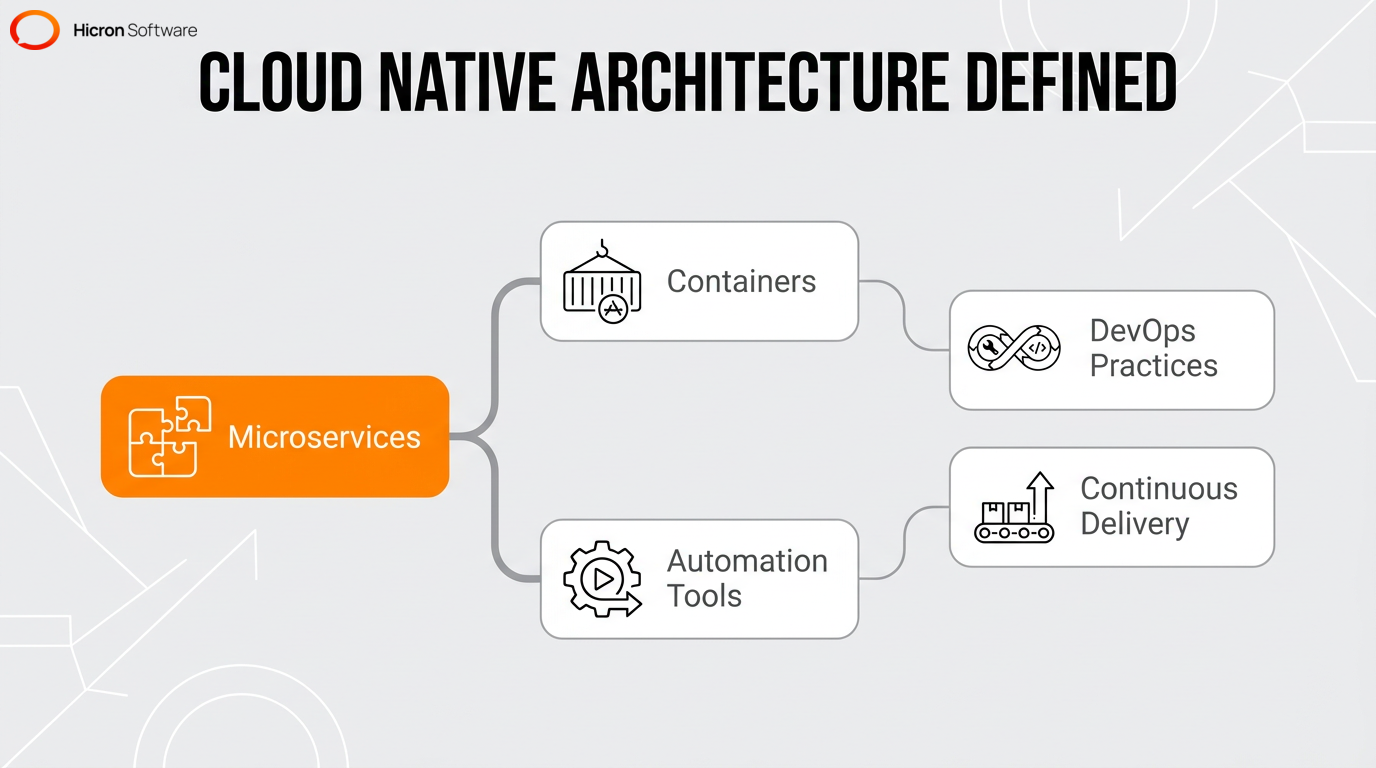
Containers isolate application processes to ensure consistent performance across different servers. Beyond consistent performance, cloud-native approaches also cut costs by eliminating the need for expensive physical servers. To keep things running smoothly, engineering teams automate updates using DevOps practices like continuous monitoring and automated testing, while organizations maintain continuous delivery pipelines by integrating CI/CD tools such as Jenkins and GitLab. Implementing container orchestration directly translates to higher application uptime.
|
Category |
Key Elements |
Description & Role |
|
Core Components |
|
Forms a loosely coupled architecture that provides modularity, independent scaling, and consistent performance across different servers. |
|
Architecture Principles |
|
Foundational components that keep applications highly available, easy to grow on demand, and enable frequent software updates without operational downtime. |
|
Cloud-Native Stack Layers |
|
A multi-layered architecture required to build, run, and manage a cloud-native application, utilizing infrastructure as code and automated configurations. |
|
Key Technologies & Practices |
|
Tools and workflows that automate code integration, manage container orchestration, ensure rapid deployments, and integrate security controls directly into the delivery pipeline. |
|
Primary Benefits |
|
Improves operational speed and the bottom line by removing physical server maintenance, isolating component failures, and dynamically adjusting computing resources via auto-scaling. |
The primary architectural difference is that developers design cloud-native applications to exploit the elasticity and distributed nature of modern cloud environments from day one. Modern streaming platforms and ride-sharing apps fit this category. On the other hand, cloud-enabled applications are legacy systems retrofitted for cloud infrastructure, such as traditional banking portals or older inventory management tools. A cloud-native design relies on microservices, like authentication services and payment modules, which are packaged using containerization within the cloud-native stack.
Cloud-enabled software stems from a monolithic architecture. This creates a bottleneck. These retrofitted legacy systems lack the inherent flexibility and scalability of a true cloud-native platform. A cloud-native app scales horizontally to handle traffic spikes during sudden user surges or seasonal sales. High network demand often overwhelms a retrofitted monolith, preventing it from matching this efficiency. By using a loosely coupled structure, a cloud-native environment maintains high resilience.
A monolithic architecture resembles a single, massive block of stone, a legacy pattern built as one entirely interconnected unit. Updating a monolithic application requires redeploying the entire system. In my experience, nothing tests a development team’s patience quite like waiting for a massive monolith to redeploy just to fix a minor bug. Cloud native breaks this large unit down into loosely coupled microservices, such as independent billing modules and user databases. Each separate component communicates through an application programming interface (API).
This modularity drives two major benefits: independent scalability and system resilience. Because a cloud-native approach allows for the continuous delivery of an individual microservice, teams can use continuous integration to automate code merges. By relying on CI/CD workflows to streamline the final deployment, the overall system’s performance remains stable even during high demand on a specific service.
Cloud-native architecture relies on five foundational components to keep applications highly available and easy to grow on demand:
Because these architectural principles enable frequent software updates, teams don’t have to worry about operational downtime when deploying new code.
Microservices are small, loosely coupled services that form a cloud-native application, such as notification modules and billing processors. Each microservice performs a specific function and communicates with other system parts through an application programming interface. Developers use declarative APIs, like a Kubernetes API or a GraphQL interface, for this communication.
Engineering teams package these microservices into containers, such as Docker or Linux containers, to ensure independent execution from the underlying operating system, and this modular architecture provides high scalability and system resilience. When demand spikes, a platform can scale up a specific microservice without affecting the rest of the system. Furthermore, this structural independence supports continuous integration and continuous delivery, meaning developers can deploy a new feature to a single service without disrupting the broader application.
By isolating specific processes for consistent execution, containers act as lightweight, executable units that package microservices and software dependencies, including runtime libraries and configuration files. This containerization ensures consistent operation across any environment. Because a container serves as the primary deployment unit for a cloud-native application, tools like Docker have become the industry-standard, open-source format for creating this unit at the runtime layer.
A container-based workload offers high portability. Developers can move these workloads across major cloud computing environments, public, private, and hybrid clouds, without heavy rework. Container orchestration tools like Kubernetes and Apache Mesos allow engineering teams to easily control loosely coupled architectures.
Think of it like replacing a broken part rather than trying to fix it. Immutable infrastructure is a deployment strategy that replaces servers entirely instead of modifying them after deployment to maintain system stability. This cloud-native approach improves deployment predictability by eliminating configuration drift and simplifying system rollbacks. Developers use infrastructure as code to manage configuration files, using tools like Terraform scripts and AWS CloudFormation templates.
DevOps departments use continuous delivery and CI/CD pipelines to automate this server replacement. Platforms use declarative APIs, such as provisioning APIs and cluster management interfaces, to run this automated process. Implementing a GitOps workflow with this strategy directly boosts infrastructure resilience and workload scalability.
Declarative APIs allow loosely coupled systems to interact without exposing internal workings. Software engineers rely on declarative APIs, often implemented using architectural styles like REST or frameworks like gRPC, to standardize communication between services. These APIs connect components like authentication services and billing modules. This connection describes key service parameters: the specific function a service performs and the exact data it requires or returns.
This abstraction allows systems to interact without processing the internal logic of other components, a method that maintains the strict independence of a microservice and ensures that a code change in one unit doesn’t break another. By managing this network, a service mesh guarantees high resilience and scalability across a cloud-native environment. Ultimately, this standardized connection maintains system stability during automated deployments, enabling successful continuous integration and continuous delivery.
The cloud-native stack is a multi-layered architecture comprising five distinct technology layers required to build, run, and manage a cloud-native application:
The infrastructure layer forms the foundation of this entire stack. Cloud providers manage this foundational tier to deliver computing resources, such as virtual machines and storage volumes.
Developers use infrastructure as code to automate configurations within the provisioning layer. Above this sits the application layer, the top tier where teams deploy microservices like billing modules and authentication services. To tie it all together, a service mesh manages the network communication for individual microservices to guarantee secure data routing across a cloud computing environment.
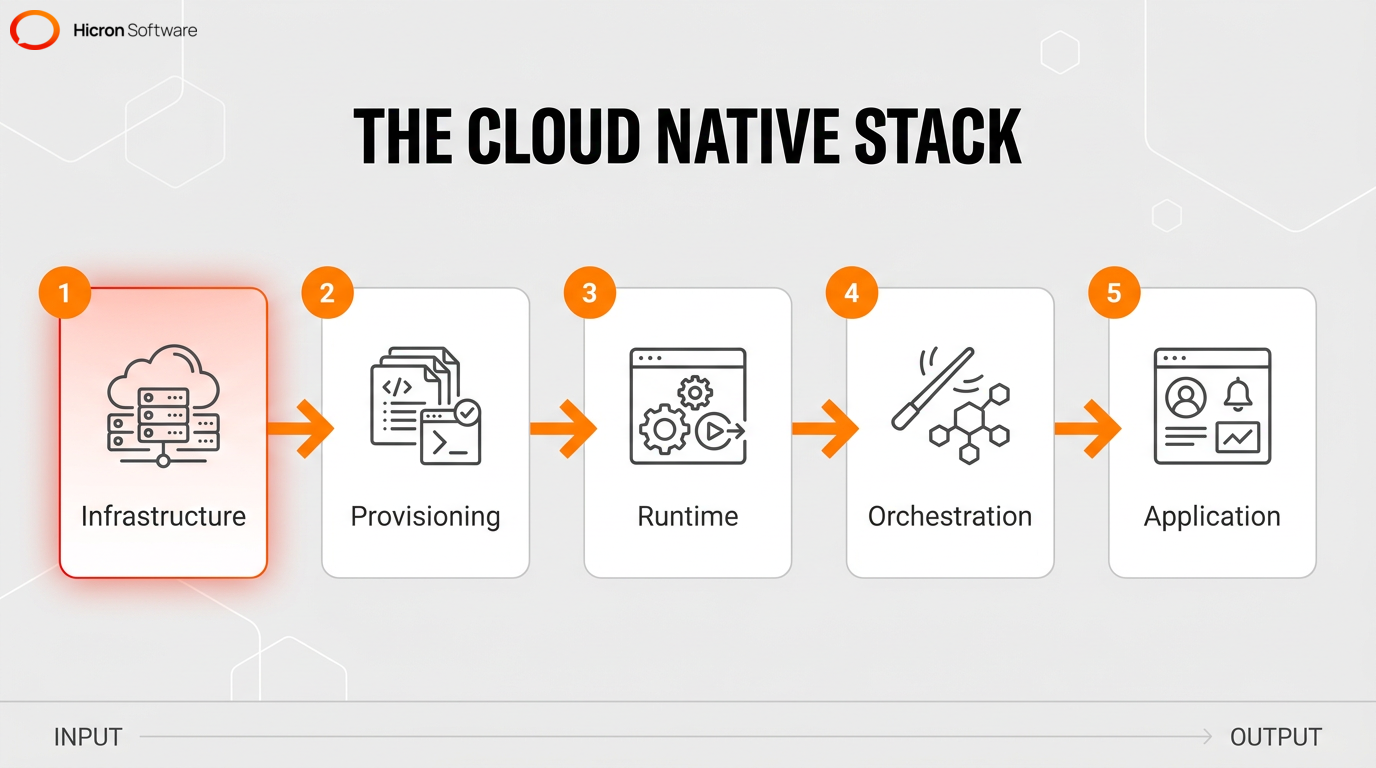
Managing storage and networking for containers, including Docker and Linux containers, is the primary job of this tier. It serves as the environment within the cloud-native stack where application code and containers actually execute. Ultimately, it ensures that containerized microservices operate consistently regardless of the underlying cloud computing infrastructure.
Container runtimes handle two main tasks: pulling container images and managing their execution on a host node. Developers rely on containerization to maintain stable performance, often using Docker to isolate specific processes. During periods of rapid scaling, the runtime layer works in tandem with the orchestration layer to ensure high resilience and application availability.
The orchestration layer controls how a distributed system interacts and scales. Tools such as Kubernetes and Apache Mesos operate within this part of the stack to manage a container lifecycle. By integrating various cloud components, like compute nodes and network proxies, it functions as a single, cohesive unit that unifies distributed microservices, such as payment gateways and search functions.
The framework achieves this unification by automating key operations: the deployment, scaling, and management of a containerized application. Container orchestration provides the capabilities to ensure high scalability, including auto-scaling, self-healing, and load balancing. During heavy traffic, Kubernetes serves as the most prominent tool in the orchestration layer to handle container orchestration, manage containers, and ensure high availability. It handles components like application pods and background workers. Efficient workload distribution by this technology ensures stable system performance.
Kubernetes serves as the primary orchestration tool for automating the lifecycle and scaling of containerized applications within a cloud-native environment. This platform manages core operations across a cluster: the deployment, auto-scaling, and load balancing of multiple containers. Engineering teams use this technology to coordinate distributed microservices, such as authentication services and data processors, effectively. While the initial learning curve can feel a bit steep, I’ve found that mastering it pays massive dividends for team velocity.
The system provides self-healing capabilities to ensure high application resilience and continuous availability; if a Docker container fails, Kubernetes automatically restarts or replaces that specific unit to maintain the desired application state. This orchestration layer automates cluster management by continuously monitoring the system and distributing network traffic evenly. To maximize the efficiency of this automated container orchestration, precise configuration files serve as the foundation.
DevOps is a collaborative culture that aligns software development and IT operations to speed up the development lifecycle, heavily relying on CI/CD pipelines to automate code integration, automated testing, and software deployment. Within this pipeline, continuous integration allows developers to merge code modifications frequently for feature enhancements or bug fixes. Once merged, continuous delivery takes over, enabling cloud-native applications to receive these updates without downtime.
These automated practices accelerate cloud-native development by eliminating manual bottlenecks, such as manual code reviews and manual server deployments. Strong CI/CD workflows allow teams to rapidly deploy loosely coupled microservices. Developers package these software updates into Docker or Linux containers to ensure consistent execution. DevOps culture and CI/CD pipelines function as the operational engines that enable the rapid and reliable delivery of cloud-native software.
DevOps practices rely on infrastructure as code, an automated methodology using machine-readable files to provision environments automatically. By writing configuration scripts and deployment templates, such as Terraform scripts and AWS CloudFormation templates, teams can replace manual hardware configuration. This reduces human error and increases deployment speed across public and private cloud computing platforms, helping engineering teams manage immutable infrastructure within a cloud-native architecture.
With infrastructure as code, developers can version-control setups just like they do with regular application code. Development departments implement GitOps workflows to track code modifications, version updates, and configuration changes. This version control supports DevOps practices like continuous delivery and automated provisioning. Platforms use declarative APIs to execute these automated files within a CI/CD pipeline. Standardizing infrastructure configuration through automated deployments guarantees high system resilience.
GitOps is an operational framework that uses Git repositories as the single source of truth for declarative infrastructure and cloud-native deployments. By using version control to automate continuous delivery, this methodology syncs Git repositories with a live environment to ensure that the deployed state of a system always matches the declarative configuration stored in Git. If a developer merges a change into the main Git branch, GitOps tools like Argo CD and Flux automatically apply the code modification to a Kubernetes cluster.
This automated process manages key deployment components: application updates and infrastructure setups. Engineering teams rely on infrastructure as code to maintain immutable infrastructure within this workflow. Platforms use declarative APIs to connect Git and the live system smoothly. This version-controlled approach supports DevOps practices by enhancing CI/CD pipelines with continuous integration and automated rollback capabilities. Integrating GitOps with container orchestration drives rapid deployment cycles.
By integrating security controls directly into a DevOps pipeline, DevSecOps ensures cloud-native applications remain secure and compliant. This includes vulnerability scanning, static code analysis, dynamic application security testing, and container image scanning. This methodology automates vulnerability detection early in the software delivery lifecycle. Engineering teams integrate automated security scanning into continuous integration and continuous delivery pipelines to prevent vulnerable container images from deploying to production.
Implementing this security framework at the platform level makes demonstrating compliance easier and cheaper. Systems use microsegmentation to isolate network traffic when developers provision infrastructure as code. Automating CI/CD deployments via GitOps workflows helps platforms maintain continuous security. They achieve this by using observability tools like distributed tracing and log aggregators.
Cloud-native applications directly improve a company’s bottom line and operational speed by offering near-instant scalability, high resilience, and reduced operational costs. Enterprises achieve notable cost savings by removing the need for hardware procurement and physical server maintenance. Container-based workloads provide high portability across various cloud computing environments, including public clouds, hybrid clouds, and multicloud architectures.
Cloud-native technologies ensure high availability to maintain highly resilient applications. Continuous delivery allows engineering teams to update software without causing operational downtime. This architecture relies on loosely coupled microservices to isolate component failures. These operational advantages ensure maximum software stability during periods of unpredictable network demand.
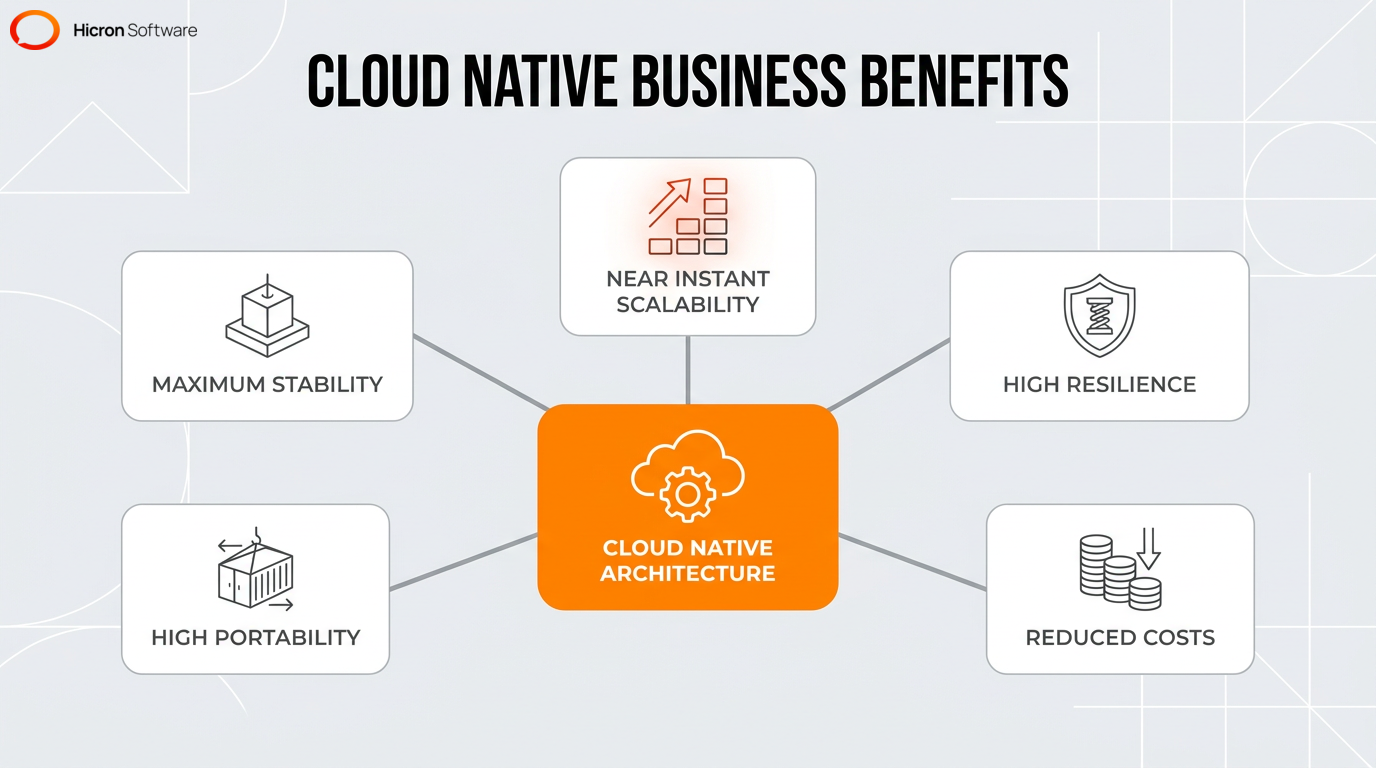
Auto-scaling dynamically adjusts computing resources based on real-time demand. Organizations avoid paying for idle servers during low-traffic periods because the cloud-native platform continuously monitors metrics like CPU usage and network traffic. When a sudden spike occurs, the system automatically spins up additional container instances to handle the load, then spins them down once traffic subsides.
A self-healing system automatically detects and recovers from component failures, such as restarting a failed module, to maintain high application resilience. If a microservice or container, like Docker and Linux containers, fails, this mechanism ensures continuous cloud-native functionality. Container orchestration tools like Kubernetes and Apache Mesos execute this recovery process.
If a cluster node goes down, the orchestration layer automatically reschedules the affected workload onto a healthy node. Platforms identify system errors by using observability tools like distributed tracing and log aggregators. To keep the application running, the architecture relies on auto-scaling and automatic container restarts.
Adopting a cloud-native approach requires an organization to overcome two major challenges: an organizational culture shift and distributed system complexity. This transition demands a cultural shift to decrease software delivery timelines and embrace DevOps practices, such as continuous monitoring and collaborative planning. Honestly, getting the technology right is often the easy part; it’s changing how your teams work together that takes real effort. The cloud-native journey is an ongoing process of constant learning and iteration rather than a one-time implementation. Moving away from a monolithic architecture introduces critical technical hurdles: data consistency and network management.
Managing the complex networking between hundreds of microservices—such as payment modules and user databases—requires specialized knowledge and advanced tools like a service mesh and an API gateway. While enterprises use platform engineering to manage the entire cloud-native stack effectively, developers implement continuous integration and continuous delivery to automate complex deployments. Integrating observability and DevSecOps into the workflow ensures stable platform performance.
Two advanced technologies enhance the capabilities of a standard cloud-native system: serverless computing and a service mesh. Integrating these advanced technologies with container orchestration reduces operational overhead and improves scaling speed across a cloud-native environment.
Serverless computing is a cloud-native model where a cloud provider fully manages the underlying server infrastructure, removing the burden of infrastructure management from developers. Because the provider handles all resource allocation directly, this execution model optimizes the cloud-native stack by eliminating manual server provisioning. Serverless functions execute by responding to specific events, such as an HTTP request or a database modification. Ultimately, this setup scales from zero to thousands of concurrent executions instantly to ensure high scalability.
The system uses auto-scaling to adjust computing resources based on exact demand. This highly efficient environment provides major financial advantages: a pay-as-you-go pricing model and zero costs for idle server time. Users pay only for actual consumption. This operational framework supports loosely coupled microservices across cloud computing platforms. Integrating serverless functions with continuous delivery pipelines strengthens system resilience. This serverless architecture frees developers from configuring infrastructure as code, allowing them to focus entirely on application logic.
A service mesh handles the complex communication and data security of distributed microservices, such as payment modules and user databases. It executes specific operational tasks, including load balancing and microsegmentation. This changes the game for monitoring. Adding a service mesh to a Kubernetes environment provides deep observability and performance metrics (like network latency) without requiring modifications to application code. This technology secures data routing when platforms use declarative APIs, such as REST APIs and gRPC interfaces, for service connections.
Scaling loosely coupled components in a cloud-native environment makes this technology essential to handle complex networking. The layer controls critical network operations without altering the underlying microservice code: traffic routing, authentication, and load balancing. A service mesh provides critical metrics that feed into observability tools to monitor inter-service health, tracking data like network latency and error rates. This infrastructure uses declarative APIs to enforce microsegmentation, ensuring high application resilience and scalability.
Observability tools monitor, evaluate, and improve system health by gathering detailed data across distributed cloud-native environments. These platforms collect essential data types (logs, metrics, and traces) to provide deep visibility into complex microservice interactions. Real-time monitoring is critical for detecting system failures early and maintaining high resilience.
Observability platforms analyze traces from a service mesh to pinpoint exactly which microservice causes a performance bottleneck. This deep visibility helps maintain the health of distributed systems by triggering self-healing mechanisms when errors occur. To support DevOps practices, engineering teams use this continuous monitoring within the cloud-native stack. By integrating these diagnostic tools, developers can ensure stable software performance throughout continuous integration and continuous delivery.
Migrating to a cloud-native approach doesn’t happen overnight. It usually involves a few key steps: re-platforming workloads, breaking down monolithic architectures, and establishing CI/CD pipelines to adopt a DevOps culture. Modernizing a legacy app starts with containerizing the monolith before gradually strangling it into smaller, manageable microservices, such as independent payment processors and user databases. Developers use containerization to isolate specific processes effectively. A quick pro-tip here: resist the urge to rewrite everything at once, as a phased approach will save you countless headaches.
After engineering teams package software components into Docker or Linux containers, this modernization process uses automation to accelerate software delivery. Development departments maintain continuous integration by establishing strong CI/CD pipelines, including testing and deployment pipelines. Meanwhile, enterprises rely on platform engineering to manage distributed systems across diverse computing environments, such as hybrid cloud and multicloud infrastructures. Successfully transitioning to this cloud-native methodology unlocks maximum platform scalability.
Hybrid cloud and multicloud strategies distribute workloads across varied environments, public clouds, private clouds, and on-premises data centers, to provide flexibility and avoid vendor lock-in. While a hybrid cloud combines these platforms to maintain data sovereignty, a multicloud architecture uses services from at least two cloud computing providers to increase overall resilience and scalability.
Container-based workloads offer the portability required to move easily between different public and private environments. A cloud-native system relies on containerization to package software into Docker or Linux containers. Using Kubernetes in the orchestration layer to manage distributed workloads ensures stable platform performance.
Platform engineering designs toolchains and workflows that enable self-service capabilities for software engineering teams. This discipline simplifies cloud-native operations. It does this by abstracting the complexity of the underlying infrastructure. Platform teams build internal developer platforms on top of orchestration tools like Kubernetes and Apache Mesos. Providing a standardized internal platform reduces cognitive load on developers, allowing them to focus entirely on writing code.
This framework speeds up development workflows by integrating automated operations: continuous integration, continuous delivery, and CI/CD. Engineering teams use infrastructure as code to manage these internal platforms efficiently, and implementing a GitOps methodology allows systems to automate updates across the entire cloud-native stack. When platform engineering effectively supports DevOps practices, organizations can accelerate their release cycles while maintaining strict reliability standards.
Hicron Software proved to be a trusted partner with unmatched technical expertise, delivering a scalable and user-friendly web application that was pivotal to our successful U.S. market expansion.

Hicron’s contributions have been vital in making our product ready for commercialization. Their commitment to excellence, innovative solutions, and flexible approach were key factors in our successful collaboration.
I wholeheartedly recommend Hicron to any organization seeking a strategic long-term partnership, reliable and skilled partner for their technological needs.

After carefully evaluating suppliers, we decided to try a new approach and start working with a near-shore software house. Cooperation with Hicron Software House was something different, and it turned out to be a great success that brought added value to our company.
With HICRON’s creative ideas and fresh perspective, we reached a new level of our core platform and achieved our business goals.
Many thanks for what you did so far; we are looking forward to more in future!

Hicron is a partner who has provided excellent software development services. Their talented software engineers have a strong focus on collaboration and quality. They have helped us in achieving our goals across our cloud platforms at a good pace, without compromising on the quality of our services. Our partnership is professional and solution-focused!

The IT system supporting the work of retail outlets is the foundation of our business. The ability to optimize and adapt it to the needs of all entities in the PSA Group is of strategic importance and we consider it a step into the future. This project is a huge challenge: not only for us in terms of organization, but also for our partners – including Hicron – in terms of adapting the system to the needs and business models of PSA. Cooperation with Hicron consultants, taking into account their competences in the field of programming and processes specific to the automotive sector, gave us many reasons to be satisfied.