How to Build Enterprise Microservices with Spring Boot
- April 14
- 11 min


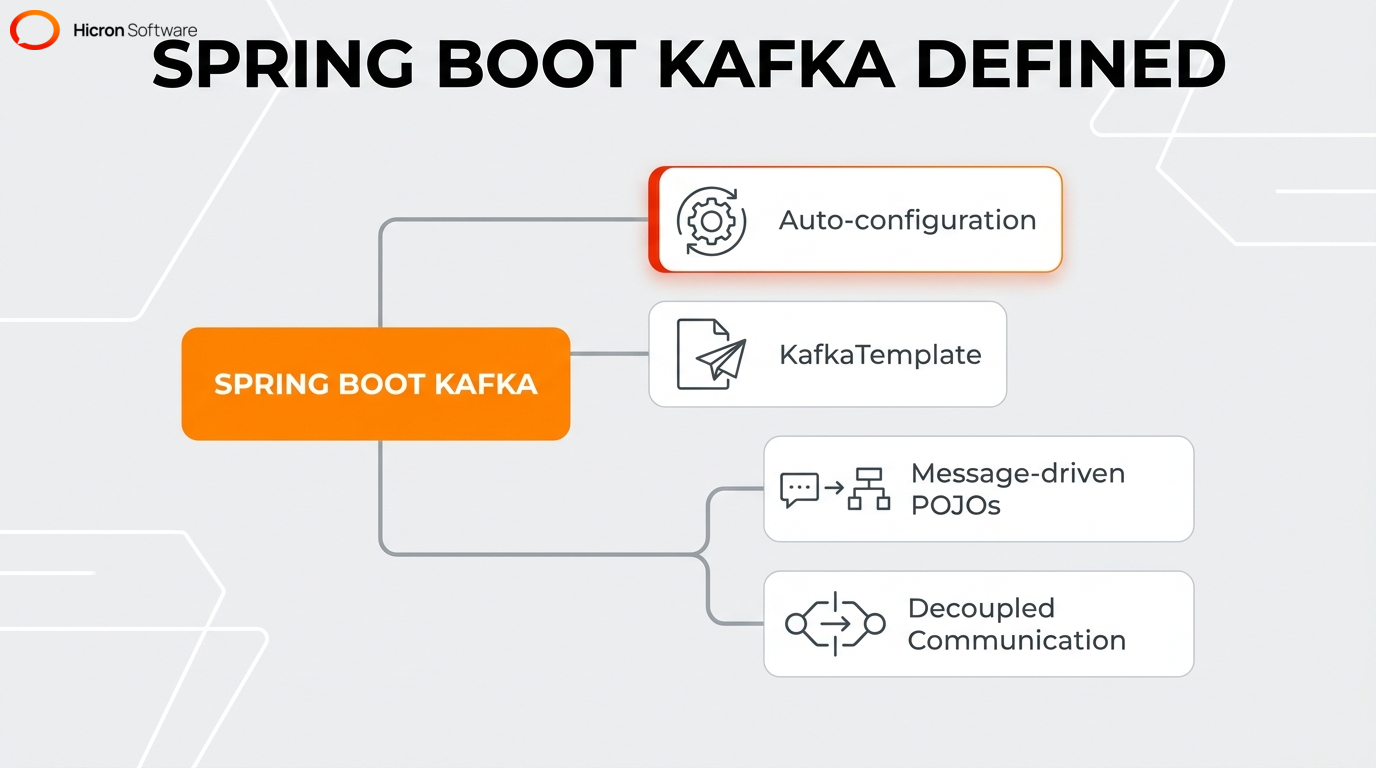
By integrating auto-configuration and dependency injection with distributed event-streaming capabilities, Spring Boot Kafka helps developers build scalable applications for real-time data processing. To manage application components like producers and consumers, the architecture uses declarative programming through Inversion of Control. Providing high-level abstractions and templates, including KafkaTemplate and message listener containers, the framework makes it easy to send and receive messages. These tools enable asynchronous communication within a microservices architecture.
By automating boilerplate setup, such as connector management and data serialization, this messaging integration simplifies development for cloud-native platforms. Developers implement message-driven POJOs to establish decoupled communication between event-driven microservices, ensuring the system maintains high throughput and scales easily when data volumes increase rapidly.
|
Core Concept |
Mechanism & Description |
Key Benefits & Use Cases |
|
Uses Inversion of Control, KafkaTemplate, and message-driven POJOs for asynchronous, non-blocking message handling. |
|
|
|
Scalability & Load Distribution |
Utilizes topic partitioning and consumer groups to split the message load across multiple application instances. |
|
|
Data Consistency |
Automates offset tracking and uses transactional messaging for atomic operations. Supports exactly-once delivery. |
|
|
Failure Handling |
Employs global error handlers, retry mechanisms with exponential backoff policies, and dead-letter queues. |
|
|
Security Protocols |
Implements SSL encryption (encrypted tunnel), SASL authentication (identity verification), and access control lists. |
|
|
Performance Monitoring |
Tracks critical indicators via REST endpoints, focusing on consumer lag, broker health, and producer throughput. |
|
Event-driven microservices improve fault tolerance by reacting to events rather than relying on hard-wired connections. They use a centralized messaging platform to decouple system components, making the entire architecture easier to scale. Because the communication is decoupled, teams can scale and deploy individual services independently. In my experience, this independence is often the biggest win for development teams transitioning from monolithic architectures.
Exchanging data this way prevents cascading failures across the system, while asynchronous communication reduces configuration complexity and accelerates development cycles for cloud-native applications. Ultimately, this architectural pattern optimizes load distribution to sustain high throughput even when system demands fluctuate.
Asynchronous communication enables non-blocking message handling within event-driven microservices. Subsequent operations execute immediately without waiting for previous results. Producers send data to a distributed event-streaming platform, and consumers process those stored messages independently. Internal containers manage tasks like:
This automation streamlines development by eliminating manual thread logic. It also improves performance by preventing bottlenecks and optimizing load distribution. This allows the system to scale naturally and sustain high throughput under heavy loads.
By using a centralized messaging platform for distributed event-streaming, Spring Boot Kafka enables decoupled communication where producers and consumers interact without direct knowledge of one another. To simplify the programming model and reduce tight coupling, the framework abstracts native client APIs. Handling infrastructure logic internally, high-level abstractions separate service components, allowing developers to use built-in support for message-driven POJOs alongside declarative listener annotations.
Application properties define key external configurations, such as broker locations and message formats. By externalizing these configurations, developers remove hard-coded dependencies between services within a microservices architecture. Through this structural separation, event-driven microservices achieve fault tolerance and scalability. While the architecture optimizes load distribution across cloud-native environments, asynchronous communication processes data continuously despite network latency fluctuations.
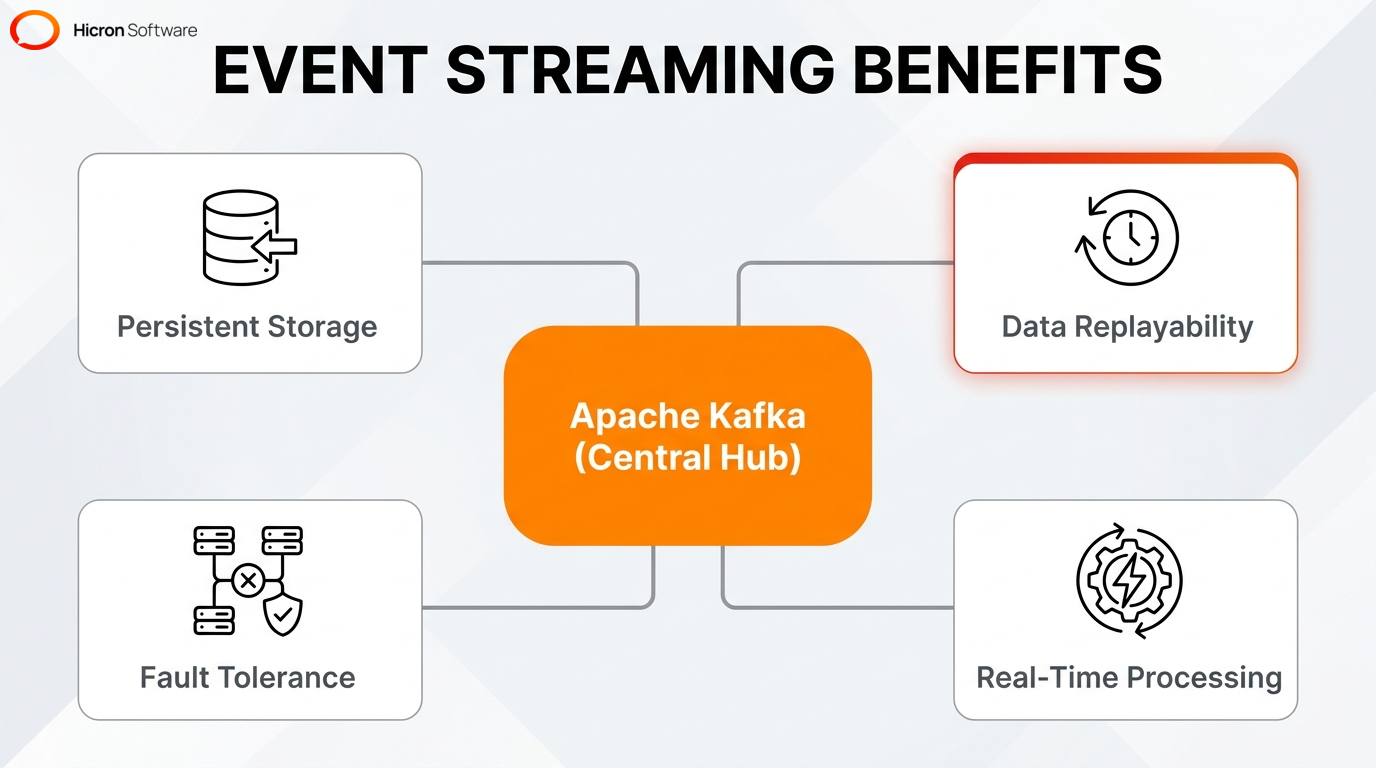
Distributed event-streaming provides a resilient, scalable foundation for handling large volumes of data across decoupled systems. This architecture offers distinct advantages over traditional messaging queues, such as:
Stream processing enables real-time data processing for continuous analytical workloads. Because decoupled communication ensures fault tolerance if individual system nodes fail, the infrastructure maintains continuous operations regardless of network traffic fluctuations.
Horizontal scaling manages high throughput by increasing producer instances and consumer group members. Topic partitioning structures data into separate logs to enable parallel processing across event-driven microservices. Adding more service instances directly increases system capacity, as the framework assigns these new instances to available partitions.
Scaling clients horizontally prevents bottlenecks when high-velocity data streams enter the platform. This load distribution enhances scalability for distributed event-streaming. It also optimizes critical performance metrics within a microservices architecture, like consumer lag and overall processing time.
Consumer groups split the message load across multiple application instances to ensure efficient parallel processing and horizontal scaling. Think of a consumer group like a team of checkout clerks at a busy grocery store. Instead of one clerk handling a massive line of shoppers (messages), the system distributes the workload across multiple clerks (instances), allowing the line to move much faster. The system balances the workload by dividing partitions among consumer group members, preventing instance overloads.
Decoupled communication ensures fault tolerance if individual nodes fail, helping event-driven microservices gain high throughput and scalability during asynchronous communication.
The framework ensures data consistency through transaction management and offset tracking. These mechanisms maintain data integrity across distributed services to guarantee reliable message processing. The platform automates offset tracking to record the exact position of consumed messages.
Because the platform tracks offsets automatically, consumers can easily pick up exactly where they left off after a restart. This structural resilience is what makes decoupled architectures so reliable during unexpected downtime. If you’ve ever had to manually untangle a partially failed batch process, you’ll know exactly why this automated tracking is such a lifesaver.
These messaging guarantees impact data integrity in a distributed system in distinct ways. At-least-once delivery guarantees processing but creates duplicates if retries occur. Exactly-once delivery provides a strict transactional guarantee, ensuring that even if network retries occur, the end system never records duplicate events. This approach is critical for sensitive operations, such as financial transactions.
To manage message states and enforce these specific guarantees during distributed event-streaming, the infrastructure uses offset tracking. By tracking offsets, the system maintains data consistency and allows services to scale reliably, even under heavy loads.
Transactional messaging executes atomic operations to guarantee that the system either entirely commits or completely rolls back message batches. This mechanism prevents partial data updates across event-driven microservices if system failures occur. The transaction manager synchronizes transactional producers and consumers.
Because these clients process event sequences as a single atomic unit, the operations enforce data consistency and fault tolerance during distributed event-streaming. By treating message batches as atomic units, financial or e-commerce systems avoid partial updates, like charging a user without generating an invoice, even if a node crashes mid-process.
The architecture handles system failures by employing mechanisms like:
These built-in mechanisms protect the system from transient failures through automated error routing. The framework inherently provides resilience by automating broker connections, partition selection, and message retries without requiring manual intervention.
This automation effectively sustains fault tolerance across the system. By separating system components, such as producers and consumers, the architecture ensures that a failure in one service doesn’t cascade to others. During transient network issues, decoupled communication isolates errors within individual nodes, while asynchronous communication allows healthy services to continue processing data independently despite localized disruptions. This structural isolation optimizes overall system reliability and scalability.
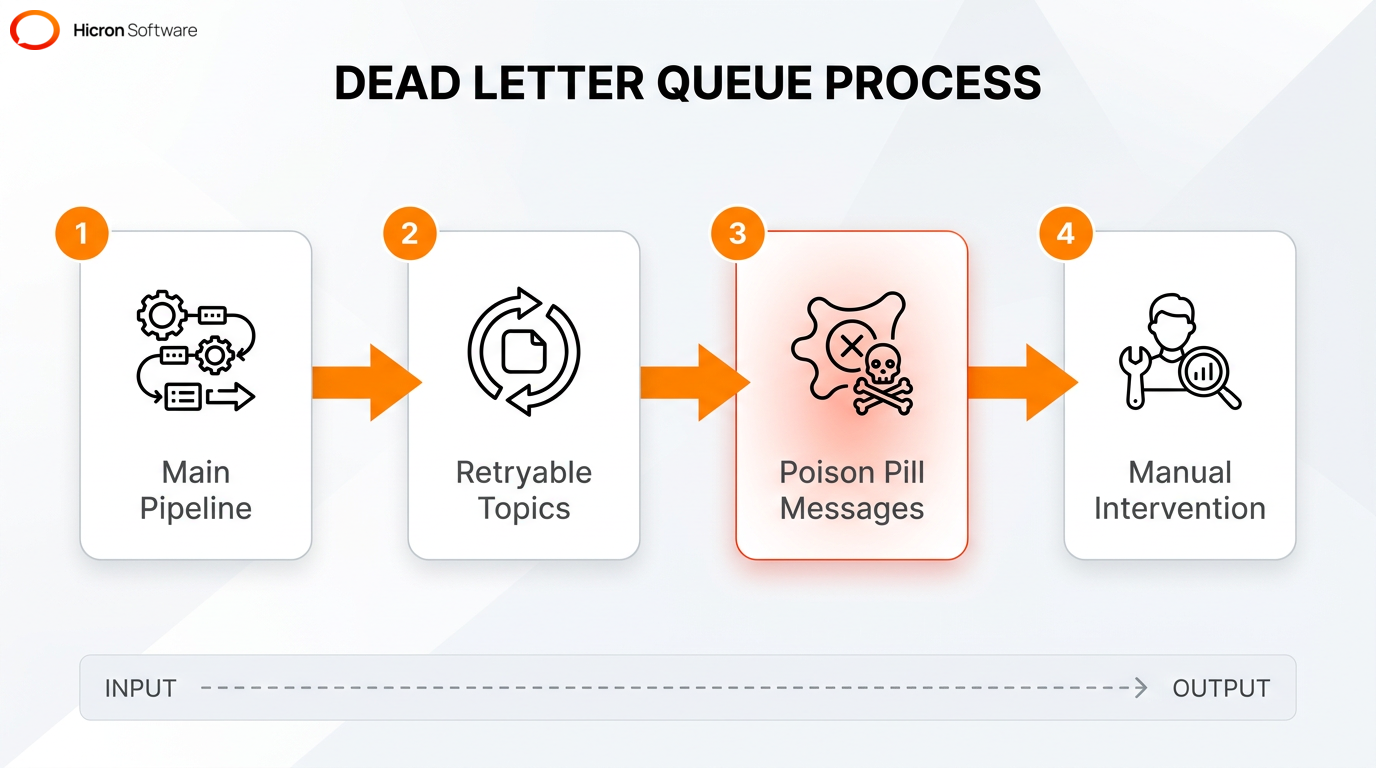
A dead-letter queue is a specialized topic that receives messages that repeatedly fail processing, holding them for manual intervention. Acting as a resilience pattern, this component prevents poison pill messages from blocking the main pipeline during real-time data processing. By integrating this structure with retryable topics, the system isolates data that exhausts all automated retry mechanisms. Consequently, the framework separates permanently failed messages for troubleshooting by moving them to this dedicated storage area. A quick pro-tip: make sure to set up active alerts on these dead-letter queues so those isolated messages aren’t simply forgotten.
Relocating failed messages allows the system to continue processing healthy messages without interruption. This structural isolation provides operational benefits like enhanced fault tolerance and strict data consistency within event-driven microservices.
Instead of overwhelming the system, retry mechanisms use exponential backoff policies to improve fault tolerance. When transient network blips or temporary downstream outages occur, these policies progressively delay retry attempts rather than flooding the system with immediate, repeated requests. This strategic pacing prevents temporary hiccups from causing permanent data loss, giving the struggling services time to recover before successfully processing the delayed messages.
When building fault-tolerant systems that require real-time data streaming and decoupled communication, developers often implement this framework. Look for requirements like continuous distributed event-streaming, asynchronous communication, and high throughput to indicate the need for this integration. Ideal for cloud-native scenarios demanding rapid asynchronous interaction, this solution suits projects that benefit from automated infrastructure boilerplate and minimal configuration within a microservices architecture.
Specific use cases highlight the value of this technology, such as fraud detection, live analytics, and processing large amounts of sensor data. Event-driven microservices achieve optimal scalability and fault tolerance when data volumes increase rapidly. Real-time data processing remains continuous even if network traffic fluctuates.
Real-time data processing is vital for project types demanding immediate analysis and transformation of arriving data, such as live monitoring and fraud detection. Immediate data transformation benefits time-sensitive applications by enabling instantaneous responses to events, rather than relying on batch processing. Integrating a stream processing library enables operations like real-time filtering, aggregation, and joining of data during distributed event-streaming.
By applying real-time analytics to aggregated logs, systems detect issues like system anomalies and security threats as they happen. Sustaining high throughput and scalability within a microservices architecture, this rapid analysis is highly effective. To maintain continuous operations during network surges, event-driven microservices use decoupled and asynchronous communication patterns.
To handle IoT data processing, the architecture uses a reactive programming model to manage high-velocity sensor data streams. Real-time data processing is enabled through a non-blocking framework, while horizontal scaling increases system scalability and sustains high throughput as device counts grow. As a result, the system can simultaneously process continuous streams of telemetry data from hardware, such as thousands of connected sensors and smart meters.
Distributed event-streaming and stream processing manage massive throughput efficiently when data volumes spike, allowing event-driven microservices to use asynchronous communication to deliver real-time analytics despite fluctuating network demands.
Stream processing enables real-time analytics by allowing applications to continuously filter, aggregate, and transform data streams on the fly. Because it extracts actionable insights immediately as events occur, rather than waiting for scheduled jobs, this method outperforms batch processing. Furthermore, the framework instantly executes complex operations, such as joining multiple streams and updating metrics.
Stream processing APIs power outputs like live dashboards and immediate alerting systems based on incoming data trends. During real-time data processing, distributed event-streaming sustains high throughput and scalability. To maintain data consistency as system loads increase, event-driven microservices use asynchronous communication, ensuring this continuous evaluation optimizes IoT data processing during network traffic fluctuations.
The system supports log aggregation by providing a centralized platform where distributed services send logs for continuous monitoring. Centralized distributed event-streaming improves system observability by transmitting data directly to destinations like external monitoring stacks and centralized dashboards. Streaming logs from multiple event-driven microservices into a central cluster allows for thorough analysis.
To detect anomalies immediately during infrastructure failures, real-time data processing evaluates these aggregated logs. Across the entire microservices architecture, this decoupled communication sustains high throughput and scalability, while real-time analytics evaluates critical outputs, including performance metrics and security alerts.
Spring Boot Kafka is exceptionally well-suited for cloud-native environments because its lightweight, stateless client architecture aligns perfectly with containerized deployments. By externalizing configuration and relying on environmental variables, developers can easily deploy Kafka-driven microservices across distributed cloud infrastructures without altering the underlying code.
Kubernetes supports this microservices architecture by dynamically orchestrating Kafka clients for smooth horizontal scaling. When consumer lag spikes, Kubernetes can automatically spin up additional containerized instances of a Spring Boot application. Because Kafka’s consumer groups natively handle rebalancing, these new pods instantly share the partition load, allowing the system to absorb traffic surges effortlessly before scaling back down when demand subsides.
Teams secure a distributed event-streaming architecture by implementing methods to protect data and restrict access in a messaging cluster, such as SSL encryption, SASL authentication, and access control lists. The framework allows developers to secure data using encryption and authentication directly within the client configuration. While it might be tempting to skip these steps in lower environments, establishing these security protocols early on prevents massive refactoring headaches right before a production launch.
Without altering business logic, the system defines this security configuration in the application property file. During secure message exchanges, decoupled communication sustains fault tolerance, ensuring the microservices architecture remains secure and scalable even when network traffic fluctuates.
SSL encryption protects data from interception in transit by establishing a secure, encrypted tunnel between the application and the broker. SASL authentication provides a strict framework for verifying the identity of connecting services. These protocols work together to secure data streams, providing strong security that prevents critical threats like unauthorized access and data breaches.
During malicious external attacks, this combined defense maintains data consistency and fault tolerance across event-driven microservices. Alongside these protocols, the system uses access control lists to enforce granular permissions during distributed event-streaming, ensuring decoupled communication remains secure within a cloud-native microservices architecture despite potential network vulnerabilities.
Access control lists protect data by defining granular permissions that dictate exactly which services read from or write to specific topics. Complementing SSL encryption and SASL authentication, they enforce the principle of least privilege across the messaging ecosystem. By assigning strict operational rights to individual clients, the framework enforces granular permissions across different topics and consumer groups, preventing unauthorized microservices from consuming sensitive data streams.
Distinct authorization configurations might allow a billing service to read a topic while explicitly denying access to a public-facing web service. By isolating permissions at the topic level, a compromised web service can’t automatically read sensitive billing streams, effectively limiting the blast radius of any potential breach.
Monitoring performance metrics is vital for maintaining the reliability and efficiency of an event-driven system. Key indicators provide the best insight into the health of a distributed messaging system: producer throughput, consumer lag, and broker health. The messaging infrastructure exposes these metrics via REST endpoints to continuously track operational status.
Monitoring tools provide production-ready features for observing client performance, such as bottleneck identification and load tracking. Developers integrate specific data types like health checks and metrics data with centralized monitoring dashboards to achieve real-time observability. This continuous monitoring supports log aggregation and real-time analytics across event-driven microservices, creating structural safeguards that optimize scalability across the system.
High consumer lag indicates that services process messages slower than producers generate them. This metric directly impacts the system by causing delays during real-time data processing and continuous analytics. Poor broker health reveals underlying infrastructure issues that compromise fault tolerance and overall scalability. Tracking these metrics is important for maintaining real-time processing capabilities when data volumes fluctuate. I’ve found that configuring automated alerts for consumer lag spikes is one of the easiest ways to catch performance bottlenecks before they impact your end users.
Monitoring consumer lag determines the exact moment to trigger horizontal scaling. By adding more consumer instances to a group when processing delays occur, the architecture optimizes load distribution, an adjustment that sustains high throughput during distributed event-streaming as network demands increase. On the other hand, poor broker health causes severe consequences, such as system-wide outages and data loss. Tracking these health indicators ensures reliable operations during infrastructure disruptions.
Hicron Software proved to be a trusted partner with unmatched technical expertise, delivering a scalable and user-friendly web application that was pivotal to our successful U.S. market expansion.

Hicron’s contributions have been vital in making our product ready for commercialization. Their commitment to excellence, innovative solutions, and flexible approach were key factors in our successful collaboration.
I wholeheartedly recommend Hicron to any organization seeking a strategic long-term partnership, reliable and skilled partner for their technological needs.

After carefully evaluating suppliers, we decided to try a new approach and start working with a near-shore software house. Cooperation with Hicron Software House was something different, and it turned out to be a great success that brought added value to our company.
With HICRON’s creative ideas and fresh perspective, we reached a new level of our core platform and achieved our business goals.
Many thanks for what you did so far; we are looking forward to more in future!

Hicron is a partner who has provided excellent software development services. Their talented software engineers have a strong focus on collaboration and quality. They have helped us in achieving our goals across our cloud platforms at a good pace, without compromising on the quality of our services. Our partnership is professional and solution-focused!

The IT system supporting the work of retail outlets is the foundation of our business. The ability to optimize and adapt it to the needs of all entities in the PSA Group is of strategic importance and we consider it a step into the future. This project is a huge challenge: not only for us in terms of organization, but also for our partners – including Hicron – in terms of adapting the system to the needs and business models of PSA. Cooperation with Hicron consultants, taking into account their competences in the field of programming and processes specific to the automotive sector, gave us many reasons to be satisfied.