Microservices Architecture Style: Pros & Cons
- June 25
- 28 min

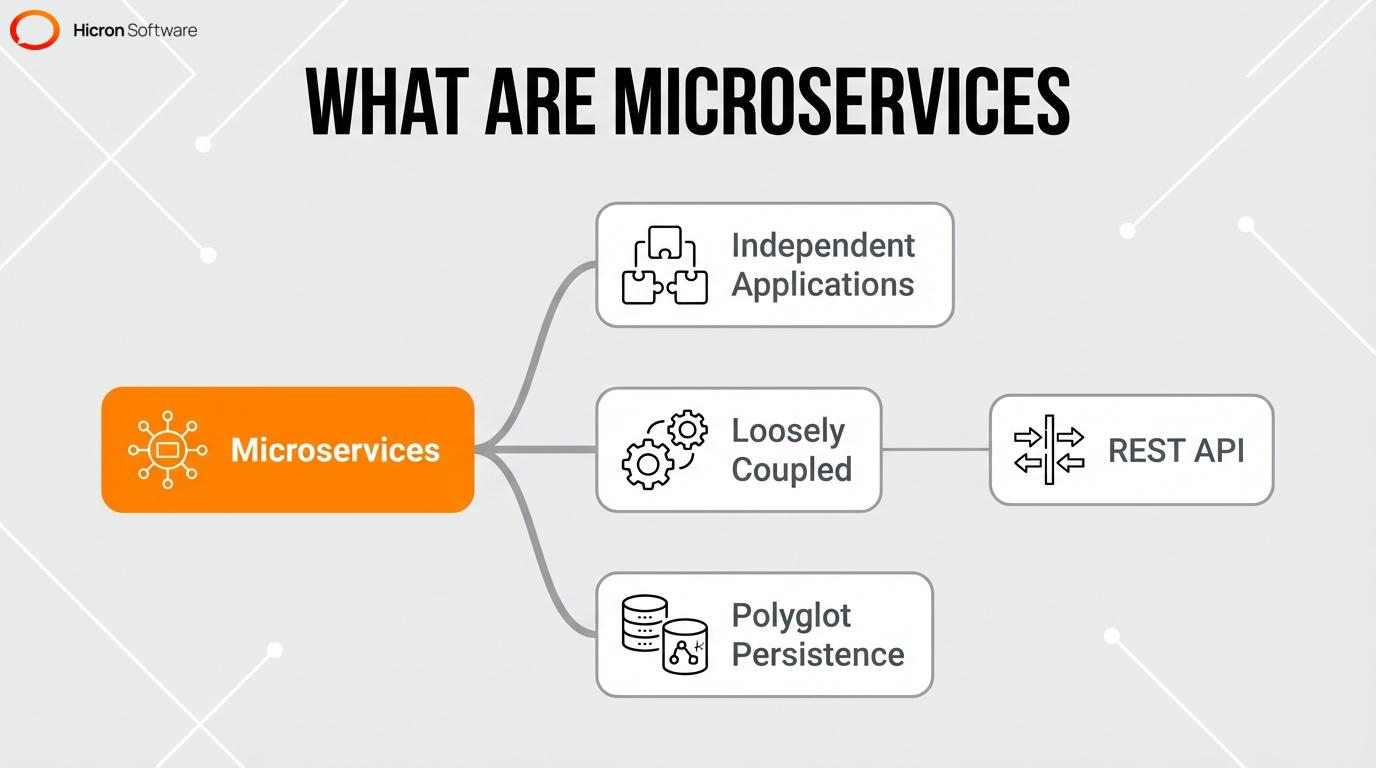
Microservice architecture is a modern system design where software is built as a collection of small, independent applications, each handling specific business functions. Instead of relying on traditional monolithic designs, it breaks projects into manageable pieces. The application functions as a suite of loosely coupled services communicating through a REST API, which offers two primary benefits:
Distributed systems built with microservices allow different modules to use polyglot persistence. For example, a system might use relational databases for financial records and NoSQL databases for analytics. Maintenance gets much easier because development teams can isolate updates to individual components.
|
Category |
Key Elements & Concepts |
Business & Technical Impact |
|
Architecture Overview |
|
Breaks monolithic projects into manageable pieces, enabling independent deployment, strong business alignment, and improved fault tolerance. |
|
Migration Indicators |
|
Transitioning resolves scalability bottlenecks and massive merge conflicts. Starting with a modular monolith is advised to establish bounded contexts and avoid premature complexity. |
|
Spring Boot Ecosystem |
|
Solves distributed system challenges by centralizing configuration, handling dynamic load balancing, enforcing security natively, and preventing cascading failures via circuit breakers. |
|
Cloud-Native Alignment |
|
Aligns with cloud principles to provide targeted scalability for uneven traffic spikes, ensuring high availability and optimizing infrastructure costs without full system deployments. |
|
Adoption Prerequisites |
|
Essential to prevent operational bottlenecks. Requires centralized governance and resiliency patterns to manage architectural complexity and ensure successful, risk-free component evolution. |
Enterprises transition to microservices when a monolithic system bottlenecks scalability, team productivity, and rapid release cycles. Companies don’t make this shift just to chase a trend; they do it because their current setup is actively holding them back. Key indicators for migrating from a monolith include:
This system design suits large development teams working on a single product. Developers use loosely coupled services to accelerate their workflows, as they can build, test, and deploy their specific features without waiting for other teams to finish their code or dealing with massive merge conflicts. If you’ve ever spent a Friday afternoon untangling a messy Git repository, you know exactly why this matters. Mapping technical components directly to specific business functions ensures the tech actually supports what the business is trying to do.
Transitioning to distributed systems improves fault tolerance; if one self-contained application fails, the rest of the platform stays online. Plus, because teams manage isolated modules, day-to-day updates cause fewer disruptions and independent deployments eliminate the traditional bottlenecks of a monolithic codebase.
Here’s a piece of advice I find myself giving constantly: Building a modular monolith first is a strategic way to establish clear boundaries before adopting a fully distributed microservice architecture. It’s often smarter to start with this traditional unified model to avoid premature complexity. Teams should migrate only when system limitations appear.
This method offers two main advantages: it reduces initial infrastructure expenses and identifies bounded contexts without the operational overhead of distributed systems. This preserves the ability to extract loosely coupled services later for independent deployment. Furthermore, keeping things logically separated allows developers to work fast without the immediate headache of managing multiple servers.
Moving to this setup pays off in three main ways:
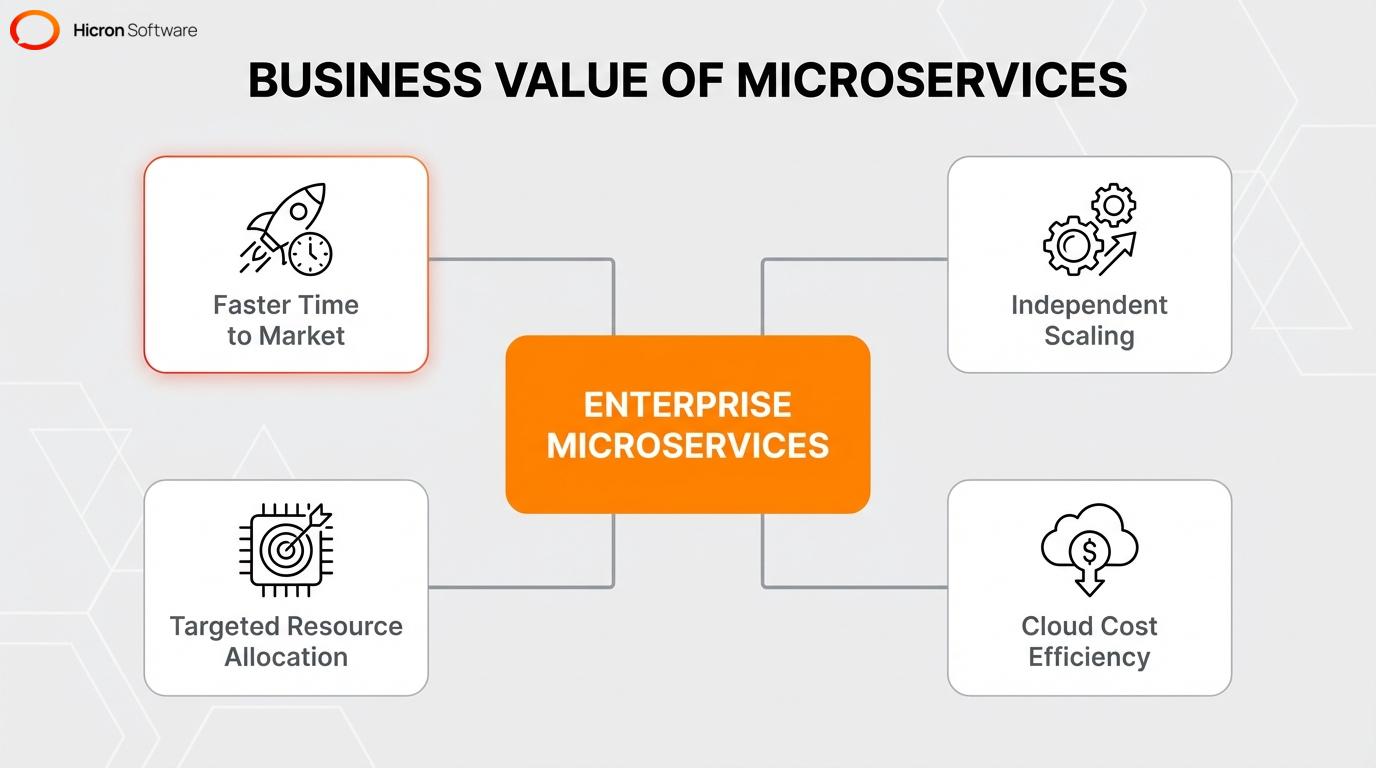
Independent service scaling helps your company move faster and stop wasting server space by adapting to specific workload demands. High-traffic components receive necessary resources without wasting capacity on low-traffic areas. This targeted approach to scalability keeps your cloud bills in check.
Loosely coupled services and independent deployment allow development teams to release updates without cross-team coordination. Instead of deploying the whole system, developers can implement environment-specific changes without requiring a full system code re-deployment. By relying on these self-contained applications, overall productivity and system design improve. As an added bonus, resource allocation remains highly efficient since teams scale only the necessary components.
Moving to a distributed system doesn’t instantly solve all your problems—in fact, it introduces a new set of architectural headaches. Trust me, the complexity doesn’t disappear; it just shifts from the code to the infrastructure. Core infrastructure challenges include service discovery, configuration management, fault tolerance, and security. Managing dozens of independent services requires centralized tooling for configuration, routing, and monitoring. System updates become complex if teams lack proper visibility across these distributed components.
Fault isolation protects the overall health of a distributed application by preventing cascading failures. Without fault tolerance mechanisms, a failure in one isolated service compromises the entire system. Think of it like an electrical circuit breaker in a house: if a power surge hits the kitchen, the breaker trips to protect the rest of the house from catching fire. A software circuit breaker does exactly the same thing, preventing a single failing component from exhausting system resources like threads and database connections.
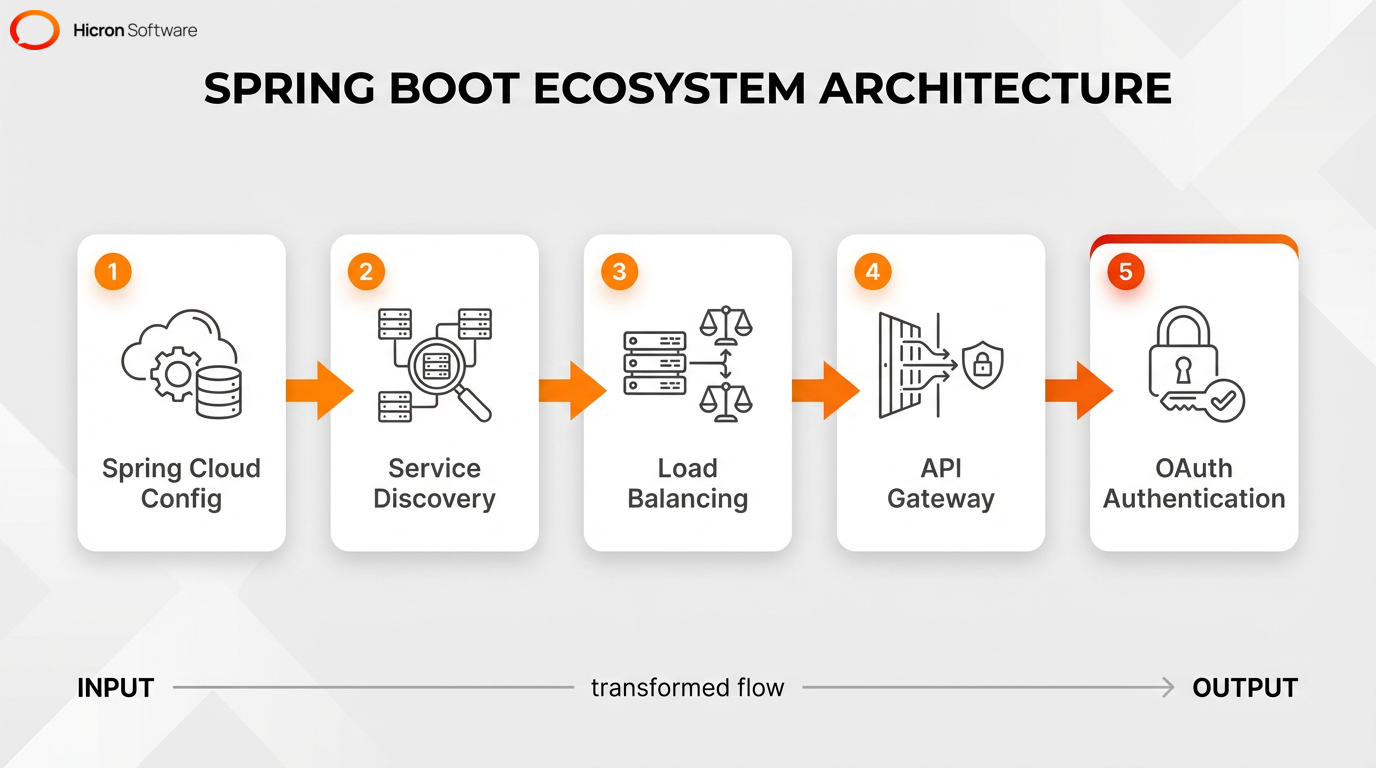
The maturity of the Spring Boot and Spring Cloud ecosystem reduces the operational risk of adopting microservices by providing a comprehensive set of built-in tools. These tools solve the most common distributed-system patterns out of the box. Spring Cloud Config centralizes the management of externalized configuration. By centralizing property management, teams can update database credentials or feature flags across multiple services simultaneously without downtime.
Because elastic scaling requires services to find each other on the fly, service registries handle dynamic runtime service discovery. From there, load balancing mechanisms dynamically route traffic only to healthy instances by querying the registry, an automated process that ensures reliable fault tolerance across the entire system.
Spring Cloud Gateway acts as a single centralized API Gateway for all client requests. It handles dynamic routing, security enforcement, and protocol translation. Industry-standard security protocols, such as OAuth 2.0 and OpenID Connect, integrate natively for centralized authentication and secure credential propagation. I can’t overstate how much of a relief this is in practice. Having these core capabilities built-in saves developers significant time that would otherwise be spent on custom security configuration.
Microservices with Spring Boot are most valuable for projects requiring independent team scaling, high availability, and risk-free component evolution. Specific project characteristics make this architecture a great fit: large products managed by multiple development teams, platforms experiencing disproportionate component loads, and systems integrating heterogeneous technologies. Measurable business value justifies the operational overhead of distributed systems when an enterprise application demands rapid, independent deployment cycles.
Targeted scalability remains crucial for platforms managing massive, uneven traffic spikes. Independent scaling ensures high-demand modules secure dedicated computing power without allocating excess resources to rarely used functions. Ultimately, this approach optimizes overall system design and reduces infrastructure costs.
Your developers will get a lot more done when they don’t have to coordinate every minor update with the entire engineering department. Because changes are isolated to specific business functions, managing the platform becomes much more predictable. This makes the architecture particularly useful for organizations that want to gradually replace outdated legacy modules. Teams extract specific functionalities into new microservices to modernize complex platforms safely. Integrating heterogeneous technologies enables each service to use distinct data storage models tailored to specific operational demands, such as graph databases for recommendation engines and time-series databases for connected devices.
Distributed architecture has become the gold standard for cloud-native development. Why? Because it perfectly aligns with core cloud principles: on-demand resources, containerized deployments, and automated delivery. In public cloud environments where elastic scalability is everything, microservices shine. They allow platforms to dynamically scale only the specific components experiencing heavy traffic, rather than scaling the entire application.
To reduce the operational burden of managing dozens of independent services, teams rely heavily on containerization and CI/CD practices. Containerization packages applications and their dependencies into lightweight, portable units, such as Docker containers, which ensures consistent environments across development, testing, and production phases. Meanwhile, CI/CD pipelines automate the lifecycle of distributed systems from the initial code commit to the final production release. By building, testing, and deploying a single updated service container without requiring downtime for the rest of the application, these pipelines streamline updates. This is what makes true independent deployment possible.
Before jumping in, decision-makers need to evaluate team readiness, infrastructure maturity, and actual business demands. Organizational prerequisites for this system design include mature DevOps practices, automated testing frameworks, and solid monitoring tools. The architecture creates operational bottlenecks if these foundational elements are absent. As a rule of thumb, if your team struggles to deploy a monolith, microservices will only multiply that deployment pain. Enterprises avoid the trap of premature architectural complexity by executing an incremental transition driven by measurable pain points. Organizations should invest in centralized governance frameworks before scaling the number of services.
Core technical requirements include centralized security and comprehensive observability. If your team isn’t ready to implement these foundational elements from day one, evaluating a modular monolith first can mitigate risk. However, if you proceed with microservices, setting up resiliency patterns and centralized configuration early prevents costly retrofitting later. Setting these structures up early keeps your developers happy and your maintenance overhead low. Concrete business needs should be the only reason you take on this operational complexity.
“

Hicron Software proved to be a trusted partner with unmatched technical expertise, delivering a scalable and user-friendly web application that was pivotal to our successful U.S. market expansion.

Hicron’s contributions have been vital in making our product ready for commercialization. Their commitment to excellence, innovative solutions, and flexible approach were key factors in our successful collaboration.
I wholeheartedly recommend Hicron to any organization seeking a strategic long-term partnership, reliable and skilled partner for their technological needs.

After carefully evaluating suppliers, we decided to try a new approach and start working with a near-shore software house. Cooperation with Hicron Software House was something different, and it turned out to be a great success that brought added value to our company.
With HICRON’s creative ideas and fresh perspective, we reached a new level of our core platform and achieved our business goals.
Many thanks for what you did so far; we are looking forward to more in future!

Hicron is a partner who has provided excellent software development services. Their talented software engineers have a strong focus on collaboration and quality. They have helped us in achieving our goals across our cloud platforms at a good pace, without compromising on the quality of our services. Our partnership is professional and solution-focused!

The IT system supporting the work of retail outlets is the foundation of our business. The ability to optimize and adapt it to the needs of all entities in the PSA Group is of strategic importance and we consider it a step into the future. This project is a huge challenge: not only for us in terms of organization, but also for our partners – including Hicron – in terms of adapting the system to the needs and business models of PSA. Cooperation with Hicron consultants, taking into account their competences in the field of programming and processes specific to the automotive sector, gave us many reasons to be satisfied.