Building Event-Driven Microservices with Spring Boot and Apache Kafka
- May 13
- 17 min


Spring Boot is an established enterprise framework that simplifies complex systems through dependency injection and inversion of control. By using embedded servers and autoconfiguration, which automatically provides beans and settings based on specific classpath dependencies, it cuts down on boilerplate code. This architecture relies on the traditional HotSpot JVM to ensure long-running application stability. Configuration management remains straightforward when developers target standard JVM environments.
Spring Boot is the go-to choice to build enterprise-grade REST APIs, manage microservices, and move applications to the cloud.
The framework supports comprehensive observability metrics by integrating libraries like Micrometer to track telemetry data. Because it tracks this telemetry data so well, system operators can then scale applications horizontally when deploying them across distributed environments.
|
Comparison Criteria |
Spring Boot |
Quarkus |
|
Architecture & Initialization |
|
|
|
Performance & Resources |
|
|
|
Dependency Injection |
|
|
|
Cloud & Deployment |
|
|
|
Ecosystem & Standards |
|
|
|
Developer Experience |
|
|
Quarkus is a modern, container-first framework that Red Hat designed specifically for cloud-native environments. Built from the ground up to be Kubernetes-native, the platform maintains a strictly low resource footprint. This architecture works perfectly in containers by minimizing memory consumption compared to a traditional JVM. By using GraalVM to generate standalone executables through AOT compilation, developers create a native image that starts in milliseconds.
It supports enterprise standards like Jakarta EE and MicroProfile through direct integration. System operators can implement resilient microservices using underlying components such as SmallRye.
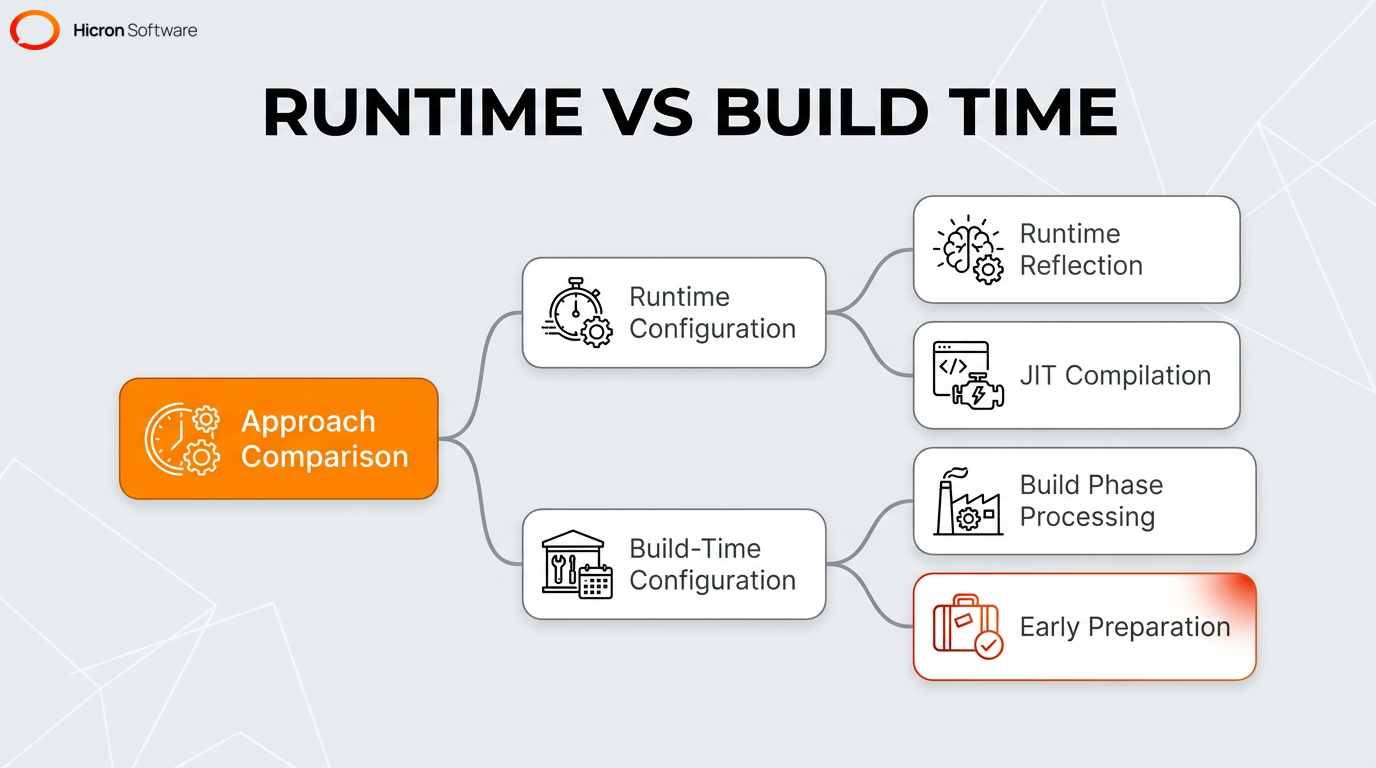
The biggest difference between the two comes down to when they configure your app: at runtime or at build-time. Think of it like packing for a trip: traditional frameworks (like Spring Boot) figure out what to pack while you’re already at the airport, using runtime reflection and JIT compilation. Modern alternatives (like Quarkus) pack your bags perfectly before you even leave the house, shifting this heavy processing to the build phase. If you’ve ever scrambled at the baggage drop, you know exactly why that early preparation is so appealing.
When the framework processes dependency injection and configuration management during the build phase, it eliminates runtime overhead and speeds up execution. This shift to build-time alters the deployment architecture by removing runtime initialization steps to generate closed-world executables. Teams use GraalVM for this specific compilation process. This build-time optimization significantly reduces the memory footprint and startup time compared to runtime initialization.
Quarkus shifts three main tasks from runtime reflection to ahead-of-time processing:
Resolving these elements early prevents the CPU and memory spikes that traditional JVMs usually cause during startup. This AOT compilation directly prepares the application for native image generation.
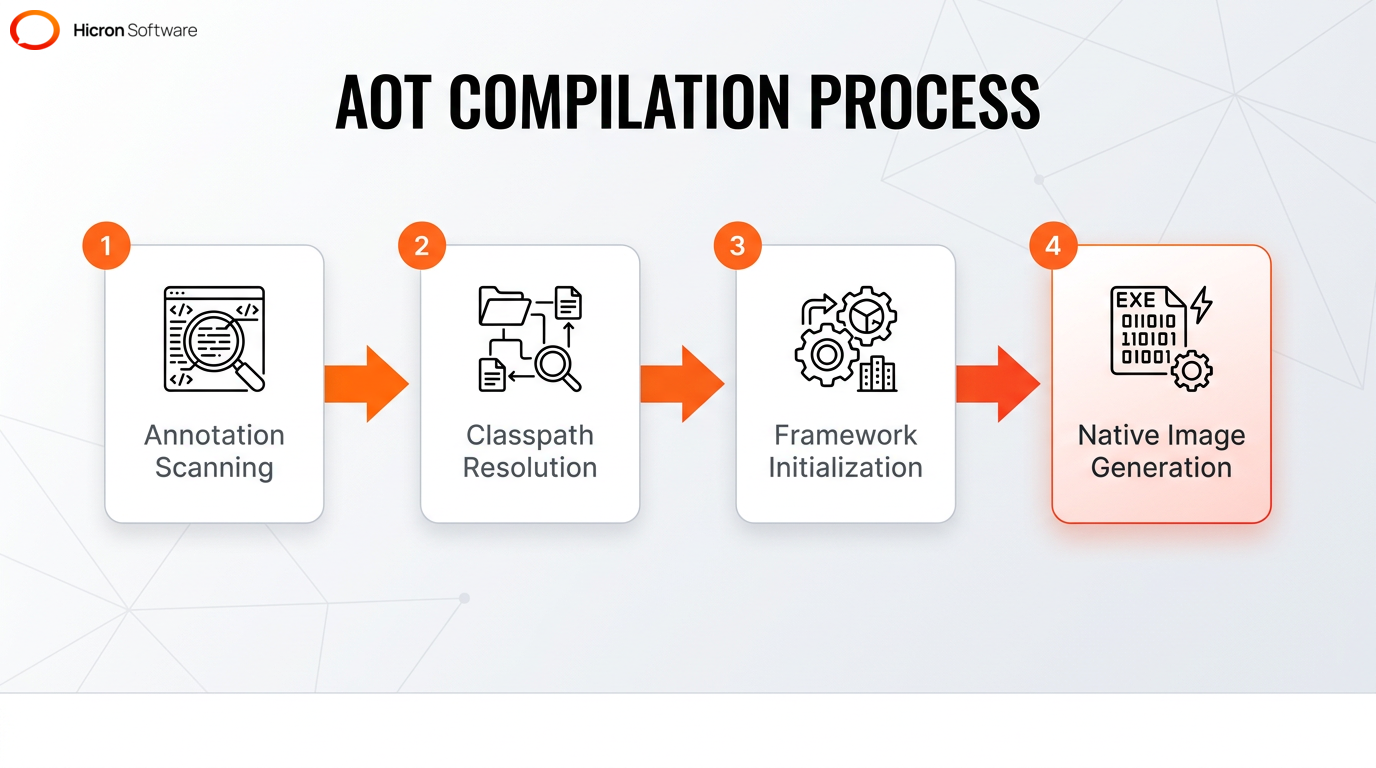
These frameworks use distinct standards for dependency management. Spring Boot relies on its proprietary container for dependency injection. Quarkus implements standard Contexts and Dependency Injection (CDI) based on established specifications like Jakarta EE and MicroProfile.
Spring Boot manages bean lifecycles through heavy runtime classpath scanning, which increases JVM memory usage during microservices deployment. Quarkus, however, processes CDI annotations during the build phase. Resolving dependencies ahead of time eliminates this runtime overhead.
Standardized CDI annotations simplify configuration for developers. Furthermore, because Quarkus processes these annotations at build-time, the resulting application executes faster in environments requiring rapid scaling. This also makes it easier for teams to execute specific validation methods, such as unit testing and integration testing for a REST API, to verify bean lifecycles.
When we talk about performance, it really depends on what you’re measuring—startup time, memory, or concurrency. Modern native frameworks excel in resource efficiency, while traditional Java virtual machines offer high peak throughput for long-running processes. The choice of the underlying virtual machine directly impacts overall performance metrics. Operators get the best performance by matching the deployment scenario with the appropriate framework architecture.
Ahead-of-Time (AOT) compilation significantly reduces startup time by eliminating runtime code analysis. Native compiled applications using GraalVM and AOT compilation start up to 85% faster than those running on a traditional HotSpot JVM. This process translates application code into a standalone executable before execution. Generating a native image with GraalVM removes the Just-In-Time warmup phases that a traditional JVM requires.
Eliminating runtime compilation bypasses heavy CPU processing during initialization. Applications can start in milliseconds to accommodate sudden traffic spikes. This rapid execution supports specific deployment models, such as serverless platforms and cloud-native microservices. Operators who use these pre-compiled binaries scale their applications horizontally with ease.
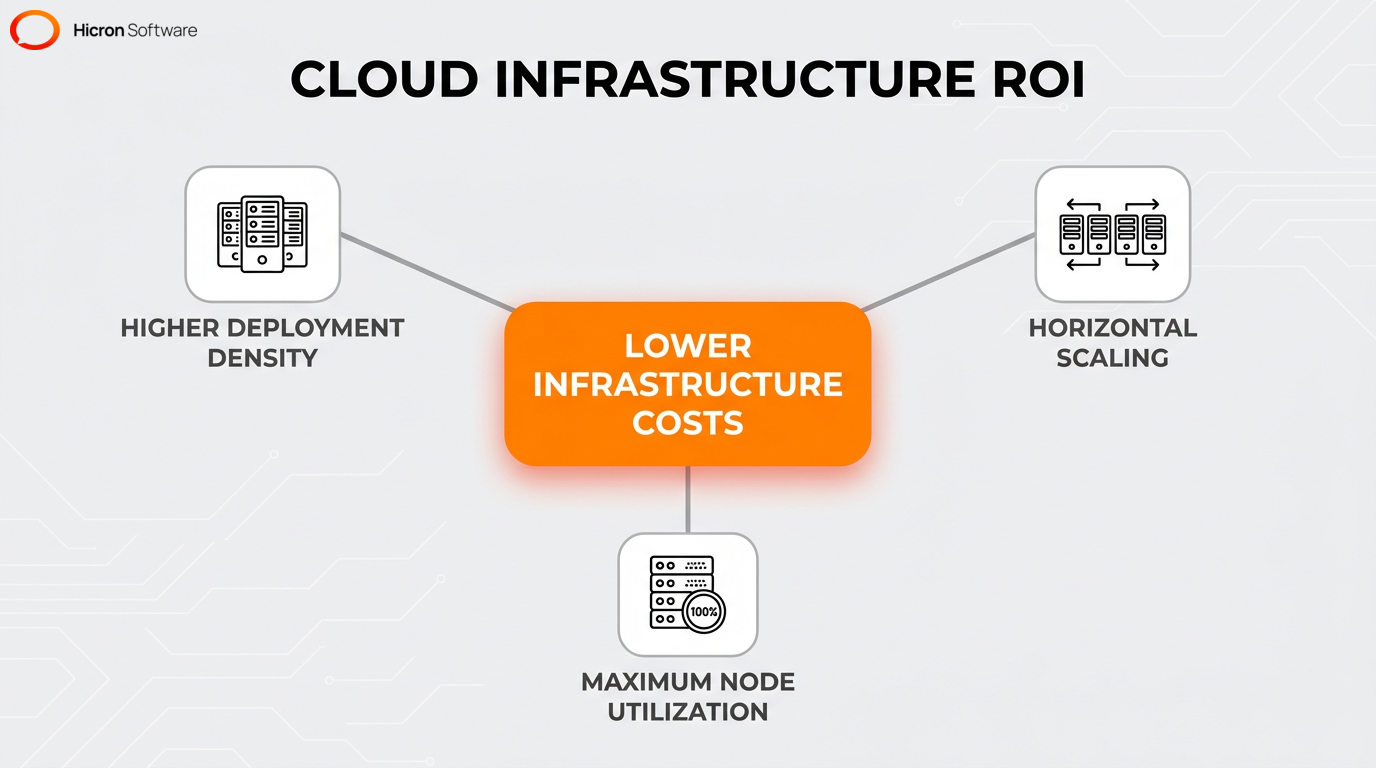
Quarkus consumes significantly less memory by executing build-time optimization. When you optimize frameworks for native compilation, they reduce RAM usage, which directly enables higher deployment density and lower infrastructure costs. Consequently, this reduced memory footprint decreases overall cloud hosting expenses by maximizing the number of active instances per server node. Ultimately, generating a native image avoids loading large virtual machine infrastructures like the traditional JVM.
Eliminating these heavy runtime components substantially cuts down the base memory required to run a single instance. Because AOT compilation uses so few resources, it’s much easier to scale horizontally. In my experience, seeing your memory footprint drop so drastically after switching to native compilation is a genuine “aha” moment for most infrastructure teams. Engineers can support massive deployments of cloud-native microservices by orchestrating these binaries using containerization platforms like Kubernetes. Compiling applications with GraalVM allows organizations to maximize node utilization.
Virtual threads provide a lightweight concurrency model that handles massive numbers of I/O operations while still using simple, blocking code. This architecture bridges the performance gap between straightforward imperative programming and complex reactive programming models, such as asynchronous frameworks like Vert.x.
By using Project Loom, developers write imperative code that scales as efficiently as asynchronous reactive pipelines. Lightweight threads simplify the development of highly concurrent applications by eliminating complex callback chains. Deploying this model drastically improves vertical scaling, allowing a single REST API instance to process thousands of simultaneous connections without exhausting system resources.
Both platforms excel in cloud environments, but they use two distinct approaches for deployment. While Quarkus focuses on deep container orchestration integration and aligns better with a strict container-first strategy, Spring Boot relies on a mature ecosystem of cloud services. Because modern container-first frameworks minimize resource consumption, they are perfect for orchestration platforms like Kubernetes and Docker. In contrast, established frameworks like Spring Boot use rich abstraction layers to connect with various cloud providers, including AWS and Microsoft Azure.
Managing distributed microservices requires three critical components:
Spring Boot handles these components through extensive external cloud configuration libraries. Developers integrate specific modules to gain deep visibility into distributed networks.
Quarkus provides native support for container orchestration by embedding deployment configurations directly into the build process. This architecture caters to containerization by automating the generation of orchestration manifests. System operators scale out quickly by using the container-optimized architecture of Quarkus. Spring Boot, on the other hand, maintains high compatibility with established enterprise infrastructures. Teams deploy reliable cloud-native applications by using its extensive ecosystem of external integrations.
When developers design frameworks specifically for containers, they offer superior resource density and faster scaling in orchestration environments like Kubernetes and Docker. Lower framework resource requirements directly increase deployment density by allowing more pods to run concurrently on a single node. Maintaining a minimal memory footprint lets you maximize node utilization for cloud-native microservices.
Because of this container-first design, applications can start in milliseconds. Generating a native image with GraalVM achieves this rapid startup time. Orchestration platforms spin up new instances instantly during traffic surges when operators deploy these optimized builds. This rapid initialization makes it easy to scale horizontally for enterprise containerization.
In serverless deployments, startup time is everything. If you want to scale to zero, your app needs to initialize almost instantly. Serverless environments heavily favor frameworks capable of native compilation to eliminate cold starts that degrade system responsiveness. Native executables bypass traditional virtual machine warmup, making them ideal for on-demand cloud functions like AWS Lambda deployments.
Generating a native image using GraalVM and AOT compilation allows microservices to scale out rapidly. Operators run their containers as efficiently as possible by deploying these pre-compiled binaries.
The developer experience differs wildly between the two: one offers modern instant feedback, while the other relies on a massive, established ecosystem. Transitioning to newer, container-focused paradigms introduces a specific learning curve for engineering teams. Modern frameworks require adapting to distinct approaches for configuration management and observability compared to a traditional JVM environment. Teams maintain high productivity levels and code faster once they master these new workflows.
Live coding speeds up development by providing immediate feedback on code changes without requiring manual application restarts. Instant reload capabilities eliminate the traditional compile-deploy-restart cycle, which can save developers up to 5 hours of waiting time per week. Let’s be honest, getting those five hours back means less time staring at loading bars and more time actually building features. This workflow integrates continuous testing directly into the active coding phase by executing automated validations in the background.
For example, programmers can modify a REST API endpoint and immediately see the result in the browser. This accelerates the creation of complex cloud-native microservices. Engineers can adjust configuration settings instantly without rebooting the JVM, and simultaneously monitor real-time observability metrics. This instant feedback loop drastically increases daily output.
Beyond just live coding, automated provisioning reduces the friction of writing comprehensive integration tests, such as end-to-end validation and database checks. This mechanism automatically launches 100% of the infrastructure you need in a temporary container for the test suite duration. Modern development shifts from heavily mocked unit testing to realistic validation. The framework manages external dependencies natively, such as a database running via Docker containerization.
Because this setup simplifies evaluation, an engineer can smoothly test a REST API while the platform tracks metrics in the background. This makes it easy to evaluate complex cloud-native microservices, such as payment processors and inventory systems, without relying on a traditional JVM environment. Developers can be confident their deployments will work when the system executes this containerized test suite.
When looking at ecosystems, you’re essentially choosing between a massive, established community and a highly optimized, standards-based set of tools that developers tailored for microservices. One environment relies on a vast array of community-contributed starters to connect with third-party libraries, including legacy drivers and complex connectors. The alternative framework provides curated, build-time optimized extensions that adhere strictly to industry standards for enterprise development.
Teams select the established ecosystem if the project requires highly specialized legacy integrations. On the other hand, organizations adopt the curated framework if the system demands standard microservice capabilities optimized for containerization.
Engineers connecting to distributed streaming platforms like Apache Kafka can choose between traditional blocking JVM drivers or optimized, reactive extensions (like SmallRye) designed for native compilation.
Object-relational mapping optimizations allow complex data layers to function within native executables. Using specialized extensions ensures the compiler processes heavy frameworks, such as Hibernate, at build-time. Processing these components early removes runtime reflection overhead to optimize heavy data and messaging integrations for low-resource environments. Developers can easily validate these optimized data pipelines during integration testing. Furthermore, reactive programming models ensure these microservices remain responsive under heavy loads.
As enterprise architecture has evolved, we’ve seen the rise of lightweight, cloud-focused standards. MicroProfile represents a vendor-neutral approach to building an enterprise API, contrasting directly with a proprietary ecosystem. This framework provides a baseline platform definition for three critical operational capabilities: health checks, performance metrics, and fault tolerance that independent vendors implement. Adhering to this vendor-neutral specification provides two long-term architectural benefits: preventing vendor lock-in and ensuring application portability across compliant application servers.
By using technologies like RESTEasy and Jakarta EE’s standard CDI, developers can construct standardized REST APIs. This approach streamlines configuration management and observability across distributed systems (like payment processors). As a result, organizations benefit from highly reliable infrastructure that implementations like SmallRye often power.
While a traditional approach separates these paradigms into different frameworks, a modern architecture offers a unified engine that natively combines imperative and reactive programming styles. This unified programming model simplifies the development of complex APIs, such as data streaming services and standard CRUD interfaces, by allowing developers to choose the appropriate paradigm per endpoint without changing the underlying stack. Furthermore, an application routes both blocking imperative calls and non-blocking reactive streams through the same core infrastructure using underlying engines like Vert.x.
This unified routing handles high concurrency using asynchronous event loops. Programmers select the specific execution model for distinct endpoints, such as a REST API, to optimize performance. A modern platform processes massive numbers of simultaneous requests using advanced concurrency models, including virtual threads that Project Loom introduced on the traditional JVM. Deploying this unified architecture makes it much easier to scale for cloud-native microservices.
Choosing between the two really comes down to where and how you plan to deploy your app. Modern applications generally fall into two primary deployment models: serverless architectures and massive existing ecosystems. Projects targeting serverless environments benefit immensely from the millisecond startup time that native compilation provides. Generating standalone executables through AOT compilation minimizes the memory footprint for strict infrastructure constraints. Operators scale out quickly by deploying these native builds within orchestration platforms like Kubernetes. This approach maximizes containerization efficiency for cloud-native microservices.
On the flip side, traditional frameworks support large-scale applications requiring extensive third-party integrations. These platforms use a standard JVM to maintain high peak throughput for massive existing ecosystems. When evaluating the appropriate architecture, you have to analyze engineering team familiarity and the learning curve associated with new paradigms, because transitioning to a container-first design introduces distinct build-time workflows. Organizations prioritize established enterprise frameworks when developers require mature legacy compatibility. The right choice depends entirely on your infrastructure: choose Quarkus for strict resource limits and serverless scaling, and Spring Boot for mature, large-scale enterprise ecosystems. I always tell my teams not to chase a framework just because it’s new, but to let the actual deployment metrics dictate the right tool for the job.
Migrating an existing application between these frameworks is easier than you might think, thanks to specialized compatibility layers. A quick pro-tip if you’re attempting this: start by migrating a small, non-critical service first to get a feel for how these layers handle your specific dependencies. However, fully realizing performance benefits depends on adapting to strict build-time optimization constraints. The modern platform provides specific compatibility extensions that map familiar annotations directly to the new underlying architecture, such as standard routing for a REST API and established dependency injection setups. Developers face two primary technical hurdles when transitioning an application to a build-time optimized framework: refactoring code that relies heavily on runtime reflection and adjusting dynamic runtime behaviors.
These structural adjustments ensure the application successfully passes AOT compilation checks. Generating a native image demands static code paths rather than dynamic class loading on a traditional JVM. Compatibility APIs ease the initial transition by translating existing code structures into optimized build steps. Engineers execute comprehensive unit testing and integration testing to validate these architectural changes, while developers make their microservices as efficient as possible by updating their configuration management practices to align with these static build requirements.
The Java ecosystem includes other alternative high-performance frameworks that developers designed specifically for cloud-native deployments. The rise of these alternative platforms prioritizes specific operational metrics, such as low resource consumption and rapid application startup. These modern tools provide distinct options for building highly optimized microservices and compete directly in the serverless space by avoiding heavy runtime reflection. These alternative architectures allow modern deployments to scale easily.
These alternatives differentiate themselves through two specific technical focuses: prioritizing strict AOT compilation and heavily using virtual threads. Micronaut avoids runtime reflection entirely to minimize memory usage and speed up execution. By executing ahead-of-time compilation to generate standalone binaries, this architecture eliminates runtime processing and reduces the memory footprint directly. Applications start in milliseconds for cloud-native deployments when operators use this framework. This fast initialization caters directly to serverless environments requiring instant scaling.
Helidon differentiates itself by building specialized web servers that maximize lightweight concurrency models. With the introduction of Helidon Nima, built specifically for Project Loom, developers can leverage a purely imperative programming model that scales just as easily as reactive frameworks. The platform manages massive numbers of simultaneous connections for a REST API by using virtual threads on the traditional JVM.
The unique architectural choices of these alternative frameworks cater to two specific performance needs: rapid initialization and high throughput. While Micronaut optimizes resource consumption for distributed microservices, Helidon processes heavy concurrent traffic without complex reactive paradigms. Engineers get the best results by matching these specific architectural strengths to exact deployment requirements.
Hicron Software proved to be a trusted partner with unmatched technical expertise, delivering a scalable and user-friendly web application that was pivotal to our successful U.S. market expansion.

Hicron’s contributions have been vital in making our product ready for commercialization. Their commitment to excellence, innovative solutions, and flexible approach were key factors in our successful collaboration.
I wholeheartedly recommend Hicron to any organization seeking a strategic long-term partnership, reliable and skilled partner for their technological needs.

After carefully evaluating suppliers, we decided to try a new approach and start working with a near-shore software house. Cooperation with Hicron Software House was something different, and it turned out to be a great success that brought added value to our company.
With HICRON’s creative ideas and fresh perspective, we reached a new level of our core platform and achieved our business goals.
Many thanks for what you did so far; we are looking forward to more in future!

Hicron is a partner who has provided excellent software development services. Their talented software engineers have a strong focus on collaboration and quality. They have helped us in achieving our goals across our cloud platforms at a good pace, without compromising on the quality of our services. Our partnership is professional and solution-focused!

The IT system supporting the work of retail outlets is the foundation of our business. The ability to optimize and adapt it to the needs of all entities in the PSA Group is of strategic importance and we consider it a step into the future. This project is a huge challenge: not only for us in terms of organization, but also for our partners – including Hicron – in terms of adapting the system to the needs and business models of PSA. Cooperation with Hicron consultants, taking into account their competences in the field of programming and processes specific to the automotive sector, gave us many reasons to be satisfied.