10 Real Estate Software Development Companies in 2026
- February 03
- 9 min



Infrastructure lease management is the practice of tracking, verifying, and updating the terms of thousands of individually negotiated site leases, such as base stations, substations, or utility easements, across a geographically distributed network.
A telecom operator running five thousand base station sites receives sixty thousand landlord invoices a year, each needing a check against its lease. Energy distributors, tower companies, and fuel station networks run the same arithmetic. Traditional property management software was built for a portfolio of a few hundred leases between professional counterparties. An infrastructure lease portfolio looks nothing like that. It runs thousands of contracts, a landlord roster spanning municipalities and private individuals, and documents ranging from a standard template to a handwritten agreement from decades ago. This article maps where that mismatch costs money and what closes the gap.
Key Takeaways
A shopping center portfolio manager works with dozens or a few hundred leases. Each one gets negotiated with a professional counterparty and is worth a meaningful share of the property’s income. An infrastructure operator manages a different kind of portfolio entirely.
|
Dimension |
Commercial real estate portfolio |
Infrastructure lease portfolio |
|
Number of leases |
Dozens to a few hundred |
Thousands to tens of thousands |
|
Value per lease |
High, often a core revenue line |
Low, a small operating cost line |
|
Landlord type |
Institutional owner or professional investor |
Municipality, private individual, church, farmer, building owner |
|
Geographic spread |
Concentrated in one or a few properties |
Every region the network reaches |
|
Document format |
Standardized lease template |
Ranges from a formal contract to a handwritten agreement from decades ago |
Each row in that table compounds the difficulty of the next one. A landlord who owns a single rooftop antenna site rarely has a legal team, a billing system, or even a habit of tracking indexation clauses. A lease signed in 1998 for a small transmission tower may exist only as a scanned page in a filing cabinet, with terms nobody has revisited since.
None of this makes an individual lease complicated. A base station site lease is usually a handful of pages: base rent, an indexation clause, a notice period, an expiry date. The difficulty lies in running the same check, correctly, across thousands of them every month, not in the content of any single contract.
Three gaps account for most of the value lost in an infrastructure lease portfolio. Each one grows quietly, because no single instance looks large enough to trigger a review.
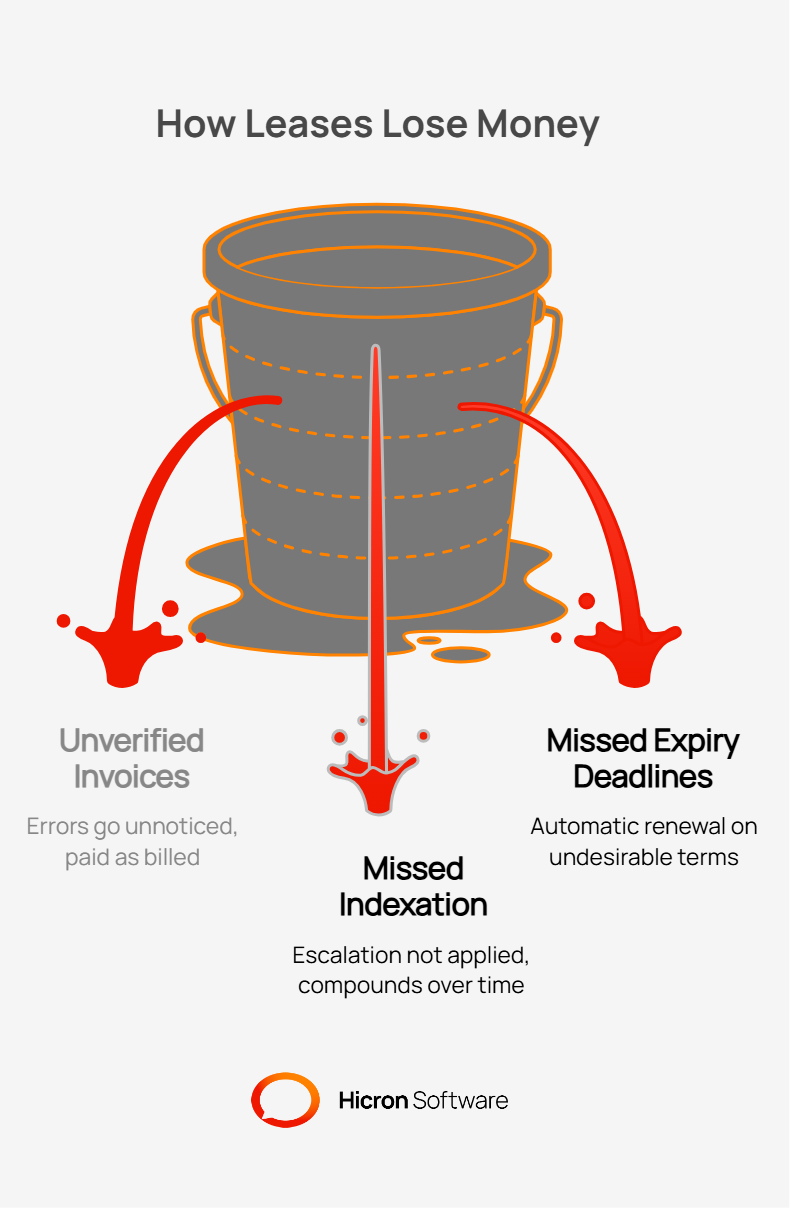
None of these three problems is difficult to solve for one lease. A site manager reviewing a single contract catches an incorrect invoice or a missed indexation clause without much effort. The difficulty is doing that same check reliably, at the same standard, across a portfolio too large for any one person to hold in their head.
The fix does not require replacing the existing lease register or the ERP system that already tracks payments. It requires a layer that reads from those systems and runs the checks a manual process cannot keep up with.
That fifth step keeps the process honest. An automated layer narrows a review task from thousands of invoices to a short list of genuine exceptions. It does not remove the judgment call at the end of the process, and it should not try to.
Take a telecommunications operator running several thousand base station leases, independent of company name or exact figures. Without automation, invoice verification runs on a sampling basis: a portion of invoices gets checked each month, and the rest get paid on trust that the landlord has billed correctly.
An invoice matching layer, built on top of the existing lease register, changes what the finance and legal teams review each month. Every invoice runs through the same automated check instead of a random sample, and only the ones that fail to reconcile reach a person. Indexation tracking shifts from a manual reminder system, dependent on someone checking a spreadsheet on schedule, to an automatic prompt tied to each lease’s own escalation date. Expiry tracking shifts from a regional manager’s personal calendar to a portfolio-wide alert visible to whoever owns the renewal decision.
The automation layer runs on three components working together:
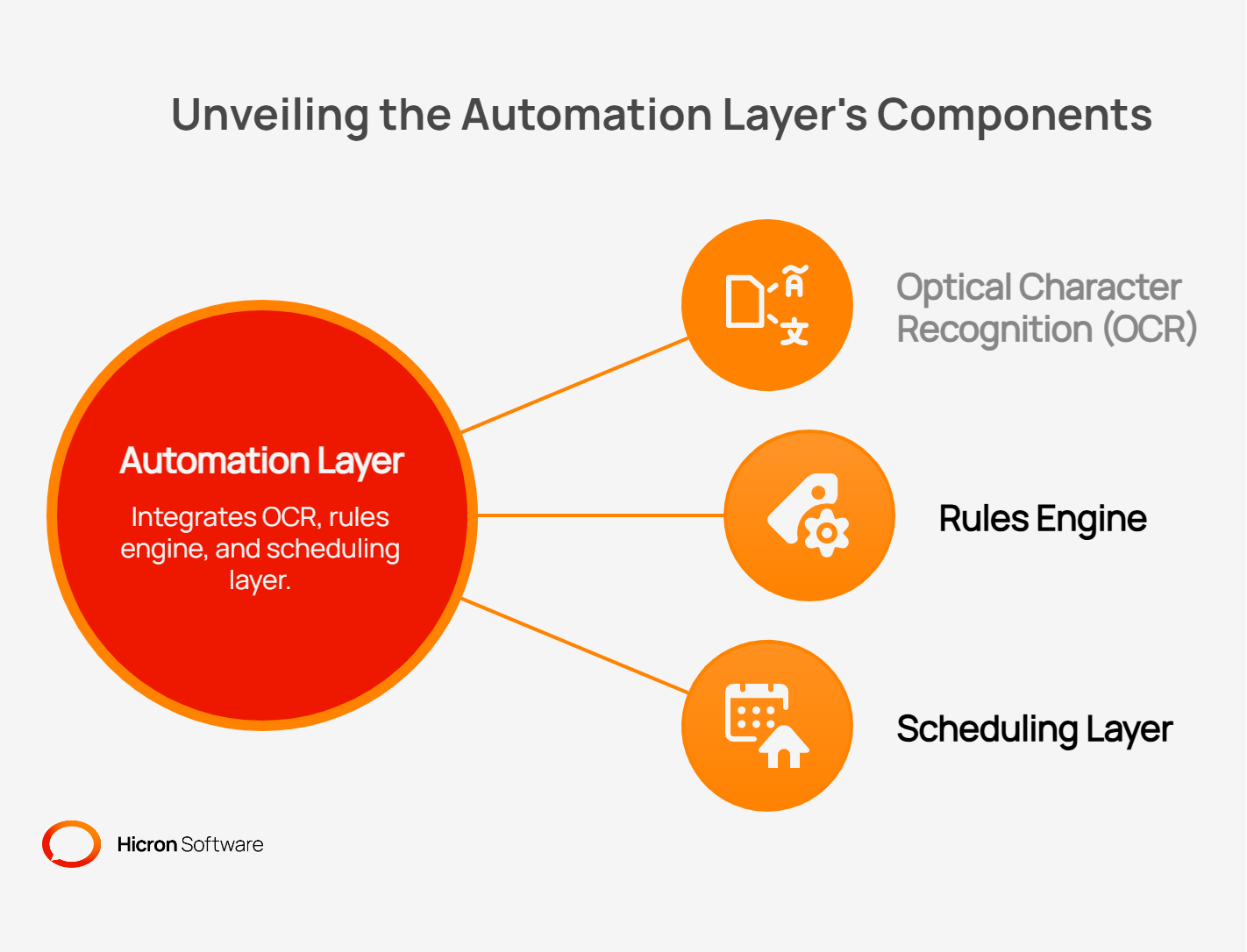
The harder part is building the initial lease register from thousands of documents that were never digitized in a consistent format. That is a one time effort, and it tends to pay for itself the first time it catches a landlord invoice with the wrong amount.
The pattern described here is not unique to telecommunications. Any operator holding thousands of small, geographically dispersed leases runs into the same three gaps, whatever the industry.
Each of these sectors shares the same underlying shape: a large number of low value leases and a landlord roster with little in common from one site to the next. A manual process scales linearly with headcount, while the portfolio itself scales into the thousands. The fix looks the same in every case. Extract the terms once, check every invoice against them automatically, and let a person handle only the exceptions the system cannot resolve on its own.
Infrastructure lease management is the practice of tracking, verifying, and updating the terms of a large number of individually negotiated site leases, such as telecom base stations, utility substations, or leased land, across a geographically distributed network. It covers invoice verification, indexation updates, and expiry tracking across every lease in the portfolio.
Tower operators, energy distributors, fuel station networks, retail chains with distributed store footprints, and parking operators all manage thousands of small, geographically scattered leases with a similarly diverse landlord base. Each faces the same three cost points: unverified invoices, missed indexation, and missed expiry deadlines.
Automated invoice matching starts by extracting structured terms, base rent, indexation schedule, caps, and deductions, from every signed lease. Each incoming invoice is then compared against those terms automatically. An invoice that matches the expected amount clears without review, and one that does not gets flagged with the specific discrepancy for a lease administrator to resolve.
A manually managed lease portfolio typically loses money in three places. Invoices that do not match the lease terms go unverified because manual sampling cannot check every invoice at scale. Indexation increases that should raise the rent annually go unapplied because no system tracks the schedule. Lease expiry dates pass without a decision, triggering an unfavorable automatic renewal or the loss of a site.
An infrastructure lease portfolio typically involves thousands of low value leases spread across a wide geography, with landlords ranging from municipalities to private individuals. A commercial real estate portfolio typically involves dozens or a few hundred higher value leases concentrated in one or a few properties, negotiated with professional counterparties.
Hicron Software proved to be a trusted partner with unmatched technical expertise, delivering a scalable and user-friendly web application that was pivotal to our successful U.S. market expansion.

Hicron’s contributions have been vital in making our product ready for commercialization. Their commitment to excellence, innovative solutions, and flexible approach were key factors in our successful collaboration.
I wholeheartedly recommend Hicron to any organization seeking a strategic long-term partnership, reliable and skilled partner for their technological needs.

After carefully evaluating suppliers, we decided to try a new approach and start working with a near-shore software house. Cooperation with Hicron Software House was something different, and it turned out to be a great success that brought added value to our company.
With HICRON’s creative ideas and fresh perspective, we reached a new level of our core platform and achieved our business goals.
Many thanks for what you did so far; we are looking forward to more in future!

Hicron is a partner who has provided excellent software development services. Their talented software engineers have a strong focus on collaboration and quality. They have helped us in achieving our goals across our cloud platforms at a good pace, without compromising on the quality of our services. Our partnership is professional and solution-focused!

The IT system supporting the work of retail outlets is the foundation of our business. The ability to optimize and adapt it to the needs of all entities in the PSA Group is of strategic importance and we consider it a step into the future. This project is a huge challenge: not only for us in terms of organization, but also for our partners – including Hicron – in terms of adapting the system to the needs and business models of PSA. Cooperation with Hicron consultants, taking into account their competences in the field of programming and processes specific to the automotive sector, gave us many reasons to be satisfied.