The Impact of Predictive Maintenance on Automotive After-Sales Services
- May 21
- 17 min

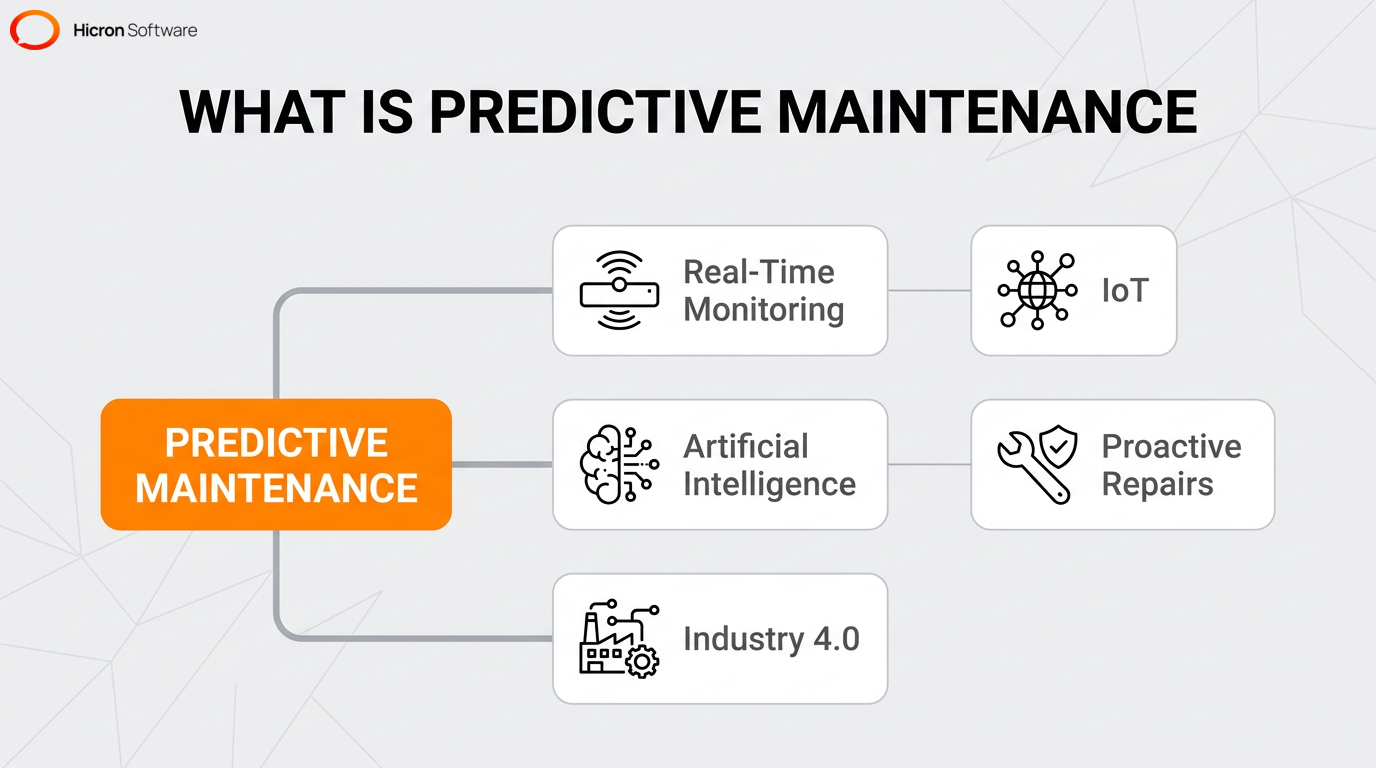
Predictive maintenance (PdM) in manufacturing is a method that relies on live machine stats and integrates core technologies:
These technologies work together to forecast equipment failures before they occur. If you’re moving toward Industry 4.0, PdM is your starting line—it keeps a constant watch on how your equipment is running. It shifts operations from reactive repairs to proactive, data-driven decision-making to ensure long-term reliability. Continuous health assessments help facilities prevent catastrophic breakdowns and modernize how the factory floor operates.
|
Category |
Key Elements |
Description |
|
Core Technologies |
|
Integrates live machine stats to forecast equipment failures before they occur, shifting operations to proactive, data-driven decision-making. |
|
Strategy Comparisons |
|
Outperforms traditional approaches by intervening only when physical degradation is detected, maximizing asset reliability and calculating exact remaining useful life (RUL). |
|
Condition Monitoring Techniques |
|
Processes continuous sensor data to detect specific mechanical and electrical wear, such as imbalances, abnormal heat signatures, physical friction, and internal motor issues. |
|
Manufacturing Benefits |
|
Extends the asset lifecycle, prevents catastrophic failures, and keeps production schedules on track by shifting maintenance to scheduled tasks based on evidence-based scheduling. |
Predictive maintenance uses actual equipment data to determine the exact time for a repair. Think of preventive maintenance like changing your car’s oil every 3,000 miles regardless of how you drive, while predictive maintenance is like having a smart sensor tell you exactly when the oil has degraded enough to need replacing. Predictive techniques outperform traditional reactive and preventive approaches. Real-time health analysis tells teams exactly what to fix and when, intervening only when they detect physical degradation to maximize asset reliability and eliminate the guesswork of calendar-based scheduling. I always tell plant managers that this transition is the single biggest step toward reclaiming their weekends.
Preventive maintenance operates on a strict time-based schedule, which leads to problems like excessive over-maintenance and missed early failures. For example, a standard preventive policy might replace a manufacturing bearing every 6-month interval regardless of its actual condition. Predictive maintenance (PdM) differs by using live tracking to trigger repairs based on actual need.
Predictive algorithms, such as anomaly detection and regression analysis, process equipment data, and machine learning models initiate a replacement only if sensor data indicates an impending breakdown. Ultimately, relying on data saves money by eliminating unnecessary preventive tasks, such as premature component replacements and redundant inspections. Tracking the exact remaining useful life prevents unexpected downtime and keeps production schedules on track.
Reactive maintenance waits for an actual equipment failure before initiating repairs. It’s no surprise that this wait-and-see approach causes factories to bleed money during unplanned downtime. Emergency interventions are inherently expensive and often lead to secondary damage, like broken shafts and shattered gears.
PdM differs by using live sensor data to help teams fix problems before they happen. Maintenance teams intervene early when sensors detect physical degradation. Catching minor issues before they escalate increases the mean time between failures (MTBF).
Predictive maintenance (PdM) isn’t just another name for condition-based maintenance (CBM). CBM is a diagnostic method using continuous health assessments to trigger an alert if an asset crosses a predefined limit, such as a vibration threshold. PdM builds upon this foundation by applying artificial intelligence and machine learning.
Predictive algorithms, such as neural networks and regression models, forecast future failures and calculate the exact remaining useful life (RUL). While a CBM system signals a technician only when a machine currently breaches a vibration limit, PdM uses anomaly detection to predict this exact threshold crossing 1 week in advance. In my experience, that one-week buffer is the difference between a planned 30-minute fix and a catastrophic production halt.
Predictive maintenance relies on a network of:
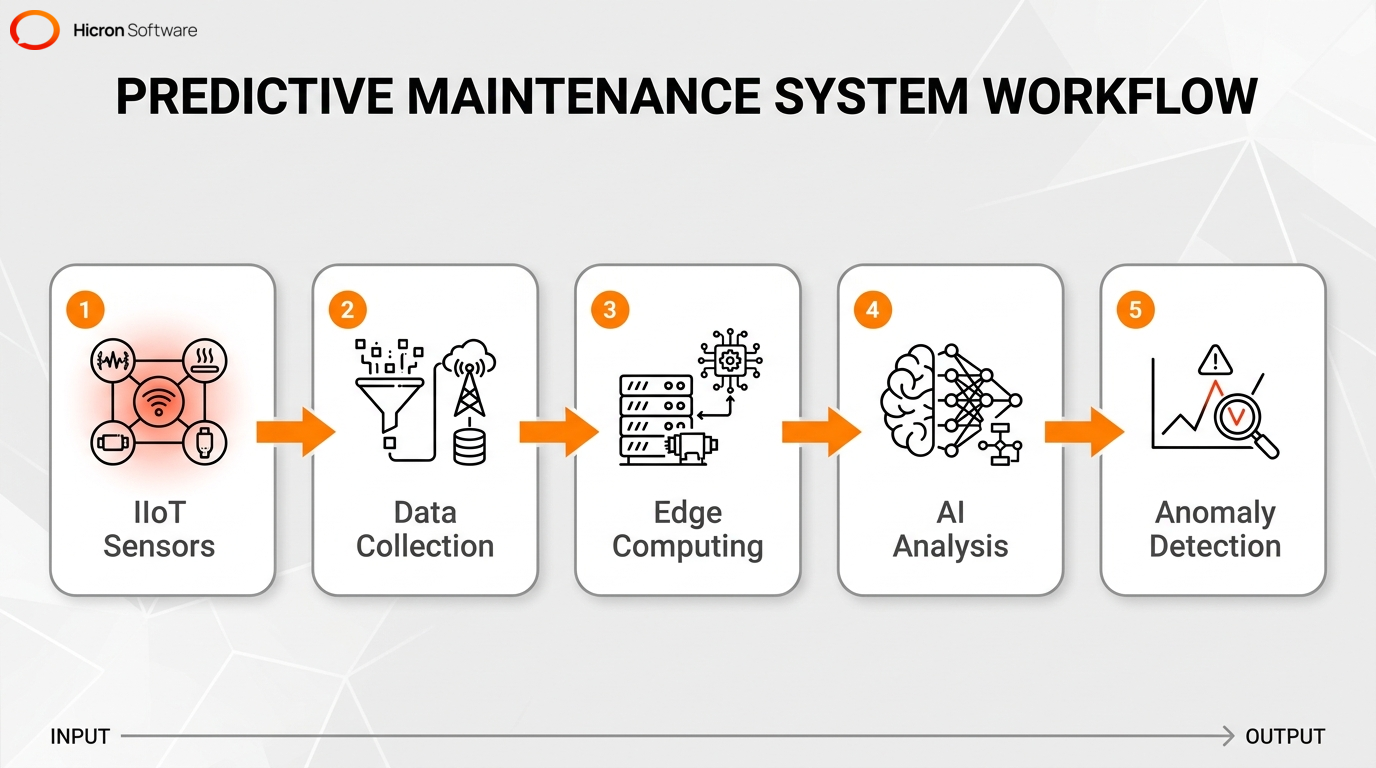
The Internet of Things (IoT) enables live monitoring by capturing physical machine data. Specific IIoT sensors, such as thermal or ultrasonic devices, continuously measure heat, vibration, and sound. Once gathered, IIoT gateways securely transmit these raw metrics to digital networks, instantly feeding the centralized systems that trigger alerts the moment an anomaly occurs.
Artificial intelligence (AI) turns raw sensor data into warnings you can actually use about equipment health, such as thermal alerts and acoustic notifications. Machine learning (ML) algorithms analyze continuous streams of sensor data to establish key parameters like historical trends and conditional baselines. Predictive algorithms then perform anomaly detection by comparing live tracking inputs against these established baselines.
ML models, such as clustering and classification algorithms, refine predictions over time to increase diagnostic accuracy. The system flags potential failures when deviations from established equipment baselines occur. Because the system is always learning, your maintenance team gets smarter, more accurate alerts over time.
Smart manufacturing uses two main ways to process data for predictive maintenance: local edge computing and remote cloud analytics. Edge computing provides immediate, localized analysis of sensor data to enable monitoring equipment on the fly. If critical faults occur, this local architecture triggers immediate shutdowns of high-speed machinery.
Cloud analytics handles massive datasets from IoT and IIoT devices to execute complex AI and ML algorithms. A hybrid approach combines both systems to give you the best of both worlds: instant alerts through the edge and long-term trend forecasting through the cloud.
Predictive maintenance relies on specialized condition monitoring techniques to detect specific types of mechanical and electrical wear. These include:
These diagnostic methods—ranging from evaluating industrial lubricants for microscopic wear particles to monitoring vibrations—process continuous sensor data to track equipment health on the fly. Evaluating data across multiple layers prevents unexpected breakdowns and provides a complete picture of asset health.
Vibration analysis monitors the physical motion of rotating machinery to identify imbalances, misalignments, and mechanical faults like bearing wear, gear damage, and structural looseness. Usually, a simple IIoT sensor is all you need. The sensor captures raw data to establish a healthy baseline, and then machine learning steps in to separate the normal operational hum from fault-related tremors. Think about how you can instantly tell if your own car engine sounds “off”—this is the highly precise, industrial version of that instinct.
The system spots the anomaly and alerts your team to fix it when live tracking identifies a deviation. Addressing equipment degradation early prevents minor tremors from turning into catastrophic gear failures.
Infrared and thermographic analysis use thermal imaging to detect abnormal heat signatures that physical friction or electrical faults cause. These signatures indicate impending equipment failure by revealing physical problems such as excessive friction, electrical resistance, and cooling failures.
IIoT thermal sensors process continuous data to monitor temperature fluctuations during continuous health assessments. Predictive maintenance systems execute anomaly detection to trigger an alert if temperatures breach the thermal baselines. Technicians often combine infrared analysis with motor current analysis to identify electrical abnormalities and overheating in industrial motors. Catching these issues early prevents minor hotspots from melting critical electrical components.
Sonic acoustical analysis monitors high-frequency sounds to identify early-stage mechanical defects, such as physical friction and poor lubrication. This method tracks specific sound frequencies using IIoT sensor data, often complementing oil analysis to give technicians a clearer picture of machine health.
Motor current analysis evaluates electrical consumption signatures to diagnose internal motor health issues, including rotor degradation and insulation problems. Predictive maintenance systems scan for irregularities to trigger an intervention if the machine breaches these acoustic or electrical baselines. Identifying these unique equipment faults early saves expensive motors from burning out.
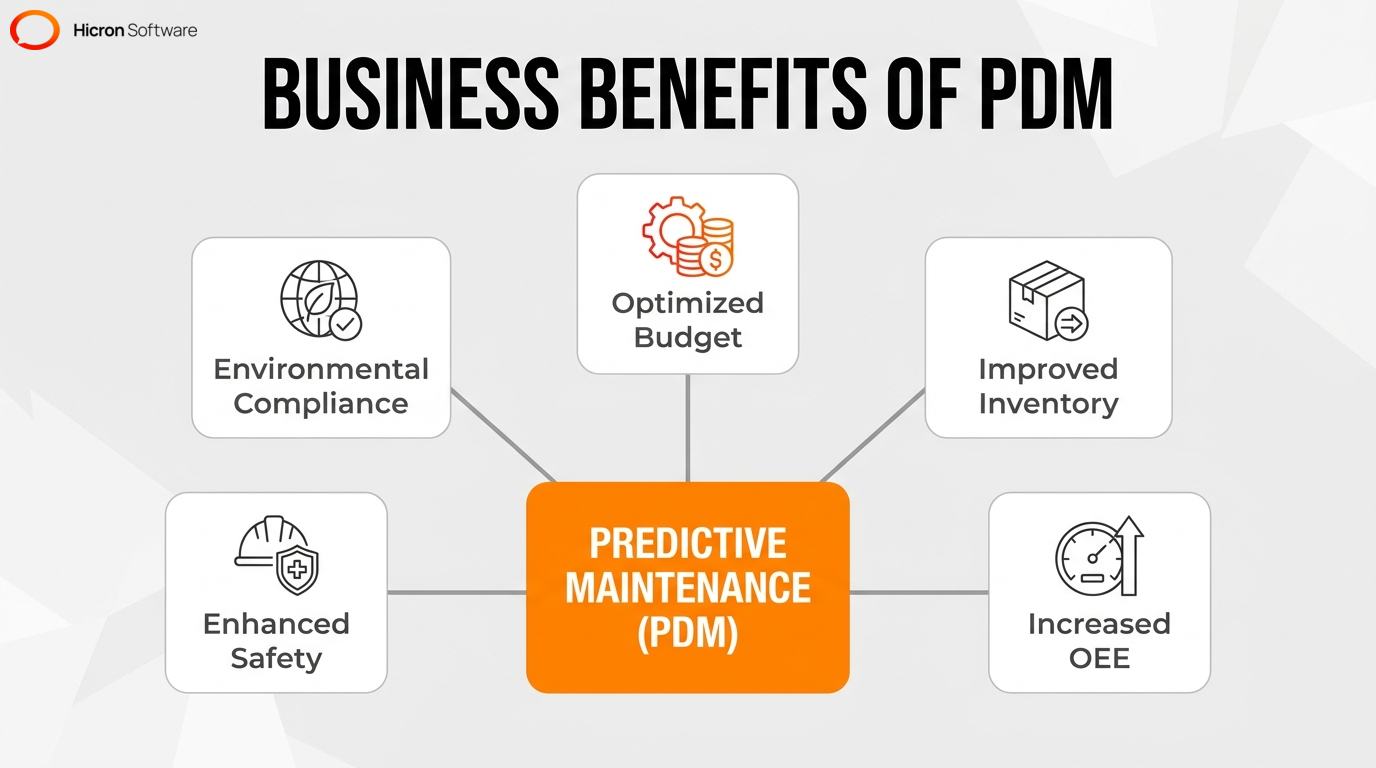
Predictive maintenance pays for itself quickly for the manufacturing sector by extending the asset lifecycle. The main perks include an optimized maintenance budget, improved inventory management, increased overall equipment effectiveness (OEE), enhanced worker safety, and strict environmental compliance.
Proactive monitoring minimizes physical wear and tear to maximize the useful life of capital equipment. Identifying a potential problem early optimizes the maintenance budget by preventing catastrophic failures. Precise, evidence-based scheduling helps a smart manufacturing facility achieve peak operational efficiency. It all comes down to timing. The system orders a spare part only when a breakdown is imminent, optimizing inventory capacity and eliminating excessive stock.
Predictive maintenance improves worker safety by preventing dangerous equipment malfunctions, such as unexpected explosions and hazardous chemical leaks. Maintaining industrial machinery based on its exact remaining useful life ensures strict environmental compliance. This strategy reduces energy consumption and prevents toxic pollution. When an early warning indicates structural degradation, a maintenance team can step in and fix the issue safely before it becomes an emergency.
Predictive maintenance (PdM) drastically reduces unplanned downtime and its associated financial costs, such as emergency labor expenses and lost production revenues running into the billions annually. If you know a machine is going to fail, you can fix it during a planned shift change instead of stopping production mid-run. When predictive algorithms detect early signs of degradation, this approach shifts maintenance from an emergency response to a scheduled task.
Live tracking continuously monitors asset health to increase the mean time between failures (MTBF). Smart monitoring virtually eliminates unexpected production halts across various manufacturing sectors, including automotive assembly and pharmaceutical production. Triggering proactive interventions based on early warnings keeps a facility’s assembly lines moving without interruption.
Overall equipment effectiveness (OEE) is a standard metric measuring specific manufacturing parameters: availability, performance, and quality. PdM gives your OEE a direct boost by improving all three of these areas at once.
Smart manufacturing uses system integration and live sensor data to keep production running at full speed. When proactive decisions guide repairs, a facility maximizes asset availability, maintains peak machine performance by preventing slowdowns, and ensures high production quality.
Predictive algorithms use machine learning (ML) and regression analysis on historical and real-time data to accurately estimate the remaining useful life (RUL) of machine components. Remaining useful life is the exact operational timeframe a physical asset possesses before experiencing a mechanical failure. Calculating RUL prevents prematurely discarding parts that still have life in them, significantly reducing both material waste and replacement costs.
Artificial intelligence (AI) models run regression analysis to evaluate continuous sensor inputs against historical degradation patterns. When this monitoring detects physical wear, this process determines the exact optimal time for a component replacement. Using ML to calculate the RUL eliminates guesswork and strengthens predictive maintenance strategies. This precise approach allows facilities to squeeze every hour of safe operation out of their components.
Making the leap to predictive maintenance isn’t always easy. Factories often run into hurdles like complex system integration, establishing accurate baseline data, and capturing tribal knowledge. System integration remains a significant technical hurdle. Facilities often struggle to connect Internet of Things (IIoT) sensors with legacy equipment and enterprise software platforms, such as CMMS applications. I’ve seen firsthand how bridging the gap between decades-old machinery and a modern cloud dashboard can test a team’s patience.
AI and ML algorithms process this connected information to enable precise, informed choices. The human element involves translating unwritten operational experience into strict rules for these predictive models. Veteran technicians use their tribal knowledge to help data scientists define specific AI model parameters, including accurate baselines and failure modes. As organizations transition to proactive asset management, this collaboration makes the new system actually work in the real world.
Implementing predictive maintenance is best done one step at a time. Deployment involves practical steps such as installing IoT hardware, establishing data baselines, deploying analytics, and integrating insights into maintenance workflows. A successful strategy begins with targeting critical assets before scaling plant-wide.
Hardware deployment kicks off the process, relying on physical infrastructure like IIoT gateways housed in custom UL control panels to simplify deployment. Next, deploying analytics enables live tracking to detect early equipment degradation. If predictive algorithms identify a mechanical anomaly, the system instantly triggers a maintenance alert.
Before a system can spot an anomaly, it needs to know what normal looks like. Establishing baselines involves analyzing informational sources to define normal machine behavior, specifically past equipment sensor data and human technician expertise. Here is a crucial pro-tip: never rush this baseline phase, because an algorithm trained on incomplete data will only frustrate your team with false alarms.
Defining normal operating parameters creates a precise benchmark for machine learning (ML) and predictive algorithms. When live sensor data identifies a variance from this benchmark, predictive maintenance systems detect future mechanical deviations. Relying on hard data prevents unexpected breakdowns and keeps the factory running smoothly.
Integrating predictive maintenance with a computerized maintenance management system (CMMS) and an enterprise asset management (EAM) platform turns data into real-world action like generating work orders and ordering spare parts. A CMMS and an EAM system centralize maintenance management across the manufacturing sector. Triggering instant maintenance requests when predictive algorithms detect early equipment degradation automates the repair process.
Automating work orders enables specific operational improvements, such as faster intervention times and leaner spare parts inventory management. A CMMS integrates directly with enterprise resource planning (ERP) systems to automatically check for available components when the system triggers a predictive alert. As a result, inventory capacity is optimized and the factory floor keeps running without a hitch.

Hicron Software proved to be a trusted partner with unmatched technical expertise, delivering a scalable and user-friendly web application that was pivotal to our successful U.S. market expansion.

Hicron’s contributions have been vital in making our product ready for commercialization. Their commitment to excellence, innovative solutions, and flexible approach were key factors in our successful collaboration.
I wholeheartedly recommend Hicron to any organization seeking a strategic long-term partnership, reliable and skilled partner for their technological needs.

After carefully evaluating suppliers, we decided to try a new approach and start working with a near-shore software house. Cooperation with Hicron Software House was something different, and it turned out to be a great success that brought added value to our company.
With HICRON’s creative ideas and fresh perspective, we reached a new level of our core platform and achieved our business goals.
Many thanks for what you did so far; we are looking forward to more in future!

Hicron is a partner who has provided excellent software development services. Their talented software engineers have a strong focus on collaboration and quality. They have helped us in achieving our goals across our cloud platforms at a good pace, without compromising on the quality of our services. Our partnership is professional and solution-focused!

The IT system supporting the work of retail outlets is the foundation of our business. The ability to optimize and adapt it to the needs of all entities in the PSA Group is of strategic importance and we consider it a step into the future. This project is a huge challenge: not only for us in terms of organization, but also for our partners – including Hicron – in terms of adapting the system to the needs and business models of PSA. Cooperation with Hicron consultants, taking into account their competences in the field of programming and processes specific to the automotive sector, gave us many reasons to be satisfied.