Transforming Legacy Java-based Enterprise Applications: 10 Frameworks to Know
- June 13
- 23 min


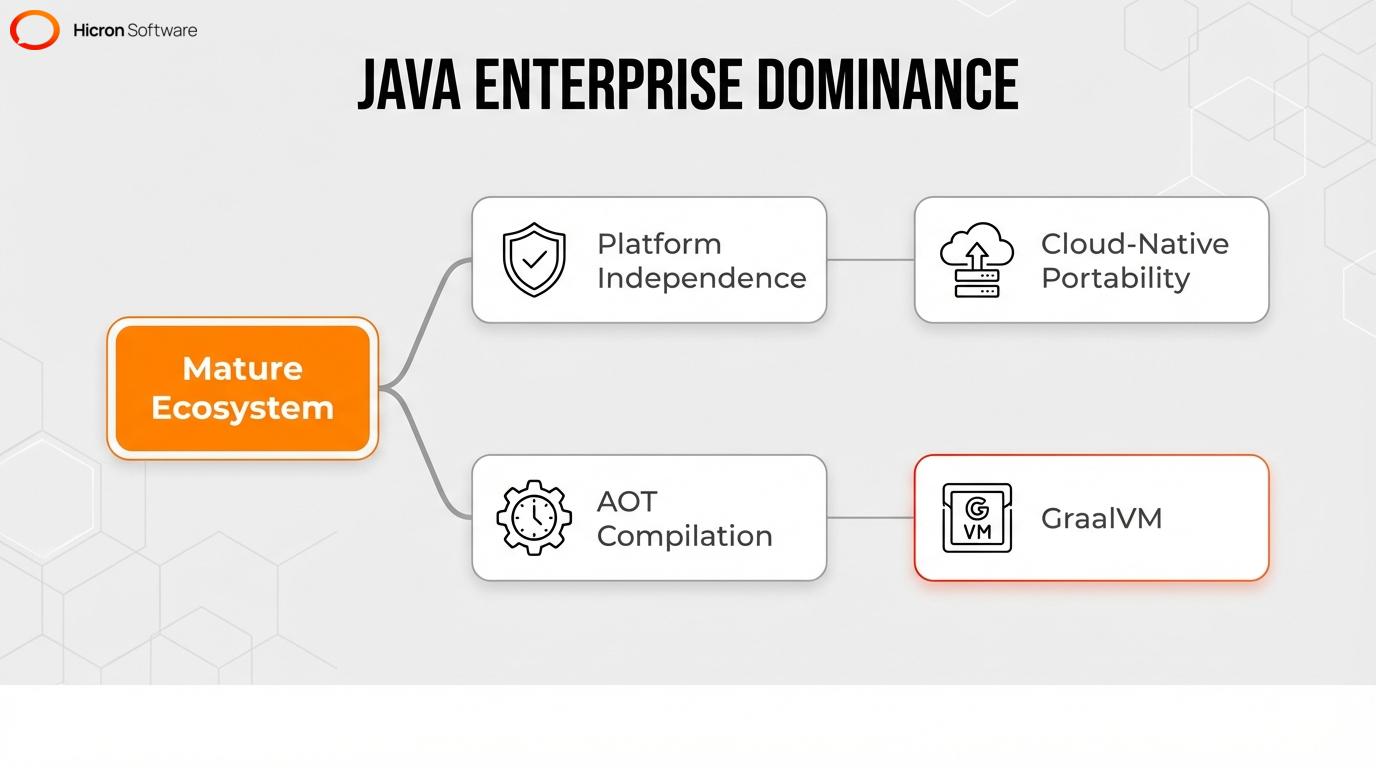
Java maintains its dominance in enterprise software through a mature ecosystem and platform independence. It also has a unique capacity to power mission-critical systems, including financial platforms and healthcare registries, at scale. These core characteristics keep the language highly competitive against newer alternatives. Software engineering teams use Java for building and maintaining large-scale company systems from day one to year ten. This coverage spans from initial system design and coding to long-term software maintenance and evolution. In my experience, there’s a certain peace of mind that comes with knowing your core stack won’t become obsolete overnight.
Today’s JVMs aren’t just about basic interpretation anymore. With advancements like Ahead-of-Time (AOT) compilation via GraalVM, Java applications now achieve near-instant startup times and minimal memory footprints, making them highly portable and efficient for cloud-native containers like Docker.
|
Enterprise Domain |
Core Java Technologies & Features |
Business & Operational Benefits |
|
Performance & Scale |
|
|
|
Cloud-Native & Microservices |
|
|
|
Legacy Modernization |
|
|
|
Emerging Tech & Integration |
|
|
|
Quality Assurance & Maintenance |
|
|
Enterprise-grade Java development differs from standard application builds by targeting complex business workflows rather than basic standalone functions. To meet specific business objectives, teams tailor custom applications by gathering precise business requirements and delivering solutions through iterative development cycles. Because this methodology enables rapid prototyping, developers can deliver a Minimum Viable Product (MVP) within 2 to 6 months. Internally, Java’s architecture efficiently processes millions of concurrent operations and handles the complex business logic that enterprise systems demand.
Engineering teams leverage these capabilities to architect secure, highly scalable software. Primary examples of enterprise-grade Java applications include Enterprise Resource Planning (ERP) and Customer Relationship Management (CRM) systems. Modern enterprise application development relies on the language to support extensive data engineering tasks and smooth API integration. When systems require advanced scalability, developers deploy a microservices architecture to isolate distinct business domains. Continuous software engineering practices guarantee reliable maintenance, minimizing defects and ensuring high availability over time.
If you’re building microservices in the cloud, Java is likely your go-to foundation. Cloud-native development principles and Java’s modular architecture work together to break down complex applications into smaller, loosely coupled services. This microservices approach makes it much easier for teams to update and scale their software quickly compared to rigid monolithic structures.
Cloud-native environments thrive on this independence. By scaling specific Java microservices dynamically based on real-time traffic, teams can dramatically improve resource efficiency during peak workloads. Plus, the Java ecosystem integrates natively with orchestration tools like Kubernetes. This means DevOps teams can rely on standard CI/CD pipelines to automate the entire lifecycle—from the first code commit straight through to production.
Developers can accelerate enterprise application development using the Spring Boot ecosystem to eliminate manual setup and manage infrastructure. The framework operates as the de facto standard for enterprise microservices by offering auto-configuration, embedded servers, and production-ready dependencies directly out of the box. If you’ve ever spent days wrestling with legacy XML configurations, you know exactly why this is such a game-changer.
Here is how Spring Boot speeds up the process:
Mapping complex domain objects directly to database tables reduces boilerplate code and shortens delivery cycles. Together, these companion frameworks make it easier to connect APIs and handle increased user loads while maintaining high availability across a distributed microservices architecture.
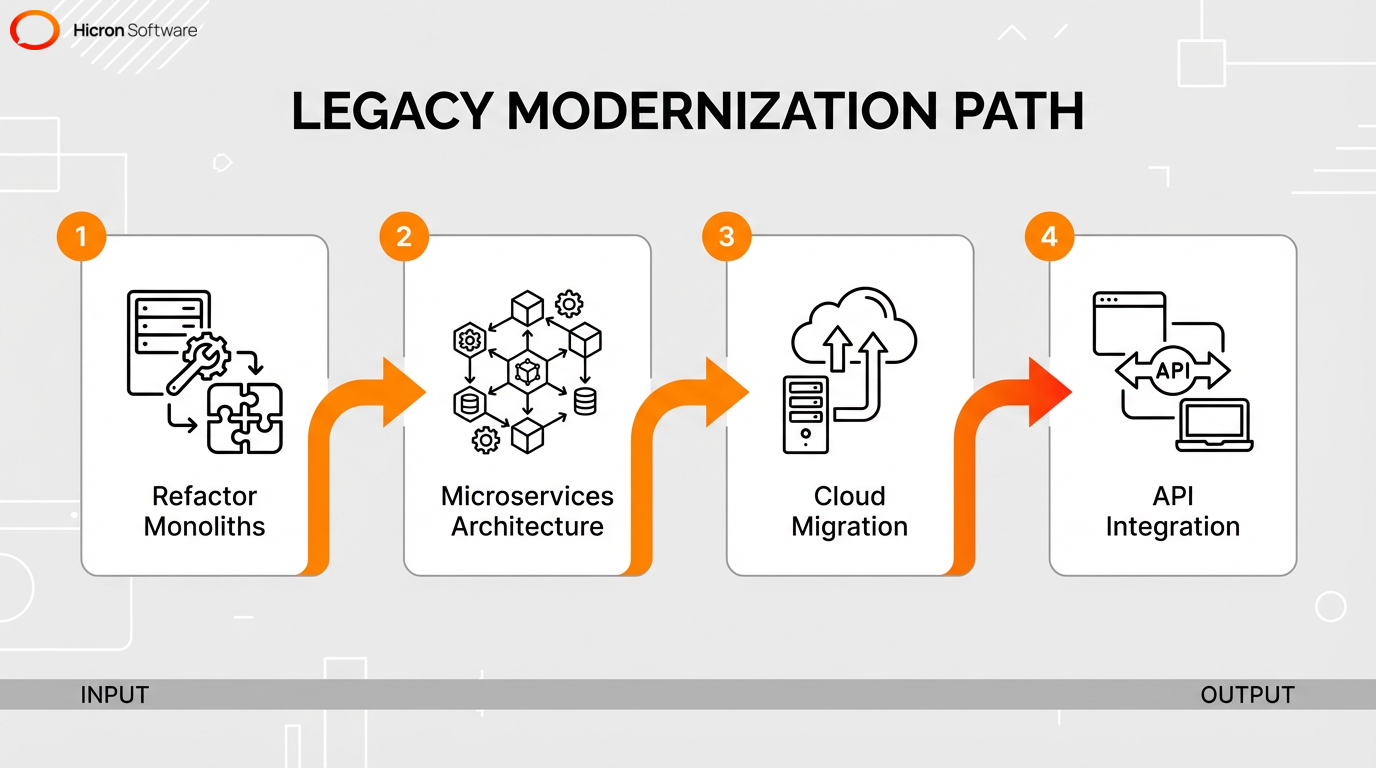
Java’s backward compatibility and modular architecture establish the language as the primary platform for upgrading outdated enterprise systems, such as legacy billing platforms and on-premise inventory databases. Because Java is so stable, organizations can modernize legacy applications incrementally without breaking their current business operations. The platform enables incremental updates rather than forcing a complete system rewrite. Here is a hard-learned lesson from the field: big-bang rewrites rarely work, which makes this incremental capability invaluable.
Modernizing an old Java system usually follows a clear path:
Ultimately, this approach optimizes application performance and significantly extends the software lifecycle. Dedicated software maintenance teams identify exactly when specific system components require migration to newer environments. This targeted approach ensures that critical business operations remain uninterrupted during the transition.
Java easily adapts when incorporating emerging technology trends into enterprise systems. The language’s extensibility allows enterprises to embed next-generation capabilities—such as artificial intelligence, machine learning, and blockchain—into existing architectures without replacing their core infrastructure. The platform supports the integration of real-time data pipelines, predictive analytics, and intelligent processing directly into enterprise back-ends. This structural flexibility makes the whole system stronger when organizations deploy cloud-native development practices.
IoT development projects rely on Java’s portability to manage ecosystems spanning diverse hardware and gateways. Engineers develop applications for memory-constrained IoT devices while maintaining heavy-duty backend processing, a capability that supports the massive data engineering workloads generated by connected sensors. When systems need to process millions of concurrent device requests, the language delivers advanced scalability.
Fintech companies trust Java for two main reasons: strict security protocols and platform portability. On the security side, the platform protects sensitive transactional data when developers use its advanced cryptographic libraries, which is essential when artificial intelligence integration powers fraud detection algorithms. Meanwhile, Java’s portability allows secure API integration to establish direct connections with global payment services and high-stakes financial algorithms across different environments.
Well-structured APIs enable reliable data exchange between disparate systems—bridging the gap between legacy databases and modern cloud platforms. To ensure this reliable data transfer, modern environments rely on distributed event-streaming platforms—like Apache Kafka or Pulsar—and advanced API gateways. Software engineering teams implement these communication structures, such as message queues and event streams, for asynchronous data exchange. This approach supports extensive data engineering workloads across a mix of different enterprise applications. By using asynchronous communication patterns, the platform maintains high scalability even under heavy data loads.
Effective API integration accelerates enterprise application development by enabling distinct business services to talk to each other easily. This connectivity forms the foundation of a distributed microservices architecture, enabling independent scaling and deployment of individual services without disrupting the broader system. To enhance overall system design, cloud-native development relies on secure connections, such as REST APIs and GraphQL endpoints.
The maturity of Java’s testing ecosystem and DevOps toolchain makes it easy to test software thoroughly and keep it running smoothly after it launches. Software engineering teams employ an integrated approach of manual and automated testing to maintain high standards of software quality at an enterprise scale. This methodology ensures resilience, security, and functionality across complex architectures.
A thorough testing approach relies on specific evaluation levels, including unit testing, integration testing, and system validation. Enterprise quality assurance processes incorporate these frameworks to align with international standards, such as ISO 9001 and ISO 27001, establishing rigorous operational baselines.
Let’s be honest, nobody wants a late-night pager alert because a production deployment failed. A mature DevOps toolchain streamlines the entire validation process. Engineers execute testing within containerized environments to validate real-world deployment conditions, while containerization tools like Docker and orchestration platforms like Kubernetes reliably simulate exact production scenarios. By automating these steps, CI/CD pipelines detect code defects early.
Once a mission-critical Java app is live, maintenance teams must:
This proactive approach delivers advanced scalability when user traffic increases unexpectedly. The entire system remains aligned with long-term business goals when administrators continuously monitor real-world resource utilization.
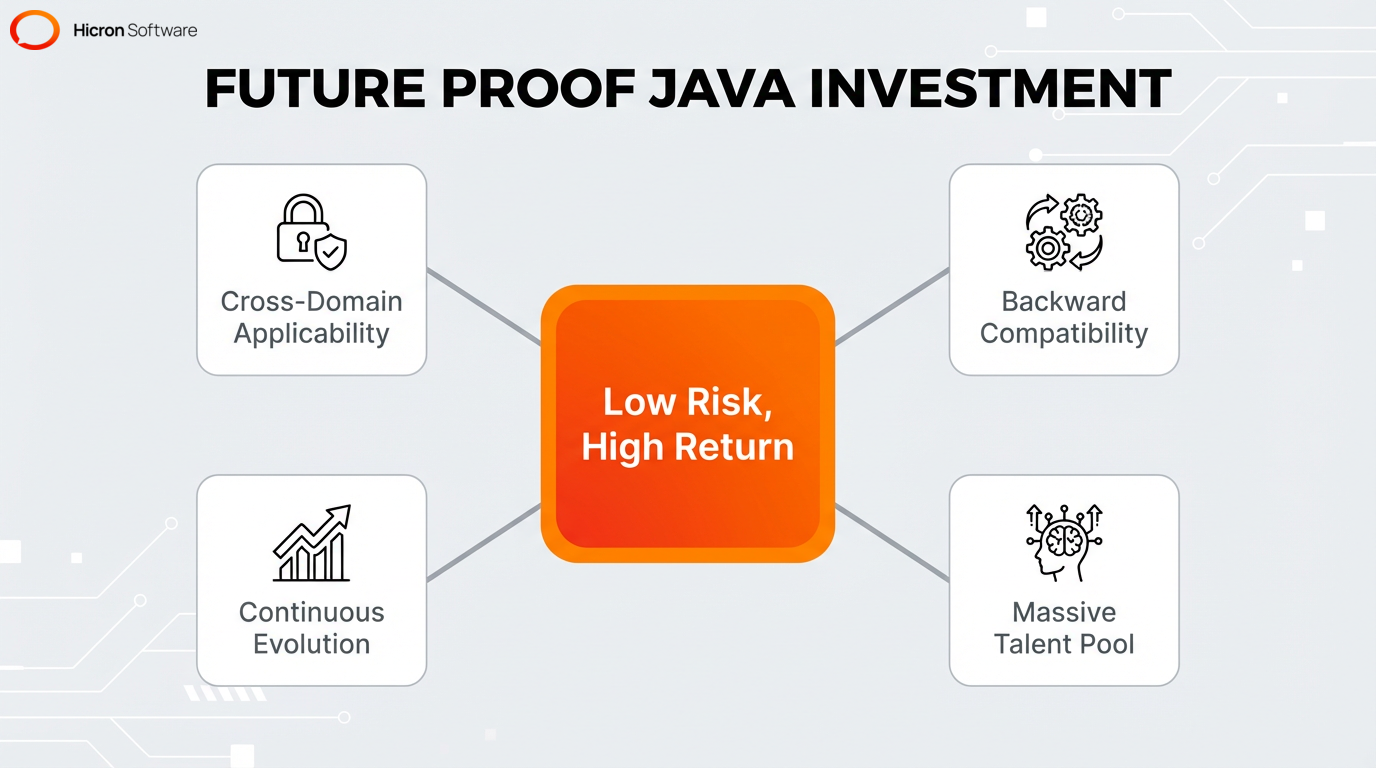
Java remains a low-risk, high-return choice for technical leaders building long-lasting software for a few key reasons. These factors include backward compatibility, a massive developer talent pool, continuous platform evolution, and cross-domain applicability. This combination establishes the language as the primary enterprise platform for 2026 and beyond. I’ve seen countless “Java killers” come and go over my career, yet this ecosystem continues to adapt and thrive.
The platform supports everything a large company needs across a modern software architecture, from dynamic web frontends to high-performing back-end systems. A dynamic user platform remains highly competitive when software engineering teams build it using modern frameworks like Spring and Vaadin.
Java extends its reach beyond a traditional server-side role by enabling cross-platform and native mobile app development. Robust API integrations link mobile interfaces to secure enterprise back-ends. High-performing Android applications, such as mobile storefronts or Enterprise Resource Planning (ERP) extensions, demonstrate the platform’s versatility across diverse delivery channels. Custom enterprise application development helps companies build custom tools that last for years while keeping costs down. Ultimately, a well-structured system design ensures elastic resource management when developers deploy cloud-native practices, such as container orchestration and service mesh implementation.
Hicron Software proved to be a trusted partner with unmatched technical expertise, delivering a scalable and user-friendly web application that was pivotal to our successful U.S. market expansion.

Hicron’s contributions have been vital in making our product ready for commercialization. Their commitment to excellence, innovative solutions, and flexible approach were key factors in our successful collaboration.
I wholeheartedly recommend Hicron to any organization seeking a strategic long-term partnership, reliable and skilled partner for their technological needs.

After carefully evaluating suppliers, we decided to try a new approach and start working with a near-shore software house. Cooperation with Hicron Software House was something different, and it turned out to be a great success that brought added value to our company.
With HICRON’s creative ideas and fresh perspective, we reached a new level of our core platform and achieved our business goals.
Many thanks for what you did so far; we are looking forward to more in future!

Hicron is a partner who has provided excellent software development services. Their talented software engineers have a strong focus on collaboration and quality. They have helped us in achieving our goals across our cloud platforms at a good pace, without compromising on the quality of our services. Our partnership is professional and solution-focused!

The IT system supporting the work of retail outlets is the foundation of our business. The ability to optimize and adapt it to the needs of all entities in the PSA Group is of strategic importance and we consider it a step into the future. This project is a huge challenge: not only for us in terms of organization, but also for our partners – including Hicron – in terms of adapting the system to the needs and business models of PSA. Cooperation with Hicron consultants, taking into account their competences in the field of programming and processes specific to the automotive sector, gave us many reasons to be satisfied.