ERP Customization vs. Out-of-the-Box Solutions: Pros and Cons
- April 05
- 23 min

A construction ERP is a software platform integrating core business operations. It acts as the central database for managing finances and operations. This software helps manage finances, project planning, and equipment tracking in one place. A construction ERP system reduces errors by keeping all data unified. Centralized databases improve team communication across different departments and building sites. Teams can access project management tools directly from the main platform. A modern construction ERP system offers specific tools for the construction industry. This solution prevents data duplication and keeps all project stakeholders informed.
Key Takeaways:
Construction companies face complex supply chain challenges that require precise tracking. These operations involve coordinating materials, labor, and equipment across multiple locations in construction and engineering. Managing these elements without a centralized system leads to costly delays. Outdated systems often cause data silos and slow down daily operations. A construction business needs immediate access to accurate financial and operational data. Without this visibility, a contractor risks exceeding project budgets and missing deadlines.
A modern construction ERP provides real-time data access for better decision-making. Managers can view project costs, resource availability, and schedule changes instantly. This transparency helps construction companies identify potential issues before they escalate. A dedicated construction ERP system integrates estimating, accounting, and project management. This integration eliminates manual data entry and reduces the risk of errors. Construction firms can track profitability at every stage of the project lifecycle.
Developing software for the construction industry improves overall efficiency and productivity. A cloud-based construction ERP allows field workers to update progress instantly. Site managers can submit timecards, approve invoices, and order materials remotely. This connectivity bridges the gap between the office and the construction site. It helps construction companies maintain accurate records and respond to issues quickly.
Construction operations require advanced tools not present in generic solutions. Many platforms used by other industries do not address industry-specific project challenges. Understanding these differences is necessary for effective project delivery.
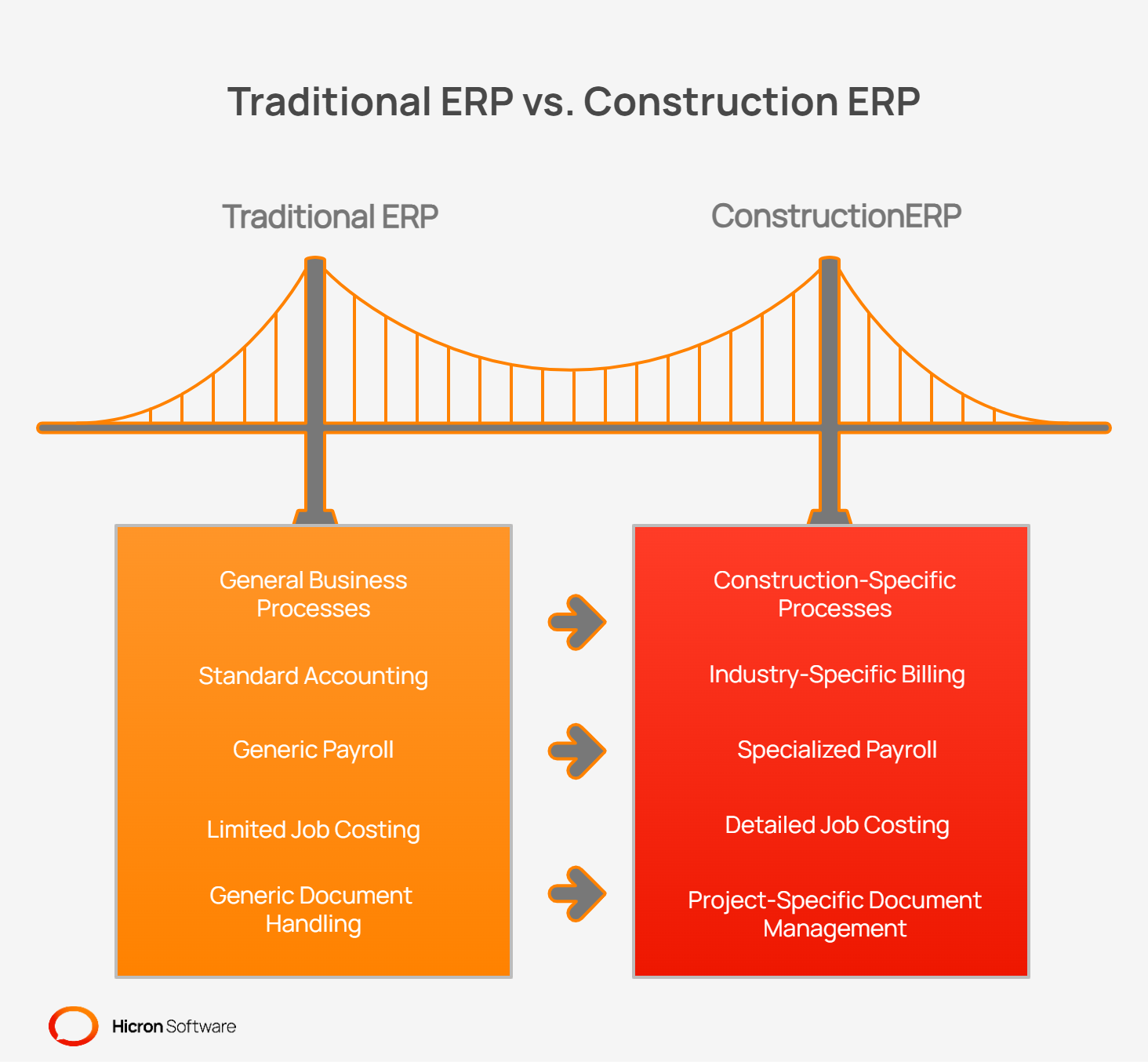
Traditional ERP focuses on general manufacturing or retail business processes. These generic platforms often lack the specialized tools required by contractors. Standard accounting software struggles to handle the unique billing methods of construction. Traditional ERP platforms require extensive customization to meet the needs of construction project management. This customization process drains resources and creates long-term maintenance challenges. A general ERP solution designed for retail cannot manage complex subcontractor contracts.
An ERP for construction offers specific tools for subcontractor management and bidding. Industry-specific systems automatically handle complex progress billing and retainage requirements. An ERP designed specifically for the construction sector includes specialized payroll features. It tracks union dues, prevailing wages, and multiple pay rates for workers. A construction enterprise requires these specific functions to maintain regulatory compliance. An ERP software for construction integrates these features directly into the core system.
The best construction ERP software addresses the unique challenges of job costing. A construction ERP offers detailed cost breakdowns for every project phase. General contractors can track estimated costs against actual expenses in real time. This functionality is critical in construction for maintaining tight profit margins. Systems like a leading construction ERP provide specialized document management for drawings. They connect RFI documents and submittals directly to the project management platform.
A well-rounded ERP system for construction should include at least a few of these essential modules, as they address the unique challenges of the construction industry. From project management to compliance tracking, these features ensure streamlined operations, better resource allocation, and improved decision-making for construction companies using ERP software solutions built for construction:
Customization is key to making an ERP system truly effective. Flexible module definitions allow construction businesses to tailor the system to their specific needs, ensuring that every tool aligns perfectly with their workflows and operational goals.
Construction services require advanced technology for precise project control. Proper use of ERP systems supports better oversight in critical construction business areas. These systems directly impact project outcomes and overall company performance.
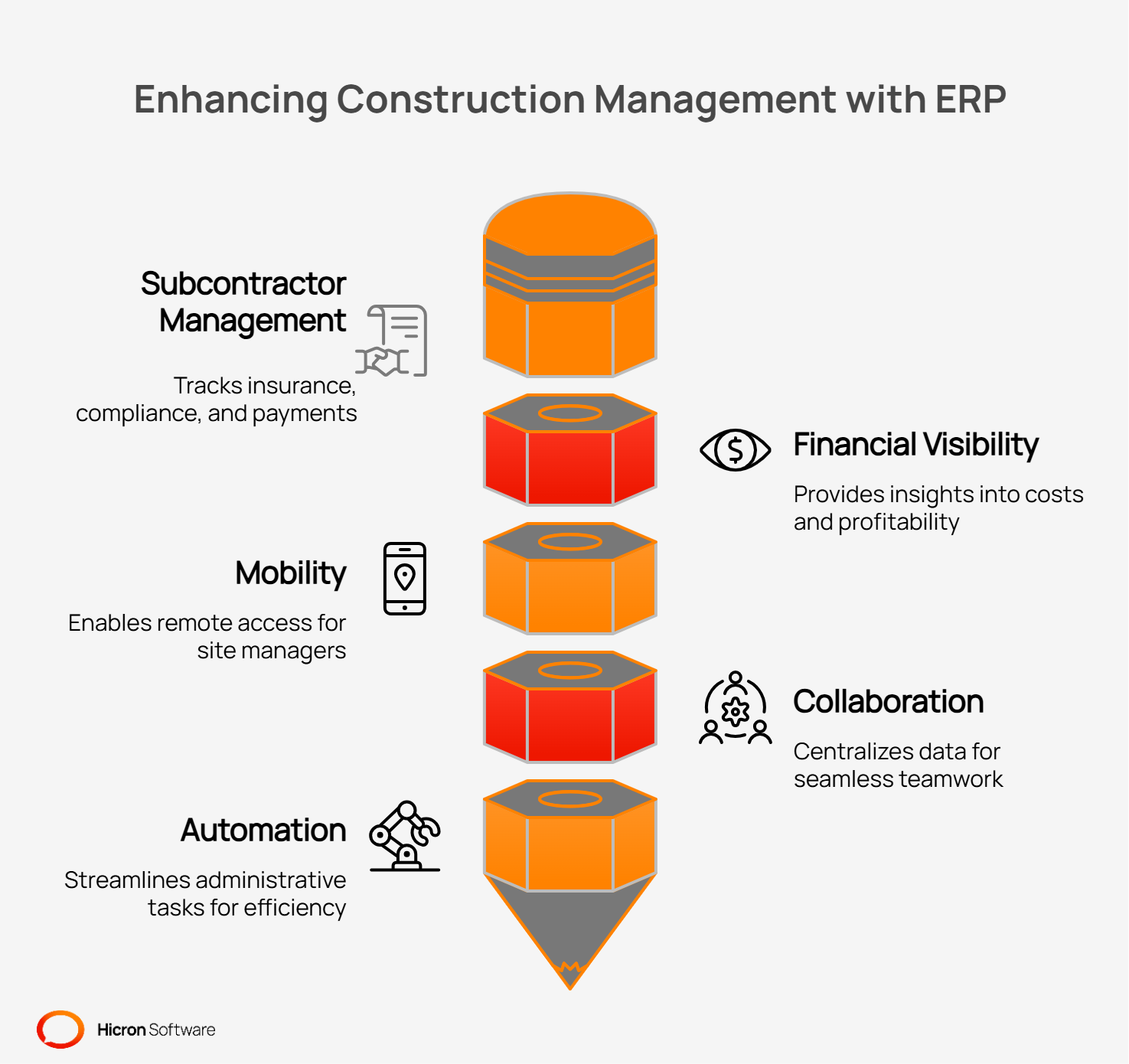
A tailored construction ERP solution improves subcontractor and vendor management processes. Contractors can efficiently track insurance certificates, compliance documents, and payment schedules. The system alerts managers when subcontractor documents expire or require renewal. This proactive approach protects the construction firm from potential liability issues. Proper management software ensures that all stakeholders reliably meet project requirements and deadlines.
ERP systems provide complete visibility into labor costs, productivity, and project profitability. Automated reporting tools generate detailed financial insights without manual data gathering. This visibility empowers construction companies to make informed strategic decisions quickly. A cloud-based ERP system enables access for site managers from anywhere. Site supervisors can review drawings, approve timesheets, and submit daily logs remotely. This mobility streamlines routine tasks and saves valuable time for everyone.
Centralized databases enhance collaboration by keeping all project data in one place. All teams work with real-time updates, preventing miscommunication and costly errors. A construction management platform ensures the office and field remain synchronized constantly, particularly when using ERP software solutions specifically for the construction industry. The best ERP for construction companies automates repetitive administrative workflows easily. This automation allows staff to focus on critical project management tasks. It improves overall efficiency and accelerates project delivery times for contractors.
Choosing the best ERP software for construction companies requires careful evaluation. Understanding the factors that drive success helps contractors select a platform that supports business growth. The following section highlights core attributes and considerations for the construction sector.
The best ERP software for construction companies scales with your business growth. Growing construction businesses need platforms that can handle increased project volumes. Large construction firms require robust systems capable of managing multiple subsidiary companies. A top construction ERP accommodates expanding operations without requiring a complete system replacement. Flexible customization features in construction software allow construction businesses to tailor the system perfectly. Flexible module definitions ensure that every tool aligns perfectly with operational goals.
An ideal construction ERP integrates well with other tools you use daily. It connects with existing estimating software, CRM platforms, and CAD drawing tools. This connectivity ensures data flows smoothly across the entire technology stack. An all-in-one construction management system centralizes data for better visibility. The right ERP system prevents isolated data silos from forming within departments. Mid-sized construction firms benefit greatly from this integrated software ecosystem approach.
Strong customer support ensures your team can resolve technical issues quickly. The software provider should offer comprehensive training and responsive technical assistance. Reliable support minimizes system downtime and keeps construction projects moving forward. Choosing the right ERP involves carefully evaluating the vendor’s industry expertise. A provider with deep construction knowledge understands your specific operational challenges. This expertise translates into better software development and long-term user success.
Defining the right ERP requirements is critical for success in the construction industry, especially when considering ERP software solutions specifically designed for the construction industry. A structured approach helps ensure all business processes are addressed, and the system is tailored to operational needs. The following steps detail what every construction business should include in its requirements documentation.
| Category | Action | Details |
| Identify core processes | Map integration needs | Identify which business processes require integration or automation across construction operations |
| Document user group needs | Record functional requirements for each group: project management, finance, and field crews | |
| Assess compliance requirements | Evaluate reporting, regulatory, and industry-specific needs unique to your projects and clients | |
| Evaluate workflow handling | Determine how the software manages your specific construction workflows | |
| Account for scale-specific needs | Large-scale construction requires detailed tracking of heavy equipment and specialized labor | |
| Finalize requirements document | Use it as the foundation for the entire software search process | |
| Prioritize features | Align features with growth goals | Match must-have features to long-term operational and business growth objectives |
| Separate needs from nice-to-haves | Distinguish essential functions from optional enhancements to guide selection | |
| Involve key stakeholders | Include field managers, accountants, and executives, each group has different priorities | |
| Gather broad user input | Ensure the chosen system meets the needs across all departments and roles | |
| Use the list to evaluate vendors | A comprehensive requirements list enables accurate comparison of software solutions | |
| Review infrastructure | Assess technical compatibility | Review hardware capabilities and network reliability for cloud-based applications |
| Check mobile device availability | Ensure field workers have adequate devices to access the system on-site | |
| Plan data migration | Identify requirements for transferring historical records to the new platform | |
| Prevent deployment issues | Proper planning at this stage avoids technical complications during final rollout | |
| Define technical requirements for vendors | Clear specs help vendors propose the most appropriate software architecture |
To achieve smooth ERP development, a clear rollout strategy is required. Construction operations benefit from structured preparation and phased project planning for new ERP software.
| Phase | Description | Typical Activities | Potential Pitfalls |
| Discovery | Conduct in-depth analysis to identify business needs, map workflows, and gather detailed requirements. Collaborate with stakeholders to define project goals and technical specifications. | Map business processes, gather integration needs, review compliance, and document goals. | Lack of stakeholder alignment, incomplete requirements gathering, or unclear project objectives. |
| Build and Integrate | Develop custom ERP software tailored to construction operations. Integrate the system with existing tools and ensure seamless data flow across platforms. Perform initial testing to validate functionality. | Create custom modules, connect legacy systems, and align the platform with operational objectives. | Integration challenges with legacy systems, scope creep, or delays in development timelines. |
| Train and Pilot | Provide role-specific training sessions to ensure users understand the system. Run a pilot test with a small group to gather feedback, refine workflows, and address any technical issues. | Provide user training, test with a pilot group, collect feedback, and adjust processes as needed. | Resistance to change from users, insufficient training, or unresolved technical issues during the pilot. |
| Launch and Optimize | Deploy the ERP system in phases to minimize risks. Monitor system performance, gather user feedback, and provide ongoing support to optimize functionality and ensure long-term success. | Rollout system organization-wide, monitor usage, and optimize with analytics and user support. | Poor user adoption, inadequate post-launch support, or failure to address feedback promptly. |
Developing an ERP software for the construction industry requires specialized technical expertise. Hicron Software provides comprehensive guidance tailored to construction operations and workflows. Our experts understand the specific accounting and project management challenges contractors face. We help construction companies deploy tailored solutions that directly improve operational efficiency. Our development methodology ensures your new system aligns perfectly with business goals.
A modern construction ERP provides real-time visibility into project costs. It centralizes document management, scheduling, and resource allocation on a single unified platform. The right ERP eliminates data silos and improves communication across all departments. Construction managers can make informed decisions using accurate financial and operational data. Investing in specialized management and accounting software prepares your business for growth. Contact Hicron Software today to get help from our experienced software experts.

Hicron Software proved to be a trusted partner with unmatched technical expertise, delivering a scalable and user-friendly web application that was pivotal to our successful U.S. market expansion.

Hicron’s contributions have been vital in making our product ready for commercialization. Their commitment to excellence, innovative solutions, and flexible approach were key factors in our successful collaboration.
I wholeheartedly recommend Hicron to any organization seeking a strategic long-term partnership, reliable and skilled partner for their technological needs.

After carefully evaluating suppliers, we decided to try a new approach and start working with a near-shore software house. Cooperation with Hicron Software House was something different, and it turned out to be a great success that brought added value to our company.
With HICRON’s creative ideas and fresh perspective, we reached a new level of our core platform and achieved our business goals.
Many thanks for what you did so far; we are looking forward to more in future!

Hicron is a partner who has provided excellent software development services. Their talented software engineers have a strong focus on collaboration and quality. They have helped us in achieving our goals across our cloud platforms at a good pace, without compromising on the quality of our services. Our partnership is professional and solution-focused!

The IT system supporting the work of retail outlets is the foundation of our business. The ability to optimize and adapt it to the needs of all entities in the PSA Group is of strategic importance and we consider it a step into the future. This project is a huge challenge: not only for us in terms of organization, but also for our partners – including Hicron – in terms of adapting the system to the needs and business models of PSA. Cooperation with Hicron consultants, taking into account their competences in the field of programming and processes specific to the automotive sector, gave us many reasons to be satisfied.