How to Secure OPC UA Communication Using Proper Authentication and Encryption Mechanisms?
- January 28
- 21 min


OPC UA server integration connects the Industrial Internet of Things (IIoT) ecosystem. While functioning as a universal translator and secure conduit, it converts data from operational technology (OT) on the factory floor for use by information technology (IT) systems in the cloud. By creating a standardized interface across diverse industrial assets, the integration bridges gaps often caused by fragmented, vendor-specific protocols.
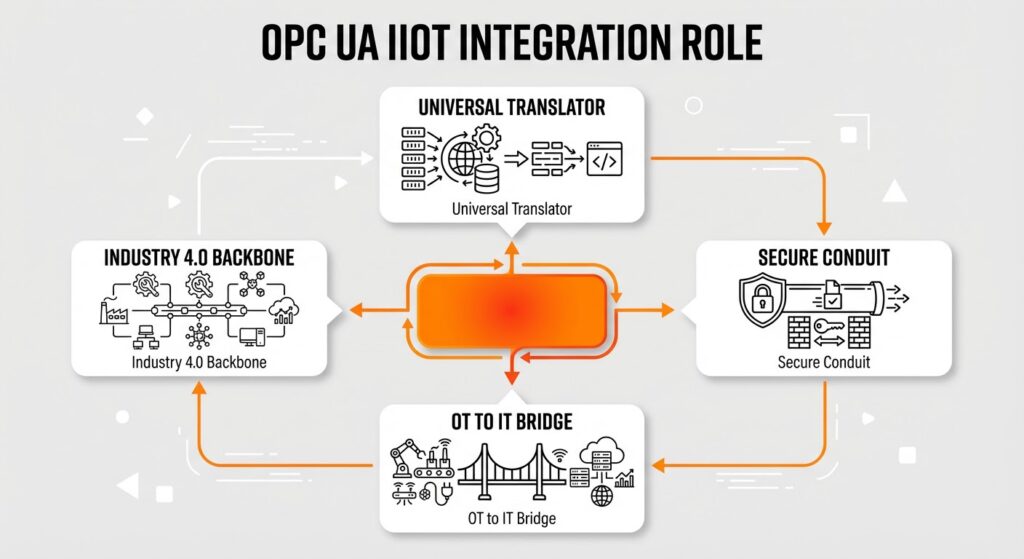
When you use a single communication language, OPC UA implementation eliminates compatibility barriers between different OEM protocols and enables seamless machine-to-machine communication. Such an architecture links industrial automation hardware and edge computing devices directly to higher-level management platforms, such as MES and ERP systems. OPC UA serves as the backbone of Industry 4.0, enabling reliable data acquisition and unifying the manufacturing landscape.
| Core Function | Technical Implementation | Role in IIoT Environment |
|
Security Architecture |
|
Hardens network security by reducing the cyber attack surface. It simplifies firewall configurations and establishes a secure integration layer with mutual authentication and point-to-point encryption. |
|
Communication Models |
|
Client-Server handles controlled point-to-point actions (e.g., machine start/stop). Pub/Sub enables scalable broadcasting for cloud analytics and telemetry without persistent individual connections. |
|
Platform Independence |
|
Reduces hardware costs by eliminating the need for dedicated Windows PCs. It allows edge computing devices to process data locally and enables plug-and-play functionality directly on PLCs and sensors. |
|
Data Modeling & Context |
|
Provides semantic context to raw data, transforming flat tags into structured objects. This ensures devices from different vendors speak the same language and facilitates seamless machine-to-machine communication. |
|
Enterprise Integration |
|
Connects OT to IT systems like MES and ERP. Aggregation consolidates connections for SCADA, while TSN guarantees real-time data transmission for critical control loops and motion control. |
The main difference lies in OPC UA’s platform-independent, service-oriented structure. Built on the international IEC 62541 standard, UA employs a multi-layered architecture that ensures scalability and security across industrial automation networks. It also supports complex information models, which is a major upgrade representing semantic data structures rather than simple data tags. Transitioning to a modern interoperability standard fixes old connection issues while expanding deployment options.
Removing Distributed Component Object Model (DCOM) dependencies hardens network security by eliminating the need to expose hundreds of dynamic ports through firewalls. Classic OPC relies on DCOM, requiring complex firewall configurations that leave industrial automation systems vulnerable to unauthorized access. If you have ever spent a weekend troubleshooting DCOM permissions, you will appreciate this change. IT administrators can block unused ports effectively because eliminating this dependency reduces the cyber attack surface.
OPC UA server integration resolves these challenges by using a single TCP port—defaulting to port 4840—for all interactions between the OPC UA client and OPC UA server. Beyond simplifying remote connection management, this architecture enhances security by enforcing mandatory authentication and point-to-point encryption without the configuration overhead associated with legacy DCOM settings. Device management becomes more efficient as security policies focus on a single, encrypted tunnel rather than managing thousands of potential entry points.
Platform independence allows OPC UA implementation across operating systems, including Linux, Android, macOS, and embedded platforms. Manufacturers can leverage this flexibility to embed the Unified Architecture directly into the firmware of PLCs, sensors, and gateways. Integrating the interoperability standard at the device level reduces hardware costs by eliminating the need for dedicated Windows PCs.
Edge computing strategies use this cross-platform support to process data locally on the source hardware rather than transmitting raw data to the cloud. Devices featuring embedded servers provide plug-and-play functionality, making it easier to manage devices and set up systems faster. Consequently, machines talk to each other more efficiently within the industrial internet of things.
Choosing the right communication architecture depends on whether the application requires confirmed point-to-point control or scalable one-to-many data broadcasting. You’ll need to balance latency, reliability, and network overhead. Time-sensitive networking integrates with these models to guarantee that data arrives exactly when needed.
The client-server model establishes a dedicated session between the OPC UA client and the OPC UA server, creating a secure integration layer that uses authentication and encryption to verify who is talking to whom. Once connected, the client executes RPC commands to trigger specific operations, such as a machine start or stop action.
Data acquisition relies on a subscription mechanism rather than constant polling. The server monitors specific items and transmits updates only when data values change or status events occur. Compared to the constant polling requests found in legacy systems, this method significantly reduces network load. Such a strategy optimizes bandwidth usage while ensuring guaranteed message delivery.
Use the publish-subscribe model when industrial IoT communication requires broadcasting data to multiple consumers without maintaining persistent individual connections. This architecture decouples data producers from consumers, making it the superior choice for large-scale cloud projects involving thousands of devices. Telemetry systems use this method to stream time series data from edge computing nodes to central repositories efficiently.
For example, sending sensor data to a cloud analytics platform via MQTT over UDP minimizes bandwidth usage while reaching multiple subscribers simultaneously. Broadcasting allows machines to communicate at scale by eliminating the bottlenecks associated with point-to-point requests. Modern industrial automation relies on this capability to support extensive data flows in complex networks.
Configuring server endpoints is the first step in OPC UA implementation, as these endpoints define the specific interface where clients connect to the OPC UA server. A valid endpoint consists of three essential components:
You need to specify a security mode, such as SignAndEncrypt, and a security policy, for instance, Basic256Sha256. Configuring policies ensures data confidentiality and integrity during transmission.
You should also enable discovery services to allow an OPC UA client to dynamically browse and identify available servers on the network. Adopting a standardized approach to connectivity and discovery simplifies integration across complex architectures.
The Local Discovery Server (LDS) works as a registry on a host machine, enabling an OPC UA client to identify all OPC UA server instances running on that specific device. During OPC UA implementation, servers periodically register their endpoint URLs with the LDS to maintain an up-to-date directory. Clients query this service via the standard TCP port 4840 to receive a full list of available connections.
Plug-and-play discovery becomes possible by eliminating the need for manual configuration of individual server ports. Streamlining connection setup significantly reduces commissioning time within industrial automation environments. With this setup, the LDS supports efficient machine-to-machine communication, reinforcing the interoperability standard required for the industrial internet of things and the client-server model.
The endpoint URL defines the precise address required to establish a connection between an OPC UA client and an OPC UA server. Beginning with the opc.tcp:// prefix, this string specifies the binary transport protocol that works best for industrial automation. The `opc.tcp` scheme enables high-performance binary transmission. Binary transmission cuts down overhead significantly compared to text-based formats. A correct URL structure typically follows the format `opc.tcp://hostname:4840/ServerName`.
The hostname identifies the specific device IP or domain, while 4840 is the default TCP port which the standard assigns to OPC UA communication. Network administrators use this port to configure firewall rules that permit machine-to-machine communication. Make sure to keep this port open only for authorized traffic, establishing a secure integration layer. Accurate URL definition simplifies device management by providing a consistent access point for industrial IoT communication within the client-server model.
Structuring the address space organizes raw industrial data into a logical, hierarchical information model that provides semantic context to the values. Unlike a flat list of unorganized tags, the address space functions like a structured directory, where every piece of data has a specific folder and drawer. Think of this as upgrading from a messy notepad to a structured database. You need to map your address space precisely, which converts flat PLC tags into object-oriented nodes. You replace isolated data points with structured objects; for instance, temperature and pressure variables are grouped under a single ‘Boiler’ entity rather than existing as a flat list. You guarantee that devices from different vendors speak the same language by using standard information models.
A well-structured address space improves data usability by allowing the OPC UA server to expose self-descriptive data structures. Self-descriptive structures support features, such as:
You can manage devices more efficiently using this semantic depth to facilitate seamless machine-to-machine communication.
NodeIds uniquely identify data points within an OPC UA server by combining a namespace index with a specific identifier. The standard format follows the structure `ns=<index>;<type>=<value>`, such as `ns=2;s=Machine1.SensorA`. In this example, `ns=2` refers to the specific index within the information models, while `s` indicates a string identifier type. OPC UA uses four primary identifier types: numeric, string, GUID, and opaque.
Fully Qualified Names work with this by mapping the complete hierarchical path through the address space mapping, functioning similarly to file paths. Stable NodeIds are critical for industrial automation because OPC UA client applications statically reference these IDs. Modifying NodeIds in a production environment disrupts data acquisition and breaks machine-to-machine communication. Consistent naming strategies involving namespace aggregation are essential for effective device management and system reliability.
Mapping industrial data establishes a direct link between proprietary hardware memory addresses and standardized OPC UA variables. This mapping translates raw signals from industrial automation controllers into semantic information models. Protocol conversion logic transforms specific PLC registers, such as Modbus holding registers, into typed nodes within the OPC UA server. You must assign the correct data type; a raw 16-bit integer from a sensor is typically cast to a specific type like `Int32` or `Float` to ensure accuracy.
Data acquisition systems often scale these raw values into engineering units, such as Celsius or Pascals, before exposing them to the network. You also need to define attributes like `AccessLevel` to control read/write permissions for secure machine-to-machine communication. To ensure data type compatibility between the PLC and the server, the OPC UA implementation explicitly defines conversion rules that align the source data width and format with OPC UA built-in types. Precise mapping ensures data integrity across the industrial internet of things.
Companion standards standardize data modeling by providing pre-defined information models that strictly define how assets are described across an industry. By ensuring semantic interoperability, this mechanism allows devices from different manufacturers to present identical data structures within an OPC UA implementation. For instance, using a robotics companion standard guarantees that all robot arms expose specific parameters, such as ‘AxisSpeed’, in a consistent format.
Standardization eliminates the ambiguity of proprietary tags, making it much easier to integrate devices from different vendors. Industries adopting standards like Euromap or MTConnect achieve direct machine-to-machine communication without complex custom mapping. These standards ultimately reduce integration time and optimize interoperability in the industrial internet of things.
OPC UA security relies on a strong Public Key Infrastructure (PKI) that enforces a strict security policy through application certificates, user authentication, and encrypted transport channels. The framework rests on three fundamental pillars: authentication, authorization, and encryption. Authentication verifies the identity of the OPC UA client and OPC UA server instances using X.509 certificates. This ensures that only trusted applications participate in industrial automation networks.
Authorization then determines the access rights and permissions for the authenticated user, while encryption secures the data in transit. By using point-to-point encryption, the protocol establishes a secure integration layer that prevents eavesdropping and tampering. Such an approach helps you meet the rigorous security demands of modern industrial environments.
Certificate exchange mechanisms use X.509 certificates to enforce mutual authentication, ensuring that both the OPC UA client and OPC UA server verify each other’s identity before exchanging data. During the initial handshake, the application instances swap public keys to establish a secure integration layer. Validating the specific application instance makes this process superior to simple password protection because it validates the client rather than just a user credential, which can be stolen or shared. The system then applies point-to-point encryption to the channel, protecting the integrity of industrial automation traffic.
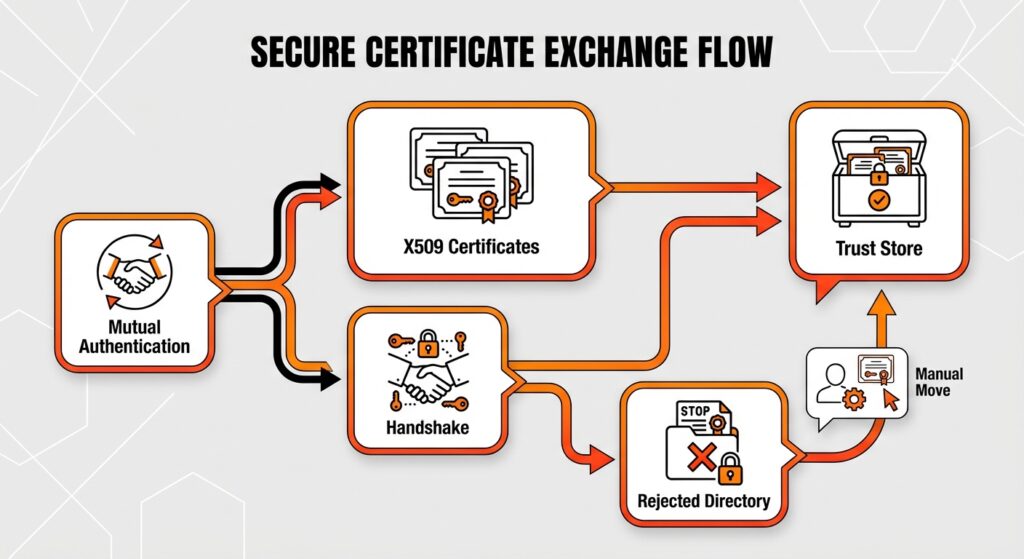
If the client’s certificate is not present in the server’s trust store, the system automatically rejects the connection request. Strict validation prevents unauthorized applications from accessing the network, making the network much safer. You should rely on this cryptographic exchange to eliminate the risks associated with weak or compromised passwords.
You must manage trust lists precisely to establish a valid connection. When a client attempts to connect for the first time, the server rejects the request because the client’s certificate is unknown. The server places this certificate into a “Rejected” directory. To authorize the connection, you must manually move the client certificate from the “Rejected” folder to the server’s “Trusted” directory. From what I have seen in the field, this is the most common stumbling block for new users. Crucially, this prevents unauthorized devices from joining the network automatically.
The process must be reciprocal; the client must also trust the server’s certificate to enable mutual authentication. To establish this trust, you must:
Once the certificates are swapped and trusted on both sides, the OPC UA client and server can initiate a secure session.
Configuring security policies defines the specific cryptographic algorithms used for signing and encrypting messages in OPC UA implementation. Configuring policies ensures data confidentiality and integrity during transmission between the OPC UA client and OPC UA server. Administrators select a security mode, typically choosing Sign to prove where the message came from or SignAndEncrypt to add point-to-point encryption.
For strong protection in industrial automation, the Basic256Sha256 policy is the recommended standard, as it uses advanced algorithms like AES-256 and SHA-256 to thwart brute-force attacks. Conversely, you should avoid deprecated options such as `Basic128Rsa15`, and the `None` security policy is disabled in production environments to prevent unencrypted access. The `Basic256Sha256` policy combined with the `SignAndEncrypt` mode offers the highest level of protection for IIoT data. The result is a secure integration layer that enforces strong authentication within the industrial internet of things.
User authentication is your second line of defense, verifying the identity of the human operator or software agent interacting with the OPC UA server. While application certificates secure the physical connection channel, user tokens determine specific permissions within the active session. OPC UA implementation supports three primary identity token types: Anonymous, Username/Password, and X.509 User Certificates.
Industrial automation systems typically disable Anonymous login in production to prevent unauthorized access, although it remains useful for initial testing. Username/Password tokens are standard for human operators requiring specific access rights. Certificate-based authentication provides the highest security for automated machine-to-machine communication, eliminating the risks associated with shared static passwords. To configure RBAC, you map these identity tokens to specific user roles defined within the server configuration. Mapping tokens restricts access to sensitive controls based on the user’s operational level rather than granting blanket permissions.
For instance, a system might allow ‘Anonymous’ users Data Access strictly for read-only monitoring of telemetry values. Conversely, a ‘Maintenance Engineer’ role authenticated via a high-security Certificate gets write permissions to adjust critical setpoints or execute RPC commands. Granular permissions ensure that authentication policies strictly limit high-risk operations to authorized personnel. By segregating duties, the secure integration layer protects the industrial internet of things ecosystem from accidental or malicious reconfiguration. Applying encryption and user verification at both the application and session levels hardens the entire system against intrusion.
Validating connectivity is the final step in OPC UA implementation before deploying the system into production. You need to confirm that the secure integration layer is active, information models are correctly mapped, and data acquisition capabilities function as intended. Rigorous testing of security configurations and connection protocols guarantees that the industrial IoT communication network remains secure against unauthorized access.
The initial connection verification begins by entering the endpoint URL into the OPC UA client and attempting a handshake. If you configured the layer correctly, the server will present its certificate for validation. The user must accept this certificate to proceed with authentication.
A successful handshake proves that the standard TCP port 4840 is open and that the firewall allows industrial IoT communication. If the connection fails, administrators should check network settings and ensure the OPC UA server service is running. You can’t establish a trusted channel without this step.
To test data acquisition, drag nodes from the address space into the client’s subscription view. The user verifies that the `Value` attribute matches the expected data from the PLC or sensor. To confirm machine-to-machine communication reliability, the user monitors the StatusCode of the variable; a code of `Good` indicates valid data.
Also, changing a value on the server side should immediately reflect in the client. Verifying real-time updates is essential for validating device management and operational integrity within the system.
Diagnostic tools allow integrators to visualize the server’s address space, test read/write permissions, and monitor connection health in real-time. Browsing nodes verifies that the information model structure aligns with the intended design specifications. You can use this inspection to ensure that address space mapping accurately reflects the physical assets within the industrial automation environment. Using the ‘Attributes’ view allows operators to inspect the specific Data Type and Access Level of a node.
For example, verifying that a setpoint is writable confirms correct Data Access configuration. Creating subscriptions tests data update rates and network latency. Monitoring these metrics validates that the OPC UA server delivers telemetry data efficiently for industrial IoT communication. A generic OPC UA client identifies configuration errors by reporting specific error codes during connection attempts. You can use these tools to find issues within the OPC UA implementation, such as mismatched security policies or Alarms and Conditions failures.
Connection failures in OPC UA implementation typically result from untrusted certificates, mismatched security policies, or network firewalls blocking the specific TCP port. The secure integration layer relies on strict certificate exchange, and any discrepancy triggers specific error codes. A BadCertificateUntrusted error indicates that the OPC UA client certificate resides in the “Rejected” folder on the OPC UA server. You need to manually move this certificate to the trusted store to enable authentication.
Errors like `BadSecurityChecksFailed` occur when encryption settings or security policies, such as Basic256Sha256, do not align between the endpoints. BadTimeout errors frequently signal network layer issues within industrial automation environments. These timeouts happen when firewalls block the standard TCP port 4840, stopping devices from connecting.
Another common cause is clock synchronization. Authentication fails if the system time on the client and server differs significantly, as X.509 certificates have precise validity periods. It is a simple oversight, but it happens more often than you might think. Ensuring time synchronization across the network eliminates this rejection cause. Diagnostic tools help you identify these specific codes, streamlining the troubleshooting process.
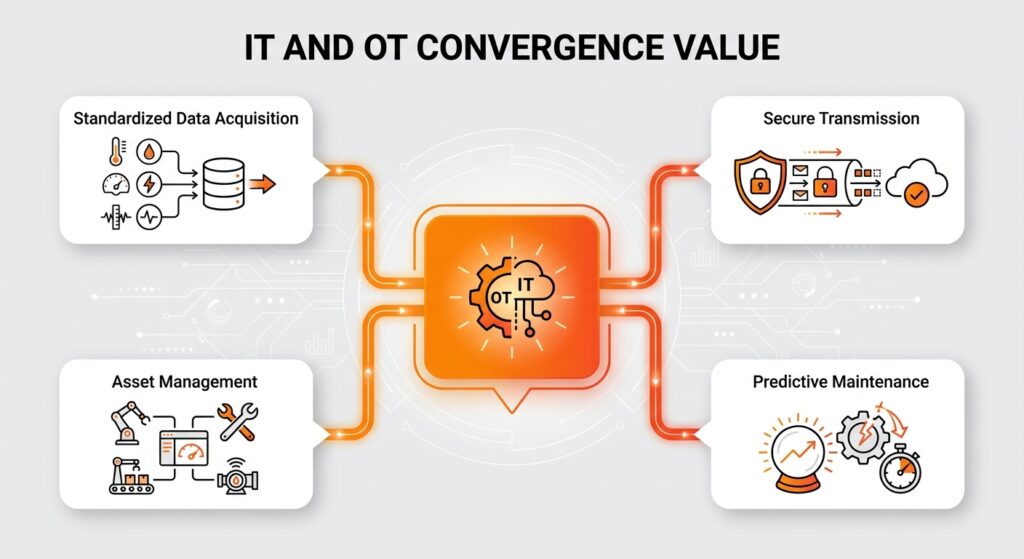
Integrating OPC UA servers with cloud platforms converts raw operational technology (OT) data into information technology (IT) compatible formats. Bridging the gap between industrial protocols and cloud APIs, the process enables Industry 4.0. OPC UA server integration preserves semantic data structures when transmitting to cloud-based analytics engines.
The architecture standardizes data acquisition, allowing industrial internet of things applications to consume complex machine data without requiring custom drivers. Convergence enables better asset management, where central systems monitor equipment health across geographically distributed sites. Secure transmission channels protect telemetry data as it moves from the local network to public or private cloud infrastructures.
OPC UA drives convergence by providing a vendor-neutral industrial IoT communication standard that both OT devices and IT applications understand. The protocol hides the complexity of physical hardware, presenting data as structured objects rather than raw memory addresses. This abstraction allows IT developers to interact with machine-to-machine communication data using familiar methods like REST or MQTT. Cloud integration becomes straightforward because the semantic context of the data remains intact during the transfer.
Using edge computing gateways is essential for buffering and optimizing data flow before it reaches the cloud. These devices connect to the OPC UA server, poll for high-frequency data, and aggregate it into manageable packets. Processing data locally reduces bandwidth usage and latency by filtering out noise and transmitting only significant changes or calculated averages. Edge gateways also act as a security boundary, isolating the critical industrial network from direct internet exposure while maintaining reliable telemetry streams.
Predictive maintenance strategies require sending aggregated production metrics to a centralized data lake for long-term analysis. The system collects high-resolution vibration or temperature readings via OPC UA server integration and uploads them using efficient protocols like MQTT. Cloud algorithms analyze this historical data to identify patterns that predict equipment failure before it occurs. By being proactive, you can minimize downtime and extend the lifespan of critical machinery within the industrial internet of things.
Bridging OPC UA to MQTT uses an edge computing gateway as a translation layer between the industrial automation network and the cloud. It uses an uplink data converter to transform the binary OPC UA data structures into lightweight JSON payloads suitable for cloud integration. Protocol conversion is essential because while OPC UA provides semantic context, MQTT offers the low-bandwidth efficiency required for large-scale telemetry. The process involves mapping specific OPC UA nodes to MQTT topics; for instance, an edge gateway reads a temperature value from an OPC UA server and publishes it to a topic like ‘factory/machine1/temp’.
The system converts complex nested objects into flat JSON formats to ensure compatibility, which industrial internet of things platforms can easily ingest. Conversely, a downlink data converter translates incoming JSON commands from the cloud back into OPC UA method calls to control local assets. Engineers frequently select MQTT as the transport layer for OPC UA data in the cloud because its publish-subscribe model decouples devices, allowing for scalable industrial IoT communication over unstable networks without maintaining persistent point-to-point connections.
OPC UA server integration connects shop floor industrial automation with top-floor management systems like MES and ERP. Connecting these layers enables the automated exchange of production orders, inventory data, and performance metrics, becoming a key part of Industry 4.0. Machine-to-machine communication facilitates bidirectional data flow; the ERP system sends production schedules and recipe parameters directly to the machine, while the machine returns execution status. You can use Historical Access Data for detailed reporting and regulatory compliance, allowing the MES to trace process variables over time.
Standardized information models ensure that these diverse systems interpret the data structure correctly. A practical example involves an ERP system reading the ‘FinishedCount’ variable directly from the OPC UA server to automatically update inventory levels without human intervention. Direct ERP integration improves production efficiency by eliminating manual data entry errors and providing real-time visibility into asset management. Successful OPC UA implementation unifies data acquisition across the entire manufacturing enterprise, improving your IIoT network.
Deploying an aggregation server becomes essential when industrial automation systems must consolidate data acquisition from multiple disparate sources into a single, unified namespace. You need this architecture when higher-level systems, such as SCADA, MES, or ERP, need to access data from numerous individual OPC UA server instances without managing hundreds of separate connections. Through namespace aggregation, the aggregation server acts as a centralized middleware that maps the address spaces of underlying devices into one logical view. Using an aggregator simplifies OPC UA server integration by providing OPC UA client applications with a single entry point, making the network much simpler.
Namespace aggregation simplifies large-scale architecture by decoupling the client applications from the physical field devices. For example, in a manufacturing facility with 50 individual PLCs, a SCADA system without aggregation would need to establish and maintain 50 separate encrypted sessions. By implementing an aggregation server, the SCADA system requires only 1 connection to the aggregator, which handles the underlying machine-to-machine communication with the 50 PLCs. Consolidating connections drastically reduces network traffic and CPU load by centralizing connection management and security handshakes. It ensures consistent address space mapping, allowing the industrial internet of things infrastructure to scale without requiring reconfiguration of the upper-level clients. Aggregation is a critical strategy for efficient OPC UA implementation in complex environments.
Time-Sensitive Networking (TSN) extends standard Ethernet capabilities to provide deterministic real-time data transmission required for critical industrial automation control loops. The Field Level Communications Initiative uses this capability to combine OPC UA with TSN, creating a solution that competes with proprietary fieldbuses. Together, they support the rigorous latency requirements of Industry 4.0 while maintaining standard Ethernet compatibility.
Time-sensitive networking uses mechanisms like time-aware shaping to reserve bandwidth for high-priority streams in mixed-traffic environments. Network switches identify critical machine-to-machine communication packets and pause lower-priority traffic, such as file transfers, to ensure immediate transmission. Precise scheduling guarantees bounded low latency and prevents network congestion from affecting control data. OPC UA implementation over TSN ensures reliable delivery even when IT and OT data coexist on the same physical wire.
Combining OPC UA and TSN offers a standardized, vendor-neutral alternative to legacy fieldbuses like PROFINET or EtherCAT. Proprietary systems require specific hardware, but this standard runs on standard Ethernet components, reducing infrastructure costs. It connects all your devices from the sensor to the cloud without protocol gateways. Field Level Communications Initiative standards ensure that devices from different vendors interact smoothly, eliminating vendor lock-in while matching the performance of traditional hard real-time systems.
Industrial automation applications, such as synchronized robot motion control, demand precise timing that standard Ethernet can’t provide. TSN synchronizes network clocks to within nanoseconds, enabling real-time data exchange for multi-axis coordination with millisecond-level cycle times. For example, 2 distinct robotic arms can coordinate complex assembly tasks perfectly over a single connection. With this capability, OPC UA can manage high-speed control tasks previously reserved for specialized hardware.
Hicron Software proved to be a trusted partner with unmatched technical expertise, delivering a scalable and user-friendly web application that was pivotal to our successful U.S. market expansion.

Hicron’s contributions have been vital in making our product ready for commercialization. Their commitment to excellence, innovative solutions, and flexible approach were key factors in our successful collaboration.
I wholeheartedly recommend Hicron to any organization seeking a strategic long-term partnership, reliable and skilled partner for their technological needs.

After carefully evaluating suppliers, we decided to try a new approach and start working with a near-shore software house. Cooperation with Hicron Software House was something different, and it turned out to be a great success that brought added value to our company.
With HICRON’s creative ideas and fresh perspective, we reached a new level of our core platform and achieved our business goals.
Many thanks for what you did so far; we are looking forward to more in future!

Hicron is a partner who has provided excellent software development services. Their talented software engineers have a strong focus on collaboration and quality. They have helped us in achieving our goals across our cloud platforms at a good pace, without compromising on the quality of our services. Our partnership is professional and solution-focused!

The IT system supporting the work of retail outlets is the foundation of our business. The ability to optimize and adapt it to the needs of all entities in the PSA Group is of strategic importance and we consider it a step into the future. This project is a huge challenge: not only for us in terms of organization, but also for our partners – including Hicron – in terms of adapting the system to the needs and business models of PSA. Cooperation with Hicron consultants, taking into account their competences in the field of programming and processes specific to the automotive sector, gave us many reasons to be satisfied.