11 DevOps Automation Tools to Streamline Your Workflow
- May 21
- 10 min

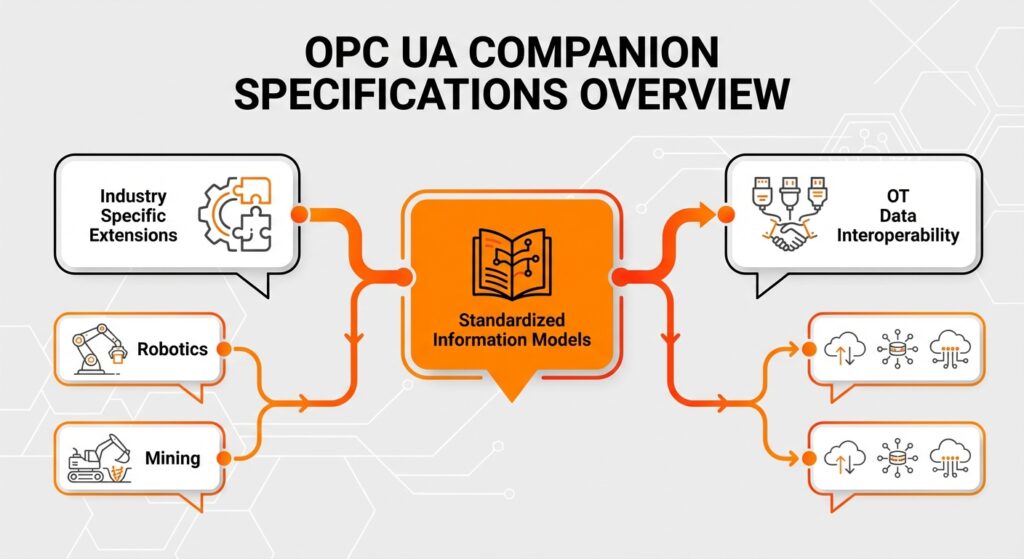
OPC UA Companion Specifications standardize information models that define data structures and interfaces for specific industries, devices, or use cases. These specifications act as industry-specific extensions of the base OPC UA framework. While the core OPC UA infrastructure provides a generic communication protocol, Companion Specifications solve specific industry challenges. They derive new models from the base OPC UA Data Model.
Such a distinction enables OT data interoperability across diverse manufacturing standards. Joint working groups develop these industry-standard models to connect general connectivity protocols with specific operational constraints. If you have ever struggled to get a robot to talk to a conveyor, you know exactly why this specificity matters.
Common sectors leveraging these specifications include:
These models are critical for implementing Industrie 4.0 architectures. They standardize how machines describe themselves. This alignment guarantees compliance with industrial automation standards.
| Category | Description & Key Data |
|
Core Definition |
|
|
Major Specifications |
|
|
Technical Architecture |
|
|
Interoperability Benefits |
|
|
Development & Access |
|
OPC UA information modeling provides a flexible meta-model architecture that allows engineers to digitally represent existing industry standards with full operational context. By mapping standard industrial concepts into specific OPC UA nodes, references, and data types, the framework creates a cohesive structure. By using an object-oriented approach to define relationships between these elements, the OPC UA infrastructure guarantees that data interchange conveys context alongside raw values.
Engineers create complex data types within the OPC UA information model to mirror real-world industrial assets and processes. Semantic relationships link these types to establish context, allowing systems to interpret data structures automatically. It supports the digitization of manufacturing standards, such as IEC 61131-3 for programmable logic controllers. Structuring data this way validates that the model aligns digital representations with established physical and operational norms.
The OPC UA information model uses object-oriented architecture to build reusable, modular data structures. This system relies on type definitions where complex data types inherit specific properties from established base types.
Physical assets rely on three core components:
Extending base types allows the OPC UA infrastructure to support custom models tailored to unique operational requirements while preserving interoperability. This hierarchy mandates that data interchange maintains rich context, as derived types automatically retain the characteristics and semantic relationships of their parent structures.
The address space organizes complex data structures by implementing the OPC UA information model into a hierarchical set of nodes. This environment reflects the physical or logical arrangement of assets, making objects and variables accessible to clients. Applications use the discovery service to browse this structure and identify supported capabilities, such as DataAccess or Alarms&Conditions. A nodeset file frequently defines this layout. This establishes the interface where the OPC UA infrastructure exposes data, transport settings, and security policies for runtime interaction.
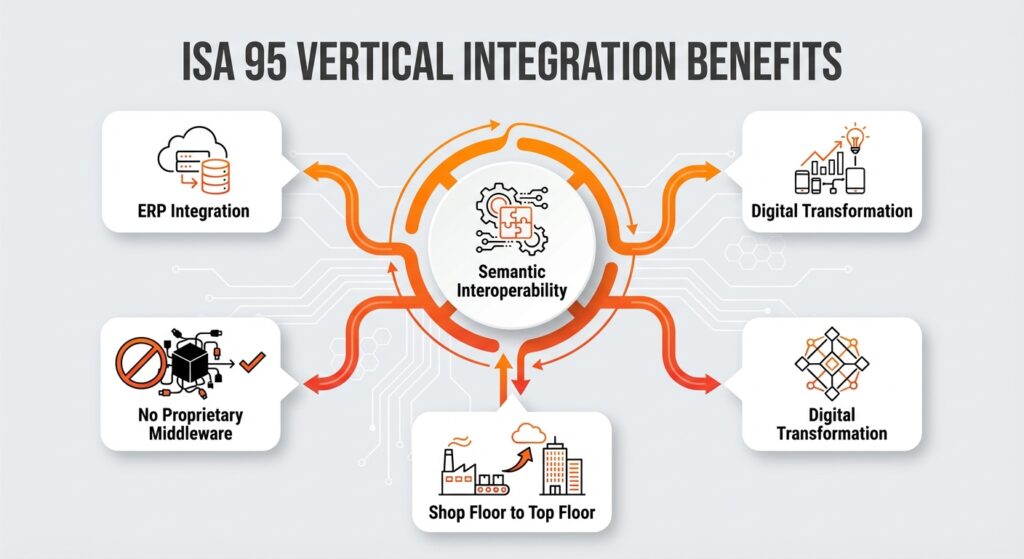
Officially designated as OPC 10030, the ISA-95 Companion Specification establishes a standardized interface for vertical integration between industrial control systems and enterprise-level platforms. By mapping the established ISA-95 standard directly to the OPC UA information model, the framework creates a unified structure for data exchange. Unifying Operational Technology (OT) and Information Technology (IT) relies on this mapping to enable the seamless movement of data from the shop floor to the top floor. In my experience, bridging this specific gap is often the biggest hurdle in digital transformation projects.
This integration drives OT data interoperability. Production data retains its context when transmitted to business applications because of this structure. The specification enables semantic interoperability. Consequently, Enterprise Resource Planning (ERP) systems can interpret complex plant floor data without requiring custom translation code. Manufacturing standards within this model define how systems exchange information regarding production capability, performance, and scheduling. This standardization is critical for IIO-T and Industrie 4.0 strategies, as it synchronizes physical processes with digital business objectives. Organizations can eliminate the need for proprietary middleware and reduce integration complexity by using OPC UA companion specifications for ISA-95.
The Common Object Model implements the OPC UA information model to define the objects and attributes necessary to represent the ISA-95 standard’s hierarchy. This structure uses object-oriented principles to map abstract entities into concrete OPC UA objects and variables. The model establishes semantic relationships between key resources, including personnel, equipment, and physical assets, to support reliable enterprise-control system integration.
Engineers define specific elements of the manufacturing environment, such as material handling and physical asset capabilities, using complex data types to ensure accuracy. This information modeling approach allows systems to exchange data at a high semantic level without losing context. A nodeset file typically distributes these standard definitions, which companies often extend to create custom implementations for specific facilities. Adherence to these manufacturing standards guarantees that the digital representation matches the physical reality of the plant floor.
ISA-95 standardizes data by providing a unified structure that removes the need for proprietary formats for MES/ERP integration. This framework ensures that data interchange between plant operations and business logistics follows a consistent model, removing the need for complex, custom translation layers.
To enhance OT data interoperability, the standard defines complex data types for:
The specification enables semantic interoperability. It verifies that data retains its context during transmission, often using standardized XML file structures or object models. Aligning information modeling with industrial automation standards creates a stable baseline for IIO-T implementations. Harmonizing these definitions allows organizations to achieve accurate and timely data flow across the enterprise.
Designated as the OPC 30050 standard, OMAC PackML enhances packaging machine interoperability by providing a unified information model for equipment from different vendors. This framework addresses the challenge of integrating diverse machinery by establishing a common language for control and status monitoring. The specification defines a standard set of machine states which mandates that every unit on a packaging line communicates its operational mode identically. Think of it as the difference between translating a dozen languages and everyone simply agreeing to speak English.
OMAC PackML harmonizes data structures. This harmonization permits supervisory systems to interpret information at a semantic level without requiring custom translation drivers for each manufacturer. This standardization significantly reduces integration time and engineering effort, as the data interchange format remains consistent across the entire plant floor. Engineers often deploy these packaging standards alongside the Weihenstephan Standards in the food and beverage industries to further refine data granularity. As one of the key OPC UA companion specifications, it aligns industrial automation standards with technical implementation. This alignment facilitates direct horizontal integration between fillers, cappers, and labelers.
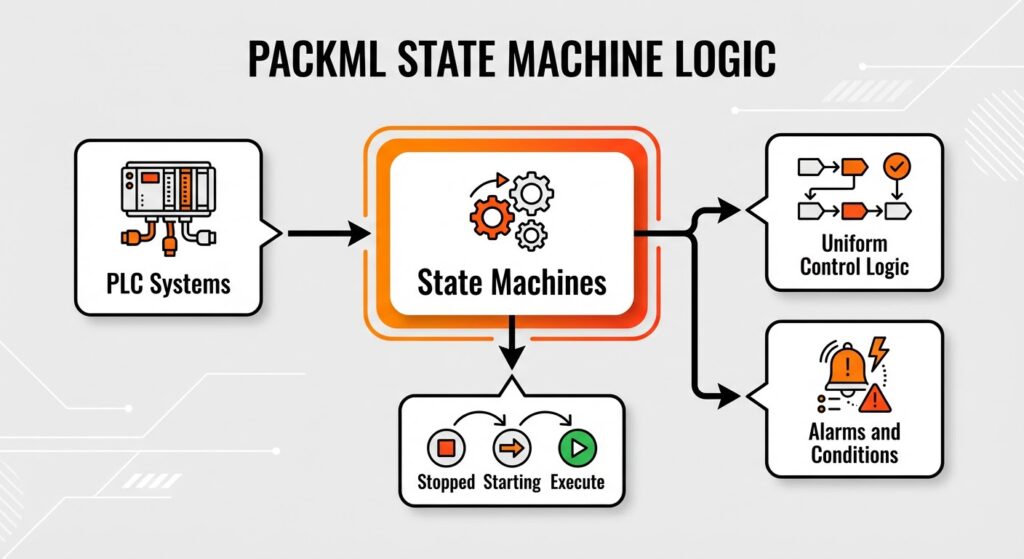
PackML uses state machines as the definitive logic model to standardize machine operations. This structured approach mandates that every piece of equipment reports its status in an identical, predictable manner, regardless of the manufacturer. The model relies on information modeling to represent complex functional logic and operational modes, such as Stopped, Starting, and Execute.
Defining how specific inputs trigger outputs based on the current state guarantees consistent behavior across different machine types. PLC systems use this structure to manage complex data types and synchronize actions according to IEC 61131-3 programming standards. This object-oriented design simplifies the integration of Alarms&Conditions, as the state machine dictates exactly when specific alerts should be active. This makes the control logic uniform, allowing supervisory systems to predict machine responses accurately.
PackML enforces a rigid tag structure, known as PackTags, which requires that equipment from different manufacturers presents an identical interface. This approach guarantees that a labeler from Vendor A and a filler from Vendor B transmit status information using the same industry standard models. The specification decouples the data structure from the underlying PLC hardware by using a shared semantic model.
This standardization simplifies the aggregation of metrics for Overall Equipment Effectiveness (OEE) calculations and line-level monitoring. This achieves OT data interoperability because the data interchange occurs at a semantic level, meaning the line controller understands the context of the data immediately. OMAC PackML bridges the gap between diverse manufacturing standards, allowing discovery services to identify and map semantic relationships automatically without custom code.
Companion Specifications achieve semantic interoperability. They embed the context and definition of data directly into the exchange mechanism, so receiving systems understand the information without manual intervention. Unlike basic syntactic interoperability, which only ensures successful data interchange or the movement of bytes, semantic interoperability ensures that the meaning of that data is preserved across systems.
OPC UA companion specifications enable this through the use of industry standard models that serve as a universal translator for diverse industrial assets. Through rigorous information modeling, these specifications define semantic relationships between objects, such as linking a temperature variable to its engineering unit and sensor metadata. This approach locks in OT data interoperability at a high semantic level, allowing applications to interpret data structures automatically. Such capabilities are essential for Industrie 4.0, as they enable machines to communicate complex concepts rather than just raw values. Harmonization efforts further align these models, ensuring that the infrastructure supports global consistency in how devices describe themselves.
Nodeset files are standardized XML files containing the machine-readable definitions of an information modeling structure. These files function as the primary deployment mechanism for OPC UA companion specifications. This enables the digital transfer of standardized models into actual software. The configuration of a server’s address space relies on these files to create the necessary object types, variables, and references automatically.
Developers use a developer tool to import a standardized nodeset file, which then generates the necessary source code or binary configuration for the OPC UA SDK. This process confirms that the server correctly supports specific transport profiles and discovery services without manual coding of every node. Trust me, avoiding manual coding here saves countless hours of debugging later on. Loading these files allows systems to validate the structure against the specification, validating that the deployed model aligns perfectly with the industry standard.
The OPC UA Cloud Library functions as a centralized cloud service and global repository where users and applications can browse, search, and retrieve standardized information modeling definitions. This platform enhances interoperability by providing a single source of truth for OPC UA companion specifications and proprietary models.
System integrators benefit primarily from the ability to access industry standard models instantly, eliminating the need for manual file management or searching scattered vendor websites. The library stores the essential nodeset file for each specification, allowing IIO-T applications to download and load these definitions dynamically at runtime. This capability supports on-demand system configuration, where a client application uses discovery mechanisms to query the library and automatically retrieve the correct model. The Cloud Library acts as a universal database, ensuring that all connected devices use the most current and accurate data structures for continuous communication.
Joint Working Groups (JWGs) are collaborative bodies where experts from the OPC Foundation partner with external industry organizations to develop specialized data models. The primary objective of these groups is to create OPC UA companion specifications that accurately reflect the specific technical requirements and manufacturing standards of a given sector. This collaboration method guarantees that the resulting industry standard models benefit from both the modeling expertise of OPC architects and the domain knowledge of subject matter experts.
Harmonization functions as a strategic priority within this process, aimed at aligning industrial automation standards to prevent market fragmentation and overlapping definitions. The foundation forms specific groups to address unique verticals, such as the collaboration with MTConnect for machine tools or the plastics industry to standardize machine-to-machine communication. Governance structures within JWGs mandate that the industry globally accepts the final specification as the definitive standard for that industry. These groups unite IT capabilities with OT operational realities by integrating diverse perspectives.
Hicron Software proved to be a trusted partner with unmatched technical expertise, delivering a scalable and user-friendly web application that was pivotal to our successful U.S. market expansion.
Hicron’s contributions have been vital in making our product ready for commercialization. Their commitment to excellence, innovative solutions, and flexible approach were key factors in our successful collaboration.
I wholeheartedly recommend Hicron to any organization seeking a strategic long-term partnership, reliable and skilled partner for their technological needs.

After carefully evaluating suppliers, we decided to try a new approach and start working with a near-shore software house. Cooperation with Hicron Software House was something different, and it turned out to be a great success that brought added value to our company.
With HICRON’s creative ideas and fresh perspective, we reached a new level of our core platform and achieved our business goals.
Many thanks for what you did so far; we are looking forward to more in future!

Hicron is a partner who has provided excellent software development services. Their talented software engineers have a strong focus on collaboration and quality. They have helped us in achieving our goals across our cloud platforms at a good pace, without compromising on the quality of our services. Our partnership is professional and solution-focused!

The IT system supporting the work of retail outlets is the foundation of our business. The ability to optimize and adapt it to the needs of all entities in the PSA Group is of strategic importance and we consider it a step into the future. This project is a huge challenge: not only for us in terms of organization, but also for our partners – including Hicron – in terms of adapting the system to the needs and business models of PSA. Cooperation with Hicron consultants, taking into account their competences in the field of programming and processes specific to the automotive sector, gave us many reasons to be satisfied.