Industry 4.0 in Europe: AI in the service of UX
- October 04
- 9 min

Industrial communication in Industry 4.0 shifts from isolated, proprietary fieldbus systems to interconnected, IP-based networks. Blending Information Technology (IT) and Operational Technology (OT) enables direct data exchange across the entire value chain. As traditional hierarchical automation pyramids evolve into decentralized, mesh-like network topology structures, these architectures support direct machine-to-machine communication and advanced interoperability between devices from different manufacturers.
Protocols now enable complex, real-time data exchange and integrity, moving beyond simple control loops. Industry 4.0 uses Industrial IoT technologies and reliable automation standards to connect sensors, controllers, and enterprise systems. Industrial Ethernet and modern IIoT protocols form the backbone for this connectivity. The industry is moving toward open standards that support both vertical integration to the cloud and horizontal integration across the factory floor.
|
Protocol |
Architecture & Pattern |
Key Features & Performance |
Primary Use Case |
|
OPC UA |
Request-response (Client/Server); Service-oriented over TCP/IP |
|
Direct machine-to-machine (M2M) communication requiring complex data relationships and platform independence. |
|
MQTT |
Publish-subscribe; Central broker architecture |
|
Low-bandwidth IIoT applications, remote asset monitoring (pipelines, wind farms), and machine-to-cloud integration. |
|
PROFINET |
Industrial Ethernet; Scheduled time-slot mechanism |
|
Applications requiring precise synchronization and deterministic performance, such as complex automation topologies. |
|
EtherCAT |
“Processing on the fly” Ethernet |
|
High-speed multi-axis motion control and robotics where every microsecond matters. |
|
EtherNet/IP |
Common Industrial Protocol (CIP) over standard Ethernet |
|
Integrating manufacturing with standard IT infrastructure; dominant in North American markets (Rockwell ecosystem). |
|
Modbus TCP |
Ethernet-based extension of Modbus RTU |
|
Retrofitting legacy equipment, building automation, and general-purpose connectivity where strict real-time sync is not required. |
OPC UA and MQTT differ fundamentally in their architectural design and intended application environments. These IIoT protocols use different methods—request-response versus publish-subscribe—to address specific connectivity needs within Operational Technology (OT) and Information Technology (IT). Data handling approaches further separate them, with Industry 4.0 suitability ratings reflecting their specialized roles in the manufacturing ecosystem.
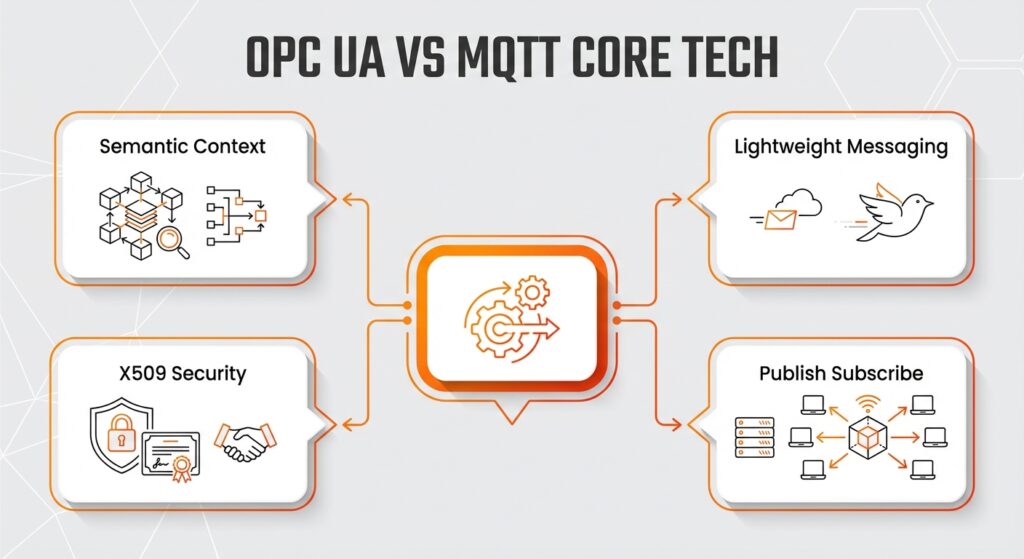
OPC UA uses a detailed information model that assigns semantic context to data. Detailed data modeling enables programmable logic controllers and SCADA systems to interpret complex data relationships without manual mapping. Semantic modeling is critical for automation standards, ensuring reliable interoperability across diverse manufacturing equipment. It uses a service-oriented architecture over TCP/IP to ensure complete platform independence. Service-oriented architecture over TCP/IP ensures complete platform independence, improving upon the platform dependence weaknesses of COM/DCOM-based OPC Classic specifications. Systems function reliably across various operating systems, helping flexible machine-to-machine communication. This capability essentially future-proofs your integration strategy by ensuring cross-vendor compatibility.
OPC UA secures data through protocol-level encryption, authentication, and session management. X.509 certificates and message signing guarantee data integrity and protect against unauthorized access. These built-in features address modern Industry 4.0 cybersecurity requirements, distinguishing OPC UA from older standards. Industry analysis rates OPC UA at 95/100 for Industry 4.0 applications, making it a top choice for direct machine-to-machine communication where low latency is critical.
MQTT operates as a lightweight messaging protocol designed specifically for environments with limited bandwidth and high latency. It uses a publish-subscribe pattern that decouples devices, significantly reducing network traffic compared to request-response models. Functioning much like a digital distribution center, the broker decouples publishers from subscribers, ensuring data reaches only interested nodes without direct point-to-point links. Packet headers as small as 2 bytes make MQTT a lightweight messaging alternative to AMQP for Industrial IoT. Remote assets relying on expensive or unstable cellular and satellite connections benefit from this minimal overhead, which keeps data costs low. From what I’ve seen in the field, this is a game-changer for monitoring remote pipelines or wind farms. Persistent sessions maintain virtual connections over TCP/IP even when physical links are intermittent.
Three Quality of Service (QoS) levels manage data transmission reliability in environments prone to packet loss:
The central broker architecture simplifies the network topology by handling message routing between thousands of clients efficiently. These features make MQTT a strong candidate among IIoT protocols for constrained machine-to-machine communication scenarios. With a score of 92/100 in recent suitability benchmarks for IIoT technology, it is superior for machine-to-cloud communication where network bandwidth is limited.
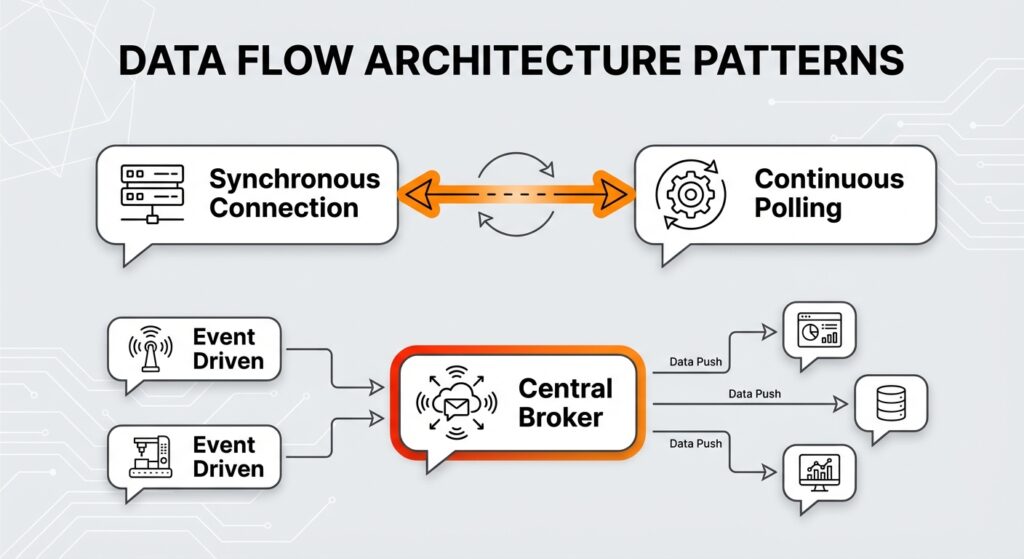
The request-response pattern establishes a synchronous connection where a client requests specific data and a server replies. Because this architecture requires continuous polling to monitor state changes, it creates a strong link between endpoints. Protocols like Modbus and the default OPC UA Client/Server mode use this model to guarantee message delivery and immediate confirmation. While this direct interaction suits applications requiring strict control loops, it generates substantial network traffic as the number of nodes increases.
Conversely, the publish-subscribe pattern decouples senders and receivers by using a central broker to manage message distribution. Publishers transmit data only when events occur, and the broker routes information to all active subscribers. MQTT employs this event-driven approach to enable scalable real-time data exchange without permanent point-to-point links. Event-driven architecture simplifies the network topology, removing the need for clients to know the identity or location of data sources. The publish-subscribe pattern is more efficient for large-scale sensor networks than request-response mechanisms. It conserves bandwidth by eliminating the overhead associated with repetitive polling cycles for static values. Reducing unnecessary traffic lowers system latency, optimizing performance for constrained machine-to-machine communication. Data indicates that publish-subscribe architectures support thousands of concurrent connections more effectively than synchronous polling models.
Industrial Ethernet is increasingly replacing traditional Fieldbus protocols in modern factory installations to support higher bandwidth and vertical integration. While all major variants use standard Ethernet hardware, such as cables and switches, they differ significantly in their application layers and real-time mechanisms. There are two primary categories based on how they handle the OSI model, trading off speed for ease of setup.
PROFINET guarantees data arrives on time through a scheduled time-slot mechanism that prioritizes critical control data over standard TCP/IP traffic. By dividing network bandwidth into dedicated channels, the protocol prevents non-real-time packets from delaying urgent signals. Automation standards rely on this method to maintain precise synchronization across complex Industrial Ethernet topologies without requiring separate physical networks.
The protocol distinguishes between PROFINET RT and PROFINET IRT to address varying latency requirements:
IRT reserves a specific time window exclusively for real-time data exchange, guaranteeing cycle times under 1 ms with jitter less than 1 µs. Separating traffic allows programmable logic controllers to execute fast, synchronized operations while simultaneously transmitting diagnostic data via standard channels.
EtherNet/IP has achieved widespread adoption largely because it implements the Common Industrial Protocol (CIP) over standard, unmodified Ethernet hardware. This architecture allows the protocol to operate over standard IEEE 802.3 physical and data link layers without requiring specialized ASICs. By using standard TCP/IP stacks to encapsulate CIP messages, EtherNet/IP integrates tightly with standard IT infrastructure, including commercial switches, routers, and wireless devices.
CIP provides a unified object-oriented framework that supports both real-time control (Implicit) and information exchange (Explicit). Dual functionality allows programmable logic controllers to manage motion control and data collection simultaneously on a single network topology. EtherNet/IP maintains a dominant market share in North America, supported heavily by the Rockwell Automation ecosystem. Such compatibility highlights its advantage in interoperability, as it makes it easier to connect devices to enterprise systems ensuring data integrity.
EtherCAT distinguishes itself through a “processing on the fly” method where slave devices read and write data to a passing frame without stopping it. EtherCAT operates like a moving train where passengers (data) board and disembark instantly, eliminating the need to stop at every station (switch). Processing on the fly differs fundamentally from the store-and-forward switching used in standard Industrial Ethernet networks, which requires receiving full packets before forwarding. Eliminating switch delays minimizes latency to just a few nanoseconds per node, maximizing bandwidth usage and making it ideal for high-speed multi-axis motion control. I’ve found this approach particularly effective in robotics where every microsecond of delay matters.
EtherCAT optimizes standard IEEE 802.3 Ethernet frames to ensure precise synchronization across connected programmable logic controllers and drives. Automation standards use this deterministic communication to achieve real-time data exchange with cycle times frequently under 100 µs. Deterministic communication supports the strict timing required for complex machine-to-machine communication.
Modbus TCP remains a viable and widely used solution for industrial automation systems despite lacking the advanced security features and real-time determinism of modern alternatives. This protocol functions as an Ethernet-based extension of Modbus RTU, encapsulating standard serial frames within TCP/IP packets. Its primary strength lies in universal vendor support and ease of implementation, making it the “lingua franca” for connecting disparate devices. Automation standards continue to include Modbus TCP because it requires minimal processing power and operates over standard network infrastructure without specialized hardware. Engineers prefer Modbus TCP over complex protocols like OPC UA in scenarios where simplicity and cost-effectiveness outweigh advanced features. Building automation, energy monitoring, and basic sensor data collection use this standard effectively. These use cases typically involve latency requirements in the range of 100 milliseconds rather than microseconds, making the non-deterministic nature of standard TCP/IP acceptable. Don’t underestimate the staying power of a protocol that just works.
Modbus TCP remains superior for retrofitting legacy status equipment into modern networks. The protocol enables simple communication between Programmable Logic Controllers (PLCs) and SCADA systems. It allows for the rapid integration of simple field devices like temperature controllers or power meters that don’t have the computational resources to run an OPC UA server. While it does not support the high bandwidth or complex semantic modeling of newer Industrial Ethernet standards, it excels at moving unstructured data reliably. Users must implement external security measures, such as VPNs or firewalls, to ensure data integrity, as the protocol transmits data in clear text. This makes Modbus TCP a pragmatic choice for general-purpose connectivity where strict real-time synchronization is not required.
Selecting the right industrial protocol requires a complete review of technical requirements, environmental constraints, and future scalability needs. Key criteria include:
Effective evaluation prioritizes the ability to secure data integrity while maintaining smooth interoperability between operational technology and enterprise cloud systems.
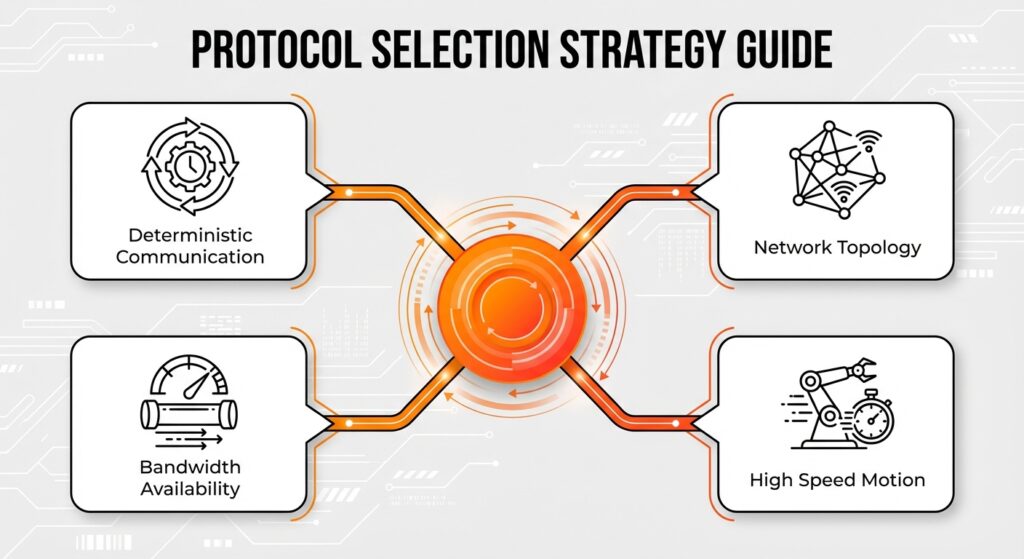
Protocol selection involves a critical trade-off between transmission speed and data volume. High-speed motion control demands ultra-low latency, requiring cycle times under 1 millisecond to maintain production precision. Deterministic communication ensures that cyclic data, such as IO signals, transmits with minimal and predictable delay to synchronize complex machinery. On the other hand, data-intensive IIoT analytics prioritize high bandwidth over immediate response times. Applications transmitting acyclic data, including video streams or large diagnostic files, require throughput exceeding 100 Mbps. Benchmarks show that Industrial Ethernet handles this data significantly better than legacy serial fieldbuses.
Network topology further impacts these performance factors. Machine-to-machine communication in a daisy-chain line topology may increase latency compared to switched star networks. Automation standards guide engineers to select protocols like EtherCAT for sub-millisecond speed or MQTT for bandwidth-efficient reporting, ensuring the infrastructure matches specific operational needs.
Deterministic communication ensures that control commands arrive at their destination within a strictly predictable timeframe, a requirement known as hard real-time. Unlike standard TCP/IP, which functions on a “best effort” basis, safety-critical applications demand absolute certainty that data will arrive exactly when expected. Automation standards define the variation in this packet arrival time as jitter. Excessive jitter disrupts the synchronization between programmable logic controllers and servo drives, destabilizing the control loop.
If a motion control system relies on a network that lacks determinism, the coordination between axes fails. This loss of synchronization causes mechanical vibration, erratic movements, and potential damage to the machine or product. Industrial Ethernet protocols like EtherCAT and PROFINET IRT prevent this by minimizing latency and guaranteeing cycle times in the microsecond range. The ability to eliminate jitter is a key measure for high-speed machine-to-machine communication and real-time data exchange.
Interoperability reduces integration costs and prevents vendor lock-in within complex manufacturing environments. It enables devices from different manufacturers to communicate effectively using standardized profiles and consistent data formats. Open standards organizations, including ODVA, PI (PROFIBUS & PROFINET International), and the OPC Foundation, establish these specifications to ensure universal connectivity. OPC UA and the Common Industrial Protocol (CIP) have become the benchmarks for supporting this multi-vendor compatibility. Standardized device profiles allow easier system integration by defining consistent data objects and behaviors for specific equipment types. For example, they define structures for variable frequency drives or temperature sensors. This pre-defined structure allows programmable logic controllers and SCADA systems to interpret data from diverse hardware without requiring custom driver development or manual mapping. True Industry 4.0 implementations rely on this capability to maintain flexible machine-to-machine communication.
But proprietary extensions often block real compatibility. Manufacturers sometimes introduce non-standard features that disrupt universal connectivity, effectively forcing users back into a single-vendor ecosystem. Adherence to strict automation standards ensures that the network remains open and scalable across the entire value chain.
OPC UA and MQTT work well together within modern Industry 4.0 architectures rather than competing alternatives. Engineers increasingly deploy hybrid solutions to get the best out of both IIoT protocols to achieve full vertical integration. The “Unified Namespace” concept serves as the architectural foundation for this coexistence, ensuring tight interoperability between Operational Technology (OT) and Information Technology (IT) systems.
Sparkplug transforms standard MQTT from a raw messaging transport into a context-aware IIoT standard by defining a strict specification for data structure and state management. Standard MQTT payloads don’t care about the data format, meaning the broker and subscribers receive binary blobs without inherent definition. MQTT Sparkplug solves this by enforcing a standard topic namespace and a Google Protobuf payload schema. With this structure, data integrity is ensured and devices can communicate complex object models without manual mapping.
The specification manages device state through “Birth” and “Death” certificates. A Birth certificate publishes the complete list of metrics, data types, and current values immediately when a device connects. Publishing the complete list of metrics establishes a session-aware environment essential for SCADA and Industrial IoT applications. If a connection fails, the broker issues a Death certificate using the Last Will and Testament feature to notify all subscribers. These features provide the interoperability and semantic context required for automation standards while maintaining the low bandwidth and latency benefits of the underlying protocol.
MQTT is the superior choice for cloud integration within Industrial IoT architectures due to its efficient network topology and security model. It employs a client-initiated, outbound-only connection over TCP/IP, which eliminates the need to open inbound firewall ports. Push-based connections make security setup easier. Other IIoT protocols often require complex VPNs or exposed ports for external access.
The publish-subscribe pattern allows systems to grow easily, allowing a single cloud broker to handle data ingestion from thousands of remote devices simultaneously. MQTT minimizes bandwidth usage through small packet headers and binary payloads, optimizing performance for large-scale data collection where latency and data costs are critical factors. It has become the de-facto standard for machine-to-machine communication extending beyond the factory floor to enterprise cloud platforms.
Integrating legacy fieldbus systems into modern IIoT architectures relies on upgrading existing systems rather than costly “rip-and-replace” projects. Established industries continue to rely on proven serial protocols like PROFIBUS and CAN bus for mission-critical control loops due to their proven reliability. Fieldbus maintains a significant installed base and is expected to coexist with Industrial Ethernet for the foreseeable future.
Migrating from PROFIBUS to PROFINET mainly requires a complete rebuild of the physical layer infrastructure. The transition requires replacing the legacy RS485 serial cabling, typically recognized as purple two-wire shielded cables, with standard Industrial Ethernet hardware. If you have ever dealt with grounding issues on RS485 networks, you will welcome this change. This upgrade involves installing Cat5e or higher copper cables, fiber optics, and active network switches to support the significantly higher bandwidth and lower latency of the new protocol. The network topology shifts from a strict linear bus structure to a more flexible star, tree, or ring configuration, which impacts installation planning and control cabinet design.
Beyond physical connections, the logical configuration within programmable logic controllers demands specific updates. Engineers replace legacy GSD files with XML-based GSDML files to define device parameters correctly in the engineering software. This step often involves remapping I/O addresses and modifying control logic to accommodate the larger data packets of Ethernet frames. Despite these hurdles, automation standards help this transition through the use of proxies. These devices allow existing Fieldbus segments to integrate seamlessly into the new infrastructure, enabling a phased migration rather than a complete system replacement. Field experience confirms that while the initial effort is substantial, the resulting architecture supports advanced diagnostics and IT convergence.
Industrial gateways function as critical translators that connect legacy Fieldbus systems and modern Industrial Ethernet networks. These devices encapsulate serial data, such as Modbus RTU, into TCP/IP packets like Modbus TCP to enable direct machine-to-machine communication, allowing SCADA systems and IIoT platforms to access data from older serial assets without requiring a complete hardware overhaul.
Protocol converters ensure data integrity during this translation by validating Cyclic Redundancy Checks (CRC) on the serial side before mapping values to Ethernet registers. Advanced edge gateways further optimize the network topology by performing local data processing and filtering before transmission. By adhering to automation standards, these gateways support interoperability, ensuring that legacy infrastructure integrates effectively into high-speed, IP-based environments.
Hicron Software proved to be a trusted partner with unmatched technical expertise, delivering a scalable and user-friendly web application that was pivotal to our successful U.S. market expansion.

Hicron’s contributions have been vital in making our product ready for commercialization. Their commitment to excellence, innovative solutions, and flexible approach were key factors in our successful collaboration.
I wholeheartedly recommend Hicron to any organization seeking a strategic long-term partnership, reliable and skilled partner for their technological needs.

After carefully evaluating suppliers, we decided to try a new approach and start working with a near-shore software house. Cooperation with Hicron Software House was something different, and it turned out to be a great success that brought added value to our company.
With HICRON’s creative ideas and fresh perspective, we reached a new level of our core platform and achieved our business goals.
Many thanks for what you did so far; we are looking forward to more in future!

Hicron is a partner who has provided excellent software development services. Their talented software engineers have a strong focus on collaboration and quality. They have helped us in achieving our goals across our cloud platforms at a good pace, without compromising on the quality of our services. Our partnership is professional and solution-focused!

The IT system supporting the work of retail outlets is the foundation of our business. The ability to optimize and adapt it to the needs of all entities in the PSA Group is of strategic importance and we consider it a step into the future. This project is a huge challenge: not only for us in terms of organization, but also for our partners – including Hicron – in terms of adapting the system to the needs and business models of PSA. Cooperation with Hicron consultants, taking into account their competences in the field of programming and processes specific to the automotive sector, gave us many reasons to be satisfied.