Business Cybersecurity: Key Focus To Protect Your Company
- January 26
- 6 min

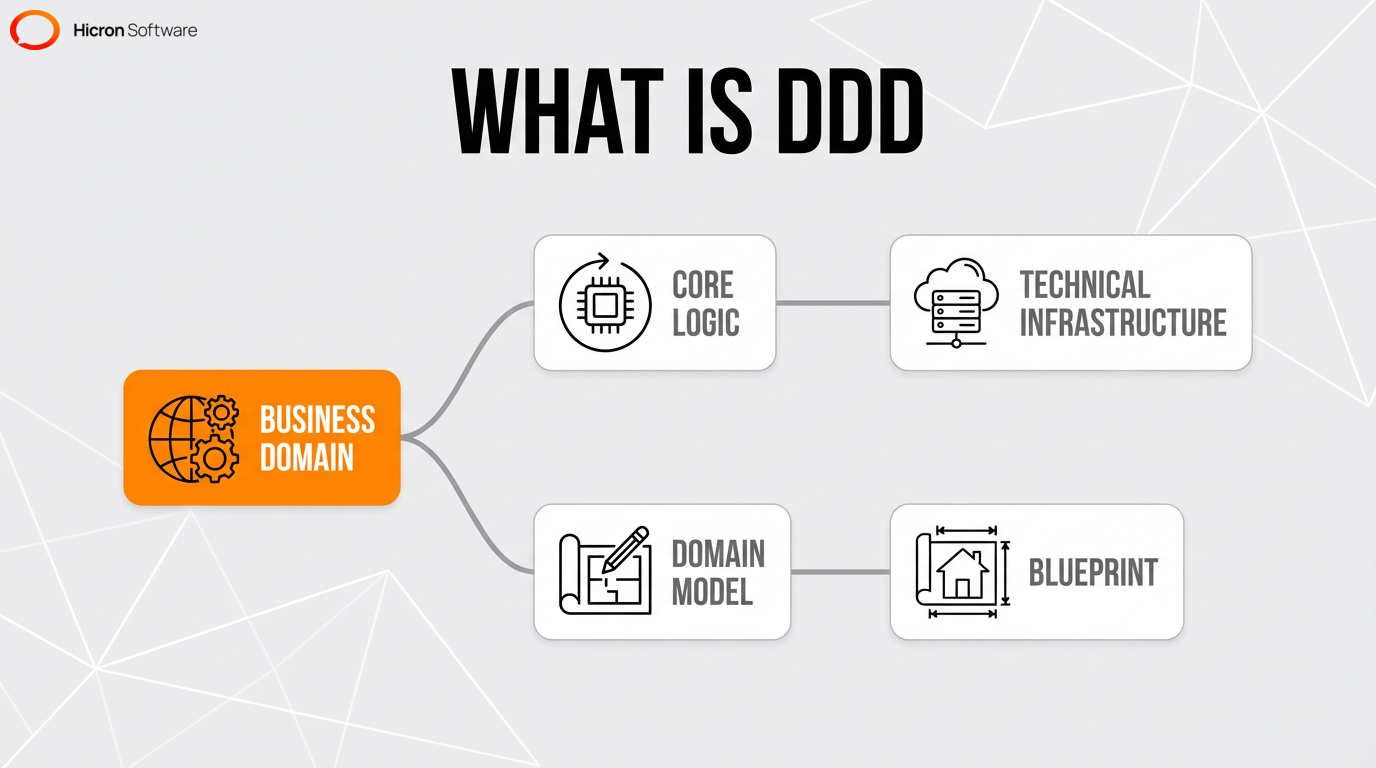
Domain-Driven Design (DDD) is a software development philosophy that models applications to match a specific business domain, prioritizing the core domain and its logic over technical infrastructure. This approach bridges the communication gap between technical teams—like developers and architects—and business experts, such as product owners. If you’ve ever felt the frustration of maintaining messy enterprise code, aligning your code structure with actual business logic is the key to improving long-term clarity and maintainability.
|
DDD Concept |
Design Phase |
Definition & Key Characteristics |
|
Domain Model |
Foundational |
A blueprint of a specific business problem that turns real-world business rules into structured software components, implemented directly into code. |
|
Ubiquitous Language |
Foundational |
A shared, consistent vocabulary used by domain experts and developers to eliminate communication disconnects across:
|
|
Bounded Context |
Strategic Design |
A logical boundary managing complexity by isolating distinct subdomains, ensuring a specific domain model and ubiquitous language remain strictly applicable. |
|
Anti-Corruption Layer |
Strategic Design |
A translation barrier used during context mapping to protect a core domain model from external system pollution and outdated legacy infrastructure. |
|
Shared Kernel |
Strategic Design |
A specific subset of the domain model that multiple teams explicitly agree to share, creating a deliberate functional dependency between bounded contexts. |
|
Entities & Value Objects |
Tactical Design |
|
|
Aggregate Root |
Tactical Design |
A specific entity acting as the sole gateway for external objects to interact with a cluster of associated domain objects, maintaining strict data consistency. |
|
Repositories & Factories |
Tactical Design |
|
|
Domain & Application Services |
Tactical Design |
|
|
Domain Events |
Architecture |
Records of significant milestones within the business domain used to decouple components, communicate state changes asynchronously, and enable independent scaling. |
|
Ideal Use Case |
Strategy |
Highly effective for complex, evolving business logic and microservices architecture. Should be avoided for simple CRUD applications due to high structural overhead. |
A domain model is the heart of Domain-Driven Design. It acts as a blueprint of a specific business problem. Developers and domain experts work together to continuously refine this blueprint, turning real-world business rules into structured software components.
Teams implement the domain model directly into code to ensure the software’s behavior perfectly mirrors the business’s real-world operations. By encapsulating this logic, teams keep it safe from the technical infrastructure, preventing unintended changes during system modifications.
Ubiquitous language is a shared, consistent vocabulary that domain experts and developers use to eliminate communication disconnects, preventing translation errors between business and IT, such as misinterpreting statuses or confusing data fields. I’ve seen firsthand how a simple misunderstanding over a single word can derail an entire sprint. To maintain consistency, teams must use this shared vocabulary everywhere:
This vocabulary ensures the software accurately reflects real-world business processes.
When developers use exact business terms—like order fulfillment or payment routing—in their code, they embed the actual business logic into the application. To prevent confusion, teams strictly apply this terminology within a specific bounded context, ensuring that words with multiple meanings across an organization don’t collide.
Domain experts shape the ubiquitous vocabulary by sharing how the business actually works on the ground. As they collaborate with technical teams, they refine the conceptual model, aligning the language with actual operations instead of technical jargon. For example, a banking expert defines an ‘Overdraft’ using strict business rules rather than generic database structures.
Strategic design is the high-level architectural phase of Domain-Driven Design that focuses on organizing large-scale systems and defining relationships between models. This phase helps teams identify the core domain so they can prioritize resources on the most critical business logic. Architects structure large-scale systems by establishing clear boundaries to prevent separate business areas from interfering with one another.
Strategic design allows a large enterprise to break down a monolithic system into manageable subdomains. Dividing the application ensures development teams allocate their efforts toward the most valuable business components while isolating generic functions. To draw these boundaries, teams rely on a few specific patterns.
Think of a bounded context like a specific department in a large company, where everyone speaks the exact same internal language. Technically, a bounded context is a logical boundary where a specific domain model and its ubiquitous language remain strictly applicable. This boundary manages complexity in large software systems by isolating distinct subdomains—such as logistics and finance—to prevent model ambiguity. Strategic tools like context maps ensure these precise definitions.
A single term can hold 2 distinct meanings depending on its bounded context. For example, the term ‘Customer’ designates a shipping destination in a Logistics context, but it’s a billing profile in an Accounting context.
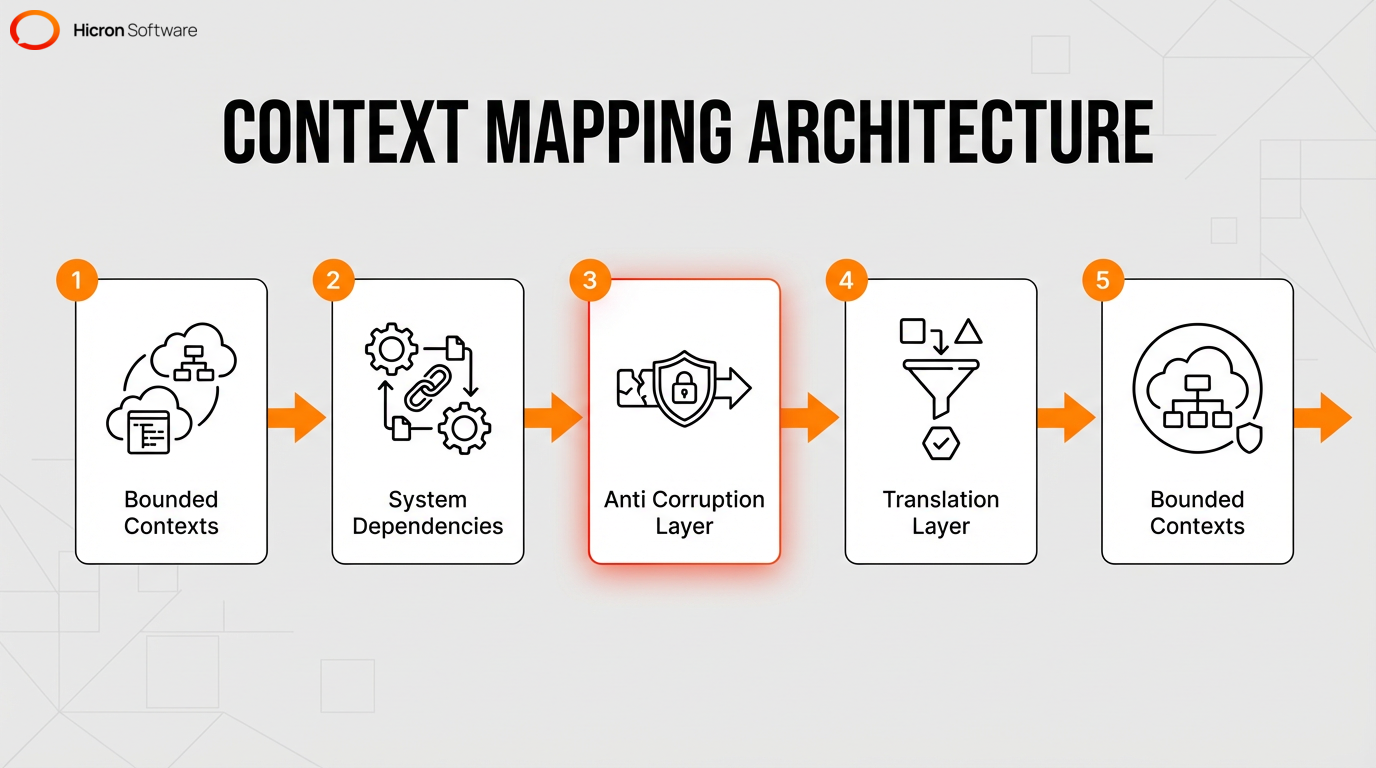
Teams use context mapping as a visual map to define data interactions and relationships between different bounded contexts. This technique illustrates how distinct models integrate across a distributed system.
Mapping these contexts helps teams by:
For example, an upstream E-commerce context might feed data directly to a downstream Inventory context.
I always share this pro-tip with new architects. Teams use an anti-corruption layer during context mapping to protect a core domain model from external system pollution. This barrier acts as a translation layer between a clean bounded context and an outside system, ensuring the internal domain model remains pure and aligned with its ubiquitous language. Proper encapsulation isolates modern business logic from outdated external concepts, preventing terminology collisions when an organization relies on older infrastructure.
For example, if a company uses a 20-year-old legacy database, the anti-corruption layer translates outdated schemas from that database into modern domain objects.
When multiple bounded contexts must rely on the same model, teams establish a shared kernel—a specific subset of the domain model that two or more teams explicitly agree to share, creating a deliberate functional dependency. This creates a shared bridge between two otherwise separate areas during context mapping.
Because modifications to this shared code affect multiple systems simultaneously, maintaining a shared kernel requires high collaboration. For example, 2 different bounded contexts might share the exact same ‘User Authentication’ model to maintain security consistency across an application.
Tactical design provides the specific implementation patterns and strategies that organize the internal logic and structure of a domain model. By using granular implementation patterns, this technical phase translates a high-level strategic vision into functioning code. These tactical patterns build a highly cohesive internal structure that enforces strict business invariants.
By locking down these components, developers safeguard the business rules within the application.
The main differences between entities and value objects come down to identity and mutability. An entity is a domain object that possesses a unique identity and lifecycle within a domain model. A value object is an immutable element that describes a characteristic without a conceptual identity. By using immutable value objects for descriptive attributes, developers prevent unintended side effects and ensure the domain logic remains accurate.
Entities track state changes over time. Examples include a User or a Bank Account. Value objects, such as Money or an Address, represent descriptive attributes that developers cannot alter once created. The system recognizes a ‘Person’ as an entity because the identity remains constant even if a name changes. On the other hand, an ‘Address’ functions as a value object because it’s completely replaced if a person moves.
An aggregate root is a specific entity that acts as the sole gateway for external objects to interact with a cluster of associated domain objects, grouping related entities and value objects together. Developers maintain data consistency across this group by establishing aggregate boundaries and routing all modifications exclusively through the root. This structural design ensures the business rules are never broken within that group.
Consider this a golden rule of tactical design. The system treats data changes within the group as a single, consistent transactional unit. An ‘Order’ aggregate root controls access to internal components, such as ‘Order Line Items. External objects can’t modify a line item without going through the main Order entity first.
To create and store complex domain objects, such as newly registered user profiles and finalized order records, developers rely on repositories and factories. The factory pattern handles the messy work of creating these elements, ensuring objects enter the system in a valid state.
The repository pattern manages object retrieval and persistence by acting as an in-memory collection. By mediating between the core domain and data mapping layers, this pattern keeps infrastructure logic out of the domain. If developers properly configure the data access layer, a repository saves and dispenses only an aggregate root to maintain strict boundary integrity.
The difference between domain and application services comes down to state and orchestration. Domain services house stateless business logic that doesn’t naturally belong to a specific entity. Application services orchestrate tasks without containing any business rules. They sit above the domain model, acting as a thin interface to coordinate activity and delegate tasks to domain objects.
To see this in practice, consider how they handle a financial transaction. A FundsTransferDomainService handles the exact domain logic of moving money between accounts. Meanwhile, a FundsTransferAppService simply receives the web request, authenticates the user, and calls the domain service to execute the action.
Domain events are records of significant milestones that have happened within the business domain. Distinct system components react to these events by listening for specific notifications to trigger background processes across the system. This approach helps decouple different parts of the domain model by communicating state changes without creating direct dependencies. This decoupling helps teams by:
For example, an ‘OrderPlaced’ domain event triggers the inventory system to reserve stock. If developers implement this asynchronous approach, the order system operates independently without knowing about inventory mechanics. Beyond just keeping systems independent, recording these historical state changes forms the foundation for advanced architectural patterns, such as event sourcing. This strict separation preserves accurate domain logic across complex applications.
Event Storming is an effective collaborative workshop technique that teams use to discover domain events and explore complex business logic. I’ve found that getting everyone in the same room for this is absolute magic. Domain experts and developers build a chronological timeline of system events using sticky notes. This modeling process rapidly identifies critical architectural elements, such as workflow bottlenecks, logical boundaries, and the ubiquitous language of the domain.
For example, to understand how an order moves through a system, a team can run an Event Storming session to map out the exact sequence of e-commerce stages. By analyzing the complete workflow, teams can track transitions from a ‘Cart Created’ state to an ‘Item Shipped’ status.
Separate bounded contexts communicate state changes to one another using integration events. These specialized notifications ensure data consistency across independent boundaries within distributed systems for state changes like user registrations and profile updates. The main difference between integration and domain events is their scope.
Domain events stay within a single bounded context, whereas integration events cross logical boundaries that teams define during context mapping. These notifications help maintain eventual consistency across distributed systems when development teams implement asynchronous communication. Independent components trigger automated processes, such as marketing workflows. For instance, the Marketing context consumes a ‘UserRegistered’ integration event published by the Identity context to send a welcome email.
Domain-Driven Design shapes software architecture by ensuring the technical structure aligns with real-world business rules and boundaries. DDD influences the overall architectural design of an application primarily by separating core domain logic from technical infrastructure and user interfaces. It also provides both strategic design for high-level organization and tactical low-level implementation patterns.
Developers use specific architectural frameworks, such as layered or hexagonal architectures, to keep the domain model isolated and pure. This model-driven design ensures core logic remains strictly enforced when teams modify external systems.
Domain-Driven Design naturally complements microservices architecture. The framework is highly effective because the concept of a bounded context provides natural, logical boundaries for defining independent services. DDD helps divide large, monolithic systems into smaller, independent models by mapping subdomains directly to microservices and ensuring each microservice maintains a cohesive domain model.
This structural alignment helps maintain a clear ubiquitous language within large-scale systems. A ‘Shipping’ bounded context translates cleanly into an independent ‘Shipping Microservice’ with its own database and logic. By isolating distinct business capabilities, bounded contexts make this approach a natural fit for microservices.
Developers frequently combine CQRS and event sourcing with Domain-Driven Design to manage complex states within an application. CQRS separates read and write operations, with an aggregate root handling the write commands. Event sourcing logs state changes as a sequence of domain events rather than storing the current state.
These patterns create highly scalable systems that natively support the rigorous historical audits required by the business. Systems rebuild the current state of complex structures by replaying historical records. For example, a system can rebuild a ‘Bank Account’ aggregate by replaying past ‘Deposit’ and ‘Withdrawal’ events from an event store.
Domain-Driven Design significantly improves software quality, maintainability, and long-term clarity by closely aligning code with actual business realities. First, it reduces the communication disconnect between business stakeholders and technical teams, such as backend developers and quality assurance engineers, through a ubiquitous language. Teams using DDD spend less time translating business requirements, like workflow rules and validation criteria, into technical specifications. This direct translation reduces software bugs that misunderstandings cause.
DDD also helps teams create highly cohesive, loosely coupled systems within enterprise applications. This approach isolates core business and domain logic from technical infrastructure. By maintaining these strict logical boundaries, developers modify the application faster as business rules evolve. Highly cohesive systems prevent isolated changes from breaking unrelated features, such as payment processing modules and inventory trackers.
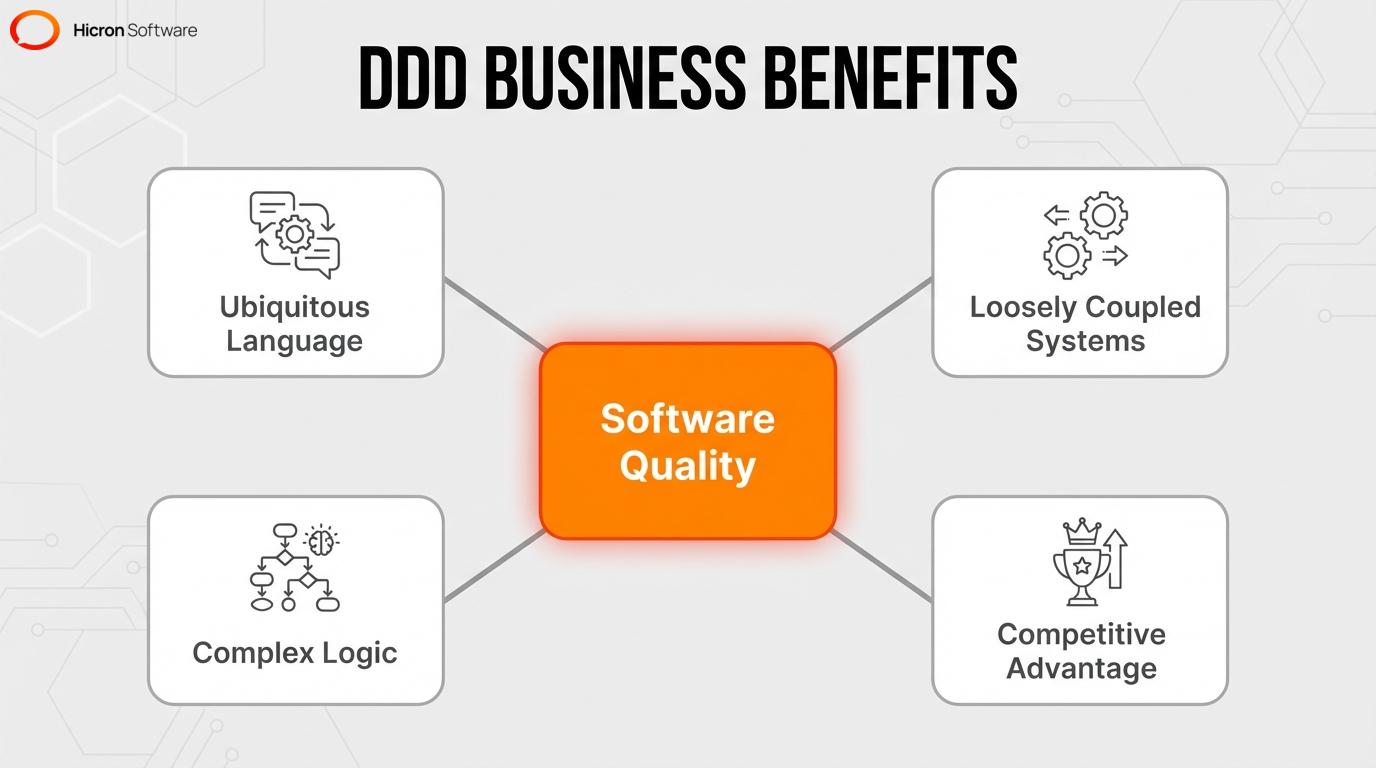
Let me be completely honest with you. You shouldn’t use DDD for everything. It shines when you’re dealing with complex, evolving business logic. DDD is ideal for systems providing a competitive advantage and applications requiring deep collaboration with domain experts. Development teams avoid this framework for simple CRUD (Create, Read, Update, Delete) applications due to its high structural overhead.
A complex logistics routing system benefits greatly from DDD because it handles complicated, real-world rules. On the other hand, a simple blog platform doesn’t require this advanced software architecture. Organizations implement Domain-Driven Design successfully when they manage highly evolving business environments.
“

Hicron Software proved to be a trusted partner with unmatched technical expertise, delivering a scalable and user-friendly web application that was pivotal to our successful U.S. market expansion.

Hicron’s contributions have been vital in making our product ready for commercialization. Their commitment to excellence, innovative solutions, and flexible approach were key factors in our successful collaboration.
I wholeheartedly recommend Hicron to any organization seeking a strategic long-term partnership, reliable and skilled partner for their technological needs.

After carefully evaluating suppliers, we decided to try a new approach and start working with a near-shore software house. Cooperation with Hicron Software House was something different, and it turned out to be a great success that brought added value to our company.
With HICRON’s creative ideas and fresh perspective, we reached a new level of our core platform and achieved our business goals.
Many thanks for what you did so far; we are looking forward to more in future!

Hicron is a partner who has provided excellent software development services. Their talented software engineers have a strong focus on collaboration and quality. They have helped us in achieving our goals across our cloud platforms at a good pace, without compromising on the quality of our services. Our partnership is professional and solution-focused!

The IT system supporting the work of retail outlets is the foundation of our business. The ability to optimize and adapt it to the needs of all entities in the PSA Group is of strategic importance and we consider it a step into the future. This project is a huge challenge: not only for us in terms of organization, but also for our partners – including Hicron – in terms of adapting the system to the needs and business models of PSA. Cooperation with Hicron consultants, taking into account their competences in the field of programming and processes specific to the automotive sector, gave us many reasons to be satisfied.